Sharing my Lecture Notes on International Finance for my PhD class. Mostly my own study notes, with efforts to clean up and organize with a coherent structure. I learned a ton from writing it, and I hope this is useful to others as well.
Comments welcome!
https://t.co/HSl6VR19TU
@danielkeyang Outright effect: yes. Long-term debt investors are fairly sensitive to supply shocks. But it may be more nuanced, because such news could also have information content beyond the quantities, such as the Treasury's assessment of the economy or its own funding condition.
Treasury is buying back long debt + issuing short debt. This is yield curve *elasticity* management.
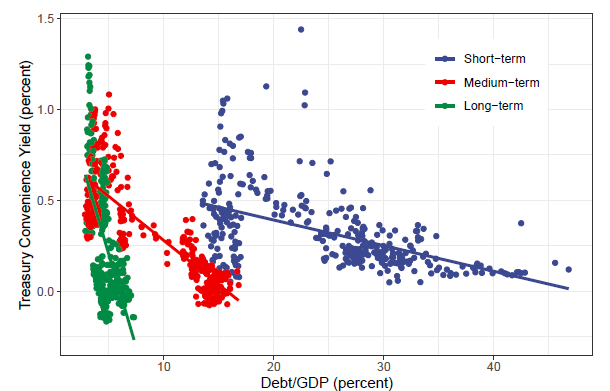
In Convenience Lost (https://t.co/IWDpgdt8nn), we show that demand for long debt is much less elastic.
But there’s a tradeoff: short-term financing increases rollover risk.
It was a pleasure to serve as AE. I learned a great deal. It was especially rewarding to see so much great research. Many thanks to the authors and referees!!
Looking ahead, I'm excited about my upcoming endeavors—many will continue to be in international economics.
The Journal of International Economics thanks departing Co-Editor Jesse Schreger (@JSchreger) and Associate Editors Zhengyang Jiang (@ProfJiang) , Rohan Kekre, and Liliana Varela (@liliana_vvarela) for their excellent service to the journal.
Intermediated debt markets give rise to two-tiered liquidity effects at currency and asset market levels. Government policies to join a currency area affect competition in asset markets, from @ProfJiang https://t.co/G64Abw4u9e
Wealth inequality shapes asset demand and asset valuation. Sufficiently high probabilities of falling into extreme poverty lead to asset bubbles, from Xuning Ding and @ProfJiang https://t.co/hIkVWNikI7
While government bonds are safe assets during financial crises, they underperform equities and growth in wars and pandemics. Inflation and financial repression drive the large losses bondholders suffer in these episodes, from @ProfJiang, @HannoLustig, @SVNieuwerburgh, and @MindyXiaolan https://t.co/iYM6IlQQE7
Deeply honored to serve as an external consultant for the IMF. In a rapidly changing global landscape, the IMF’s mission is ever more vital. I look forward to working with IMF colleagues to contribute, in my own small way, to promoting global economic stability and development.
🎓 Call for Applications | JIE Summer School 2026
📍 Milan (Bocconi University) | 🗓 July 6–8, 2026
Lectures by Cécile Gaubert, Christoph Trebesch, David Hémous, Federica Romei, Christopher Clayton & Natalia Ramondo.
🗓 Deadline: Jan 25, 2026
👉 https://t.co/rXcgF6O1DX
Glad to see this come out in the JPE now. Seems relevant. Joint work with an amazing team: @SVNieuwerburgh , @ProfJiang, Mindy Xiaolan and Z. Chen.
Stijn and I ended up in the same vol. as our adviser T. Sargent who first got us thinking about fiscal issues some 25 years ago!.
https://t.co/aONf28vktt
Happy to see our Manufacturing Risk-free Government Debt out in JFE!
We develop a Modigliani-Miller counterpart for govt finance: to manufacture risk-free debt, govt must shift risk onto taxpayers; to insure taxpayers, its debt must carry more risk. Three is no free lunch.
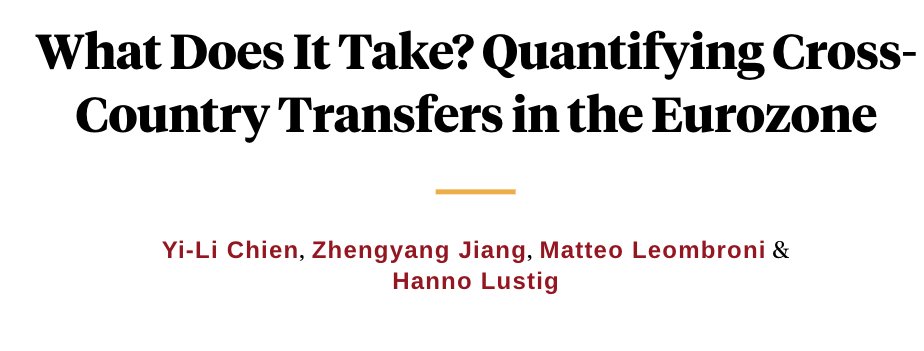
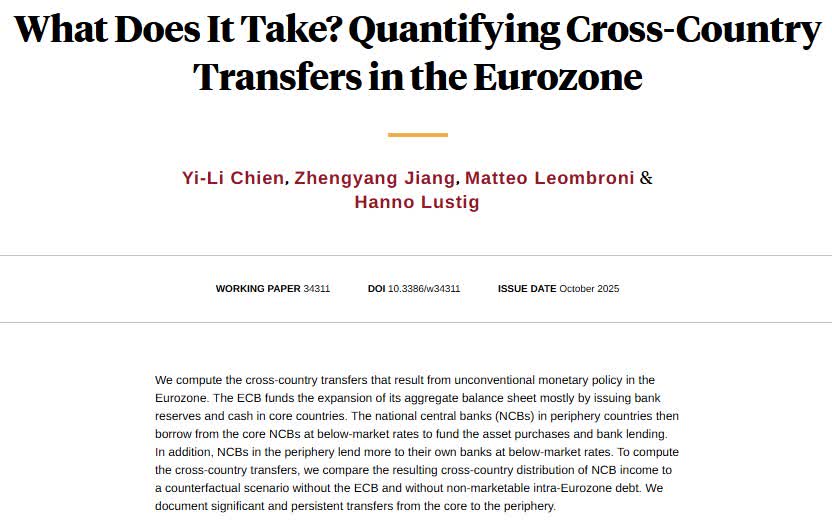
1/In the Eurozone, unconventional monetary policy leads to large cross-border fiscal transfers because it allows the periphery to borrow from the core at belo-market rates. We quantify these transfers.
Via income pooling and below-market rate cross-border lending, the European Central Bank's unconventional policies created large, persistent transfers from Eurozone core to periphery countries, from Yi-Li Chien, @ProfJiang, Matteo Leombroni, and @HannoLustig https://t.co/rwF3axJ7Bj
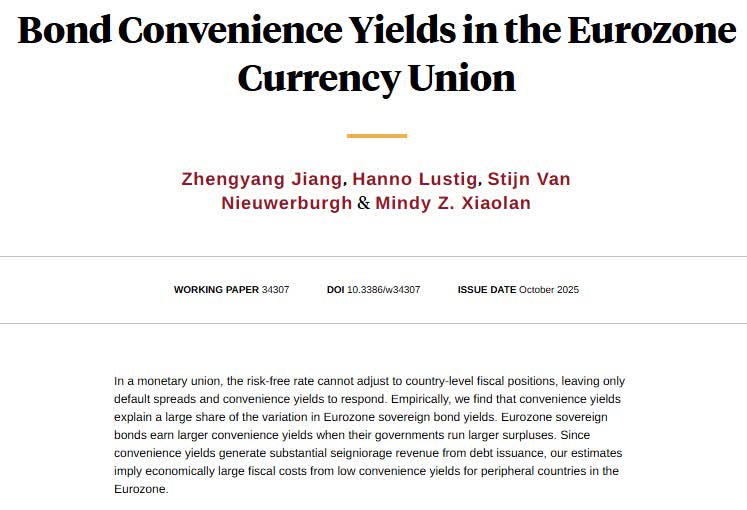
In a monetary union, risk-free rates cannot adjust to country-level fiscal positions, leaving credit spreads and convenience yields to respond. The latter is empirically important, from @ProfJiang, @HannoLustig, @SVNieuwerburgh, and @MindyXiaolan https://t.co/67TWIxOUrW