Deep learning is often taught as a sanitized collection of facts and math. But work at the frontier of AI is messy and empirical.
Our new class, Deep Learning Alchemy, aims to teach the art and science of deep learning in the hands-on spirit of Language Modeling From Scratch.
Students build intuition by running experiments on small LMs, then test it through prediction quizzes: given an unseen code diff, can you predict what happens?
https://t.co/0H82T1yyam
My co-instructor @kothasuhas and I think there's significant demand for classes that treat students as serious learners who want to be assessed for what they’ve learned, and so we're trying a new exam-heavy approach to the class (7 exams, 85% of the grade, with the remaining 15% in-person discussion assessments).
We’ve designed the class so students can use AI agents to run their experiments and do their assignment, but they then have to demonstrate that mastery on exams without access to the assignment, and any partial credit on the exam has to come through citations to the assignment, incentivizing them to know what’s in their write-up.
The same assignments and quizzes are public for anyone to try (lecture recordings will be released through @StanfordOnline with some delay). We have some very fun assignments and quizzes covering both classic topics (like NQM, run-to-run stochasticity, and scaling laws) and new and timely topics like muP or hyperball. Made by some real experts like @TristanThrush and @wen_kaiyue
Try some quizzes below!
The most important word here is *ecosystem*. It's not just about having an open-weight model. Open-weight models are a means to an end. To have a truly strong, open ecosystem, we need four critical frontier-level ingredients: open-weight models, open training datasets, open software stacks, and open process knowledge. Few people realize that NVIDIA actually has been pushing beyond open weights by releasing code and datasets for their Nemotron models, which is something open-weight model developers don't do. Marin further opens up the process knowledge - not just how to train one model, but how to iteratively improve and shape a model given particular goals, custom data, and hardware, e.g., how to design scaling laws and evals to guide architecture and data ablations. Open weights, datasets, software, process knowledge: these are the four critical ingredients (renewable resources) that give everyone the ability to most efficiently turn their compute (consumable resources) into the best models according to their needs and values.
Our new optimizer AMUSE: Muon + Schedule-Free + time-varying SF momentum.
No LR schedule needed, beats tuned scheduled baselines.
Two concurrent works converging on similar ideas:
• ScheduleFree+ (@aaron_defazio): SF-AdamW + time-varying SF momentum
• SF-NorMuon (@jlylekim)
🚨New Optimizer Paper
AMUSE: Anytime MUon with Stable gradient Evaluation
AMUSE combines Muon with Schedule-Free-style gradient evaluation for stable anytime training without LR decay.
• Stronger 124M / 720M / 1B pretraining
• Strong ImageNet / ViT fine-tuning performance.
It��s an honor to receive the Best Student Paper Award at #ALT2026 (37th Algorithmic Learning Theory) ! 🏆
Huge thanks to my amazing collaborators Boyao,@Collapsar0000 ,@Tianyu0628 ,@MinhakSong ,@nsfzyzz !
Had a great time at the Fields Institute in Toronto. 🇨🇦 Looking forward to attending ALT again next time! ✨
Even with full-batch gradients, DL optimizers defy classical optimization theory, as they operate at the *edge of stability.*
With @alex_damian_, we introduce "central flows": a theoretical tool to analyze these dynamics that makes accurate quantitative predictions on real NNs.
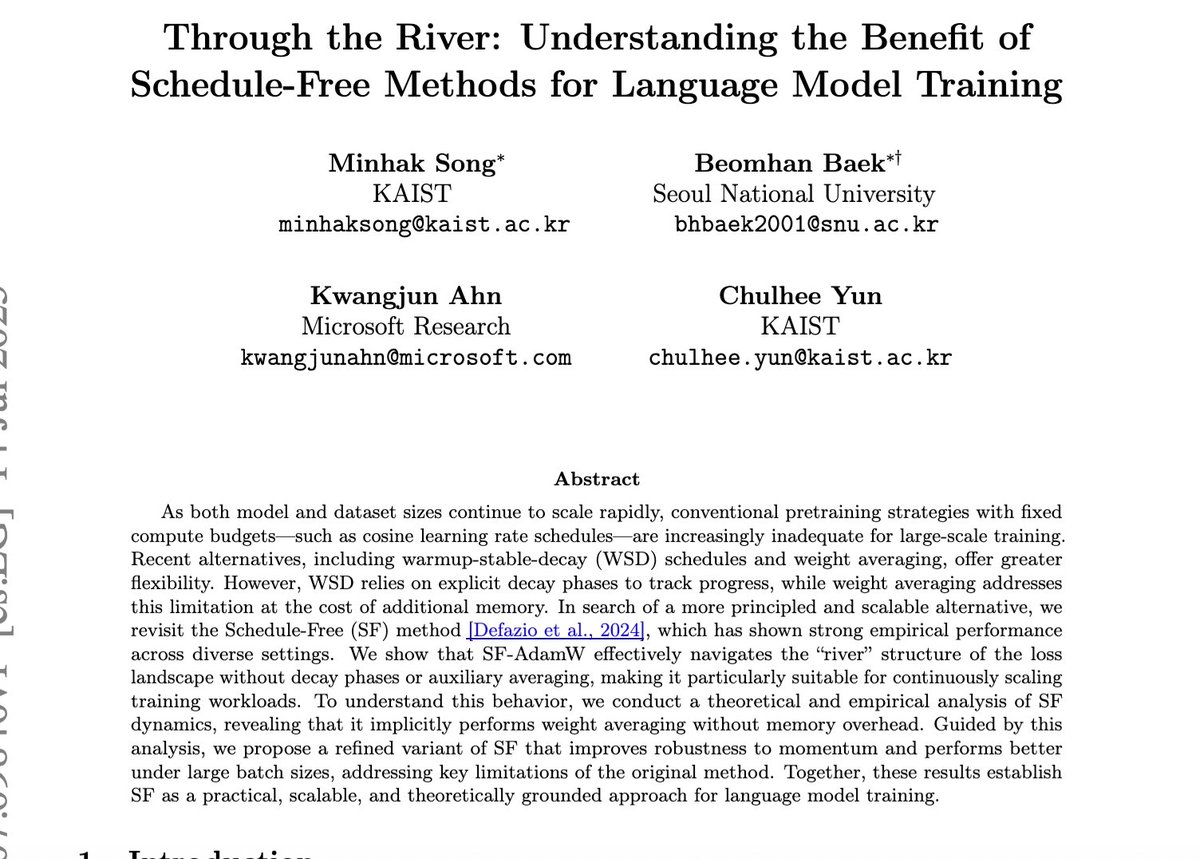
Schedule-Free methods, which forgo cosine/linear schedulers by averaging iterates and computing gradients at interpolated points, yield smoother training curves. It's still unclear why they work well, and this paper explains the phenomenon through the river-valley loss landscape.
PPO vs. DPO? 🤔
Our new paper proves that it depends on whether your models can represent the optimal policy and/or reward.
Paper: https://t.co/qNWwWhQQpA
Led by @smellycat_ZZZ@MinhakSong
RLHF vs DPO under reward and/or policy model misspecification—when does each method succeed?
Our new paper provides a fine-grained theoretical comparison.
📄 https://t.co/vdpAiQHu5l
Two-stage RLHF or one-stage DPO: Which one is better for learning from preferences?
Equal under strong assumptions, but representation differences break the tie. Our paper reveals their fine-grained performance gaps under various conditions.
paper: https://t.co/B3OD6YRAts