Advice for new PhD students: choose a mentor who is committed to your training, not just your project. The most important product of your PhD - even more important than the science - is you, a newly trained scientist.
A new @Nature * study introduces a clever “binding-to-release” cancer drug strategy.
Instead of requiring a target to carry the drug inside the cell, binding itself triggers release of the payload right at the tumor surface.
Against FAP, a tumor-associated protein that has been difficult to target with conventional antibody-drug conjugates (ADCs), the approach achieved similar tumor drug exposure to a FAP-ADC, with a 59-fold better tumor-to-liver ratio and a 7.5-fold higher tolerated dose than an internalization-dependent version. In one mouse model, a single dose produced complete regression in all 8 mice. The strategy was also extended to PD-L1.
Still preclinical, and extracellular drug release could increase off-tumor toxicity. An interesting way to potentially expand the number of tumor-surface targets we can drug.
Did you know that KRAS might have been called MRAS if Leon Mayer had named the murine sarcoma virus after himself than his colleague Werner Kirsten (shown in the photo below).
The Long, Remarkable History of KRAS and #PancreaticCancer
By Hruban & Kern
https://t.co/wcS43Ge1qG
I said to my PI, I want to go do my postdoc, will you write a letter for me. And he wrote in my letter that I wasn't very creative .. I finally met with Magda and she told me she saw straight through the letter.
–Samantha Morris, Harvard Professor
@morris_lab@ZernickaGoetz
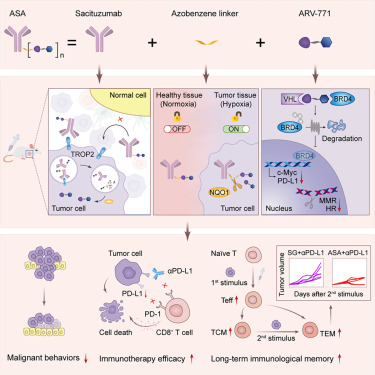
An antibody-PROTAC conjugate targets BRD4/c-Myc/PD-L1 to enhance immunotherapy efficacy in triple-negative breast cancer @CellRepMed
https://t.co/XPN42S6qdL 🇨🇳
Patient-Derived Tumor Organoids Show Promise for Personalizing Cancer Treatment
Researchers developed a 220-sample pan-cancer patient-derived #organoid platform that faithfully mirrors #tumors and may identify new treatment opportunities
@WeillCornell
https://t.co/wBKhDiNdAc
New! Online now: Ferroptosis heterogeneity in triple-negative breast cancer reveals an innovative immunotherapy combination strategy https://t.co/UwzdT0Ffq5
AI + RNA-seq meets drug repurposing.
Can public transcriptomic datasets automatically identify drugs that regulate disease genes?
A new bioRxiv study introduces SNACKKSS (Signature-based Networks from Automatically Curated Knockout, Knockdown, and Small-molecule Studies)—an end-to-end framework that automatically mines GEO metadata using fine-tuned BERT models, constructs perturbation signatures from RNA-seq experiments, and predicts gene regulators without manual curation.
Key findings:
• Built an automated NLP pipeline using BioBERT/BioMedBERT to curate GEO knockout, knockdown, and drug-treatment RNA-seq studies at scale.
• Generated consensus transcriptomic signatures from >300,000 human and mouse perturbation samples using ARCHS4, Recount3, and DEE2 datasets.
• Introduced DF1 (Differential F1), a computationally efficient signature-matching algorithm for comparing perturbation transcriptomes.
• Developed SA4, which combines transcriptomic signature matching with ARCHS4 co-expression networks, substantially improving identification of inhibitory drug–gene relationships.
• Ensemble models integrating literature mining (PubTator3, PARMESAN), co-expression, Connectivity Map, and SNACKKSS consistently outperformed individual predictors.
• At high-confidence thresholds (~95% precision), adding SA4 expanded inhibitor coverage by ~40 additional target genes, highlighting complementary value rather than replacing literature-based approaches.
• The authors also report an important reproducibility observation: identical BERT pipelines produced different outputs across CPU architectures, emphasizing that AI pipelines should be validated on multiple hardware platforms.
Rather than relying solely on curated knowledge graphs or manually annotated datasets, SNACKKSS demonstrates that automatically curated public RNA-seq perturbation data can become a scalable source of pharmacologic hypothesis generation, especially when integrated with complementary literature- and network-based predictors. The work provides both an openly available resource and a practical roadmap toward transcriptome-driven drug repurposing for Mendelian diseases and beyond.
#DrugRepurposing #RNAseq #Transcriptomics #Bioinformatics #AI #MachineLearning #DrugDiscovery #MendelianDisease #SystemsBiology #PrecisionMedicine #SNACKKSS
Single-cell multiomics maps the transcriptional circuitry driving EMT progression.
A new Nature Communications study combines scRNA-seq, scATAC-seq, SCENIC/SCENIC+, and CRISPR functional validation to define the gene regulatory networks controlling epithelial-to-mesenchymal transition (EMT) states during tumor progression.
Key findings:
🔹 Integrated single-cell transcriptomic and chromatin accessibility profiling identified distinct EMT states rather than a simple epithelial/mesenchymal binary.
🔹 Gene regulatory network analysis uncovered stage-specific transcription factors controlling EMT progression: • KLF5 and PITX1 maintain epithelial and early hybrid EMT states. • NFATC1 and CREB3L1 promote progression into late EMT states.
🔹 CRISPR/Cas9 loss-of-function experiments confirmed these predictions: • Klf5/Pitx1 deletion accelerated transition toward advanced EMT states. • Nfatc1/Creb3l1 deletion impaired acquisition of late mesenchymal programs.
🔹 Functional studies revealed an unexpected distinction: • Loss of Klf5 or Pitx1 markedly reduced lung metastasis. • Loss of Nfatc1 or Creb3l1 altered EMT state composition but did not significantly reduce metastatic burden.
🔹 Similar EMT regulatory architecture was observed in mouse pancreatic adenocarcinoma and conserved across human cancers, supporting broad conservation of these transcriptional programs.
Take-home message: EMT is governed by sequential, state-specific transcriptional networks rather than a single master switch. Early EMT regulators such as KLF5 and PITX1 appear to be critical determinants of metastatic competence, whereas NFATC1 and CREB3L1 primarily stabilize late mesenchymal identity.
This work provides one of the most comprehensive mechanistic maps linking single-cell multiomics → regulatory networks → functional validation → metastasis across EMT progression.
UniCVac is an “all-in-one” cancer vaccine that reprograms tumor cells and triggers a robust antitumor immune response, according to a new study. This marks a promising strategy to combat cancer treatment resistance. https://t.co/ZQJrTCrGrQ
Stumbled across this store when I was in Dubrovnik and had to stop for a photo. For a second I thought I’d found the global headquarters of #KRAS inhibitors! 😄 🧬
Between all the excitement in #oncology and this iconic Croatian chocolate brand, “KRAS” is definitely having a moment.
#KRASinhibitors #Oncology #CancerResearch
Enhertu approved in the EU as first tumour agnostic HER2-directed therapy and antibody drug conjugate for patients with previously treated HER2-positive metastatic solid tumours
https://t.co/S1fFqVnUKn
Learn more 👇
https://t.co/grrbYHj0tV
https://t.co/jI3bewJ2TT
https://t.co/Mv83R16VqO
#LARVOL #CancerResearch #CancerData #Oncology #OncologyInsights #ClinicalTrials #SolidTumors #Enhertu | @PTarantinoMD | @VivekSubbiah | @ADesaiMD | @BalazsHalmosMD | @Erman_Akkus
If aging is associated with molecular damage, why don't offspring inherit the accumulated damage of their parents?
How does the germline avoid transmitting damage from one generation to the next ?
These questions motivated a causal investigation of aging mechanisms:
The answer involves a rejuvenation program.
As fertilization approaches, sperm-derived signals activate lysosomal acidification in oocytes, triggering the clearance of protein aggregates and restoring proteostasis before the next generation begins.
This work suggests that maintaining a youthful proteome is one of the mechanisms that enables biological rejuvenation:
> Proteostasis renewal is a core mechanism by which biological age is reset.
Like most good studies, this one also raises many questions about the generality of this observation beyond the studied model systems and the molecular mechanisms by which protein damage is cleared:
⬛ Excitingly, these questions can now be investigated using direct measurements of protein synthesis, degradation, modifications, interactions, and accumulation.
Such investigations demand technologies for scalable and direct protein analysis at high-resolution !
⚠️ New findings presented in the plenary session at #ASCO26 suggest daraxonrasib could help usher in a new era of treatment for metastatic pancreatic cancer.
In a phase 3 study led by @EileenMOReilly and colleagues, patients receiving #daraxonrasib lived a median of 13.2 months compared with 6.7 months for those treated with chemotherapy.
"To date in my career, I have not seen this level of benefit from any single anti-cancer drug in this disease."
Learn more: https://t.co/1Lt18DdKMt