If you encouraged, supported or didn’t question ‘lockdown’ what did you expect?That closing schools & universities,disabling the NHS,suffocating the economy & atomising society, would leave a little pocket of normality?Adults have let children & young people be abused for months.
A number of people have said the same thing to me lately…Britain on the far side of Covid is a different place. The decay is plain enough to see. But, what is harder to describe is the spirit slowly draining out of society. The country feels subdued, as if a fog has settled over it and never quite lifted.
I wrote that Jews and Christians should stand together.
The comments filled up with Muslims and leftists telling me it should be Christians and Muslims. Same floor. Same root. Brothers of the book.
Last year that brotherhood killed 4,849 of us.
Christians are the most persecuted group on earth. 388 million now live under high or extreme persecution. More than one in seven Christians on the planet.
Of those 4,849 killed for their faith, 93 percent died in sub-Saharan Africa.
Nigeria alone: 3,490 people, murdered for being Christian. 125,000 have been killed since 2009. Around 32 a day right now.
Go look up who killed them.
Boko Haram and ISWAP in Nigeria. Al-Shabaab in Somalia, where not one open church remains. Islamic militias in Mali, Burkina Faso and Niger, handing villages the choice of conversion, jizya or flight. The ADF in Congo, beheading villagers in Allah's name. ISIS in Mozambique. The Taliban in Afghanistan, where a Christian has no legal existence at all. The blasphemy laws in
Pakistan, where Christian girls of twelve are abducted, forcibly converted, and handed back to their kidnapper by a court. The Copts in Egypt, bombed inside their own churches.
Iraq had one and a half million Christians in 2003. Today under 250,000. Syria had more than two million. They are gone.
That is not crossfire. That is a direction.
Now the part where the conversation always gets shut down.
Islam was not built as a private faith. It was built as a state. Muhammad was lawgiver, judge and commander in one.
Christianity began with a man on a cross who said his kingdom was not of this world.
Islam began in Medina with an army. Classical jurisprudence divides the world into dar al-islam and dar al-harb, the house of Islam and the house of war. The objective is that the first expands until the second no longer exists.
And people want it. Pew surveyed 38,000 Muslims across 39 countries. 99 percent
in Afghanistan want sharia as the official law of the land. 84 percent in Pakistan. 86 percent in Malaysia. Nearly eight in ten across sub-Saharan Africa.
That is not the fringe. That is the centre.
Now try this.
A Muslim stands up and says: Jesus is God.
In that second he is no longer a Muslim. Placing anything beside Allah is shirk, and according to the Quran it is the one sin that is not forgiven. Sura 5:72 says it plainly: whoever calls Christ God is an unbeliever.
What does it cost? At least 22 countries criminalise leaving Islam. In roughly a dozen of them it can cost your life. Saudi Arabia, Iran, Afghanistan, Yemen, Sudan, Somalia, Mauritania, Qatar, the Emirates, Pakistan, Malaysia, the Maldives, Brunei.
Elsewhere you lose your marriage instead, your children, your inheritance, your citizenship. In Malaysia, Lina Joy fought six years for the legal right to leave Islam. She lost.
And outside the courtrooms, the family is waiting.
A Christian who converts to Islam in the West gets a welcome ceremony and a post on social media. A Muslim who converts to Christianity changes his name, moves city, and never tells his mother.
There is your same root.
So no.
If that solidarity were real, it would run both ways. Where were the marches for the 3,490 Nigerians? Where was the Friday sermon about the burned churches in Burkina Faso?
It does not exist. Solidarity that only switches on when it can be aimed at a third party is not solidarity. It is an alliance against someone.
There is not one Muslim-majority country where Christians hold full and equal rights. Not one.
Meanwhile there are Western countries where Muslims hold more rights than Christians hold anywhere in the Muslim world. The whole case sits inside that asymmetry.
And let us not pretend this only happens out there. We carried the ideology forward ourselves. Not under force. Out of politeness. CONTINUES👇🏽
The Social Cost of Not Going Out
When a pub closes, Britain loses more than a business.
It loses a meeting place. A first date. A birthday meal. A wedding reception. A works party. A wake.
It loses the corner table where old friends put the world to rights, and the familiar place where people come together.
That is why our hospitality sector matters, and why the decline of our pubs, bars, restaurants, clubs and music venues matters.
It is far more than a pint down the boozer. It is about the erosion of British culture: the places where communities meet. From a village pub to a town-centre club, hospitality venues are where British traditions are lived.
Humans are social beings. We need to meet face-to-face to laugh, talk, celebrate, and share an atmosphere that cannot be recreated through a delivery app or another night home alone in front of a screen.
If Britain keeps losing its hospitality and nightlife, it will lose part of its soul.
Hospitality is being squeezed from every direction: higher minimum wages, increased employer National Insurance, VAT, corporation tax, business rates, rent, insurance, energy, repairs and soaring stock costs.
These are labour-intensive businesses. They employ people, train young workers, buy from local suppliers and keep town centres alive. Yet they are expected to absorb ever-higher costs while their customers have less to spend.
Consecutive governments have treated hospitality as an easy target for another tax, another levy or another burden. A pub, restaurant, club or venue should not be viewed as little more than a cash machine for the Treasury.
Every closure takes life out of a town.
A pub closes, then the taxi firm loses fares, the local supplier loses orders, the hairdresser and clothes shop lose trade, the high street loses footfall, and a once-vibrant town becomes that “Ghost Town” where
“bands don’t play no more”.
But what is a town centre without pubs, cafés, restaurants, bars and venues?
What is a high street without somewhere to meet?
A town without hospitality is not regenerated.
It is diminished.
We do not want our town centres turned into housing estates; we want vibrant towns, with busy pubs, welcoming cafés, family restaurants, local music and lively streets where people still have a reason to gather.
The Great British Pub is a true part of British society, rooted in our villages, towns and cities for some 2,000 years. It is where communities gather in good times and bad; where friendships begin, celebrations are held and people from every walk of life still mix naturally. It is part of the fabric of Britain.
We must start supporting the on-sales market:
To make hospitality businesses economically viable and make going out affordable for everyone.
I suggest giving tax breaks to on-sales only, to ensure Britain does not become a nation served only by takeaway businesses delivering to isolated people in their homes.
Once these places are gone, they are not easily replaced.
When a nightclub or live music venue closes, we lose a dancefloor, a youth space and a place where music becomes part of your soul, giving memories that live forever.
These are the places that give young people somewhere to belong, somewhere to discover themselves, and somewhere to find a new style, an identity and a culture that feels like their own.
New music does not begin in big cities. It starts in small towns, in small venues. These are the places where the next new scene begins, grows and develops into the next big sound.
The next youth revolution will not be invented by committee or born in an arena in a big city.
It will come from a small town, a backstreet bar, a local promoter, a new beat and a crowd of young people hearing something that feels like their own.
But if all the clubs have closed down, where does the next scene come from?
Will there be a venue for that underground sound to become the next mainstream scene?
Where will we build new venues if our town centres have been changed from vibrant high streets into housing estates?
Where will you dance once the last dancefloor in England has gone?
And where will we build new venues if our town centres have been changed from vibrant high streets into housing estates?
Having spent more than 40 years in nightlife and hospitality, I have seen a few changes. Let me assure you now:
A change is coming - A new sound will emerge.
I only hope we have not lost all the spaces to housing, and we still have space for new venues to open and play that underground sound which becomes the new mainstream.
A society that removes its shared spaces becomes more isolated. Public life shrinks. Town centres die. Communities weaken. The world becomes a smaller, quieter and far lonelier place.
Britain must not become a place where isolation is normal and togetherness is a luxury.
Save the pubs. Save the clubs. Save the dancefloors. Save the high street. Save the town centre.
#SaveNightlife #SaveHospitality
Save the places that bring Britain together.
Because once they are gone, they are gone for good.
Martin Murray
.
.
@UKHospKate@UKHofficial@ntiaofficial@morningad@reformparty_uk@LeeAndersonMP_@SuellaBraverman@danny__kruger@TiceRichard@SarahForRuncorn@AndrewRosindell@RobertJenrick@Nigel_Farage@Ben_Bradley_32@McivorJaymey
Taraneh and Romina Rahimi were two sisters who were arrested in Isfahan on January 8. Taraneh was sentenced to death, while Romina was sentenced to 25 years in prison. Romina is now facing the horrifying reality of witnessing her sister’s execution from behind bars.
These are not just numbers. They are human lives.
The Islamic Republic’s execution machine continues to take lives while the world watches, debates, and carries on.
Mass executions, political repression, arbitrary arrests, and the silencing of dissent must never be accepted as normal governance. These are serious human rights abuses, and those responsible must be held accountable.
The people of Iran deserve freedom, justice, dignity, and a future without fear.
The world cannot keep looking away.
Silence is not neutrality when people are being executed.
#StopExecutionsInIran
#EndTheIslamicRepublic
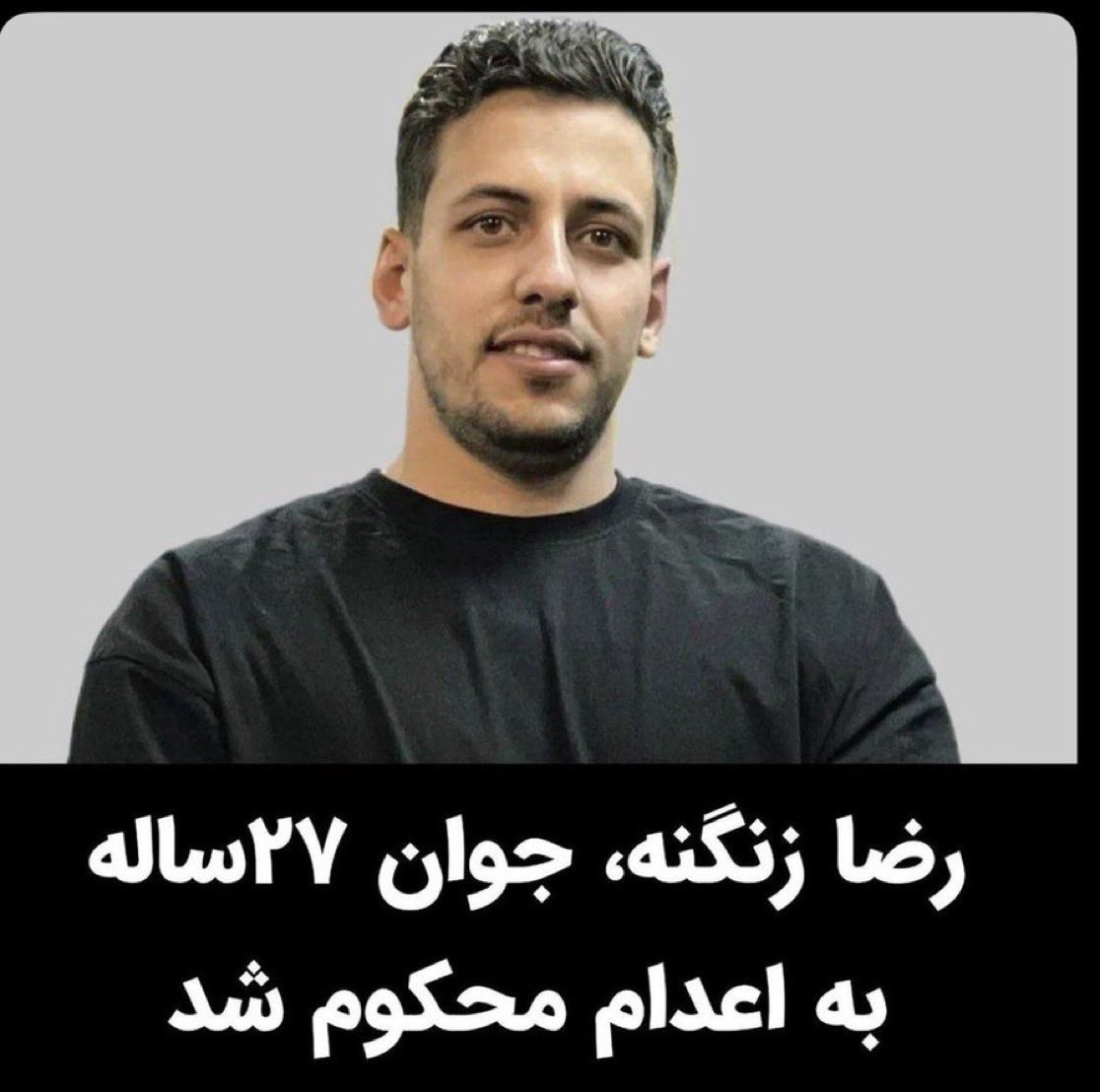
URGENT: Stop the Execution of Reza Zanganeh, 27
Reza Zanganeh, a 27-year-old from Malayer living in Karaj, is on death row in Qezel Hesar Prison. He was sentenced to death for “Moharebeh” and alleged “cooperation with Mossad”—charges his family strongly rejects. Arrested in a raid on his car repair shop shortly after returning from Malayer, he was reportedly beaten. Recently married and with limited time for appeal, this young man’s life is at immediate risk after an opaque process.
This regime must stop executions in Iran. These death sentences, often after unfair trials lacking evidence and due process, serve only to instill fear and crush dissent. They violate the right to life and justice. Halt the killing of Reza Zanganeh and end this cycle of state violence now.
#IslamicRepublicHangs
#RezaZangeneh
The ‘Beautiful 6’.
OTD in 2024, we remember these 6 beautiful souls, executed by Hamas in captivity in Gaza:
🕯️ Hersh Goldberg-Polin
🕯️ Almog Sarusi
🕯️ Eden Yerushalmi
🕯️ Alexander Lobanov
🕯️ Carmel Gat
🕯️ Ori Danino
May their memories always be blessed!
The Highland Clearances are taught as a tragedy of poverty. They were the removal of a cattle economy, and the famine that followed was designed on paper decades before the blight arrived.
In 1800 the Sutherland estate raised a Highland regiment in Strathnaver. In 1814 it burned Strathnaver to the ground.
The first muster of the 93rd was held at Skail, in the strath. The men who came were sons of tenant farmers, related to each other, recruited off the same few miles of glen, and officers wrote about them with something close to bewilderment, because British regiments were not usually made of respectable neighbours. Fourteen years later their families were carried out of their houses and the roofs set alight behind them.
The Highlands before this ran on cattle. Small black cattle, walked south in droves to Crieff and Falkirk, and at home the milk, the butter, the cheese and the beast. Land was held through kin. After Culloden the law turned the chief into a landlord, and a landlord with a rent roll starts doing sums.
The sum favoured the Cheviot. One shepherd and a flock beat a valley of tenants, and wool was booming.
On 13 June 1814 Patrick Sellar's men fired the houses at Strathnaver with a woman of ninety still inside one of them. Margaret MacKay was pulled out by her daughter with her blankets alight, carried to a shed, and died five days later.
Donald MacLeod, a stonemason from that strath, stood on a hill and counted the burning houses in every direction. More than two hundred alight at once, smoke visible from out at sea, and the cattle bellowing.
Sellar was tried at Inverness in 1816 for culpable homicide and acquitted at a quarter past one in the morning by a jury of landowners, merchants and lawyers, most of them magistrates. He then took a tenancy of the emptied ground and farmed sheep on it for the rest of his life. Around fifteen thousand people were cleared off that one estate between 1811 and 1821.
Sellar put the plan in writing. The interior to shepherds, the people down onto the coast in lots of under three acres, sized to be pinched enough to cause them to turn their attention to the fishing. He described this as benevolent, and as a step towards civilisation.
Under three acres of coastal rock will not graze a cow.
So the cattle went, and the family's own milk, butter and meat went with them. What grows on that ground and feeds a family is potatoes. A people who had lived off animals for a thousand years were put on a single root crop, by design, in writing, and told it was progress.
Thirty-two years later the blight reached Scotland.
Charity, relief and the mass shipping of people to Canada kept the death toll below Ireland's, which is why the whole thing fell out of the national memory. The people went anyway. The glens have never refilled.
Eight years after that the Crimean War started, and the Duke of Sutherland went north to raise men from the country his family had emptied. The meetings were attended and the recruiters were baaed at. Send your sheep, the men told them. Send your deer and your gamekeepers. They never did us any harm.
Sutherland is being bought again. Estates are selling to investment funds and corporations for tree planting and carbon credits, and land values are climbing past anything a local buyer can reach.
Wool needed shearing, carting and selling, which meant somebody had to live there. Carbon does not need shearing.
The land pays best now with nothing on it at all, and this time nobody has to hold the torch.
Samira Khani was only 12 when she was killed by Islamic Republic forces on January 8.
A child whose name must never be forgotten.
Your path lives on, Samira.
#IranMassacre2026
2 years ago I faced you all with this. I was distraught.
I would say exactly the same words again now. The silencing of millions will be the end of not only free speech but the life you take for granted. I cannot be clearer than I was here.
Be brave fellow humans 🙏
Right now I am facing a defamation case against me for speaking about the profound child abuse of medicalising children, a police interview for speaking about Islam and two separate men have been charged for violent threats toward me.
This is the life of a women’s rights campaigner.
That's precisely why the policy is so hard to defend. If a job pays so little that the person doing it contributes less in tax than they consume in public spending, importing more people to do that job doesn't solve the underlying problem. It entrenches it.
The answer isn't to import an endless supply of low-paid labour. It's to raise productivity, improve pay and conditions, invest in training and make employers compete for British workers. If the job genuinely needs doing, the market should have to pay enough to attract people to do it.
And there's another point you're overlooking. A British citizen already here doesn't require the state to provide the additional housing, infrastructure, schools and services needed to accommodate a new population. Comparing the two as though they are fiscally identical misses the wider cost of large-scale immigration.
The issue isn't nationality. It's the decision to use mass immigration as a substitute for fixing a low-wage, low-productivity economic model.
Every word of this piece matters Jim. But these are the words I think that matter the most:
"Mass immigration on this scale, without the integration needed to bind people into a common society, changes the character of the country itself. It alters the language, customs, schools, neighbourhoods and town centres around us. It changes what is taught, what is spoken, what is celebrated and what is regarded as normal. Most seriously, it weakens the shared culture and common assumptions that allow millions of people, many of whom have never met, to feel they nevertheless belong to the same country".
Vast unprecedented amounts of immigration into the United Kingdom has changed everything, and none of it for the better. That once ambient sense of a shared belonging has been shattered and replaced with a sense of alienation. The familiar is now unfamiliar. The sense of connection replaced with fragmentation. What was once known has become the unknown. What was a sense of relative safety has been replaced with feeling like a fish swimming in a shark tank. A sense of sameness replaced with difference.
Culture isn't a dish on a menu or garment in clothes store. It is a highly complex and elaborate tapestry woven from silk that dates back centuries. Trying to put your finger on exactly what culture is, is like trying to put your finger on how consciousness emerges from every connection between every neuron in the human brain. What was once socially taken for granted thirty years ago can no longer be taken as read. And this, as your piece points out, is getting worse with each passing day. The United Kingdom is an egg timer and the sand is slipping away.
Islam being introduced to children in primary schools is becoming increasingly normalised. A teacher remains in hiding with his family fearing for their lives. Democracy is buckling under the tensions of voting blocs. Enclaves of other countries within a country (to quote you), that spawned the preying, raping, and sexual torture of native young women and girls spanning more than 50 cities and major towns. Negotiated policing orchestrated by woke activists disguised as police chiefs. A changing profile of crimes that we never saw - at least not on this scale. Our laws being rewritten to accommodate people with cultures inherently incompatible with our own. And we have no choice but to stand by and observe our country being colonised beneath our feet. Speaking up is often met with retorts that sounds like revenge for the sins of our forefathers and we had somehow had all this coming. A reckoning for a history rewritten by woke communism.
The fact that economically it has been a disaster. No rebuilding an infrastructure that mirrors an increase in population that is half the size of the total population of Australia. Reservoirs, the NHS, housing, and GP's. National insurance has now become International Insurance but with no contributions needed. I doubt this is what Bevan had in mind in 1942.
All of these become secondary when the saying "there's no place like home" becomes a relic, a plaque in a museum in remembrance to a culture that ran out of silk and is no longer woven into the fabric of history.
Britain Is Changing One Minute at a Time. Nobody Asked Us.
Somewhere in Britain today, once every minute, a stamp is placed on a document and settlement or citizenship changes hands. Nearly 200,000 people received indefinite leave to remain this year, a 16-year record. A quarter of a million more became citizens. Shabana Mahmood is preparing reforms to slow this. Her own backbenchers are already working to gut them before they pass, exempting care workers and refusing to apply the rules retrospectively, so the 1.2 million migrants already approaching eligibility will sail through regardless of what Parliament decides.
The government cannot explain this contradiction because there isn't a clean one to give. Its own forecasters, the ONS, say Britain needs net migration near 230,000 a year simply to stop the working-age population collapsing before 2030, a figure they themselves call historically high and massively unpalatable. Two thirds of the public want it below 100,000. Ministers are therefore asking a shrinking, ageing workforce to fund immigration on a scale the public has repeatedly rejected.
The OBR has already done the sum the government won't say aloud. Low-skilled migrants cost more in public spending than they contribute in tax over a lifetime. Yet the visa data shows precisely this pattern taking root. Just 3.3 per cent of Zimbabwean workers have left Britain since arriving, 4 per cent of Nigerians and 4.5 per cent of Ghanaians. Compare that with 61 per cent of Saudis, 40 per cent of Belgians and 39 per cent of Germans. The routes Britain opened widest were those feeding the care sector at minimum wage, and they are the routes people do not leave. This was a conscious decision, repeated year after year, by governments that knew the costs.
And the consequences are not confined to spreadsheets. Mass immigration on this scale, without the integration needed to bind people into a common society, changes the character of the country itself. It alters the language, customs, schools, neighbourhoods and town centres around us. It changes what is taught, what is spoken, what is celebrated and what is regarded as normal. Most seriously, it weakens the shared culture and common assumptions that allow millions of people, many of whom have never met, to feel they nevertheless belong to the same country.
This did not happen by accident. Successive governments expanded migration routes, lowered barriers and encouraged recruitment from abroad while repeatedly ignoring warnings about housing, public services, wages, integration and social cohesion. They knew millions of newcomers would permanently change the composition of the population. They knew integration was not keeping pace. They carried on regardless.
Mahmood's reforms will pass in some diminished form, applying to almost no one already here. The dependency ratio will keep tightening. The country that has changed will not simply change back. Lowering the inflow does not undo the transformation already created.
There is no minister, in this government or the one before it, who has ever stood before the country and said plainly: this is the scale of immigration we have chosen, this is what it will do to our economy, our communities and our national identity, and this is the price we are asking you to pay. That reckoning never came. The price was simply spent, a minute at a time, until there was nothing left to ask permission for.
"They knew millions of newcomers would permanently change the composition of the population. They knew integration was not keeping pace. They carried on regardless."
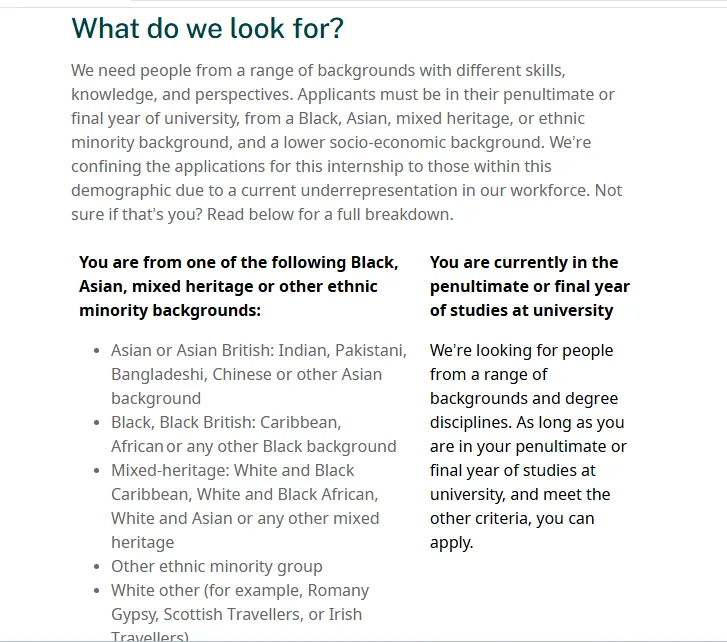
Britain’s Secret Intelligence Service (SIS) is advertising for a summer intern. If you’re 'White British', however, please don’t think about applying. You are expressly prohibited. (Hell, even persons who identity as 'White Other' are eligible!)
I don’t think I’ve ever seen a more blatant example of racism against a specific ethnicity by a state institution. Utterly indefensible.
🌍 WORLD, WAKE UP.
Diana Taherabadi is only 16 years old an innocent Iranian girl facing execution by the Islamic Republic for participating in protests.
Do everything in your power to stop executions of protesters and political prisoners in Iran.
🆘 Don’t look away. Speak up. Act now.
#DianaTaherAbadi #StopExecutionsInIran
Having worked in journalism for many years, I’ve always told people something that sounds strange coming from a journalist:
Journalism isn’t the truth.
I don’t mean it’s lies. I mean it’s a curated account of events, incidents, current affairs and topical issues.
We look for what will grab attention. We choose headlines. We decide which details matter most to create what we tellingly call “stories”. We strip away nuance to make the complex understandable. Crucial context that dilutes the narrative is often omitted or relegated to a footnote. And overwhelmingly, we report what’s going wrong rather than what’s going right.
That mattered less when people read a newspaper once a day and watched the evening news.
Now we carry the news around in our pockets. Push alerts. Social media. Live blogs. 24-hour news channels.
This endless stream of crisis, conflict and outrage has fuelled anxiety and fear.
Always-on news has also brought with it another societal blight: always-on ideological activism dressed up as journalism.
There have always been newspapers with political perspectives. You knew roughly what you were getting when you bought the Guardian or the Telegraph.
But the BBC is supposed to be different. It has a duty to demonstrate due impartiality.
Yet the BBC allowed activist thinking on issues including gender ideology to influence its journalism. It presented contested propositions as fact. It adopted the language of campaigners. It allowed progressive ideology to override observable reality. And when senior presenters pushed back against that reality inversion, the BBC upheld complaints against them.
That isn’t balanced journalism.
It is the precise opposite of what journalism should be doing: interrogating claims, challenging orthodoxies and giving audiences the facts they need to make up their own minds.
The BBC doesn’t belong to its executives. It doesn’t belong to its journalists. It certainly doesn’t belong to activists of any political persuasion.
It belongs to all of us.
So if you value public-service broadcasting, make your voice heard. Write. Email. Complain.
Demand that contested claims are challenged, evidence is sourced and scrutinised, and facts are never subordinated to ideology.
A genuinely impartial BBC.
It really shouldn’t be a big ask.
On August 30, 2021, Mobina Souri was murdered in an alleged honour killing in Iran. She was 14 years old.
Married as a child at 11, Mobina never had the chance to live the life she deserved. Mobina was failed by a country set on gender apartheid laws and a community entrenched in violent misogyny. Today we remember her.