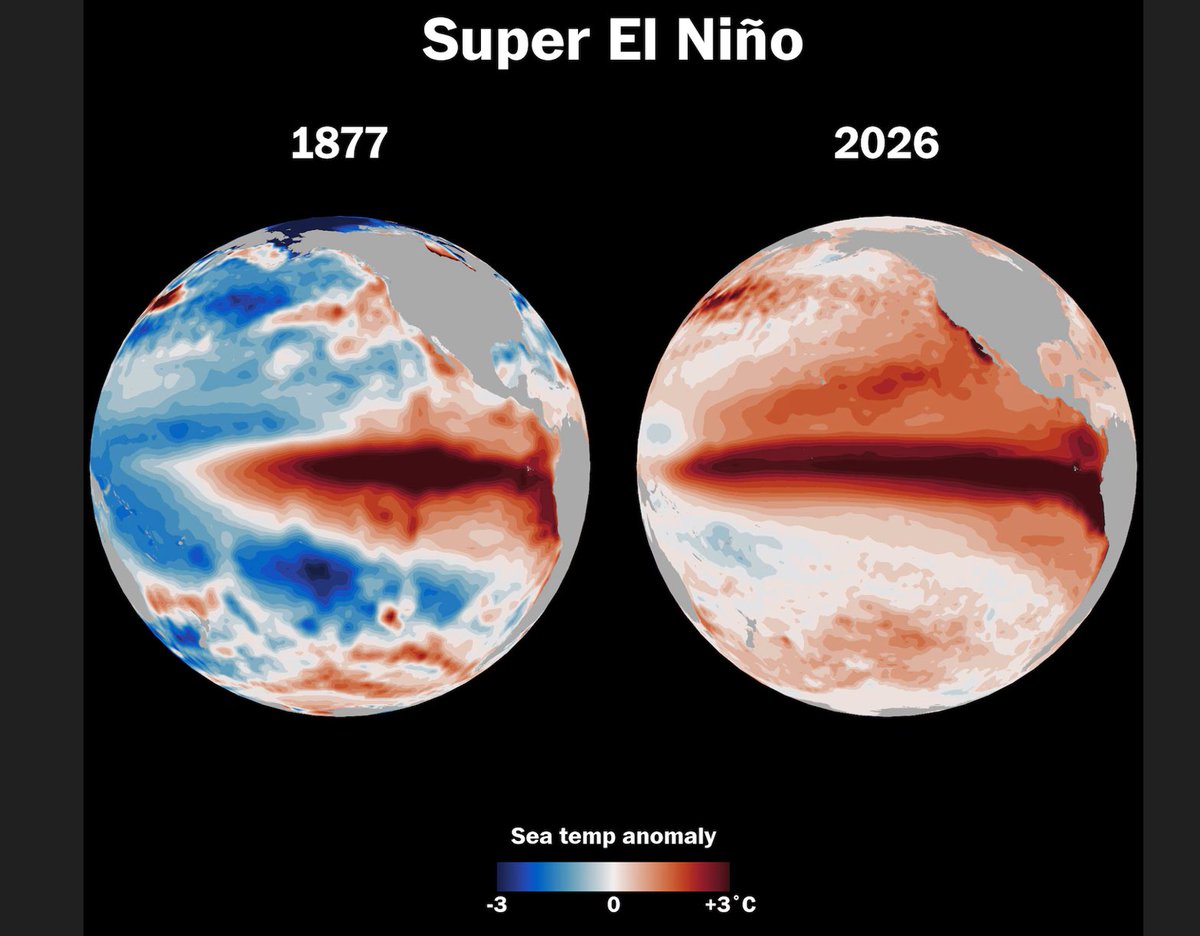
Malgré les incertitudes, mon inquiétude concernant l’établissement d’un des plus puissants épisodes El Niño jamais mesurés reste intacte depuis mon premier tweet du 6 avril. Et je maintiens le terme : dans l’état actuel des prévisions, la situation est « alarmante ».
Le puissant El Niño de 1877-1878 a contribué, parmi d’autres événements météorologiques cocomittant, à la Grande Famine mondiale de 1876-1878 via d’importantes perturbations hydriques autour du Pacifique. Selon l’étude de Deepak Ray et collègues publiée dans le Climatology (« Climate and the Global Famine of 1876-78 », 2018), cette famine aurait causé entre 30 et 60 millions de décès, soit environ 2 à 3,5 % de la population mondiale de l’époque.
Certaines analyses décrivent cet événement comme possiblement « la pire catastrophe environnementale ayant frappé l’humanité » au cours des derniers siècles, avec un bilan humain comparable à celui des guerres mondiales ou de la pandémie de grippe de 1918-1919.
Évidemment, dans une économie agricole mondialisée, les conséquences d’un El Niño comparable ne seraient probablement pas équivalentes aujourd’hui. Mais plusieurs éléments distinguent notre contexte actuel de celui de 1877 : nous faisons face à une polycrise mêlant tensions géopolitiques, instabilités sur les engrais et l’énergie, ainsi qu’au changement climatique qui ajoute un réchauffement de fond supplémentaire aux anomalies liées à El Niño. Le tout dans un contexte de réchauffement dont la pente est accélérée depuis 7 ans (sur de récentes études, mais dont les conclusions ne sont pas encore partagées par toute la communauté).
Même si les modèles persistent à signaler un épisode potentiellement inédit par son intensité, l’incertitude demeure importante jusqu’à l’été. Cependant, lorsqu’il s’agit d’agriculture et de sécurité alimentaire, mieux vaut anticiper que subir, en particulier pour les pays en développement qui restent les plus vulnérables aux chocs climatiques.
Je maintiens donc ma position : à ce stade, les prévisions et les observations continuent d’aller dans le sens d’un épisode potentiellement majeur et préoccupant.
Pour ce thread, je me suis notamment appuyé sur des échanges avec le compte @MystereMeteo, qui m’a transmis l’article scientifique cité plus haut. Je vous conseille vivement de le suivre.
L'image est tirée du Washington Post.
One of the most significant studies of glyphosate is The Agricultural Health Study conducted in the USA by following the health of thousands of farmers and they families over decades. These farmers used formulated products, not pure glyphosate and the clear conclusion of this study is that it showed no link between glyphosate and any type of cancer.
https://t.co/lOrsQ4IdYp
@fuckthedip C'est le principe même de la politique du clientélisme, commencé sous Giscard et amélioré par Mitterrand avec l'état providence.... La logique de performance à complètement été effacé de l'éducation, de l'esprit
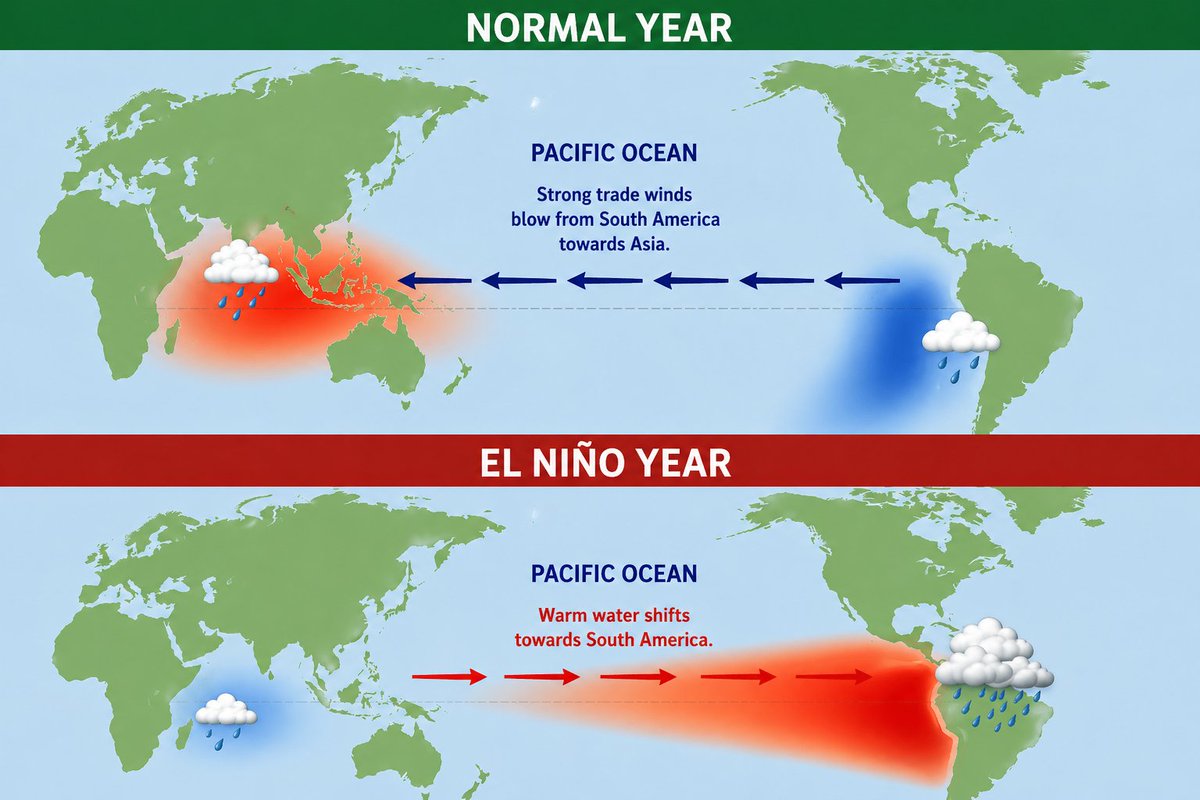
🔥 EL NIÑO EXPLAINED: Why India is Heating Up & Monsoon Risk is Rising 🌍
India’s heatwave and weak monsoon fears?
Not politics. Not policy. It’s El Niño.
Here’s what’s really happening 👇
🌊 Normal Year
Strong winds push warm Pacific water toward Asia → more clouds → strong monsoon 🌧️
🔥 El Niño Year
Those winds weaken or reverse → warm water stays near South America → clouds shift away from Asia
➡️ Result:
• 🌧️ More rain in South America
• ☀️ Less rain in India & Asia
• 🌡️ Rising land temperatures
But here’s the critical part most people miss 👇
Air works like a loop.
When it rises over the warm Pacific (near South America), it must sink somewhere else.
That “somewhere else” = India & parts of Asia
⬇️ Sinking air =
• Hotter
• Drier
• Fewer clouds
• More direct sunlight
💥 That’s the recipe for:
• Heatwaves
• Weak monsoon
• Crop stress
📊 El Niño hits every 2–7 years — and when it does, it reshapes weather across the globe.
👉 So the current heat? It’s part of a much bigger climate system, not a local event.
#ElNino #Monsoon #IndiaWeather #Climate #Heatwave
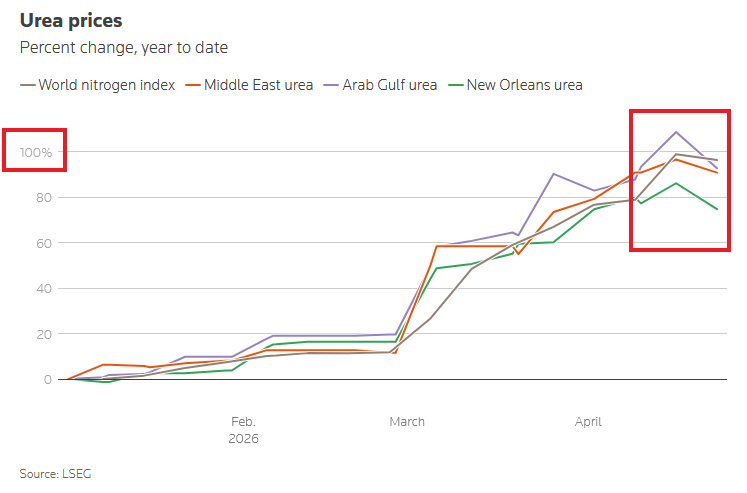
🚨 Fertilizer Shock Is Here — And It’s Escalating Fast 🌍🌾
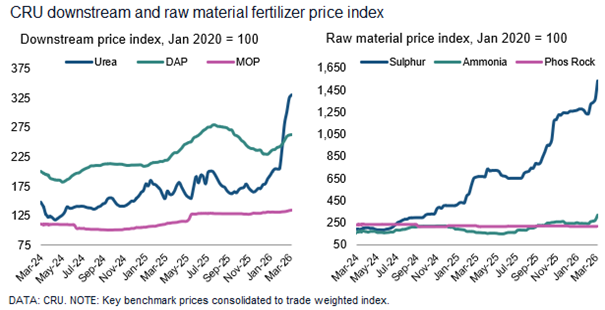
Urea prices are exploding.
📈 +80% to +100% YTD across global benchmarks
⛔ ~33% of global urea trade disrupted
🌊 Strait of Hormuz effectively shut
This isn’t just a commodity move — it’s a direct hit to global food production.
Urea = essential nitrogen fertilizer
➡️ Must be applied every season
➡️ Direct impact on yields & crop quality
And the timing couldn’t be worse…
🌍 The Middle East supplies ~45% of global urea exports
Key buyers: India, Europe, Brazil
Now supply is choking just as planting decisions are being made.
🇮🇳 India just booked record urea imports
💰 Paying nearly 2x vs 2 months ago
🇦🇺 Western Australia already reacting:
🌾 Wheat area expected to drop -14%
➡️ Farmers shifting away from fertilizer-heavy crops
⚠️ What this means:
• Higher food production costs
• Lower crop yields (if fertilizer use drops)
• Rising global food inflation risk
• Supply chain stress spreading beyond energy
This is how a geopolitical shock turns into a food crisis.
Watch fertilizer. It’s becoming the next big pressure point.
Ukrainian farmers say the crop could drop 5% to 10% this year because of a spike in input prices - RTRS
We tend to agree. Among major grain exporters in the Northern Hemisphere, Ukraine could suffer the most. That was a key reason why we cut our Ukrainian #wheat and #corn crop forecasts earlier this month.
More details: https://t.co/VzsntEzZUr
----
Reuters: Many [Ukrainian] farmers say high fertiliser prices will squeeze their budgets.
"The increase in average production costs will probably be around 20% - 30% in the short term," said Dmytro Skorniakov, CEO of Ukrainian agricultural company HarvEast, which farms tens of thousands of hectares of land, exporting grain and oilseeds.
Skorniakov forecast a 5% to 10% drop in Ukraine's farm output this season. "There will definitely be a decline, unless we're extremely lucky with the weather," he said.
In the longer term, a rise in food prices would help to maintain the value of Ukraine's exports, he said.
#oatt #sizovreport #blacksea
Unveiling the world’s first selective herbicide to control resistant grass weeds in soybean and cotton in nearly 40 years!
We’re launching VIRESTINA™ technology globally after Argentina approved this new weed control. We plan to roll out this breakthrough to other countries such as Brazil, Australia, the U.S., and Canada. Follow us for updates!
#Ammonium#sulphate is on the rise as buyers pounce on scarce #nitrogen. #Urea prices moved into the $800s/t FOB from the AG, North Africa and Southeast Asia. The world is looking for answers
Australia is the largest importer of diesel fuel in the world. It also holds the lowest fuel reserves of any IEA member nation — dead last out of 28 developed economies. Japan stockpiles 260 days. We're at ~26 and falling.
Six of eight refineries have closed since 2013. We import over 90% of our refined fuel, mostly through a single chokepoint that's been closed for 37 days.
I built https://t.co/KYzH1ebsSu to track what's actually happening — in real time, from primary sources:
— Live AIS tanker tracking (750+ vessels, 40+ confirmed inbound)
— Government reserve data direct from DCCEEW Power BI
— 90-day depletion projections with vessel delivery modelling
— Daily intelligence briefings synthesised from 80+ sources
— Cargo type inference, multi-source vessel fusion, confidence grading
— 28 evidence-backed policy solutions stress-tested against expert review
Every data point sourced. Every claim confidence-graded. Independent and non partisan.
Follow @FuelAustralia for daily briefings.
Hedge funds have turned net bullish on #wheat for the first time in nearly four years, betting on higher #prices driven by dry weather in the US and a shortage of fertilizer and fuel arising from the war in the Middle East.
https://t.co/xPEEA9zsgw
Corn requires 140 to 180 pounds of synthetic nitrogen per acre. Soybeans require near zero because rhizobia bacteria in their root nodules fix atmospheric nitrogen directly from the air. This biological fact is now the most consequential variable in American agriculture because the synthetic nitrogen that corn needs is manufactured through the Haber-Bosch process, the Haber-Bosch process runs on natural gas, and one third of the world’s seaborne fertiliser trade transits the Strait of Hormuz, which has been effectively closed for five weeks.
The USDA’s March 31 Prospective Plantings report confirmed the shift. Corn planted intentions fell to 95.3 million acres, down 3.45 million from 2025. Soybean intentions rose to 84.7 million acres, up four percent. Anhydrous ammonia hit $1,035 per tonne at retail, the first time above $1,000 since April 2023. Urea hit $826, the first time above $800 since November 2022. The urea-to-corn price ratio reached 126 bushels per tonne against a historical average of 75. At that ratio, planting corn on marginal land is a guaranteed loss. The farmer is not making a philosophical choice. The farmer is doing arithmetic. And the arithmetic says soybeans.
America produces 75 to 94 percent of its ammonia domestically. It is not Bangladesh, which shut four of five state urea plants within a week. It is not Sri Lanka, which reactivated military-escorted QR fuel rationing. The United States will not have a nitrogen famine. What it will have is a nitrogen price trap that alters the composition of what is planted, how much nitrogen is applied to what remains, and what that means for the 6.2 billion bushels of corn that the USDA projects will be consumed as animal feed this marketing year.
The chain is linear and each link is verified. Strait closed. Gas trapped. Haber-Bosch plants offline or repriced. Urea surges. Corn margins collapse. Farmers shift acres to soybeans. Fewer corn acres at harvest. Tighter supply against sticky feed demand and inelastic ethanol mandates under the Renewable Fuel Standard, which alone consumes 5.6 billion bushels annually regardless of price. Higher corn prices transmit into feed costs for cattle, hogs, and poultry. Livestock producers absorb, pass through, or liquidate herds. Meat, dairy, and egg prices rise 10 to 25 percent by early 2027 according to commodity analysts tracking the acreage shift.
India says its stockpile is “comfortable.” American farmers face a different test: not whether they can get nitrogen, but whether they can afford it before the biological window closes in mid-May. Every acre that shifts from corn to soybeans removes a feed grain acre. Every pound of nitrogen skipped on remaining corn reduces yield on a quadratic curve: the first 20 pounds cut cost far more in lost bushels than the last 20 applied.
The war is in Iran. The strait is in the Gulf. The molecule is methane. The reaction is Haber-Bosch. The product is urea. The crop is corn. The consumer is a chicken in Arkansas, a hog in Iowa, a dairy cow in Wisconsin, and every American who buys what they produce. The strait and the steak are connected by a single chemical reaction that was invented in 1909 and has fed half the world’s population ever since. When the feedstock for that reaction is trapped behind a naval blockade, the steak reprices. Not today. At harvest. And harvest does not wait for diplomacy.
https://t.co/iFmUcarGdV


















![sizov_andre's tweet photo. Ukrainian farmers say the crop could drop 5% to 10% this year because of a spike in input prices - RTRS
We tend to agree. Among major grain exporters in the Northern Hemisphere, Ukraine could suffer the most. That was a key reason why we cut our Ukrainian #wheat and #corn crop forecasts earlier this month.
More details: https://t.co/VzsntEzZUr
----
Reuters: Many [Ukrainian] farmers say high fertiliser prices will squeeze their budgets.
"The increase in average production costs will probably be around 20% - 30% in the short term," said Dmytro Skorniakov, CEO of Ukrainian agricultural company HarvEast, which farms tens of thousands of hectares of land, exporting grain and oilseeds.
Skorniakov forecast a 5% to 10% drop in Ukraine's farm output this season. "There will definitely be a decline, unless we're extremely lucky with the weather," he said.
In the longer term, a rise in food prices would help to maintain the value of Ukraine's exports, he said.
#oatt #sizovreport #blacksea](https://pbs.twimg.com/media/HF39PqmXgAAYlCu.jpg)