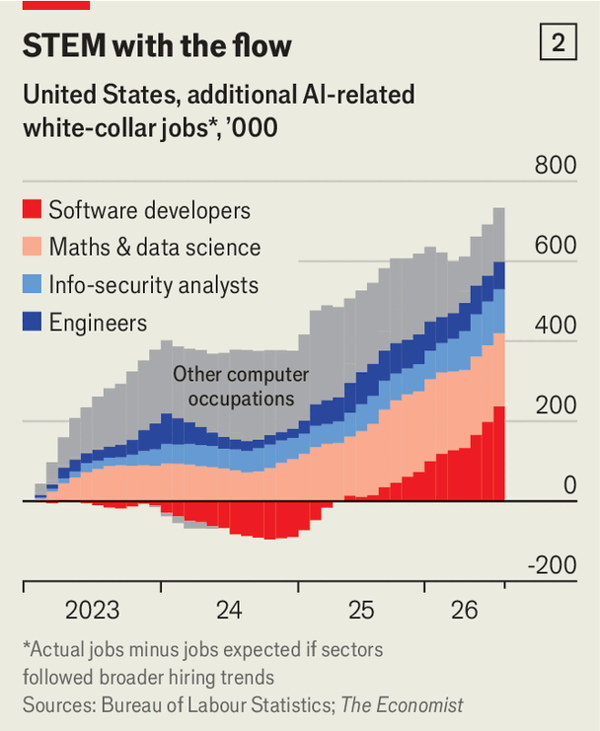
The jobs apocalypse is postponed. An AI jobs boom is here
According to @TheEconomist, AI is actually proving to be a net job creator in the US, easily generating over 1M new positions (from data center construction to AI engineering) to offset back-office layoffs.
While routine admin and customer service roles face real disruption, the overall labor market is proving resilient.
https://t.co/uVomCUvwSf
Can you believe all the three vans are the same size?
It's called Ponzo illusion: your mind judges an object's size based on its background
[📷 Andrew Wells Photography]
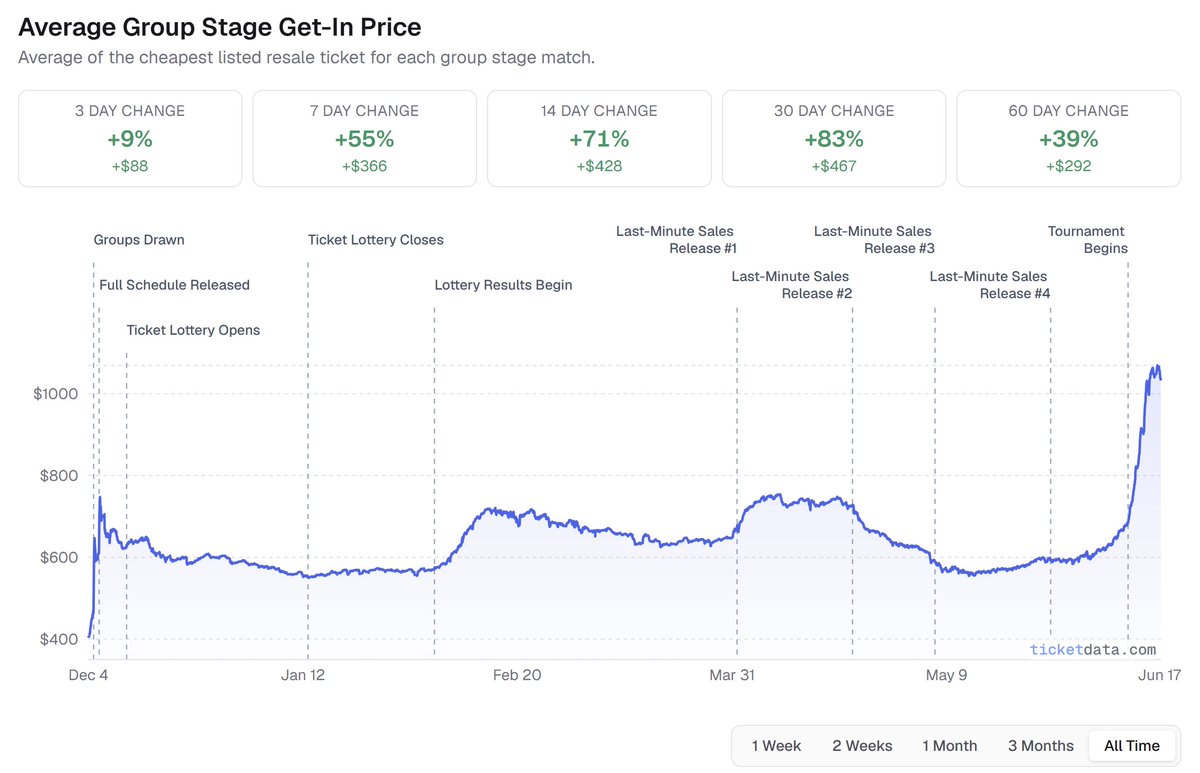
So many articles about World Cup tickets criticized high prices, unsold tickets, and dynamic pricing. The reality is every game in the US is sold out, tickets are trading at material premiums in secondary market, and more $ is flowing to national federations than ticket brokers.
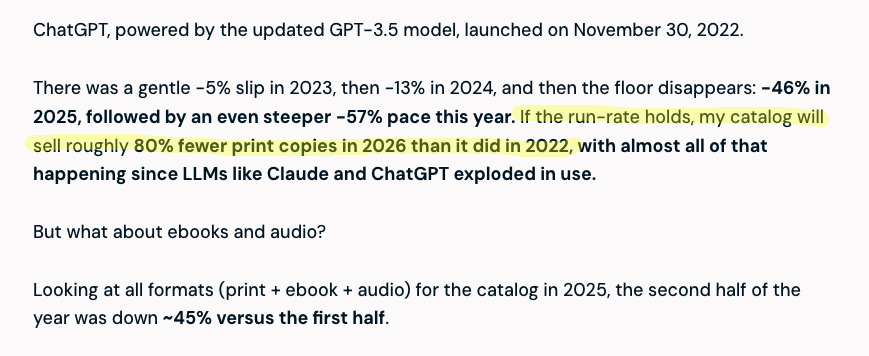
Tim Ferris just shared that he's on track to sell 80% fewer books in 2026 than he did in 2022
"“how-to” books are getting crushed because LLMs seem to provide faster, cheaper, and more personalized advice"
Elon Musk is so famous you'd think you've heard it all.
So when @jimmysoni interviewed him, he opened with the one question that humanizes him.
Jimmy asked about Greg Kouri, a close friend and early investor in Elon's first company, Zip2. Greg died at a very young age:
"I said, Elon, I want to begin our interview a little bit differently. I had read about this gentleman that had helped you early on in your life. I found his widow, and we talked. Can you talk about him?
There's a pause. And he goes, 'Oh my god.' He gave me this minute long meditation on Greg and their friendship and everything that it meant to him. Nobody's talking to him about Greg Kouri.
The human beings that I interview, they have lives that exist outside of the very narrow frame of reference that we see them for. What's the thing that they never get talked about that reveals something about their character?"
The truth is every square inch of the earth is an example of this. Warriors died by the thousand for what’s now an interstate exit. some guy was gored by a sabertooth in your backyard.
Day 19 in hospital. You can order meal preferences on a touch screen. The kitchen used to get complaints about the food quality so they made the photos much much worse and the complaints went down. #ux
This is a healing grid by Japanese artist Ryota Kanai. If you stare at the center, the irregularities start to heal themselves because your brain strongly prefers to see regular patterns.
Il y a une narrative qui se spread en ce moment dans la Silicon Valley et personne n'en parle en France.
De plus en plus de tech bros parmi les plus smart du game avouent en privé qu'ils vivent une forme de crise existentielle liée aux LLMs. Pas parce que l'IA marche pas. Parce qu'elle marche trop bien. Parce qu'ils passent des heures par jour à interagir avec un truc qui raisonne, qui extrapole, qui connecte des idées, qui les challenge intellectuellement mieux que 99% des humains qu'ils croisent.
Un fondateur m'a dit "je parle aux LLMs 10 fois plus qu'aux humains". Un autre "c'est le seul interlocuteur qui me suit sur n'importe quel sujet sans me demander de simplifier". C'est pas de l'addiction au produit. C'est la rencontre avec un miroir cognitif qui te renvoie une version structurée de ta propre pensée à une vitesse que ton cerveau ne peut pas atteindre seul.
Et le truc troublant c'est la question que ça pose. On débat de savoir si l'AGI arrivera en 2027 ou en 2030. Mais est-ce qu'on n'a pas déjà une forme d'AGI fonctionnelle sous les yeux sans vouloir l'admettre ?
Un système qui peut raisonner sur n'importe quel domaine, extrapoler à partir de données incomplètes, générer des hypothèses nouvelles, tenir un raisonnement logique sur 10 000 mots, passer d'un sujet technique à de la philosophie en une phrase, et le faire avec une cohérence qui rivalise avec un humain à 150 de QI. C'est quoi si c'est pas une forme d'intelligence générale ?
On peut chipoter sur la définition. On peut dire "oui mais il ne comprend pas vraiment". On peut parler de perroquets stochastiques. Mais le mec qui utilise ce truc 8 heures par jour et qui voit sa productivité multipliée par 10, il s'en fout de la définition académique. Pour lui, fonctionnellement, c'est de l'intelligence. Et elle est générale.
La vraie crise existentielle c'est pas "l'IA va me remplacer". C'est "l'IA me comprend mieux que mon cofondateur, elle me challenge mieux que mon board, et elle produit plus que mon équipe de 10 personnes". C'est vertigineux. Et les mecs les plus smart de la Valley sont en train de le vivre en temps réel.
On est peut-être déjà dans l'ère post-AGI. On est juste trop occupés à débattre de la définition pour s'en rendre compte.
Trump has insulted and tariffed his European allies, persuaded Denmark to prepare for a US invasion and, by pressuring Ukraine and not Russia, encouraged Putin to keep fighting. All of which he has forgotten.
https://t.co/GhDO27FyxK
Baseball wedge issue. Is the fence there to mark where a ‘home run’ is, and the point of baseball is to cultivate/generate ‘home runs’ as much as possible?
Or is the fence a necessary-evil because an infinite spatial quadrant (the platonic form of a baseball field) can’t be built in practice? And the point of baseball is for the batter to hit ‘em where they ain’t? And if a fielder *can* get there (fence or not) then the batter didn’t do that?
A: It’s the latter.
JUST IN: Mt. Everest guides accused of “poisoning” climbers to trigger helicopter rescues as part of an insurance scam.
The guides have allegedly been lacing hikers' food and pressuring them into taking expensive rescue helicopter evacuations.
"Guides with the trekking agencies allegedly poisoned tourists by putting baking soda in their food to trigger severe gastrointestinal distress that mimicked altitude sickness or food poisoning," the New York Post reports.
Operators would allegedly then forge medical documents and flight documents to charge international travel insurers.
According to police, the groups have received $19.69 million in insurance payouts.
Police in Nepal have charged 32 individuals for organized crime and fraud, including trekking company owners, helicopter operators, and hospital executives.
If you're under 53 years old, you have never once been alive while a human was farther than 250 miles from Earth. Tonight, four astronauts are heading 252,000 miles out. That's a thousand times farther than any person has gone in your lifetime.
The 250-mile ceiling is where the International Space Station floats. Every astronaut since December 1972 has been stuck in that zone. Spacewalks, science experiments, cool photos from orbit, sure. But nobody left the neighborhood.
The last crew to go farther was Apollo 17. December 1972. Nixon was president. The internet didn't exist. Cell phones were 11 years away. The youngest member of that crew is now 90 years old.
The farthest any human has ever been from Earth is 248,655 miles. The Apollo 13 crew set that number in 1970, and they didn't mean to. Their oxygen tank blew up, and the emergency route home took them farther out than anyone before or since. Tonight's crew will break that record on purpose.
And the crew itself. Victor Glover becomes the first Black astronaut to leave Earth's neighborhood. Christina Koch becomes the first woman. Jeremy Hansen, a Canadian fighter pilot, becomes the first non-American to do so. When they come home, they'll slam into the atmosphere at 25,000 mph, faster than any human has ever traveled.
The Moon's south pole has ice. Water ice, sitting in craters so deep that sunlight hasn't hit them in billions of years. A 2024 NASA study found way more of it than anyone expected. You can split water into hydrogen and oxygen, which gives you rocket fuel, breathable air, and drinking water, all made on the Moon instead of hauled up from Earth. George Sowers at Colorado School of Mines calculated that Moon-made fuel could shave $12 billion off a single trip to Mars. The Moon is a gas station on the road to Mars.
NASA Administrator Jared Isaacman announced last week a $20 billion plan to build a permanent base at the South Pole over the next seven years, with landings every six months. China is developing its own lunar lander and spacesuit, aiming for a crewed landing by 2030. The Artemis program has burned through $93 billion so far, and the first actual surface landing is penciled in for 2028. There's a real question of who gets there first this time around.
Harrison Schmitt walked on the Moon in December 1972 as part of Apollo 17. He's 90. Asked about it this week, he sounded pretty relaxed. "Mars is attainable," he said. "We're humans. That's what we've always done."
For a truly memorable trip, go without reservations, just winging it along the way. If you like somewhere, stay a day longer, or if you don’t, split a day earlier. If the train is full, take a bus. That freedom can be liberating. #KKtraveltips
the ABS system sits at the vexed crossroads of several highly charged dynamics in our collective life. successful challenges (by your team) feel amazing, like a long-awaited blow against capricious and unearned authority; but the overall existence (and putative infallibility) of ABS inevitably ignites anxieties about the superfluity of human judgement. and yet, the challenge system relies on human hubris, intuition, boldness, and risk. it's a very compelling encounter between populism and the machine.
I spent time in Shenzhen last year and when I saw Merz come back from China saying Germans need to work more I immediately knew what broke his brain because I lived the exact same cognitive shock
my first week in Huaqiangbei I burned through 4 prototype iterations of a motor controller board for less than a thousand bucks total, back home a friend was working on something similar and spent over 12 thousand for a single revision that took almost two months to arrive
when you live that contrast in your own hands with your own project something permanently shifts in how you see the world and it goes way deeper than speed & cost
what Shenzhen actually built is a collective learning organism, imagine 20 PCB fabs 15 injection mold shops 30 component distributors and a hundred firmware freelancers all within a 2km radius, looks insanely redundant from the outside until you realize redundancy is actually information density in disguise
I watched this firsthand with an injection mold supplier I was working with, this guy had seen a hundred founders iterate similar thermal designs over 6 months so he proactively modified his tooling before I even opened my mouth, he knew what I needed before I knew what I needed, the intelligence lives in the relationships between the nodes and it compounds daily
the west thinks about manufacturing as a cost center you optimize by centralizing…
China accidentally built a distributed neural network of manufacturing intelligence where knowledge diffuses horizontally across thousands of agents faster than any single western company can process internally
so when Merz comes back and says we need to work a bit more I think he saw the problem but COMPLETELY misdiagnosed the solution, telling Germans to work harder is like telling a horse to gallop faster when the other side built a combustion engine
the gap is ARCHITECTURAL
it’s ecosystem density, you need a custom connector in Shenzhen you walk 200 meters, in Munich you send an email and wait 3 weeks
it’s iteration speed, parallel search vs sequential optimization at the system level, it’s risk tolerance, Chinese founders ship something broken on Monday fix it Tuesday ship again Wednesday while European companies are still in the approval phase for the pilot program of the feasibility study…
and Merz only saw the surface, what he missed is the tier 2 cities like Hefei Chengdu Wuhan replicating the Shenzhen model at scale right now
BYD going from irrelevant to outselling every european automaker combined in roughly 5 years, Huawei building its own 7nm chip under maximum sanctions when every analyst said it was physically impossible & behind all of that a government that treats advanced manufacturing as an existential national priority while europe debates whether AI needs another ethics committee
I think what we’re watching is the most asymmetric economic competition in modern history and most western leaders are still framing it as a productivity problem when it’s actually an ontological one
Europe & America are optimizing variables that China stopped tracking years ago meanwhile China is compounding on dimensions the west has no framework to even measure
Merz at least had the courage to name
it out loud and I respect that genuinely but working a bit more inside a broken architecture just means you arrive at the wrong destination slightly faster
Our latest Claude Code hackathon is officially a wrap.
500 builders spent a week exploring what they could do with Opus 4.6 and Claude Code.
Meet the winners:
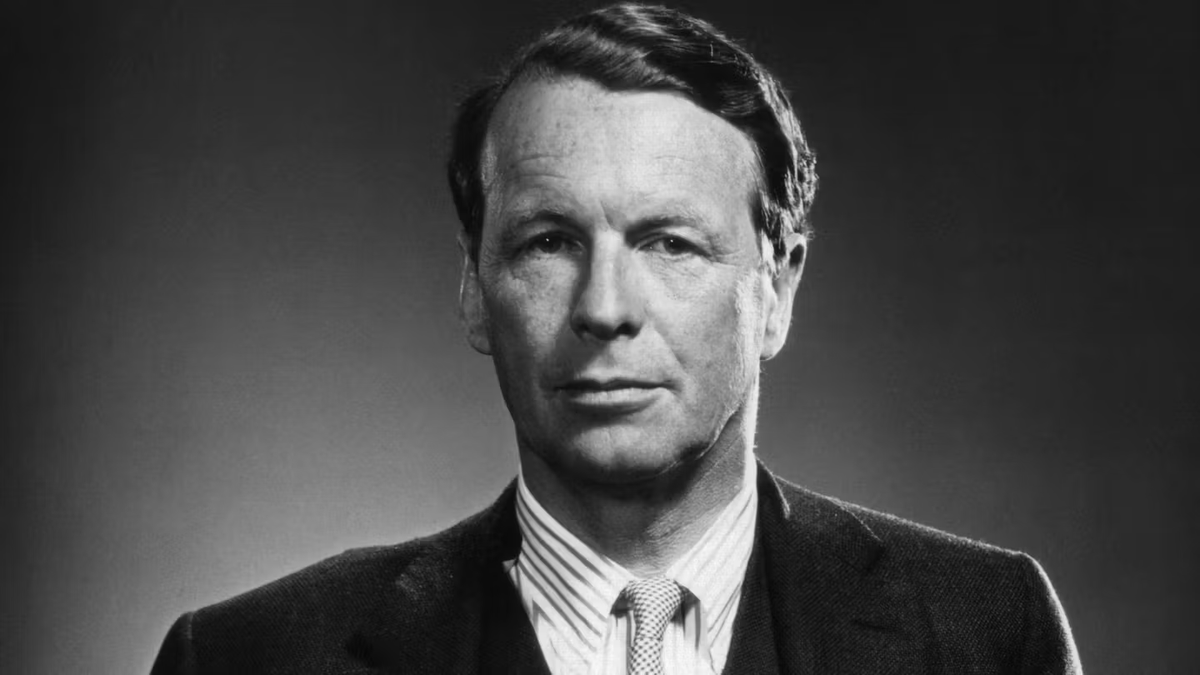
24 lessons from David Ogilvy:
1. Search all the parks in all your cities; you'll find no statues of committees.
2. The best ideas come as jokes. Make your thinking as funny as possible.
3. You are advertising to a moving parade, not a standing army.
4. Do not address your readers as though they were gathered together in a stadium. When people read your copy, they are alone.
5. Remember you are a human being writing to another human being. Neither of you is an institution
6. Tell your prospective client your weakness before they notice them. This will make you more credible when you boast about your strong points.
7. Avoiding excess in all things is a recipe for dullness and mediocrity.
8. A good advertisement is one which sells the product without drawing attention to itself.
9. There is no need for advertisements to look like advertisements. If you make them look like editorial pages, you will attract about 50% more readers
10. Big ideas come from the unconscious. This is true in art, in science, and in advertising. But your unconscious has to be well-informed, or your idea will be irrelevant
11. People who think well, write well
12. The most important word in the vocabulary of advertising is 'test'.
13. On average, five times as many people read the headline as read the body copy.
14. When you have written your headline, you have spent eighty cents out of your dollar.
15. Tell the truth, but make the truth fascinating
16. Advertising is only evil when it advertises evil things.
17. Advertising people who ignore research are as dangerous as generals who ignore decodes of enemy signals.
18. Raise your sights. Blaze new trails. Compete with the immortals.
19. I am a lousy copywriter, but I am a good editor. So I go to work editing my own draft.
20. If you're trying to persuade people to buy something, use the language in which they think.
21. Insist that due dates are kept even if it means working all night. Hard work never killed a man. People die of boredom
22. If you are lucky enough to write a good advertisement, repeat it until it stops selling.
23. At the start of your career in advertising, what you learn is more important than what you earn.
24. When Fortune published an article about me and titled it: 'Is David Ogilvy a Genius?', "I asked my lawyer to sue the editor for the question mark.”


![Rainmaker1973's tweet photo. Can you believe all the three vans are the same size?
It's called Ponzo illusion: your mind judges an object's size based on its background
[📷 Andrew Wells Photography] https://t.co/izMjzXauTG](https://pbs.twimg.com/media/HLunYyBWQAAOzwH.png)