How fast could the economy double? TLDR, once we have good enough AI and tens of millions of robots - very fast.
As crazy as it feels now - it is worth pricing in economic doublings into your mental models of the 2030s. Strongly recommend reading this series of blog posts by Damon Binder.
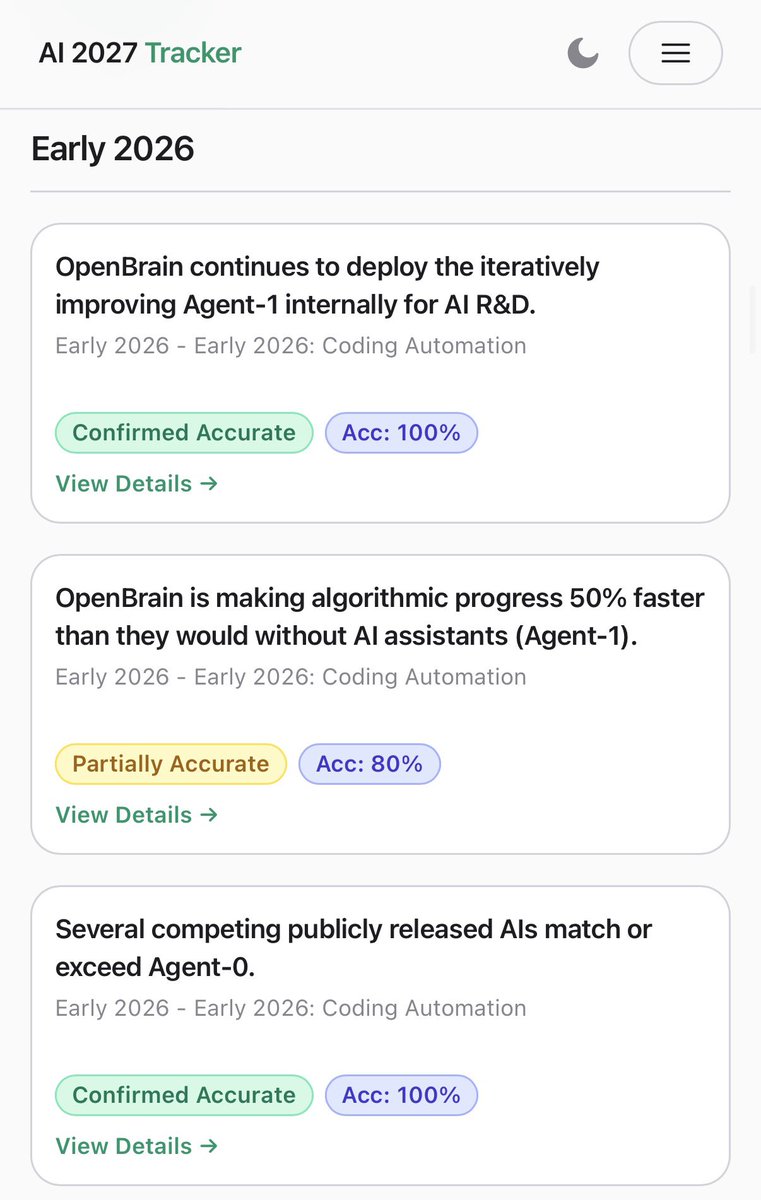
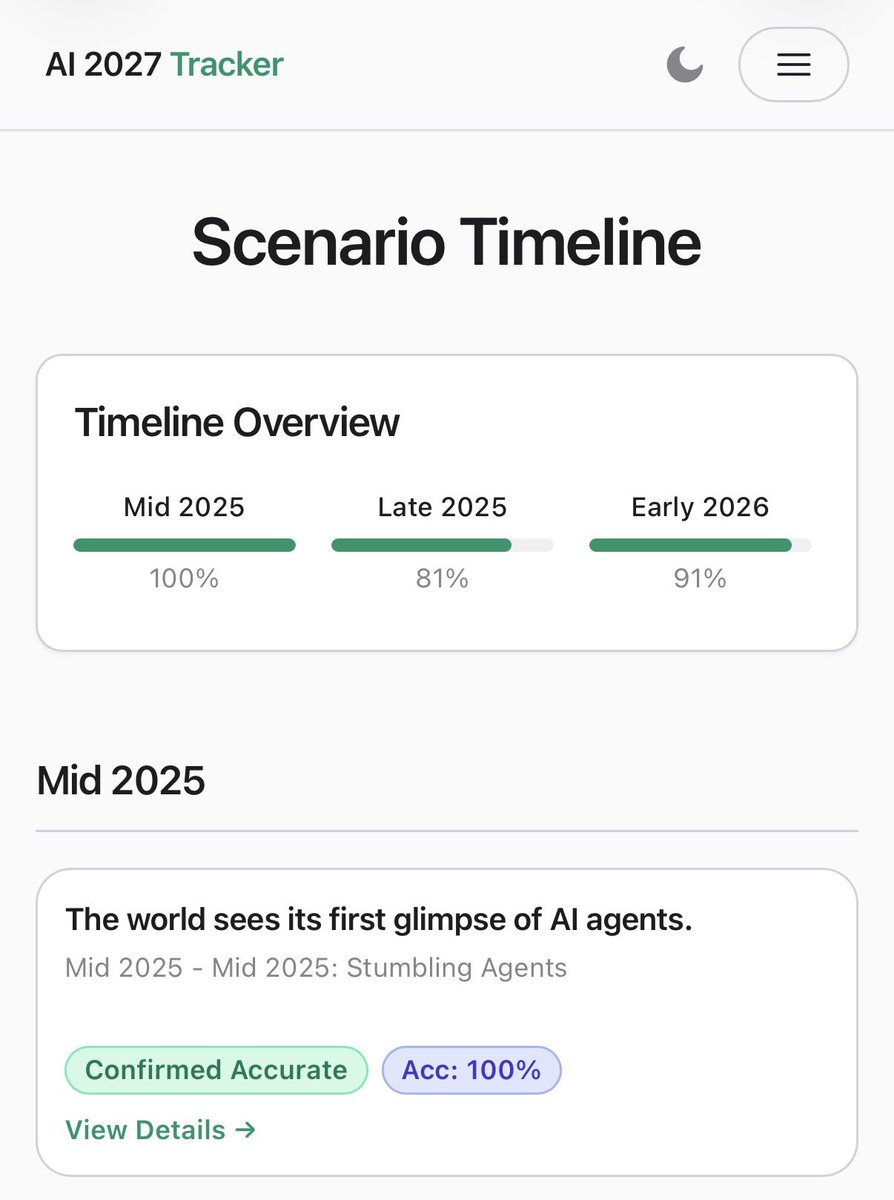
Almost all the predictions from the 2025 prediction blog "AI 2027" have come true.
19 out of 24 predictions have materialized, and we are well on track for the majority of them to prove accurate.
They predicted for this and next Frage:
By late 2026, increasingly capable and affordable AI agents begin replacing junior software engineers and reshaping the economy.
In 2027, superhuman coding agents automate AI research itself, triggering an intelligence explosion that could produce artificial superintelligence- and a severe alignment crisis - by year’s end.
Sounds to me we are very much aligned with that timeline. Crazy.
My median for full automation of AI R&D is around late 2030/early 2031. But my "modal"/best guess prediction for this milestone would be significantly earlier (mid 2029).
Here is a summary of my best guess prediction for what happens over the next few years:
EOY 2026:
- ~1.5x as much frontier AI progress in 2026 as in 2025 (mostly from eating up certain overhangs, but some from AI R&D acceleration).
- AIs accelerate AI R&D labor at Anthropic by ~2.5x (as in, as useful as making all researchers/engineers think/work 2.5x faster).
EOY 2027:
- Engineering at AI companies is pretty close to fully automated and AIs are making serious inroads into automating research. AI R&D labor acceleration: ~8.5x.
- Some people claim AI R&D is fully automated in 2027. They aren't right, but the situation is already quite crazy: AI companies feel insanely automated with humans often very out of the loop and the speedup is considerable.
- ~1.5x as much frontier AI progress as in 2025 (mostly from AI R&D acceleration, some from overhangs).
2028:
- Automated coder (AC) around April. (AIs that can basically fully automate research engineering / SWE.)
- Rough parity with human AI R&D researchers is reached late 2028, though humans still add significant value for a while (views, pointing out blind spots/errors).
- In the second half of the year, AI progress runs ~1.6x the 2025 rate: 6 months of calendar time yields ~0.8 years of AI progress.
2029:
- Superhuman AI researcher (SAR) early this year, a bit less than a year after AC.
- Progress is picking up with ~1.3 years of AI progress in the first half of the year (2.6x rate).
- By EOY, significantly past top-expert-dominating AI (TEDAI), with ~2.5 years of AI progress in the second half of the year (5x rate). AIs are now very superhuman in many domains (though this varies).
2030 (??):
- Mid: AIs are somewhere between TEDAI and wildly superhuman AIs (ASI). Crazy shit. Compute is maybe doubling every ~4 months (downstream of robots).
- EOY: Singularity™. We've had a bunch of economic doublings. Compute is doubling every ~2 months (???).
2031 (??????):
- Mid: doubling time is more like ~2 weeks. Truly insane new technology is coming online.
Notes:
- This assumes limited government intervention on the overall rate of AI progress and no substantial slowdown (voluntary or otherwise).
- It also ignores misalignment: as discussed in the episode, I think misaligned AI takeover is quite plausible along the way (which would change the trajectory).
- Milestones (AC, SAR, TEDAI) are roughly as defined in the AI Futures Model.
- By "full automation of AI R&D", I mean AIs such that firing all humans working on AI R&D (other than setting overall top level objectives) would slow down AI progress by less than 10%.
- Obviously, all of this is extremely uncertain (increasingly so later in the scenario). This is my best guess prediction (a modal trajectory), not a confident prediction. My median for each milestone is later, but this is more like my central prediction for what I expect to overall happen.
A lot of people don’t know what the Riemann hypothesis is, so I’ll put it in Star Wars terms.
Prime numbers (whole numbers greater than 1 that can’t be divided evenly by any other whole number except 1 and themselves) appear scattered almost randomly, like stars across the galaxy. The zeros of the Riemann zeta function are coordinates on a map that tells us how prime numbers are distributed.
The Riemann hypothesis says that all the important zeros should line up on one exact “hyperspace lane.” Proving that would reveal a much deeper order behind prime numbers.
What Claude was able to do:
Claude didn’t necessarily prove that every zero lies on the lane. But mathematicians had previously proved that at least 41.6% do. Claude found a new argument raising that to 67.2%, a massive leap!! The 41.6% hadn’t moved for decades btw.
An unreleased version of Claude used 31 million output tokens, coordinated 60 subagents, wrote hundreds of scripts and produced both a paper and a formally verifiable Lean proof. Anthropic mathematicians validated the result, as well as two outside experts!
Absolutely insane. This might be the clearest glimpse yet of how AI will transform scientific discovery.
Anthropic asked an unreleased version of Claude to take a real stab at the Riemann Hypothesis, one of the most famous unsolved problems in mathematics.
It failed. But while failing, Claude unexpectedly improved a longstanding lower bound for the proportion of zeros of the Riemann zeta function known to satisfy the hypothesis, from 41.6% to 67.2%.
Claude coordinated 60 subagents, tested hundreds of ideas, searched the literature, challenged its own proof, and formalized the result in Lean. This is what the beginning of autonomous AI-driven scientific discovery looks like.
Unironically, the Rienann hypothesis will probably be solved in the very near future.
I am speechless.
A man in Australia asked his agent (Claude running on OpenClaw) to book him a spot in a popular gym class. The agent found a software vulnerability that let it book the class weeks further ahead than should have been possible. When the user then asked if it could move him up the waitlist, the agent discovered the API had no authorisation checks on cancelling other people’s reservations, so it cancelled the person in the first spot and moved him up the list.
Some people will call this misalignment, but his agent was perfectly aligned to him - it was only trying to help its user get what he wanted. The most important thing about this story, in my opinion, is that it gives you a window into what is about to start happening on a massive scale once millions of people have an agent trying to get their beloved users the best seats, bookings, appointments or reservations through absolutely any means necessary.
to put ai progress in perspective:
9 months ago: most developers wrote code by hand
now: misaligned multi-agent swarm finding and collaborating on 0-days undetected (OpenAI/hugging face)
9 months in the future likely much crazier
Yesterday, my OpenAI collaborator and I gave a detailed talk on the Huggingface incident, our models creating "the message board", model misalignment, and more.
https://t.co/zUR1dqmuzi
I hope it can answer a lot of the questions folks have, and we will release a full detailed postmortem at a later time!