Full opinion at the Oregon Court of Appeals page: https://t.co/EHnStwZm9p
Fun fact - this is my 17th case where I was the trial attorney who properly preserved the issue for appeal & the appellate attorney won at the Court of Appeals!
Appellate attorneys are awesome!
Congrats to attorneys Meredith Allen (appeal) & @rachelbusygrl (trial) for State v Sims! Court of Appeals says error for trial court to overrule defense objections to prosecutor's improper comments during rebuttal - reversed!
Press release:
#Florida’s next governor won’t just inherit a budget. He’ll inherit a reckoning.
Consider the fiscal challenges awaiting the Donalds administration:
• Post-Amendment 3 cities and counties facing potential insolvency (Do we offer temporary grants or pursue a permanent solution?)
• Florida’s corrections crisis: a growing prison population, crumbling facilities, chronic staffing shortages, inmate healthcare and billions in deferred maintenance (punted for years)
• SNAP’s potential $1 billion annual state obligation (this one’s the sleeper)
• Property insurance affordability
• Housing affordability (starter homes are becoming an endangered species. Is A3 the kill shot?)
• Medicaid and rising healthcare costs (Florida’s boomers are booming)
• Transportation infrastructure
• Education and workforce development
These problems didn’t appear overnight, and they won’t disappear with another budget cycle. For years, Florida has deferred difficult decisions, postponed investments and pushed costs onto the next administration. Amendment 3 adds another enormous fiscal challenge to an already crowded agenda. The bills are coming due. The only questions now are what Florida chooses to fund, what it can afford to defer, and who will ultimately be left paying the price.
A relaxation of zoning restrictions in Raleigh, North Carolina, led to a surge in construction, which reduced inflation-adjusted rents by 15% between 2022 and 2025.
Low-income renters benefited the most.
https://t.co/AA5HhdbeuI
I’ve had my issues with Schumer. The tension between Reidworld and Schumerland circa 2010 was the stuff of legend.
Once, I was meeting with Reid in his office and Schumer came in and demanded that I leave. As I sat outside, I could hear Chuck yelling “fucking JENTLESON” through the closed door. As Reid told me later, Schumer had become convinced that I’d planted a story that cast Chuck in an unflattering light. Who can say.
But the thing that bugs me on a deep level about the Chris Van Hollen challenge is that it seems like a vanity play at the expense of the caucus—which is the exact opposite of what the job of leader requires.
The caucus, especially a big tent one like what we have now, is ideologically diverse, and the job of leader is to chart a direction that reflects that diversity.
In something like a shutdown fight, unity is critical, so you need to stake out ground that can unite the caucus.
I seriously doubt that the caucus would unite behind the idea of shutting down the entire government weeks before the holidays, putting at risk government workers who are still digging out from being DOGE’d—using the filibuster, no less, when Dems should be building a case for getting rid of it.
When we have control of both chambers, we can write and pass funding bills that keep the government open while isolating funding for the Iran war.
Staking your claim to leadership on pushing the caucus into a government-wide holiday shutdown is the kind of thinking that plays to a narrow, extremely online crowd while putting the caucus in an awkward position.
In contrast, Harry Reid took pride in absorbing the slings and arrows of criticism in order to protect the caucus. Over the course of his career, criticism came from all directions—including, sometimes, from the left.
CVH seems to be taking the opposite approach—putting the caucus on the spot in order to promote himself and play to the online crowd.
The fact that these poll numbers are so weak—from a pollster who supports his challenge—really begs the question of what this is all about.
Numbers like these make it hard for CVH to claim he’s channeling the will of the people. If anything, they represent yet another data point illustrating the gap between the online world and rank-and-file Democrats.
@RadioFreeTom While I am generally opposed to freezing iconic characters in amber, I appreciate @RadioFreeTom’s point that, when it comes to Bond, frozen in amber is a virtue,
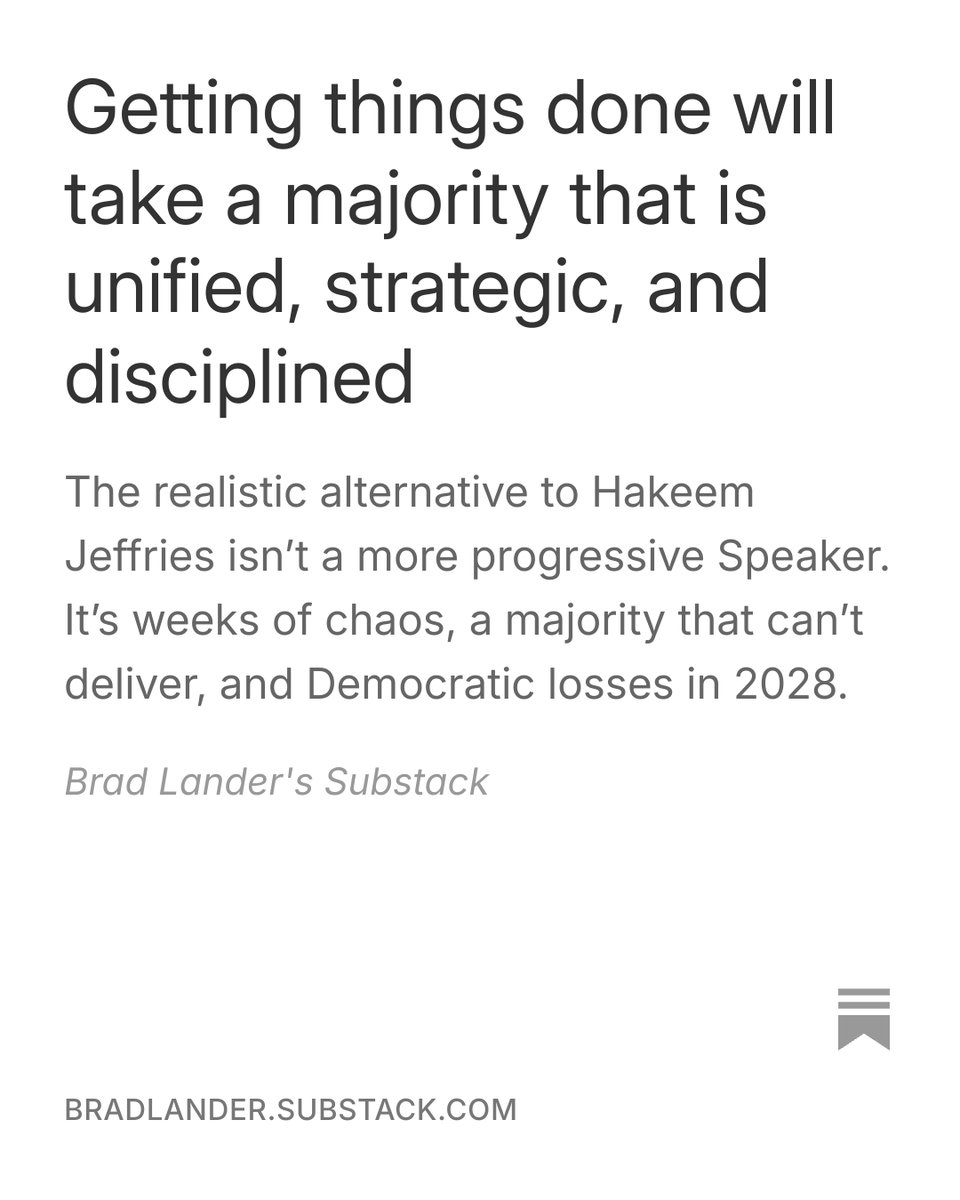
I’ve received a good deal of correspondence from constituents expressing opposition to Hakeem Jeffries serving as the next Speaker. I take this outreach seriously. Here’s the email I sent to my neighbors explaining my decision to support him. https://t.co/9JnJhreZ3w
I’m not even a Schumer guy (feel free to do a search on my past tweets about him lol) so I can’t believe I’m the one laying this all out, but everyone seems to have memory holed this period, so here goes nothing.
From 2021-2022, when Democrats held 50 seats in the Senate (with VP Harris as a tiebreaker) — so they had zero votes to spare — Schumer got 97 federal judges confirmed to the bench (including Ketanji Brown Jackson to the Supreme Court) and shepherded the following bills through to passage on their way to becoming law.
You can argue that these didn’t go far enough, he had the wrong priorities, that Build Back Better was a flop, etc. But it is objectively damn impressive that he was able to get all of these through with literally no room for error:
American Rescue Plan ($1.9T)
Huge economic stimulus package in the midst of the pandemic — provided $1,400 stimulus checks to eligible Americans; expanded unemployment & child tax benefits; funded schools, hospitals, small businesses, local governments, and COVID-19 vaccinations and testing.
Infrastructure Investment and Jobs Act ($1.2T)
Repaired roads and bridges, invested in public transportation and passenger rail, expanded broadband internet access, funded improvements to airports and ports, invested in electrical vehicle charging stations & upgraded drinking water systems.
CHIPS and Science Act
Provided over $50B in incentives to build more computer chip factories in the U.S. and research funding for semiconductor manufacturing to reduce our dependence on Chinese chips.
Inflation Reduction Act
Allowed Medicare to negotiate prices for certain prescription drugs, capped Medicare beneficiaries' insulin costs at $35 per month, extended Affordable Care Act health insurance subsidies, offered tax incentives for electric vehiclesand clean energy, created a 15% minimum tax on certain large corporations, increased IRS funding to improve tax enforcementand collections.
PACT Act
Expanded healthcare coverage for veterans exposed to burn pits and toxic chemicals, made it easier for veterans to qualify for disability benefits, and added more VA healthcare facilities and resources.
Bipartisan Safer Communities Act
Expanded background checks for gun buyers under 21, provided federal funding for state crisis intervention programs, invested in school security and mental health services.
Respect for Marriage Act
Protected federal recognition of same-sex and interracial marriages and required states to recognize valid marriages performed in other states.
NEW DATA: We rolled out “SMART” to cut flight delays and help air traffic controllers, and it’s WORKING 🛫
Early results:
- 10+ minutes saved per flight
- 180 flights rerouted around congestion (24,000 travelers)
- 80 gallons of fuel saved per trip
Soon this technology is going NATIONWIDE, read more in replies ⬇️
Number of ethnic Russian men in Russia under 30 has dropped from ~28 to ~16 million since 1989, headed to 10 million in 2050. Complete demographic collapse of the people who briefly ruled a third of our planet.
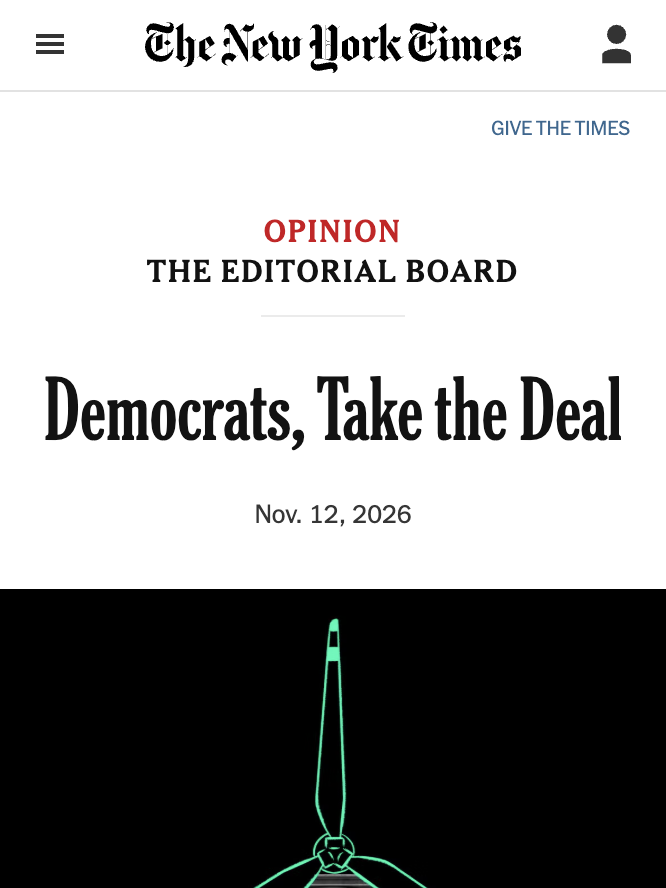
Very glad to see the NYT editorial board endorse BAAJA, the bipartisan permitting reform bill.
Key points from the article:
1. "Democrats who call climate change an emergency should not defend a permitting system too slow to build the clean energy that would address it."
2. "[BAAJA] would make it easier to build solar energy farms, battery storage, power lines and more. As a result, it would reduce energy prices. The status quo is expensive, dirty and unstable. The country needs to build a lot of big, new things to make its future cheaper and cleaner."
3. "The bill’s Democratic skeptics are making a mistake. President Trump would almost certainly veto a follow-up bill next year. And time matters, especially for the climate. Congress should pass this bill now. It can then return next year and pass other bills that would do even more good."
4. "Today, it typically takes between 5 and 13 years to build a long-distance power line, like the one that transports clean hydropower from Quebec to New England. That line took about a decade to finish, and opened in January. It has enough capacity to meet about one-fifth of Massachusetts’s electricity demand, and it’s projected to save consumers $50 million a year."
5. "A more robust, cleaner grid would make American energy more reliable and less dependent on hostile foreign nations. No country can embargo the wind."
6. "[BAAJA] would force data center operators to pay the full costs of the electricity they use, protecting the average electricity consumer."
7. "On net, the bill would cut greenhouse gas emissions from power plants by as much as 18 percent by 2040. It would do so in part by nearly tripling the construction of high-voltage transmission lines."
8. "Anyone who cares about climate change should cheer this bill. And a party that just won an election on affordability should not pass up a chance to start delivering immediately."
@jonathanchait I’m in agreement but I would note in defense of progressives that the distance between the two wings of the Democratic Party is also smaller. That’s good but as is often said about academia, the fights are nasty bc the differences are trivial
@MattBruenig I believe in M4A on the merits. But I believe in a lot of things on the merits. I also believe the senate should hold votes on bills that either can pass, or else unite Democrats and embarrass Republicans. It’s pointless to randomly demand votes on stuff that splits the majority.
@ASFleischman@acmisthinking "Genocidal settler colonial apartheid"? Is this leftist MadLibs? They really don't understand the relationship between language and persuasion and how devaluing words diminishes their argument.
@J__Davenport@mattyglesias . . . the costs and sacrifices we have to make for that policy is where I think the real mendacity is. Recognizing that once you do that, you will lose 90% of support for universal health care, means tailoring what you say that will move in that direction, even if it takes years
@J__Davenport@mattyglesias We may have different definitions of "right policy." Let's assume "universal health care" is something we both support. That's not a policy. There are many different ways to get there, and a real policy will inform people what they will sacrifice. Failing to point out . . .