Mr Allan’s top tips for achieving your target grade:
Attend class. 🏫
Pay attention. 🎯
Do the homework. ✏️
Ask for help. 🙋♂️
Catch up if you are absent. 🤒
Let’s call this “Allan’s Principles of Effective Learning”. The book will be out by Christmas.
Fraction division can make more sense when we focus on the division models
(Okay the title doesn't sound that attention-grabbing but I like this video)
@MrMac_Math It absolutely is a curriculum problem. But this type of thing is being worked on in Scotland. Time will tell if there’s going to be a change in practice.
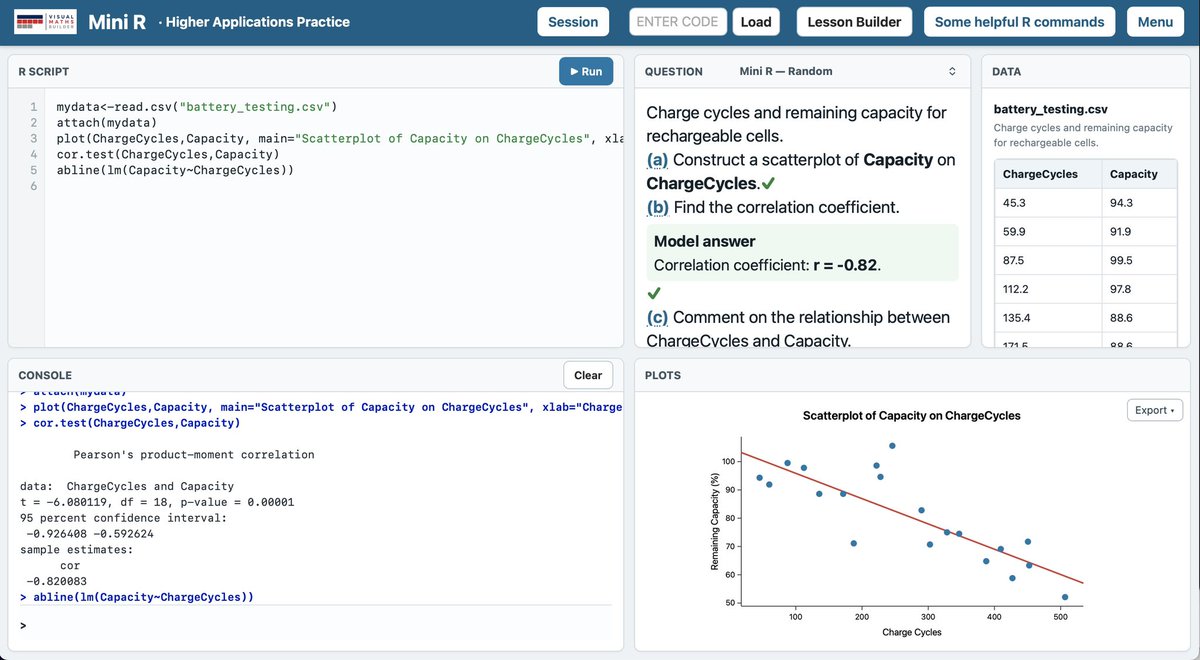
It looks like 2, maybe 3, classes of pupils across Scotland used Mini R today. That’s a huge jump in numbers for Mini R. Have you used it yet?
https://t.co/00H9iLZ1TR
#HigherApps
@tmgclEd Some schools expect students to learn higher apps using iPads. Exams need to be completed using full R Studio on a desktop computer (as far as I know), but Mini R provides a great way to practise. I’m really excited to hear how people are using it and how they are finding it.
Please share/RT.
Higher Apps teachers will be amazed at how useful this is, especially if their pupils don’t have access to computer suites or are trying to use iPads. Mini R works well on iPads and is excellent on laptops. Give it a go. 👇
https://t.co/iVj8mVha5t
Back to school this week?
If you teach Higher Applications of Maths, take a look at Mini R.
Simulate R Studio via a web page.
You can use it on any device.
No logins.
No ads.
Free to use.
@mrallanmaths Running an R-style environment in the browser removes two common barriers: software installation and access to computer suites. That should make simulation and data work easier to use in Higher Applications lessons.
@UnofficialOA@dare_richard The school I worked at during the 2019-20 fidget spinner fad added “allowed to use a fidget spinner” to the support profiles for tens of pupils. Giving out fidgets sounds like a plausibly good thing until one actually thinks about it.
5yo: “How does a horse say no?”
2yo: “…”
5yo: “Neigh chance!”
2yo: “…”
Later…
5yo: “What does a horse say?”
2yo: “Neigh, no chance!”
5yo: “… What does a cow say?”
2yo: “Moo, no chance!”
@stphnpc@adamboxer1 I’m not expecting anyone to implement all 10, but there should be enough ideas for everyone to pick one thing to work on. I think it’s easy to fix a lot of behaviour by removing lots of triggers. Eg use FLMOP —> reduce calling out.
@stphnpc@adamboxer1 I’m going to be running a workshop for teachers in my school focusing on 10 simple things teachers can do in their next lesson to massively improve the chances that students will do what the teacher wants them to do. FLMOP is on that list. Along with many ideas stolen from Adam.
Low level disruption is still rife.
We know this. The evidence tells us students are routinely calling out, answering back, and chatting in class.
Policy makers seem not to care. I do. The problem is easily fixable, and its a disgrace that we aren't doing it.