The engine of nature is grinding to a halt in face of unrelenting attack by humans and climate change
“Nature functions like a self-repairing engine, constantly swapping out old parts for new ones. But we found this engine is now grinding to a halt.”
https://t.co/GcLzDpnS7c
I’ve made a short film.
Look at the things around you: doors, bins, staircases, furniture, railings, doorhandles, windows.
Do you like how they look, or not?
Modern design has become boring, but it doesn’t have to be this way.
The word “beautiful” is overused. We don’t need “beautiful” lamps, bus stops, and water fountains – we just need lamps, bus stops, and water fountains that are interesting, that actually mean something.
Or, at the very least, not boring.
Because the aesthetics of architecture and urban design aren’t just a bonus; they totally change how we think, feel, and behave.
Boring environments make us more stressed and less productive; they erode our sense of community; they make us sadder, less trusting, and lonelier.
A boring world is one where we spend even more time online and where our addictions are even harder to battle.
The Problem
There is global, widespread dissatisfaction with how the world looks. In this film, and the series it will lead to, we want to investigate that feeling and give it a voice.
The point isn’t that we should return to the past or get rid of modernism. It’s about learning from the past in order to improve the present, and about giving the public what they very clearly want, which isn’t the eradication of modernism but the co-existence of modernism AND traditionalism.
Just look where tourists go, where they take their photos, and that tells you everything you need to know about what most people find interesting or beautiful.
And look at where people go on holiday. It’s always to cities filled with old architecture and design, with churches and mosques and palaces, with charming little alleyways and stone staircases and wrought-iron railings.
Of the world’s fifty most visited buildings, only four were made in the 20th century, and they’re all museums or memorials.
There’s a reason why posts about this go viral online all the time. Regardless of why the change happened, it is clearly the case that we no longer make things how we used to.
People are rightly confused by the fact that old lamp posts (to take the example we focus on in the film) are usually so pretty, while modern ones are usually so boring.
Some people say this is just an example of survivorship bias… and they’re mostly correct. But that’s the whole point!
Saying old buildings are usually prettier than modern buildings is not to say that architecture used to be better, or that the past was better.
It is simply to say that certain kinds of buildings, because they have been preserved, are good examples of what people like most.
In which case... shouldn't we try to design at least some buildings in a way that we know people like?
A Unifying Cause
Everybody, from all sides of the political spectrum and all backgrounds, stands to benefit from a world that is designed more thoughtfully and imaginatively. The world could be such a colourful, meaningful, and thrilling place!
So this isn’t about left versus right or conservatism versus progressivism; it’s about making our world a more interesting and meaningful place to live in. This should be a unifying cause, because everybody loses out when our homes and cities are badly designed.
I want this film to unite people who think they’re on opposite sides, and to create a consensus that we need to change our approach to how we design our buildings and the objects – benches, bus stops, bins, lamp posts, aircon units – that fill our cities.
The Importance of Details
We are incredibly rich and have a sprawling choice of shows to stream, phones to buy, or shoes to wear… but everything feels more and more generic all the time.
If you want to understand a society, don’t listen to what it says about itself – look at what it creates. You can learn everything about the Victorians – the good and the bad – just by looking at their lamp posts.
And what do the ordinary details of the modern world say about us?
That we are technologically advanced, very efficient… and care more about making money, about making things as quickly and cheaply as possible, than making our world an enjoyable place to actually live in.
It’s important to learn about why and how things have changed, but that’s for another time. The first step is establishing that the public aren’t happy with modern architecture and design, and that something needs to be done.
But what we need isn’t a total revival of so-called ‘traditionalism’; the truth is that traditionalism and modernism can (and should) co-exist.
The trouble right now is that we only have one, and that people are tired of it.
The Power of Noticing
But this film (and the series it will, all being well, lead to) is about more than the specific argument it presents. Above all it’s about a way of seeing the world around us, a way of noticing and thinking.
“How you do anything is how you do everything.” That is probably true, and it also applies to whole societies, not just individuals; a single doorbell implies everything else about the whole socio-economic and political system that gave rise to its creation.
And, beyond being merely “useful”, the ability to notice details makes the world a richer place to live in, and life a richer thing to lead. This is what the film is about, more than anything: the power and joy of noticing.
A Bigger Project
This short film is just the beginning. We want to make a full series about the history of art and architecture, both for their own sake and also to see what we can learn about life in the twenty-first century and how to improve it. To keep updated you can join our email list over at our website, linked in the reply below.
Final Words
You can watch the film here on X, or over on YouTube, also linked in the reply below.
So… this is where the dream begins, the dream of a new series and the dream of a more charming, more interesting, more meaningful modern world.
Spread the word.
Is there another way the world could be run?
Here are 5 things to know about the @UN’s landmark Summit of the Future:
#OurCommonFuture
https://t.co/wu6M41tWyg
Climate-related risks are higher for #globalwarming of 1.5°C.
🦒 3 to 14% of the tens of thousands of species assessed will likely face a very high risk of extinction at a global warming level of 1.5°C.
More on the risk of species losses beyond 1.5°C ➡️ https://t.co/zAMzd12lR7
"Ukraine Russia war: US House passes crucial Ukrainian aid deal worth $61bn." This aid would prolong war but it is unlikely to change war outcome, because Russia still would have significant advantage in manpower, artillery, aviation, tanks, drones, missiles, electronic warfare & financial resources. https://t.co/NdgAkR3957
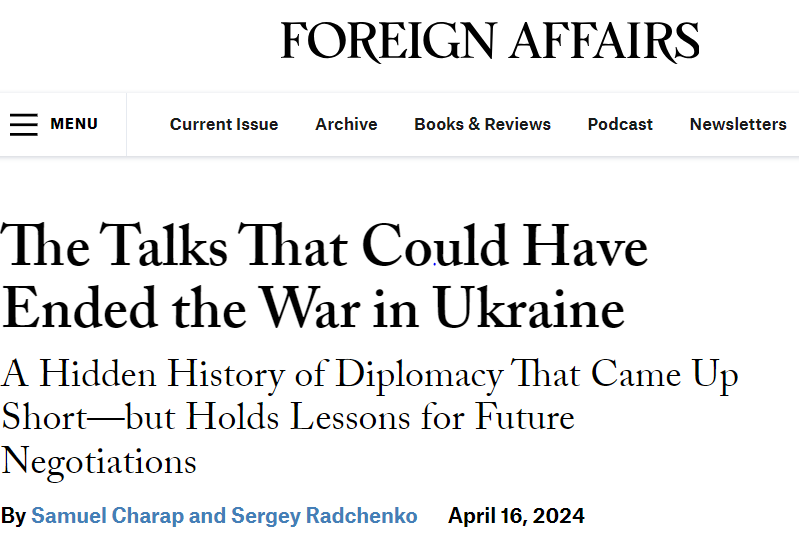
Foreign Affairs writes about the "hidden history" of diplomacy that could have ended the war.
It was not "hidden"! The media refused to report on verifiable facts & smeared anyone who discussed it as "Putinists" and "propagandists"
Why did the media fail to report on the following:
- On the first day after Russia invaded, Zelensky confirmed that Moscow contacted them to negotiate peace based on neutrality
- On the third day after the invasion, both Moscow and Kiev confirmed negotiations would start based on restoring Ukrainian neutrality.
- The US spokesperson, Ned Price, argued the US could not support the peace negotiations as this war was much greater than Ukraine
- The Israeli and Turkish mediators at the negotiations confirmed they were close to an agreement as Russia would compromise on everything besides neutrality / end of NATO expansionism, but the US and UK blocked it as they saw an opportunity to weaken Russia by fighting with Ukrainians
- The head of Zelensky's political party confirms there was a deal, and the former advisor of Zelensky also confirms there was a deal but the Americans could get the Russians and Ukrainians to fight each other.
- Ukrainian ambassador Chalyi who participated in the peace negotiations argues Putin "tried everything" to get a peace agreement and they were very close to a deal before it was postponed
- General Harald Kujat, former head of the German Army and Chairman of the NATO Military Committee, argues a deal reached before the US and UK sabotaged it by telling Zelensky they would not support the peace agreement but would give him all the weapons he needed to defeat Russia on the battlefield. According to Kujat, the US and UK saw an opportunity to kill Russians and thus weaken a strategic rival
This has been an amazing propaganda campaign, appealing to the best in humanity to do the worst. They provoked a war and sabotaged all paths to peace to fight Russia to the last Ukrainian, and they sold it to the public as "supporting" and "helping" Ukraine. Almost every "pro-Ukrainian" policy since the coup in 2014 failed to have support from the majority of Ukrainians and always ended in tragedy for their nation.
- The only reason we are now allowed to speak about the negotiations is that NATO has run out of Ukrainians and the war is lost. The public must therefore be prepared for a settlement after two years of claiming that Ukraine is winning while refusing to even sit down and talk with Russia. Absolutely disgusting and shameful!
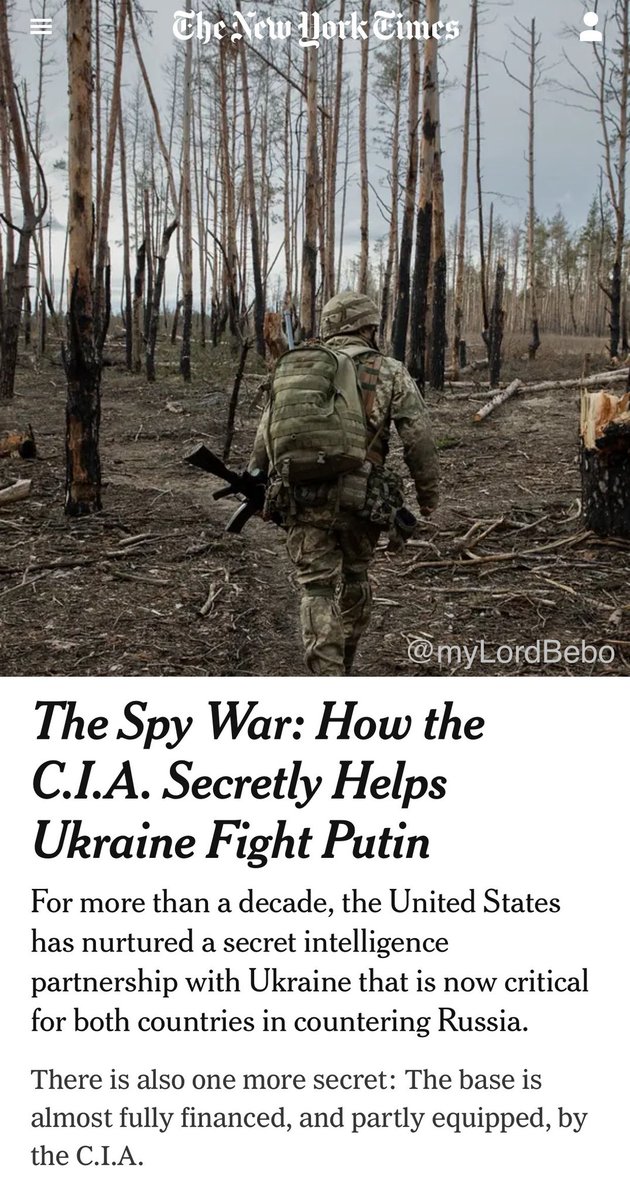
The New York Times reports on America's secret war against Russia since Maidan in 2014:
- On the eve of the US-backed coup in Ukraine, 24 February 2014, the new spy chief of the US-installed government in Kiev "called the C.I.A. station chief and the local head of MI6... and proposed a three-way partnership"
- The partnership "is no wartime creation" as it "took root a decade ago"
- Since the coup, Ukraine's intelligence agencies were transformed into "Washington’s most important intelligence partners against the Kremlin"
- "A C.I.A.-supported network of spy bases constructed in the past eight years that includes 12 secret locations along the Russian border"
- Secret bases established "fully financed, and partly equipped, by the C.I.A."
- "Around 2016, the C.I.A. began training an elite Ukrainian commando force — known as Unit 2245 — which captured Russian drones and communications gear so that C.I.A. technicians could reverse-engineer them and crack Moscow’s encryption systems"
- "That initial tranche contained secrets about the Russian Navy’s Northern Fleet, including detailed information about the latest Russian nuclear submarine designs. Before long, teams of C.I.A. officers were regularly leaving his office with backpacks full of documents"
- The CIA used their secret bases in Ukraine to "track Russian spy satellites and eavesdrop on conversations between Russian commanders"
- "The C.I.A. also oversaw a training program, carried out in two European cities, to teach Ukrainian intelligence officers how to convincingly assume fake personas and steal secrets in Russia"
- The CIA directs attacks on Russian cities such as Rostov
- "The C.I.A. and other American intelligence agencies provide intelligence for targeted missile strikes"
https://t.co/8ROIc2umo5
🆕 UN Climate Change report 🆕
A new report summarizing countries' national climate plans (#NDCs) shows that current commitments remain insufficient to limit global temperature rise to 1.5°C by the end of the century.
#COP27 | #ClimateCrisis
This basically sums up our current situation. The “code red” IPCC report came out a week ago. Since then not one politician has been held accountable. Not one politician has been asked how they are going to act in line with this. 1/4
(Graph by @Peters_Glen )
The press conference to present the Summary for Policymakers of #IPCC’s next #ClimateReport, Climate Change 2021: the Physical Science Basis, will be held via livestream at 10am CEST on 9 August.
Read more ➡️ https://t.co/vyY5AfYjJz
Livestream ➡️ https://t.co/40X0Fv6E99
The months leading up to #COP26 must not be a time of inaction.
"We don’t have to wait for international agreements on the climate and nature crises," the alliance states. "Change can happen now." @commondreams
https://t.co/4lfn4VwMwi
To prevent and address #ViolentExtremism, we need to prevent and address all drivers of fragility – including #ClimateChange. See how we work with partners around the world to tackle the climate crisis and conflict together. https://t.co/RgX5ps2JZ9
#ClimateChange impacts food security in 2 ways. 👇
1️⃣'Climate shocks', which cause widespread losses and damages to #FoodSystems
2️⃣ 'Climate stresses’ such as rising salinity in soils water, rising incidents of pests & diseases, or growing heat stress.