Israeli Watchdog Reveals Record-High 58% of Anti-Christian Attacks in the Old City of Jerusalem Target the Armenian Quarter 🇦🇲
➖➖➖
The Religious Freedom Data Center (RFDC) has published its quarterly report, "Incidents Against Christians in Israel," documenting 106 acts of harassment across 96 incidents between July and September 2026. According to the report, 45 of the 77 incidents recorded inside Jerusalem's Old City occurred on Armenian Patriarchate Street, in the heart of the Armenian Quarter. This was reported on X by Kegham Balian, a Jerusalemite Armenian, who said the figure is a record high.
That 58 percent is up from half in RFDC's April to June 2025 report, when the Armenian Patriarchate was already the single most frequently targeted Christian site in Jerusalem. The Armenian Quarter is one of four quarters in the Old City.
The incidents included spitting, physical assault, throwing objects, verbal abuse, threats, defacement of signage, and vandalism. Of the 106 recorded acts, 77 involved spitting, 9 verbal abuse, 5 vandalism, 4 physical assault, 3 throwing objects, 3 defacement of signage, and 1 a threat. Another 4 were categorized as "other."
Jerusalem accounted for 88 of the 96 incidents, or 92 percent. Within the city, 77 took place inside the Old City (88 percent), 7 at other Jerusalem locations (8 percent), and 4 on Mount Zion (4 percent).
Inside the Old City, Armenian Patriarchate Street led with 45 incidents (58 percent), followed by Via Dolorosa with 18 (24 percent) and other Old City locations with 14 (18 percent).
Outside Jerusalem, 4 incidents were reported in northern Israel (4 percent), 2 at airports (2 percent), and 1 each in Holon and Jaffa (1 percent each).
The report singled out the Armenian community's exposure. "The Armenian community suffers particularly severely," it said. "Thousands of people walk through its streets on their way to the Western Wall, and it has the highest number of documented incidents of harassment. Regrettably, the community has received no specific attention, response, or action plan to put an end to its suffering."
RFDC identified the pepper-spray attack on a 9-year-old Armenian boy, logged as case 75, as the culmination of an escalation in attacks. The boy was sprayed in the face in Mamilla, outside the Old City walls, by a 22-year-old Israeli Jewish settler from the West Bank settlement of Ganei Modi'in. "If the punishment does not reflect the gravity of the act, the incident may send a message of tolerance toward religiously motivated violence, reinforce perpetrators' sense of impunity, and encourage further attacks," the report said. The settler was released on October 4 with a restraining order and four days of house arrest while the case proceeds.
During the quarter, RFDC filed 35 police complaints, most supported by photographs or video footage identifying the harassment, the suspects, or both. In the previous quarter, 12 police cases were opened, of which 10 were closed. In its April to June 2025 report, RFDC recorded that of 22 cases filed with Israeli police since January 2025, only 2 had been transferred to prosecution, 6 had been closed, and 14 remained without any status update.
The report documented clergy and monks leaving their institutions in ordinary clothes and community members concealing necklaces bearing crosses beneath their clothing. In informal conversations with clergy, RFDC said it repeatedly hears the same statement: "Not a week goes by without someone spitting at me." The Center estimated that dozens of additional spitting incidents occur each month without being reported, documented, or countered, and said such acts have become established as a norm among perpetrators. In some cases, it noted, perpetrators justified their actions to RFDC volunteers, and on camera, as consistent with religious injunctions.
RFDC called on the Jerusalem Municipality to address the absence of visible Christian representation in public space, noting that from the Municipal Compound to Jaffa Gate the public sphere prominently reflects Jewish presence through posters, holiday greetings, and projections of images and films onto the city walls. It said signage at the entrance to the Armenian Quarter via Armenian Patriarchate Road should indicate that visitors are entering a Christian quarter and present its historical, religious, and cultural significance.
Volunteers were deployed on field shifts throughout the Old City during the Tisha B'Av fast and the Jewish High Holidays, which the report said doubled the number of documented incidents compared with the same periods in previous years. Following the April attack on a nun on Mount Zion, RFDC volunteers accompanied nuns every morning and evening, six days a week, for four consecutive months. The escorts ended recently when the nuns felt safe walking without one.
While the report was being prepared, prosecutors filed an indictment against a person who spat at a church entrance on July 25, 2025. RFDC urged the court and prosecution not to dilute the case through a plea bargain, calling instead for a judgment that establishes a clear principle and is publicized in the media.
The RFDC is an independent initiative founded in July 2023 by Yisca Harani, an Israeli activist, scholar, and expert in Christian history and interfaith relations. It is funded and operated exclusively by private citizens, without governmental or political affiliation, and runs what it describes as Israel's largest volunteer network providing real-time assistance to the Christian community. The Israel Religious Action Center provides legal assistance on complaints RFDC files with police, and the Institute for the Study of Relations between Jews, Christians and Muslims at the Open University, headed by Prof. Denis Charbit, supports its work.
The Armenian community of Jerusalem traces its origins to the 4th century and has maintained an uninterrupted presence in the Holy Land for 1,700 years, the oldest living Armenian community outside Armenia. It now numbers approximately 2,000 Jerusalemite Armenians, a population that has declined sharply since 1948.
Azerbaijan is taking its state-sponsored “Western Azerbaijan” expansionist agenda to the United States, presenting a book about Yerevan, the capital of Armenia, as part of its historical falsifications.
The author, Professor Farida Safiyeva, is head of a department at the Azerbaijan State University of Culture and Arts and chairs the Yerevan City Community of the “Western Azerbaijan” Community. The book is a clear example of state-sponsored publication, and this is just one small part of Azerbaijan’s broader expansionist agenda.
This state-sponsored agenda undermines President Trump’s and US efforts to mediate peace in the South Caucasus.
The Islamic regime in Iran has sentenced 23-year-old student Najmeh Amini to death for the ‘crimes’ of demanding freedom, criticizing Islam and ‘insulting’ Muhammad online.
UN Women has not said a single word about her or other women persecuted by the Islamic regime.
“The Armenian genocide of 1915 has been well documented. Much less known is the Turkish genocide of the Assyrian, Chaldean and Syriac peoples, which occurred simultaneously in their ancient homelands in and around ancient Mesopotamia -- now Turkey, Iran and Iraq.
“The advent of the First World War gave the Young Turks and the Ottoman government the opportunity to exterminate the Assyrians in a series of massacres and atrocities inflicted on a people whose culture dates back millennia and whose language, Aramaic, was spoken by Jesus.
“Systematic killings, looting, rape, kidnapping and deportations destroyed countless communities and created a vast refugee diaspora. As many as 300,000 Assyro-Chaldean- Syriac people were murdered and a larger number forced into exile.
“The 'Year of the Sword' (Seyfo) in 1915 was preceded over millennia by other attacks on the Assyrians and has been mirrored by recent events, not least the abuses committed by Islamic State.
“Joseph Yacoub, whose family was murdered and dispersed, has gathered together a compelling range of eye-witness accounts and reports which cast light on this 'hidden genocide.' Passionate and yet authoritative in its research, his book reveals a little-known human and cultural tragedy.
“A century after the Assyrian genocide, the fate of this Christian minority hangs in the balance.” https://t.co/IFdgPzcssj
📚Gandzasar Monastery was built by Hasan-Jalal Dawla. He was an Armenian prince.
Hasan-Jalal Dawla was his Arabic-style royal name. His Armenian name was Haykaz, son of Vakhtang.
Gandzasar is an Armenian Apostolic monastery.
Azerbaijan: This Turkish country has destroyed more Christian monuments than ISIS.
Based off satellite data, Azerbaijan erased 108 Armenian monasteries, churches and cemeteries - in just one region.
By comparison, ISIS destroyed dozens of churches.
How is this okay?
This is how "Western Allies" steal Christian history.
They're calling an Armenian monastery "Caucasian Albanian", linking it to "ancestral Azerbaijanis".
After kicking ancestral Christians out.
If Christendom & Christian powers were strong, this would not be tolerated AT ALL.
Baku is attempting to present Dadivank as part of the “heritage of Caucasian Albania,” while portraying Armenian restoration work as a “distortion of the monument’s original appearance.” But this narrative faces one fundamental problem: Dadivank itself contradicts it.
The monastery preserves medieval Armenian inscriptions, khachkars, and the names of Armenian princes and benefactors. The main church of the complex was built in 1214 by Arzu Khatun, as directly attested by an Armenian construction inscription.
Therefore, explaining Dadivank’s Armenian character as a result of “later Armenianization” is chronologically impossible. These inscriptions and architectural elements existed centuries before the restoration works of the 20th and 21st centuries.
Baku now also accuses the Armenian side of removing crosses, khachkars, bells, and other cultural objects to Armenia in 2020. However, these objects were moved at a time when control over the territory was changing and there were serious concerns regarding the preservation of Armenian cultural heritage.
Those concerns later gained further grounds.
On December 7, 2021, the International Court of Justice ordered Azerbaijan to take all necessary measures to prevent and punish acts of vandalism and desecration affecting Armenian cultural heritage, including churches, monuments, cemeteries, and artifacts.
Yet additional destruction was documented even after that order. Caucasus Heritage Watch, using satellite imagery, documented the complete destruction of the Armenian Church of St. John the Baptist, known as Kanach Zham, in Shushi, the destruction of the Armenian cemetery near the Ghazanchetsots Cathedral, and the loss of other heritage sites.
Against this background, accusing the Armenian side of attempting to save and relocate individual khachkars, crosses, or other objects appears deeply contradictory.
This is not merely a dispute over the fate of a few objects. Khachkars, inscriptions, and ecclesiastical artifacts are material evidence of the Armenian history of these monasteries. Their preservation is therefore of fundamental importance, especially at a time when efforts are simultaneously being made to reinterpret these monuments as “Caucasian Albanian.”
The history of Dadivank is determined not by the statements of today’s officials, but by the primary sources preserved on the monastery itself.
Savez-vous pourquoi la @fia a avancé le Grand Prix d’Azerbaïdjan au samedi ?
Tout simplement pour respecter la soi-disant « journée de la mémoire » de ce pays, mémoire qu’il foule aux pieds en même temps que le droit international.
Soutien au peuple arménien. Boycott ! 🇦🇲🇫🇷
A 12th Kachkar from Artsakh, rescued before the invaders could change history by pretending there were no Armenians there - in the grounds of Holy Etchmiazdin now
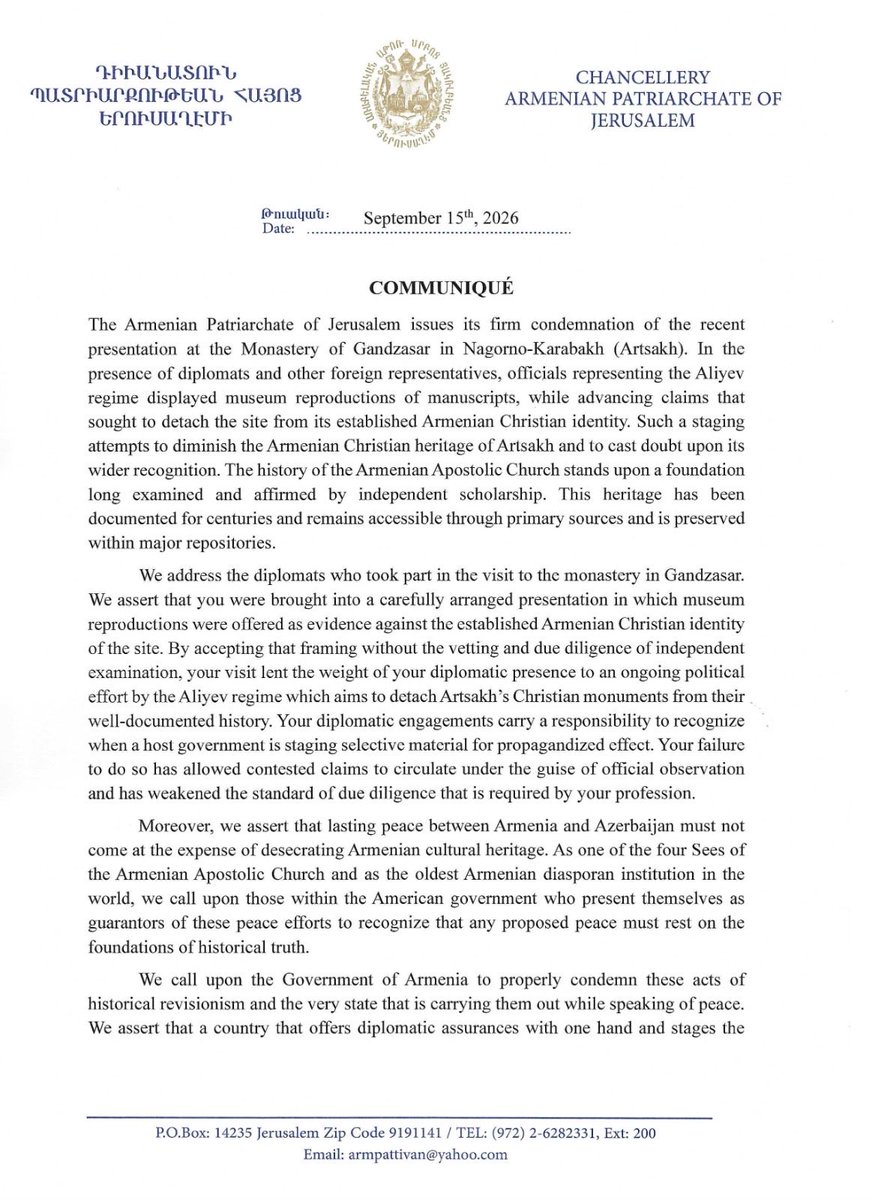
🚨BREAKING: The Armenian Patriarchate of Jerusalem has issued a blistering condemnation of Azerbaijan and Armenia, as well as international diplomats whose presence it says legitimized the systematic erasure of the Armenian Christian identity of Gandzasar Monastery in Artsakh.
Call it Albanian, Mesopotamian, Babylonian, whatever helps you sleep at night.
Just don’t destroy medieval churches and cultural heritage in the process.
Three years ago Azerbaijan carried out ethnic and religious cleansing in Nagorno-Karabakh. No Armenians remain there.
Azerbaijani Ombudsperson Sabina Aliyeva dismissed human rights defender Siranush Sahakyan’s allegations of torture and religious discrimination against #Armenian prisoners as “groundless,” portraying them as a threat to the peace process.
However, an official denial alone is not enough. If Baku is confident that the allegations are false, the Azerbaijani authorities should provide independent international monitors, lawyers and doctors with regular and unhindered access to the prisoners. They should also publish the findings of independent medical examinations—with the prisoners’ consent.
Moreover, footage released by Azerbaijani media itself raises serious concerns about the condition of the #Armenian detainees. The visible deterioration in the appearance of former Nagorno-Karabakh President Bako Sahakyan and businessman and philanthropist Ruben Vardanyan is particularly alarming. In Sahakyan’s case, apparent dental problems were also clearly visible. These circumstances require an independent investigation, not propaganda statements.
The ombudsperson’s references to inspections conducted by the institution she herself heads cannot replace independent international oversight. If Azerbaijan truly has nothing to hide, the solution is simple: allow independent experts to visit the prisoners and speak with them confidentially, without pressure or the presence of government representatives.
Armenian hostages illegally held in Azerbaijan have been subjected to torture targeting their Christian identity, including having crosses tattooed on their bodies burned from their skin, human rights lawyer Siranush Sahakyan said.
“There have been cases where hostages were forced to read the Quran. If there was a cross tattooed on the body, it was removed through torture,” Sahakyan said.
Sahakyan, president of the International and Comparative Law Center and legal representative of Armenian hostages before the European Court of Human Rights, said the targeting of Christian identity has also included denying Bibles and confiscating religious symbols.
She first raised the issue publicly in January, saying Bibles had been prohibited for Ruben Vardanyan and other Armenian hostages even though other books were allowed, and that Christianity itself had become a factor in their treatment.
The abuse extends beyond religious persecution. Sahakyan said Armenian hostages have suffered fractures as a result of beatings, while concerns remain over deteriorating health and inadequate medical care. Medical personnel are not present at the detention facility at all hours, and treatment in serious cases is often limited to medication that temporarily eases symptoms rather than addressing underlying conditions.
The hostages also remain largely cut off from independent outside contact, without physical access to relatives, independent doctors, lawyers, consular representatives or the International Committee of the Red Cross.
The torture targeting Christian symbols comes against the backdrop of the destruction and alteration of Armenian Christian heritage across occupied Artsakh, where churches, cemeteries and other religious sites have been destroyed, damaged or stripped of their Armenian identity under Azerbaijani control.
Attorney Siranush Sahakyan Reveals Armenian Hostages In Baku Have Had Their Christian Cross Tattoos Burned Off, Been Forced To Read The Quran, Suffered Beatings, & Are Held In "Absolute Isolation"
➖➖➖
Attorney Siranush Sahakyan, representative of Armenian hostages before the European Court of Human Rights, disclosed on Thursday that Armenian Christian citizens unjustly imprisoned in Baku have had their Christian cross tattoos burned off their skin through torture, been forced to read the Quran, suffered fractures from beatings, and are held in "absolute isolation" from other prisoners. Her disclosures represent the most detailed public accounting yet of the torture, religious persecution, and psychological pressure that the former Artsakh military and political leadership have endured in Azerbaijani custody. Sahakyan also confirmed that the European Court of Human Rights has officially communicated her application in the case of former Artsakh State Minister Ruben Vardanyan to the Azerbaijani government, advancing the case into full examination.
Sahakyan made the disclosures during a wide-ranging press briefing that touched on the physical and religious torture of the hostages, the legal absurdity of the Azerbaijani charges against them, the diplomatic effort by Armenia to secure third-country consular assistance for its citizens, and the international legal strategy she is now coordinating on their behalf.
The physical evidence of torture is documented and specific. Sahakyan said Armenian hostages have arrived at proceedings with fractures consistent with beatings, and that Christian cross tattoos, common among Armenians as expressions of religious identity, have been burned off the skin of prisoners held in Baku. Armenian Christian hostages have also been forced to read the Quran, while Bibles have been prohibited even as other books have been permitted, and religious symbols have been confiscated. The burning of Christian religious tattoos and the coerced reading of the Quran on the bodies and in the daily lives of Christian prisoners in Azerbaijani custody constitutes both physical torture and religious persecution under international humanitarian law. It fits a broader pattern of Azerbaijani targeting of Armenian Christian identity that has included the systematic destruction of Armenian churches, khachkars, and cultural heritage across occupied Artsakh and, before that, across Nakhichevan.
Sahakyan first raised the prohibition on Bibles publicly in January 2026, saying at the time that religious targeting of Vardanyan and other Armenian hostages was already evident. Thursday's disclosures represent the most detailed picture yet of the pattern. She said the abuse has been documented by the U.S. Commission on International Religious Freedom, which cited Azerbaijan's violations of the religious rights and freedoms of Armenian captives in its most recent annual report, and by the UN Committee Against Torture, which has explicitly addressed the torture of Armenian hostages. Sahakyan noted that international documentation of the religious targeting undercuts any Azerbaijani denial.
The hostages are held in what Sahakyan described as "absolute isolation," a condition confirmed by the International Committee of the Red Cross during the period when the ICRC still had access to the prisoners, before Azerbaijani authorities expelled the ICRC delegation office from Baku in September 2025. The hostages are separated from other prisoners, restricted in family contact, and denied access to independent legal counsel, independent doctors, and any humanitarian monitoring. Their only contact with the outside world is monitored telephone calls. Three of the sentenced hostages are permitted to call approximately once every 40 days. The rest are permitted one call per week. Individual calls range from two or three minutes to as long as ten minutes, and every call is monitored, with calls forcibly interrupted based on their content. Vardanyan's own phone call was cut off when he attempted to discuss difficulties obtaining a copy of his verdict. Family visits, correspondence, packages, and short and long-term visits, all standard rights under Azerbaijani prison law, are denied to the Armenian hostages. Sahakyan characterized the isolation regime as a deliberate psychological pressure tactic, designed to break the hostages' resistance and to obstruct their ability to prepare international legal petitions.
Sahakyan drew a direct connection between the treatment of individual hostages and the political calculation behind their detention. She said the former Artsakh military and political leadership hold significantly greater "hostage value" for Azerbaijan than ordinary civilian prisoners, which is why negotiations for the leaders' release have stalled even as some civilian prisoners have been released in earlier exchanges. The Artsakh leaders, in Baku's political calculus, are bargaining chips of a higher order.
The most detailed portion of Sahakyan's briefing addressed the Vardanyan case, which she filed with the European Court of Human Rights on July 19. On Thursday, she confirmed that the court has now officially communicated the application to Azerbaijan, meaning Baku is required to respond formally and the case has advanced into full examination. The step is a significant procedural escalation, moving Vardanyan's case from filed to actively adjudicated in Strasbourg. The Vardanyan filing is separate from another mass ECHR application Sahakyan filed on August 21 on behalf of the fifteen other former Artsakh leaders and hostages sentenced by the Baku Military Court, in a case that runs to 422 volumes and roughly 105,000 pages of documentation.
The Vardanyan verdict itself, running to approximately 100 pages and only fully released to his defense team after his sentencing, contains what Sahakyan described as unprecedented violations of due process and factual claims that collapse under any scrutiny. Vardanyan was convicted, in part, on the finding that he joined an Artsakh "criminal community" in December 2020, at a time when he was living in Moscow and had no operational role in Artsakh. He was further charged with financing terrorism on the basis of his philanthropic activity, which included, in one specific example cited in the verdict, his financing of the Great Artsakh Wedding, a mass Armenian wedding celebration held as a public philanthropic event, which Azerbaijani prosecutors treated as evidence of criminal conspiracy. His entry into Artsakh through the Lachin Corridor, then the only route open to Armenians reaching their homeland during the Azerbaijani blockade, was characterized as illegal crossing of Azerbaijan's state border.
Sahakyan also disclosed that Armenia has begun negotiations with third countries to secure consular assistance for the Armenian hostages, an unusual diplomatic step made necessary by Azerbaijan's refusal to permit Armenian consular access to its own imprisoned citizens. Under the Vienna Convention on Consular Relations, when a detainee's home state cannot provide consular protection, a third state may be authorized to do so. The Armenian effort to secure such arrangements signals the depth of Azerbaijan's obstruction and the extent to which Yerevan has been forced to work through international mechanisms rather than direct bilateral channels.
Sahakyan concluded her briefing with a public appeal to international lawyers, human rights scholars, academic institutions, and legal defenders of conscience to engage with the hostage cases. She called for international legal briefs, academic research, and expert testimony to be brought to bear on the ECHR proceedings and on the broader effort to document Azerbaijan's treatment of the Armenian hostages as an ongoing violation of international humanitarian law. The appeal reflects a coordinated strategy of moving the cases beyond Armenian and diaspora advocacy into the mainstream of international human rights practice.
Thursday's disclosures follow a series of statements from the hostages themselves that have progressively exposed the Azerbaijani judicial and detention system. In May, Vardanyan marked his 58th birthday in captivity with an address to the Armenian people accusing the Armenian government of doing nothing in any organized way for the hostages. In the same period, former parliament speaker Davit Ishkhanyan issued a statement accusing the Armenian government of not wanting Baku to free the hostages at all. In July, Zonabend, Vardanyan's wife, sent open letters to Azerbaijan's Human Rights Commissioner, ICRC President Mirjana Spoljaric Egger, Armenian Prime Minister Nikol Pashinyan, and EU High Representative Kaja Kallas to advance a women's humanitarian delegation to Baku. Late last month, former Artsakh Foreign Minister David Babayan revealed that the Baku appeals court had upheld the sentences of the Artsakh leadership in a proceeding he called a "theater with the script written in advance," and confirmed that all seven of the former Artsakh leaders sentenced by Baku are preparing to petition the European Court of Human Rights.
Vardanyan is one of 19 Armenian hostages currently held in Azerbaijan, seized in September 2023 when, following a nine-month blockade and a military assault on occupied Artsakh, Azerbaijani forces detained members of the region's former military and political leadership in the days surrounding the ethnic cleansing that forced the entire Armenian population from their homeland. Five former Artsakh leaders are serving life sentences: former President Arayik Harutyunyan, former Foreign Minister David Babayan, former National Assembly Speaker Davit Ishkhanyan, former Defense Army commander Levon Mnatsakanyan, and former deputy commander Davit Manukyan. Former presidents Arkadi Ghukasyan and Bako Sahakyan received 20-year terms, as did Vardanyan, whose case was tried separately and concluded with his sentencing on February 17. Other officials and civilians received prison terms ranging from 15 to 19 years. Amnesty International condemned the verdicts as a travesty and a mockery of justice. Former International Criminal Court prosecutor Luis Moreno Ocampo published a legal opinion in August 2023 concluding that the nine-month Azerbaijani blockade of Artsakh constituted genocide under the Genocide Convention.
BREAKING: Israeli activist Yisca Harani, Director of the Christian Harassment Hotline, calls out the Jerusalem Municipality and Mayor Moshe Leon for failing to deal with the ongoing spitting on Christians and Christian holy sites.
Full letter in English:
To the Jerusalem Municipality Spokesperson’s Office,
Hello,
During the Selichot period, volunteers from the hotline for documenting incidents of spitting intended to humiliate Christians and Christian holy sites have been documenting regrettable cases of spitting. Unfortunately, these videos are being circulated around the world and are tarnishing Jerusalem’s reputation, as well as tourism in Israel in general.
We would like to receive the Mayor’s response to this reality.
I will attach an example here. All of the incidents are in our archive and, of course, in the archive of the Armenian Church in Jerusalem.
Complaints have been filed with the police. However, it is the Jerusalem Municipality—not the police—that is being blamed for the situation, because the Municipality has made no response whatsoever to this well-known and ongoing problem.
We hope to receive a clear response regarding your position and your intention to address the issue.
Yisca Harani
Director of the Hotline for Documenting Harassment of Christians
Religious Freedom Data Center (RFDC)
This is not Iraq or Afghanistan, this is Chicago Illinois
“They're declaring that all Jews and all Christians would be removed from this city — They’re chanting "Muhammad is the only one. May Allah be lifted up.”’
The enemy is no longer in some far off land, it’s not at our gate, it’s right here
“I can't make this up, guys. I am standing in the exact place where we are doing a Jesus march in one hour, and look who's here. A massive march, a massive Muslim march”
This is the Islamic takeover of America
The Trump Administration is doing nothing about this. We need to get louder and demand mass deportations while we still can
At the 1922 Lausanne Conference (or Paris Conference context), the Armenian delegation stated that 6 to 7 million Armenians perished in 1915 alone.
The British delegation allegedly reported 3.5 million casualties, while the Turkish side acknowledged 1.5 million.
It is claimed that 1.5 million perished in the Deir ez-Zor desert alone, with over 60 cities and 2,500 villages destroyed.
According to this data, in 1915 the Ottoman government killed not 1.5 million, but 8-9 million Armenians.
this is Genocide.
#BREAKING: The Trump Administration signals its intent to extend the waiver of Section 907 of the FREEDOM Support Act, clearing the way for continued U.S. aid to Azerbaijan.
"President Trump continues to make a mockery of his America First promise by greenlighting foreign aid to Azerbaijan - shipping U.S. tax dollars to an oil-rich, genocidal dictatorship," stated ANCA Executive Director Aram Hamparian.
"A regime that holds Armenian hostages, occupies Armenian territory, bulldozes Christian churches, and blocks the return of refugees to Artsakh.
Azerbaijan's ruling Aliyev family - a clan with net worth in the tens of billions of dollars - neither needs nor deserves the generosity of the American people," concluded Hamparian.
The Senior Bureau Official for Legislative Affairs at the State Department transmitted the determination, titled "Extension of Section 907 Waiver," to the Senate Committee on Foreign Relations. It was printed in the Congressional Record on July 28th (Vol. 172, No. 123, EC-4220) under Executive and Other Communications.