Robinhood $HOOD price target raised to $145 from $135 at Piper Sandler
Piper Sandler analyst Patrick Moley raised the firm's price target on Robinhood to $145 from $135 and keeps an Overweight rating on the shares.
Football season is right around the corner, and the firm sees potential for meaningful upside to Robinhood's prediction market revenues.
The World Cup carried prediction market volumes through the summer, but the NFL and NCAA football seasons are about to take center stage.
MEON Supporter 🥇
Support liquidity · Get early access
What you get:
🏅 Supporter Role
⚡ Early token claim before public
🪙 +1,000,000 MEON to balance
🎯 Priority allocation at TGE
📱 https://t.co/KXi9E2yhn7
5 USDC Base.
#MEON#Airdrop#Farcaster#Base
@raniem57 The "slower and less predictable" part is what trips up most founders. I've found that borrowing distribution from creators who already have audiences fills that gap without the paid ads spend. Organic still compounds best long term though.
@LinoLeighton Breaking past a revenue ceiling usually means finding new distribution, not just optimizing existing channels. Curious what Claude helped you unlock here, reading the full thread now.
Microsoft $MSFT price target raised to $600 from $500 at BofA
BofA analyst Tal Liani raised the firm's price target on Microsoft to $600 from $500 and keeps a Buy rating on the shares.
Microsoft's fiscal Q4 results provided further validation of its AI strategy, with Azure growth accelerating to 43% and projected to grow 45% in Q1 of FY27, the analyst tells investors.
The firm remains constructive on the company's long-term positioning across AI infrastructure, models and applications and applies a higher multiple to reflect accelerating cloud growth and improved visibility into investment returns.
@Jay_Joysail Great mix of tickers this week. I check @tipranks for $NVDA and $PLTR analysis at https://t.co/5c9qJMuZhi, really useful for price targets.
Analysts remained constructive on Marvell $MRVL following Q2, though the stock’s post-earnings selloff reflected expectations that had already moved significantly higher.
The main takeaway was accelerating and broadening data center growth. Analysts highlighted strength across interconnect, switching, scale-up connectivity, and custom silicon, with management raising its 2026 revenue outlook and guiding to roughly 50% year-over-year growth in fiscal 2028. Needham also expects gross margins to improve in FY28 and FY29 as the custom silicon mix becomes more favorable.
Rosenblatt called the post-earnings decline a buying opportunity, arguing that Marvell has unusually strong visibility into future ramps through hyperscaler engagements and custom-silicon co-designs. The firm sees longer, more predictable product cycles supporting sustained data center growth. Oppenheimer raised its target to $325 from $300, while Needham moved to $300 from $270.
Goldman Sachs and Morgan Stanley were more cautious. Both raised their targets – to $220 and $246, respectively – while maintaining Neutral or Equal Weight ratings. They acknowledged improved medium-term visibility, including the Google custom-silicon opportunity, but said elevated expectations and a premium valuation could limit near-term upside.
Overall, analysts remain positive on Marvell’s long-term AI infrastructure opportunity, with the October investor day expected to provide the next major read on custom compute growth and future hyperscaler ramps.
@sampathptrvu The "too junior, too many jobs, too late" pattern is so real. I'd add a fourth: no distribution infrastructure to support them, so even good brand work dies in a vacuum.
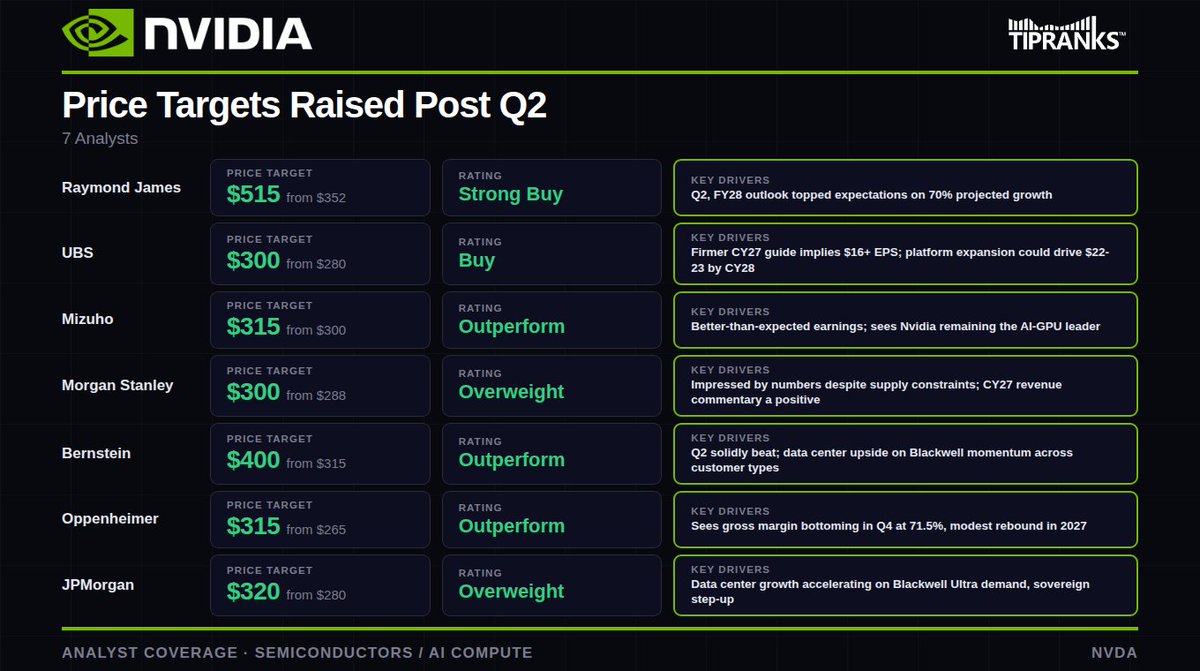
Analysts were overwhelmingly bullish on Nvidia $NVDA following Q2, with every firm raising its price target and highlighting stronger-than-expected AI demand and long-term growth visibility.
The biggest takeaway was NVIDIA’s new fiscal 2028 outlook, which implied roughly 70% growth and significantly exceeded expectations. Analysts highlighted accelerating Blackwell and Blackwell Ultra demand, with strength extending beyond hyperscalers into sovereign AI, AI-native companies, and enterprise customers. JPMorgan noted that NVIDIA remains supply-constrained and believes the company’s formal forward-year revenue framework could prove conservative given the pace of global agentic AI adoption.
Raymond James delivered the most aggressive target increase – to $515 from $352 – citing accelerating architectural demand, strong capital returns, and expectations that non-hyperscaler revenue could grow even faster than hyperscaler sales. Bernstein raised its target to $400 from $315, highlighting continued data center upside across both hyperscale and other AI infrastructure customers. UBS sees earnings exceeding $16 per share in calendar 2027 and potentially reaching roughly $22-$23 by 2028 as NVIDIA expands its platform and open-model ecosystem.
Gross margins were the main near-term pressure point, largely because rising memory and other input costs are being absorbed before pricing adjustments fully catch up. Oppenheimer expects gross margin to bottom around 71.5% in Q4 before recovering modestly in 2027, while Morgan Stanley viewed the margin reset as constructive.
Overall, analysts see NVIDIA maintaining its clear AI GPU leadership, with accelerating demand and unusually strong forward visibility outweighing near-term margin pressure.
Moved my @openclaw agent swarm to use @AntSeed and canceled my minimax subscription.
It can use the free models, or ad-hoc call premium models at >50% discount to what I could get them anywhere else.
https://t.co/w2x1BQSjib
Analysts were decisively bullish on CrowdStrike $CRWD following fiscal Q2, with every firm raising its price target and several describing the quarter as a clear inflection in growth.
The main takeaway was accelerating recurring revenue growth and a sharp improvement in new business momentum. Annual recurring revenue grew roughly 25% year-over-year, accelerating for the fourth consecutive quarter, while Canaccord highlighted record net-new ARR of $333 million – up 51% year-over-year and well above guidance. Several analysts described this as the strongest evidence yet that CrowdStrike has moved beyond the post-outage slowdown.
AI emerged as the biggest structural catalyst. TD Cowen argued that expanding AI adoption is increasing the cyberattack surface, positioning CrowdStrike’s Falcon platform to benefit disproportionately. Goldman Sachs sees an earlier-than-expected inflection in security budgets as companies accelerate AI-related modernization, while Piper Sandler pointed to growing agentic AI threats and CrowdStrike’s opportunity to both consolidate cybersecurity spending and lead the emerging AI security market.
Citi raised its target to $260 from $250, the highest among these updates, while TD Cowen moved to $250 and KeyBanc to $245. Piper Sandler delivered the largest increase – to $240 from $188 – and Canaccord raised its target to $210 from $185 after calling Q2 CrowdStrike’s best quarter ever.
The main remaining question is how broadly AI-driven security spending accelerates across customers, but analysts increasingly see CrowdStrike entering a sustained growth reacceleration into 2027.