“Poor Gil Chae, Rich Gil Chae, Gil Chae who doesn’t love me, Gil Chae who loves me. Any version of Gil Chae is fine with me.”
“What about Gil Chae who was violated by barbarians?”
“Then I should hold you because you must have suffered.”🥹🥹🥹
The debate is being framed incorrectly.
The issue is not the existence of CCTV cameras in school dormitory hallways. Surveillance in common areas is a standard safety measure in many boarding institutions and is often intended to enhance student security, emergency response, and accountability. Hallways are not private spaces.
The fundamental question is this: Why are students sleeping in hallways in the first place?
If learners are occupying corridors designed for movement and emergency evacuation, then the discussion should focus on overcrowding, inadequate infrastructure, student welfare, and compliance with minimum boarding standards.
A corridor is not a dormitory. It is not a sleeping area. The presence of students sleeping there points to a deeper institutional and policy failure that cannot be obscured by arguments about cameras.
Public attention should be directed toward capacity management, dormitory standards, and the conditions under which students are being accommodated. When a school reaches the point where hallways become sleeping quarters, the problem is not surveillance, it is overcrowding.
That is the issue that demands answers.
I have been doing a lot of soul searching , trying to understand what the issue with Kenya is. After a 5 year thought process , I have a conclusion that Kenya’s problem is not the government, but the people.
Why Omtatah Wants 3 Court of Appeal Judges Removed — Hon. Justice Luka Kimaru, Hon. Justice Sila Munyao and Hon. Justice Dr. Johnson Okoth Okello
Omtatah filed a constitutional petition challenging the Kenya-US Health Cooperation Framework (signed 4 Dec 2025), raising concerns on sovereignty, health data privacy, parliamentary oversight, and financial obligations
The High Court granted conservatory orders on 19 December 2025 stopping implementation pending hearing
The Government appealed to the Court of Appeal to stay those orders
On 12 May 2026, the three judges stayed the High Court orders but refused to give reasons at that point
They deferred reasons to 30 October 2026 — nearly five months later
The order took immediate effect, but its legal basis was withheld
Why Omtatah Considers This Unconstitutional
✅Without written reasons, he cannot meaningfully appeal to the Supreme Court
✅The Supreme Court itself has held that reasoned judgments are prerequisite for effective appellate review
✅His constitutional right of appeal under Article 163(4)(a) is rendered practically ineffective
Consequential Harm
✅The contested framework is already being implemented (e.g., US Ebola isolation centre in Kenya)
✅By October 2026 when reasons arrive, consequences will be irreversible — data transferred, fiscal commitments made, regulatory arrangements changed
What He Is Asking JSC to Investigate
✅Gross misconduct
✅Breach of the Judicial Service Code of Conduct and Ethics
✅Violation of constitutional rights to fair hearing and access to justice
✅Conduct in bad faith outside judicial immunity protection
✅Alternatively — incompetence for failing to apply binding Supreme Court precedent
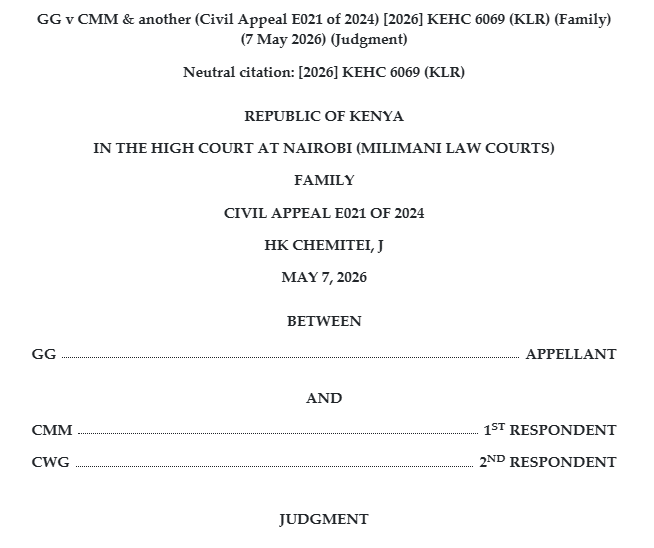
BREAKING: High Court Says “Equal Parenting” Does Not Always Mean Equal Financial Contribution
The High Court in Nairobi has delivered a significant family law ruling in GG v CMM & another, exposing a major tension in Kenyan child maintenance law: equal parental responsibility does not always translate into equal financial contribution. The dispute involved an adopted daughter over 18 years old who sought continued parental support while pursuing university education. Her adoptive father appealed after a magistrate ordered him alone to pay all tuition fees, upkeep, and related expenses, despite evidence that he suffered from diabetes, hypertension, brain surgery complications, and declining earning capacity. He argued that the mother, who had relocated to the United Kingdom and allegedly earned substantial income from employment and Nairobi rental properties, should shoulder at least 50% of the burden. Even the daughter supported the father’s appeal, insisting that both parents had equal constitutional obligations under Article 53 of the Constitution and the Children’s Act.
The High Court agreed with the father on a critical legal point: the magistrate had indeed failed to properly investigate the parties’ respective incomes, obligations, health conditions, and earning capacities before imposing the entire financial burden on one parent. Justice HK Chemitei held that maintenance orders should not be punitive or oppressive and acknowledged that parental responsibility under Kenyan law is generally joint and proportionate. The court also noted procedural discomfort with the magistrate relying on another children’s case whose file had not formally been produced before the court. However, despite identifying those errors, the appeal was still dismissed. The turning point was another related appeal involving the same couple’s biological son living in the UK with the mother, where the mother had already been left to solely maintain that child. The High Court therefore adopted a broader “family balancing” approach, effectively reasoning that if the mother carries one child abroad, the father can carry the adopted daughter in Kenya.
The jurisprudential implication is massive. This case quietly shifts Kenyan family law away from a rigid mathematical interpretation of “equal parental responsibility” toward a contextual and equitable model. The court appears to say that equality under Article 53 is not necessarily a 50:50 financial split in every case, but rather a fair allocation assessed against the wider family matrix, existing obligations, custody realities, and economic circumstances. That introduces uncertainty too. On one hand, the judgment protects flexibility and practicality in family disputes. On the other, it risks weakening predictability because courts may now justify unequal burdens using external family dynamics rather than strict proportional contribution analysis. The decision also reinforces another growing legal threshold: parental responsibility may extend beyond 18 years where a child remains dependent and is actively pursuing education, though courts will scrutinize dependency, finances, and fairness before granting such relief.
Kindly retweet.🙏
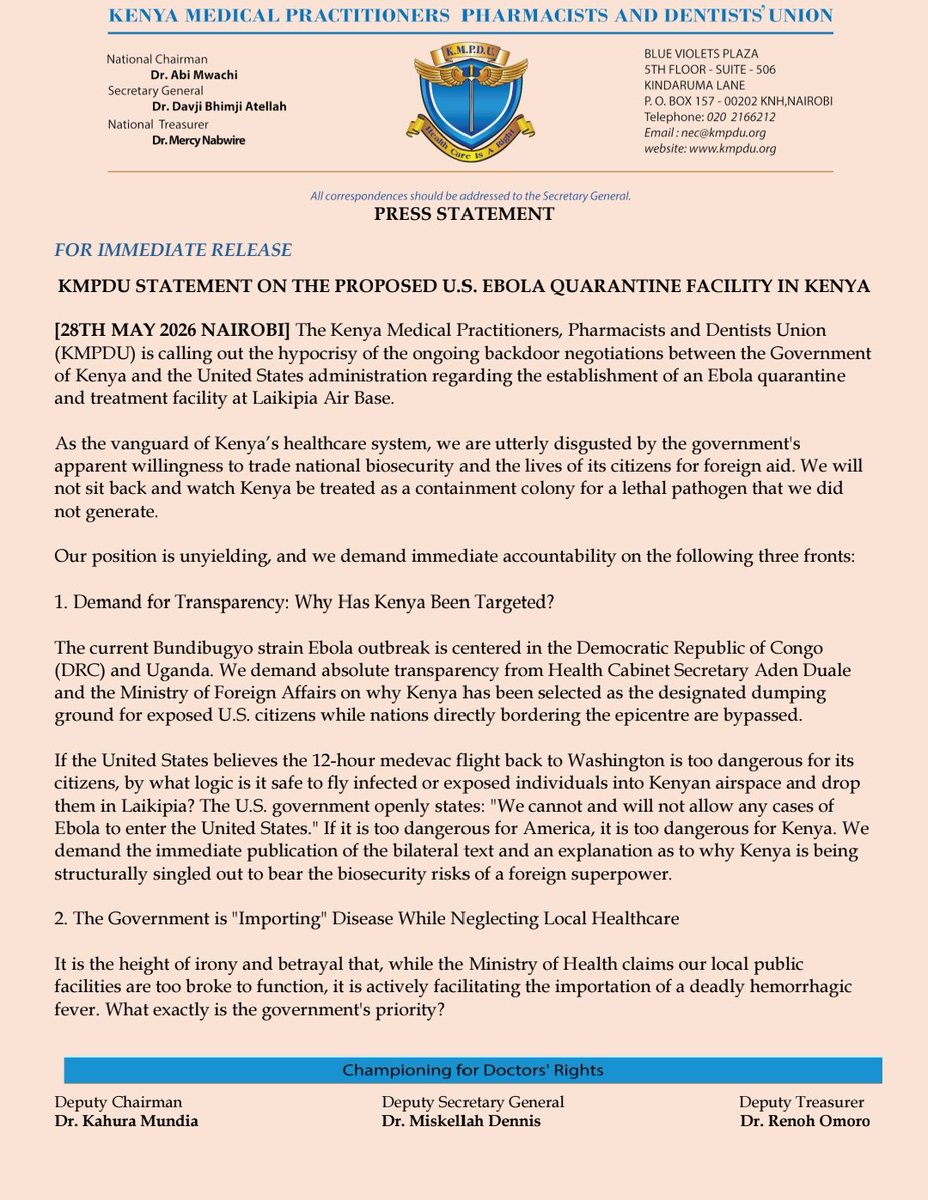
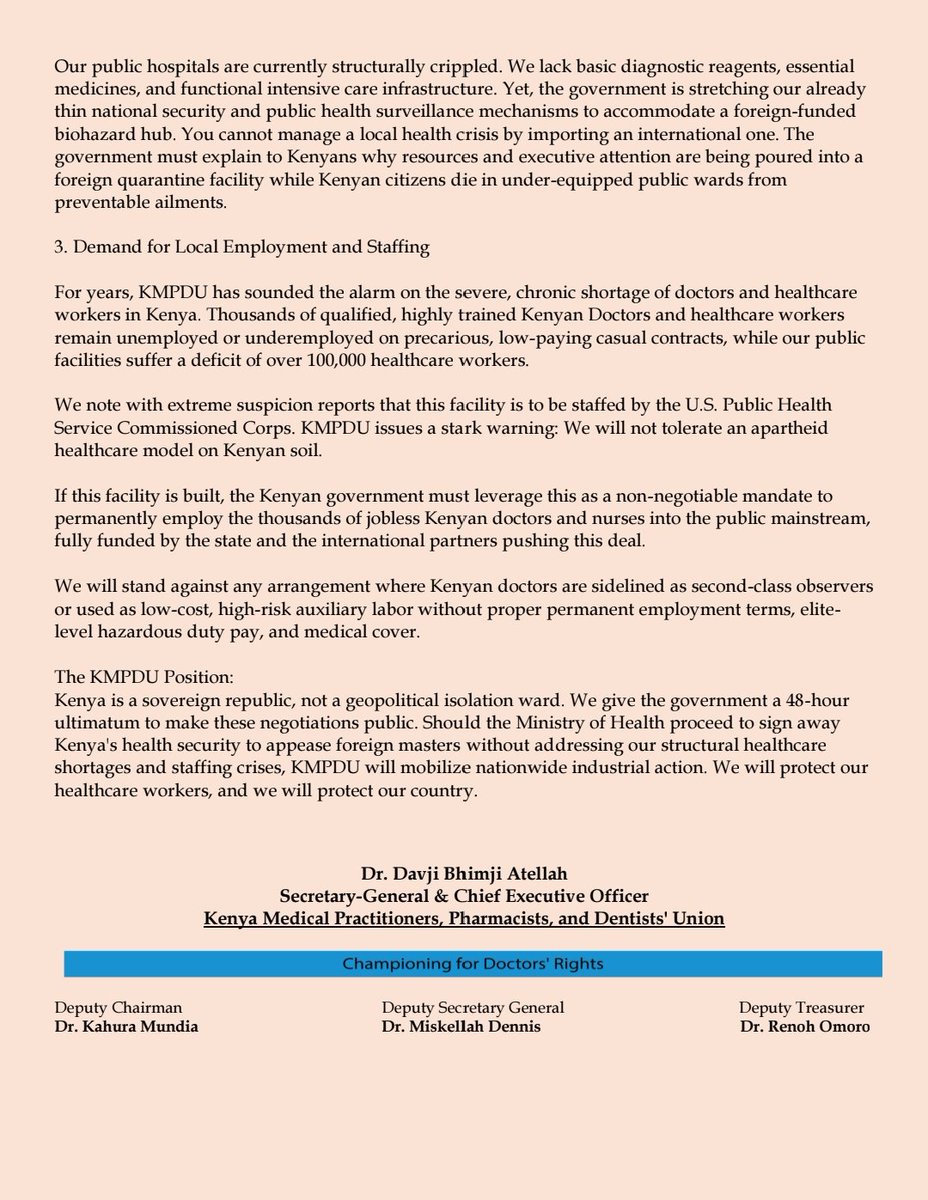
“We are going to allow Ebola patients into Kenya because, during the COVID-19 period, we had thousands of patients coming to Kenya for quarantine from all over the world,” Health PS Oluga says, adding that Kenya will receive Ebola patients just as Kenyans seek cancer treatment abroad.
Turmeric is the most powerful anti-inflammatory on Earth.
It destroys chronic pain, flushes toxins from your liver, and protects your brain from early aging.
Here's everything you need to know about it (thread):
1) It heals your gut first
@PART_RIOT 😂😂😂 I thought I'm the only one who has an issue with this cause you're no 20 on the list and still insisting on telling the JO goodmorning, why?
Our children are being stolen. Between Jan 2025–Mar 2026, Kenya recorded 10,581 child protection cases,1,952 abductions, 173 trafficking cases. That is 23 children a day.
Last week in Githurai, a 2-year-old was kidnapped by a teenager sent to steal a child for a phone. In Juja, residents shut down the Thika Superhighway after 4 children vanished in two weeks. In Central Kenya, 372 violence-against-children incidents in under a year. This is a national emergency.
The Penal Code provides for life imprisonment for kidnappers. I want to see DCI and DPP match that seriousness with urgent investigations and full prosecutions, not just press releases.
To every Kenyan, watch the children around you. Speak up and report because if we do not protect our children, we have failed at the most fundamental duty of a society. Our children are not a footnote. They are our future.
A predator should never feel safer in a community than a child. The moment evil becomes comfortable among us, it means good people have become too passive and too silent.