Flow Matching connects two distributions.
Can a one-step generator learn from the flow between its own samples and real data?
Meet Midpoint Generative Models (MGM), our new training framework built on this idea.
Here’s how. 🧵
Why should a 3D molecule generator learn a benzene ring atom by atom? 🤔
MotiFlow generates molecules from rigid motifs instead: one joint flow over motif types and their SE(3) poses.
#NeurIPS2026 🎉 with @MarcelKollovieh, @ESEberhard, and @guennemann 🧵
Built Tough AI Paper Reviewer from my own research experience: the prompt we use to check our papers before submission.
8 sub-agents check proofs, experiments & novelty against relevant literature. Try it!
For Claude Code/Codex and similar tools 🦉
https://t.co/daJbsyZGTt
This Monday, Nov 2, Dmitry Baranchuk (@DmitryBaranchuk) will present his paper:
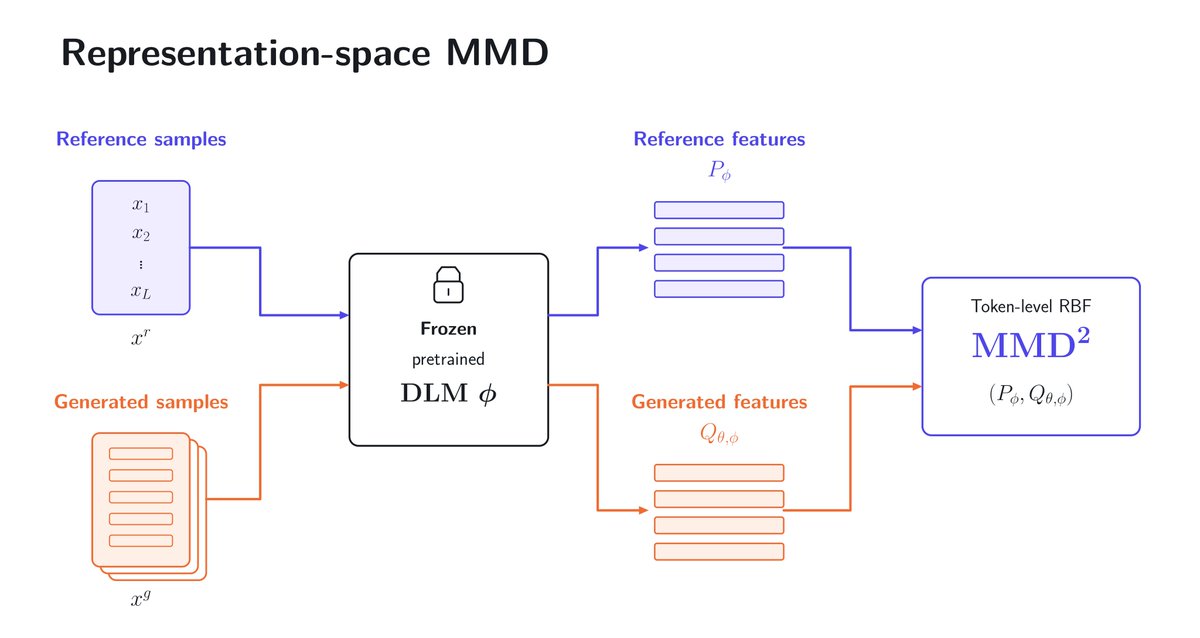
Representation-Space MMD for Diffusion Language Models
Project also co-led by Ilya Drobyshevskiy (@free001style) and Ilia Sudakov (@sudakov_il)!
Masked diffusion LMs unmask several tokens per step, but sample them independently - so few-step text falls apart.
We introduce E-MoE: the routing decisions of a Mixture-of-Experts backbone become a discrete shared latent. 2× lower generative perplexity at 1–2 steps. 🧵
🔬Can we learn how a population evolves without tracking a single individual? And what if the data is intrinsically discrete?
Introducing Discrete Action Matching (DAM): from population snapshots to stochastic dynamics on a graph.
📄 https://t.co/ifZCGYwY6U
🖼️ Details below 👇
Introducing a simple method to post-train both discrete and continuous diffusion LMs.
It's based on Maximum Mean Discrepancy (MMD) that matches token-level feature distributions. Our method improves generation and speed on OWT/GSM8K and scales to 16B models. 🧵
We introduce Inverse Distillation Unlearning (IDU): distilling a multi-step flow/diffusion teacher into a one-step generator that suppresses unwanted outputs while preserving retained-data quality: https://t.co/E5gW02kClQ
A short teaser below. Details in the next post.
Continuous diffusion for text is taking off.
But most methods still diffuse in spaces that were never learned for denoising and this limits their performance.
In LDLM, we train the encoder, diffusion model, and decoder jointly, so the denoising objective shapes the representation directly.
❌ Not: learn a space → run diffusion on it.
✅ Instead: learn a diffusable space.
On OpenWebText & LM1B, LDLM achieves a better quality–speed trade-off than MDLM, Duo, CANDI, and FLM.
Up to 13× faster sampling.
🧵 Recipe and insights below ↓
Latent diffusion for text.
Better quality? Faster sampling?
Seen one? Didn't think so.
Meet LDLM — beats MDLM, Duo, CANDI, FLM on OpenWebText & LM1B.
2–13× faster.
The trick is:
Don't run diffusion in a latent space.
LEARN a latent space FOR diffusion.
Paper: https://t.co/LYgkxTWJuE
Excited to share CatSBench (#ICLR2026) - a ready-to-use benchmark package for EOT/SB on discrete spaces.
It covers the full benchmarking cycle: data, metrics, ground-truth solutions, and all current solvers + utils.
Paper: https://t.co/w7Usb2d7Kd
GitHub: https://t.co/5MPaAZQLge