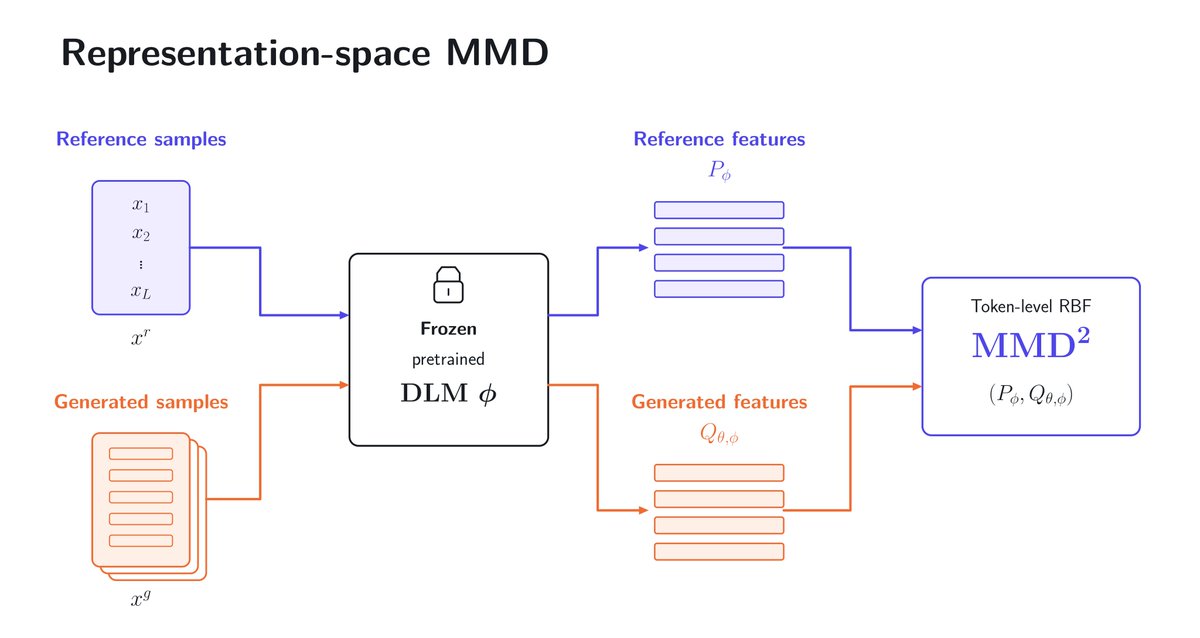
Introducing a simple method to post-train both discrete and continuous diffusion LMs.
It's based on Maximum Mean Discrepancy (MMD) that matches token-level feature distributions. Our method improves generation and speed on OWT/GSM8K and scales to 16B models. 🧵
Really enjoyed @anvilapex’s talks at our diffusion seminars: a clear overview of post-training visual diffusion models (DPO, RL, and reward modeling).
The recordings are in Russian, but he’s now written up the material in English blog posts. Well worth a read!
Double announcement!
🤖 TabPack: an effective, practical baseline for medium-to-large tabular datasets. Competitive out of the box on benchmarks and trainable on a modern MacBook
📦 TabPackage: a Python package for training TabPack and building similar models
👇 Links & Thread
This Monday, Nov 2, Dmitry Baranchuk (@DmitryBaranchuk) will present his paper:
Representation-Space MMD for Diffusion Language Models
Project also co-led by Ilya Drobyshevskiy (@free001style) and Ilia Sudakov (@sudakov_il)!
@peter9863 Nice work! We observe similar behaviour in continuous diffusion language models: our post-trained model iteratively refines predictions via self-conditioning at inference (Eq. 12). We also distill this into a single prediction (Appendix B.1, Eqs. 13–14).
https://t.co/3z4gN6rCba
Introducing a simple method to post-train both discrete and continuous diffusion LMs.
It's based on Maximum Mean Discrepancy (MMD) that matches token-level feature distributions. Our method improves generation and speed on OWT/GSM8K and scales to 16B models. 🧵
Introducing a simple method to post-train both discrete and continuous diffusion LMs.
It's based on Maximum Mean Discrepancy (MMD) that matches token-level feature distributions. Our method improves generation and speed on OWT/GSM8K and scales to 16B models. 🧵
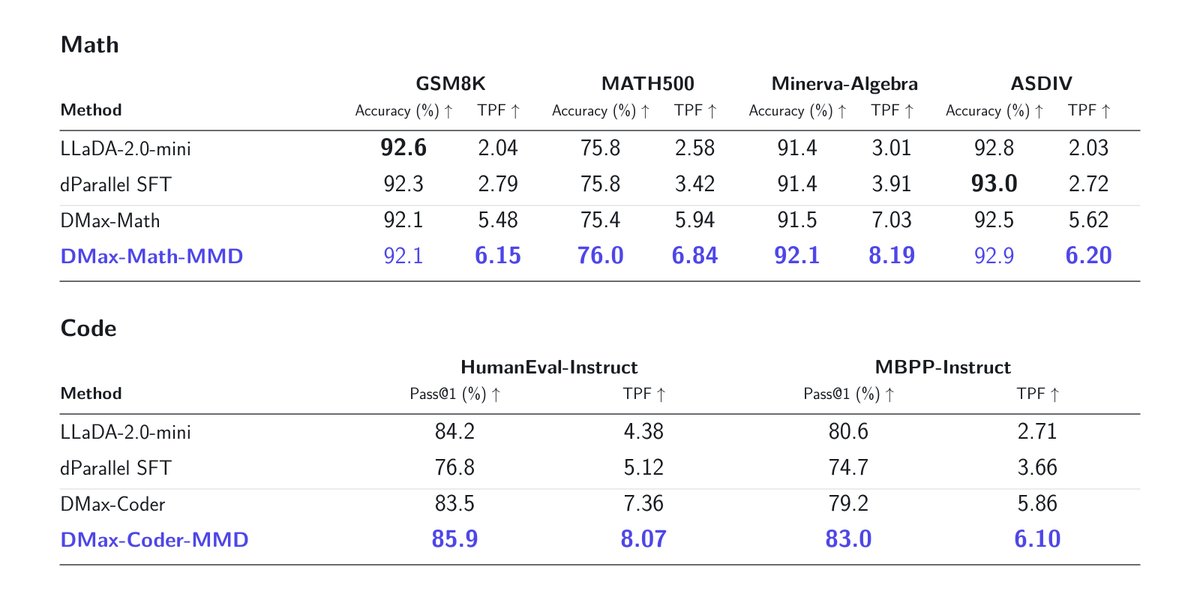
[🧵6/7] Our approach scales! 🚀 We apply MMD to 16B DMax-Math and DMax-Coder. Just 400 post-training updates per model and the results are exciting!
• Math: 10.3–16.5% more tokens per forward pass, with similar or higher accuracy.
• Code: MBPP-Instruct pass@1 jumps from 79.2% to 83.0%, while tokens per forward pass rise from 5.86 to 6.10.