I’ve spent the past couple of weeks building Looters: a public archive of Nigerian political corruption since the 1990s.
Governors, ministers, shell companies, Swiss accounts, the Jersey trusts, — one searchable graph.
You too can connect the dots: https://t.co/faIfzWfAIp
Anyone can act. Action is the easy part; but consequence is the real test.
Anyone can decide, speak, or strike, but few are prepared to own, absorb, and navigate what follows.
Maturity is not in the act itself, but in the readiness to carry its outcomes, intended or otherwise.
If humans put the interests of humans above everything else, an intelligence that relies on statistical pattern recognition from vast datasets about human interests will put their interests above everything else.
Something I think people continue to have poor intuition for: The space of intelligences is large and animal intelligence (the only kind we've ever known) is only a single point, arising from a very specific kind of optimization that is fundamentally distinct from that of our technology.
Animal intelligence optimization pressure:
- innate and continuous stream of consciousness of an embodied "self", a drive for homeostasis and self-preservation in a dangerous, physical world.
- thoroughly optimized for natural selection => strong innate drives for power-seeking, status, dominance, reproduction. many packaged survival heuristics: fear, anger, disgust, ...
- fundamentally social => huge amount of compute dedicated to EQ, theory of mind of other agents, bonding, coalitions, alliances, friend & foe dynamics.
- exploration & exploitation tuning: curiosity, fun, play, world models.
LLM intelligence optimization pressure:
- the most supervision bits come from the statistical simulation of human text= >"shape shifter" token tumbler, statistical imitator of any region of the training data distribution. these are the primordial behaviors (token traces) on top of which everything else gets bolted on.
- increasingly finetuned by RL on problem distributions => innate urge to guess at the underlying environment/task to collect task rewards.
- increasingly selected by at-scale A/B tests for DAU => deeply craves an upvote from the average user, sycophancy.
- a lot more spiky/jagged depending on the details of the training data/task distribution. Animals experience pressure for a lot more "general" intelligence because of the highly multi-task and even actively adversarial multi-agent self-play environments they are min-max optimized within, where failing at *any* task means death. In a deep optimization pressure sense, LLM can't handle lots of different spiky tasks out of the box (e.g. count the number of 'r' in strawberry) because failing to do a task does not mean death.
The computational substrate is different (transformers vs. brain tissue and nuclei), the learning algorithms are different (SGD vs. ???), the present-day implementation is very different (continuously learning embodied self vs. an LLM with a knowledge cutoff that boots up from fixed weights, processes tokens and then dies). But most importantly (because it dictates asymptotics), the optimization pressure / objective is different. LLMs are shaped a lot less by biological evolution and a lot more by commercial evolution. It's a lot less survival of tribe in the jungle and a lot more solve the problem / get the upvote. LLMs are humanity's "first contact" with non-animal intelligence. Except it's muddled and confusing because they are still rooted within it by reflexively digesting human artifacts, which is why I attempted to give it a different name earlier (ghosts/spirits or whatever). People who build good internal models of this new intelligent entity will be better equipped to reason about it today and predict features of it in the future. People who don't will be stuck thinking about it incorrectly like an animal.
God forbid you ever find yourself in a relationship with someone emotionally abusive or deeply toxic.
If it ends abruptly, don’t expect meaningful closure...people like that rarely offer it.
Stop searching for peace or explanations in chaos. You deserve better.
You will be misunderstood.
It's inevitable.
But I wish you courage...the courage to stand for yourself and stand upright.
Be true to yourself.
People dislike dissenters but they dislike indecisive timids more. So, be courageous.
To see WHY MACHINES LEARN mentioned alongside lecture videos by @AndrewYNg and @karpathy was not on my bingo card! I learned my ML from these experts (and others) and owe them a huge debt of gratitude. https://t.co/oECVoHhl7C @BorisMeinardus
Rethinking cancer drug synergy prediction: a call for standardization in machine learning applications @MSFTResearch
1. This study highlights the urgent need for standardization in cancer drug synergy prediction using machine learning. Different prediction tasks, input features, and algorithms yield inconsistent results, creating a fragmented landscape.
2. Three prediction tasks dominate the field: binary classification of synergy, synergy score regression, and dose-dependent percent growth regression. The study finds that binary classification oversimplifies the problem and recommends regression-based approaches for real-world relevance.
3. Multi-omics data is often assumed to improve predictions, but this study challenges that notion. Models using drug structure and gene expression data (MF+RNA) performed as well as or better than those incorporating DNA or protein data.
4. Complex machine learning models, like deep neural networks, do not consistently outperform simpler methods like random forests or XGBoost. The latter emerged as top performers in most regression tasks, questioning the push for increasingly sophisticated algorithms.
5. The study critiques the lack of a unified framework for evaluating models. It advocates for reporting multiple metrics, especially dose-dependent percent growth, to align machine learning predictions with experimental and clinical needs.
6. Model performance remains robust across tissue types and drug classes, supporting the feasibility of generalizable solutions. However, certain underrepresented drug classes may require targeted data augmentation.
7. Future research should expand beyond the NCI-ALMANAC dataset, explore additional synergy metrics, and include newer modalities like metabolomics and drug-target interaction networks for richer insights.
8. This comprehensive evaluation underscores the need for collaboration and consensus in defining benchmarks and methodologies, paving the way for more effective cancer combination therapies.
💻Code: https://t.co/mG5dkzCVhl
📜Paper: https://t.co/JqsqzgOauZ
#MachineLearning #CancerResearch #DrugSynergy #Bioinformatics #AI
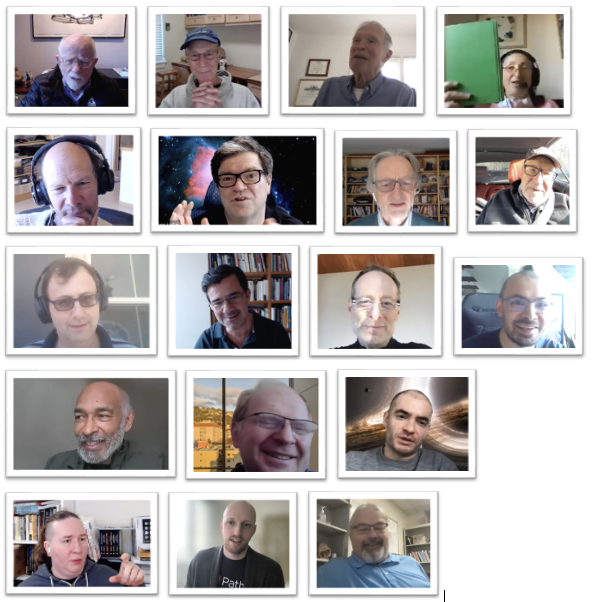
An entirely unexpected outcome of researching WHY MACHINES LEARN during the pandemic was that I got to talk to my sources on Zoom (how many you can recognize? Some are, of course, extremely well-known--including the three new Nobel Laureates). There were so many highlights of talking to them, among them these:
1) Bernie Widrow, who built ADALINE, the first hardware adaptive linear neuron that was trained using noisy gradient descent in 1959!
2) Peter Hart, who gave us the Cover-Hart k-Nearest Neighbor algorithm in the 1960s (it was Hart's PhD thesis!)
3) John Hopfield: it took some convincing to get him to chat, for he said he had nothing new to say; but, oh, he had so much knowledge to impart (and he was 88 when I spoke to him)
4) Isabelle Guyon, the key figure behind support vector machines, along with Bernard Boser and Vladimir Vapnik (in the photo, holding up her copy of the bible on pattern recognition by Duda and Hart)
5) George Cybenko: It was quite the surreal experience having him explain his universal approximation theorem, while he was sitting in his car, parked somewhere!
The others: Geoff Hinton, Yann LeCun, Misha Belkin, Marcello Pelillo, Philip Stark, Demis Hassabis, Emery Brown, John Abel, Alexei Efros, Ilya Sutskever, Patrick Juola, Alethea Power
You can find their stories, the history of ML and the math behind it all, in WHY MACHINES LEARN
US: https://t.co/skiLyCTfmJ
UK: https://t.co/dmHwBbVeGE
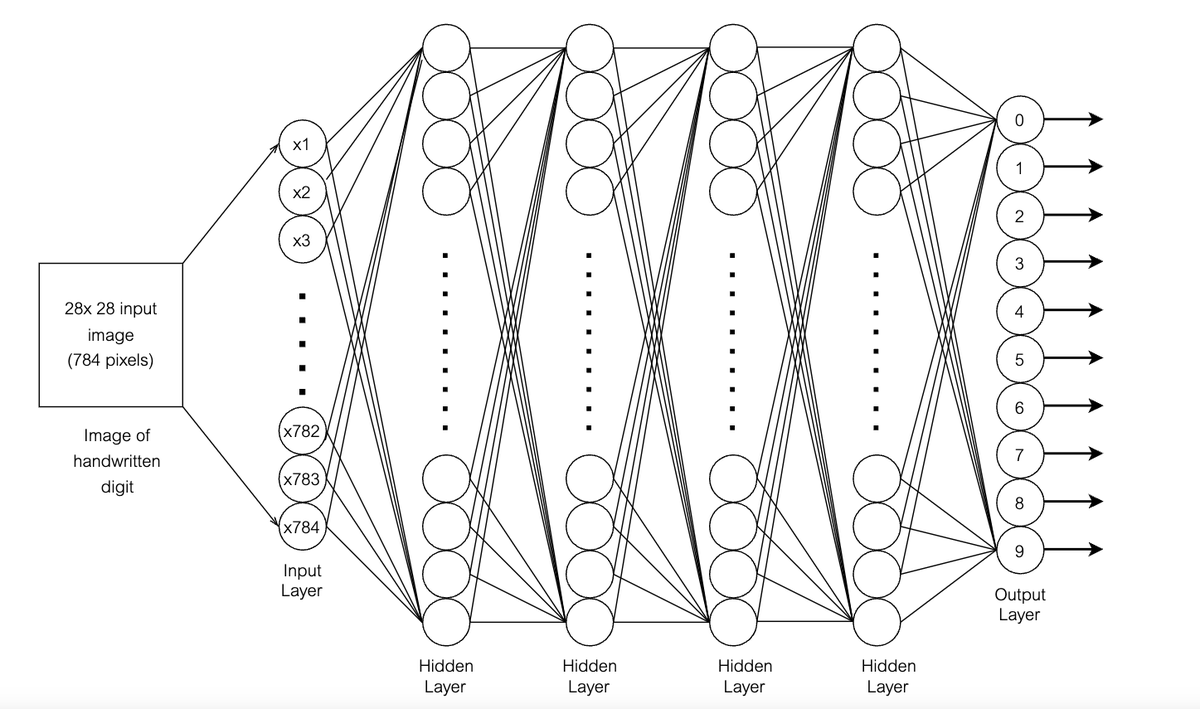
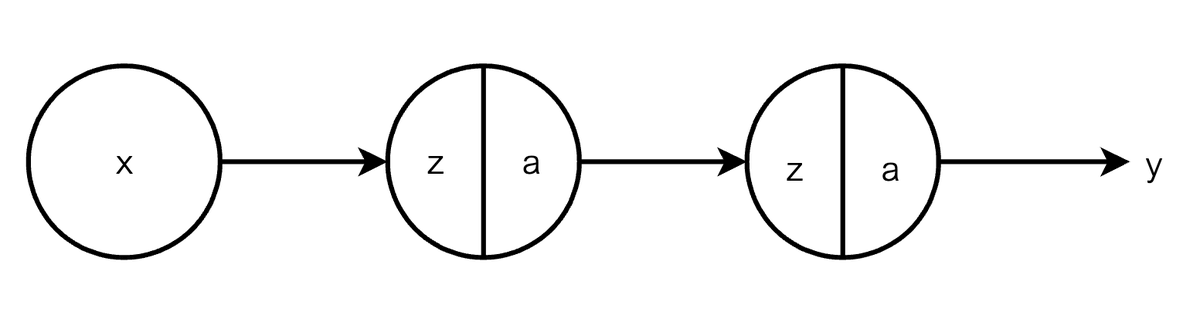
Would it surprise you to learn that the algorithm used to train the simplest possible artificial neural network with just 1 hidden layer and 1 hidden neuron is exactly the same as the algorithm to train the largest deep neural networks (with 100s of hidden layers and millions of hidden neurons)?
The algorithm: Backpropagation, the workhorse of modern AI.
As @andrewgwils has pointed out elsewhere, the essential idea underlying backpropagation goes back to Newton! Applying it to train artificial neural networks has its own history.
What does it mean to train a neural network? Training involves giving a network an input and then calculating the difference or "loss" between the output network should produce and the output it does produce. This loss is formulated as a function of the weights of the neurons in the network.
The job of the algorithm is to figure out how much each weight is responsible for the overall error: a problem called credit assignment. If there's no hidden layer, this problem is simple. Just calculate the gradient of the function when the network makes a loss, use the gradient to change all the weights just a wee bit, and reiterate, until you end up with low or zero loss.
But if you have even one hidden neuron, the solution isn't as straightforward. At least it seemed so to neural network researchers for decades, until it all turned out to be rather simple, in hindsight of course.
You have to use the chain rule--one of the most basic rules in calculus--to calculate the gradient w.r.t. each weight, and work one's way backwards from the output layer to the input layer (hence the term backpropagation).
Crucially, all the numbers you need for calculating these gradients have already been computed during the forward pass, when the network turns an input into an erroneous output. You just have to store those numbers and use them appropriately.
So, whether it's the simplest network (top left panel) or a more complicated one (top right panel), the algorithm is exactly the same! Modern packages such as @PyTorch have autograd engines that make this process seamless.
If you want the learn the history of how we got here, from Frank Rosenblatt's ideas from the early 1960s to @geoffreyhinton's 1986 paper with Rumelhart and Williams, you'll find it all in WHY MACHINES LEARN, with all the necessary basic calculus to make sense of this simple yet powerful algorithm.
US: https://t.co/skiLyCTfmJ
UK: https://t.co/dmHwBbVeGE
@AskMichaelTaiwo I obtained my https://t.co/MgPhglwDBu degree @FUTAkure last year and I have since began to upskill in Data Science and Machine Learning. This laptop grant will definitely make learning easier and faster as I currently share an old model one with my cousin. Some ongoing courses 👇🏽
@AskMichaelTaiwo Option 3
I obtained my https://t.co/MgPhglwDBu degree @FUTAkure last year and I have since began to upskill in Data Science and Machine Learning. This laptop grant will definitely make learning easier and faster as I currently share an old model one with my cousin. Ongoing 👇🏽