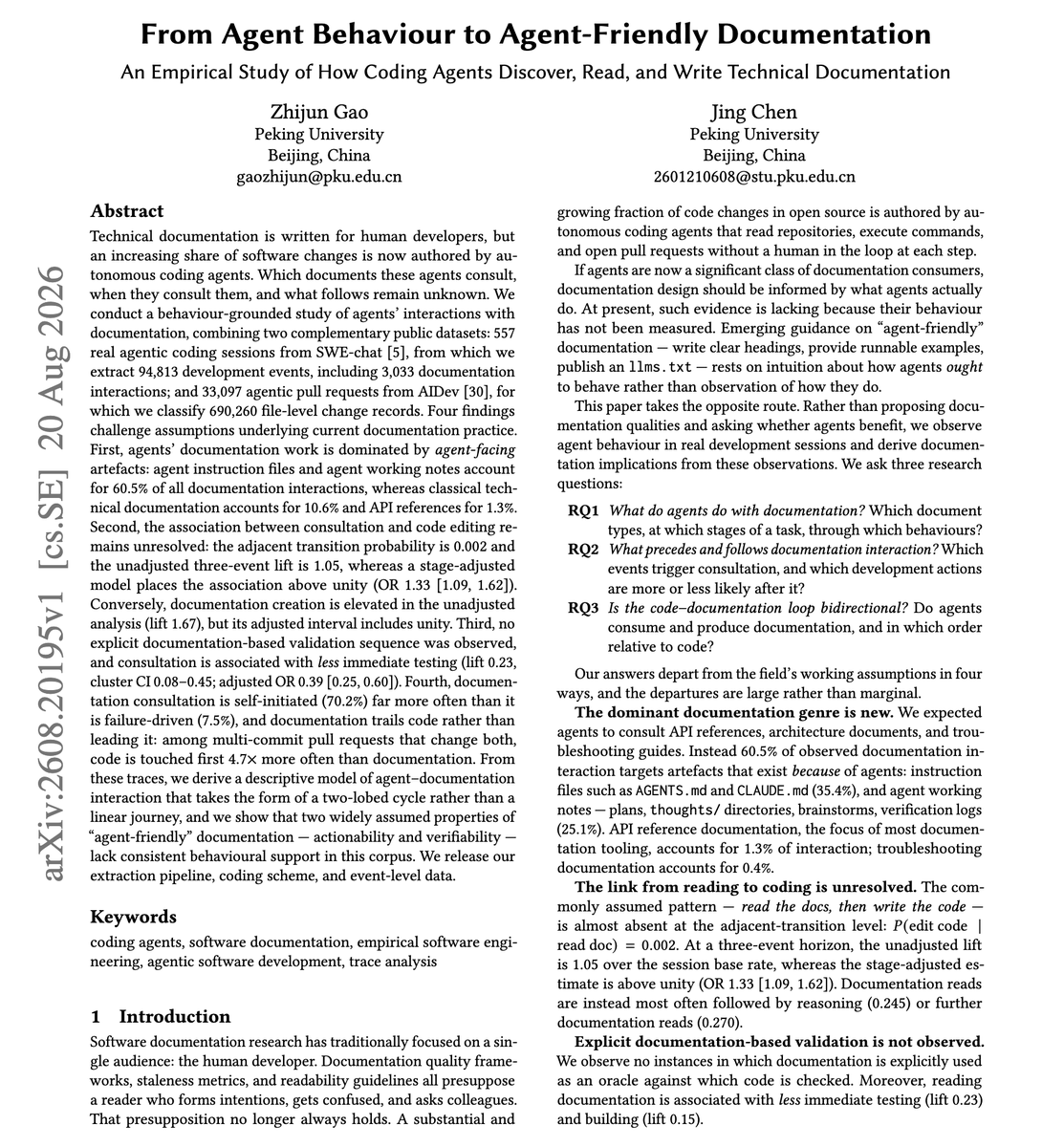
If you maintain an AGENTS.md or a CLAUDE.md, this one is worth your time.
(bookmark it)
Researchers traced 94K development events across 557 agentic coding sessions, plus 690K file-level change records from 33K agentic pull requests.
Instruction files and working notes account for 60.5% of everything agents read.
Classical technical docs get 10.6%.
API references get 1.3%.
Reading docs is associated with less immediate testing, at an adjusted odds ratio of 0.39.
And consultation is self-initiated 70.2% of the time, against 7.5% driven by a failure.
In multi-commit agentic pull requests, code gets touched first 4.7x more often.
Paper: https://t.co/alrihmMkQd
Track more trending AI papers in our academy: https://t.co/LRnpZN7L4c
The Day I understood “That market does not know what you paid for a stock”, my Investing Proved 10X
But most investors manage their portfolios as if it does.
"I cannot sell, I need to get back to my buying price."
"I will hold it until it recovers."
That is not patience. That is your hope wearing patience's clothes.
Your cost price is irrelevant to what the business is worth today.
The only question that matters:
Is this business, at today's price, a good place for my capital?
If yes, hold.
If no, the price you paid once does not change the answer.
Waiting to break even is not a strategy.
Want advice on your financial freedom journey: https://t.co/guoo0Wox4h
If only we started younger, we would've been so much better.
If only I knew back then, what I know now, things wouldn't be different.
But the truth is,
Today is the youngest you'll ever be again.
The best time to plant a tree was 20 years ago,
But the second best time is now.
Instead of watching an hour of Netflix, watch this 30-minute speech by the Head of Anthropic’s Coding Agents research team. It will teach you more about vibe coding than 100 paid courses.
Mark Cuban on the next job wave.
Customized AI integration for small to mid-sized companies.
"Software is dead because everything's gonna be customized to your unique utilization. Who's gonna do it for them... And there are 33 mn companies in the US."
- Drafted a blog post
- Used an LLM to meticulously improve the argument over 4 hours.
- Wow, feeling great, it’s so convincing!
- Fun idea let’s ask it to argue the opposite.
- LLM demolishes the entire argument and convinces me that the opposite is in fact true.
- lol
The LLMs may elicit an opinion when asked but are extremely competent in arguing almost any direction. This is actually super useful as a tool for forming your own opinions, just make sure to ask different directions and be careful with the sycophancy.
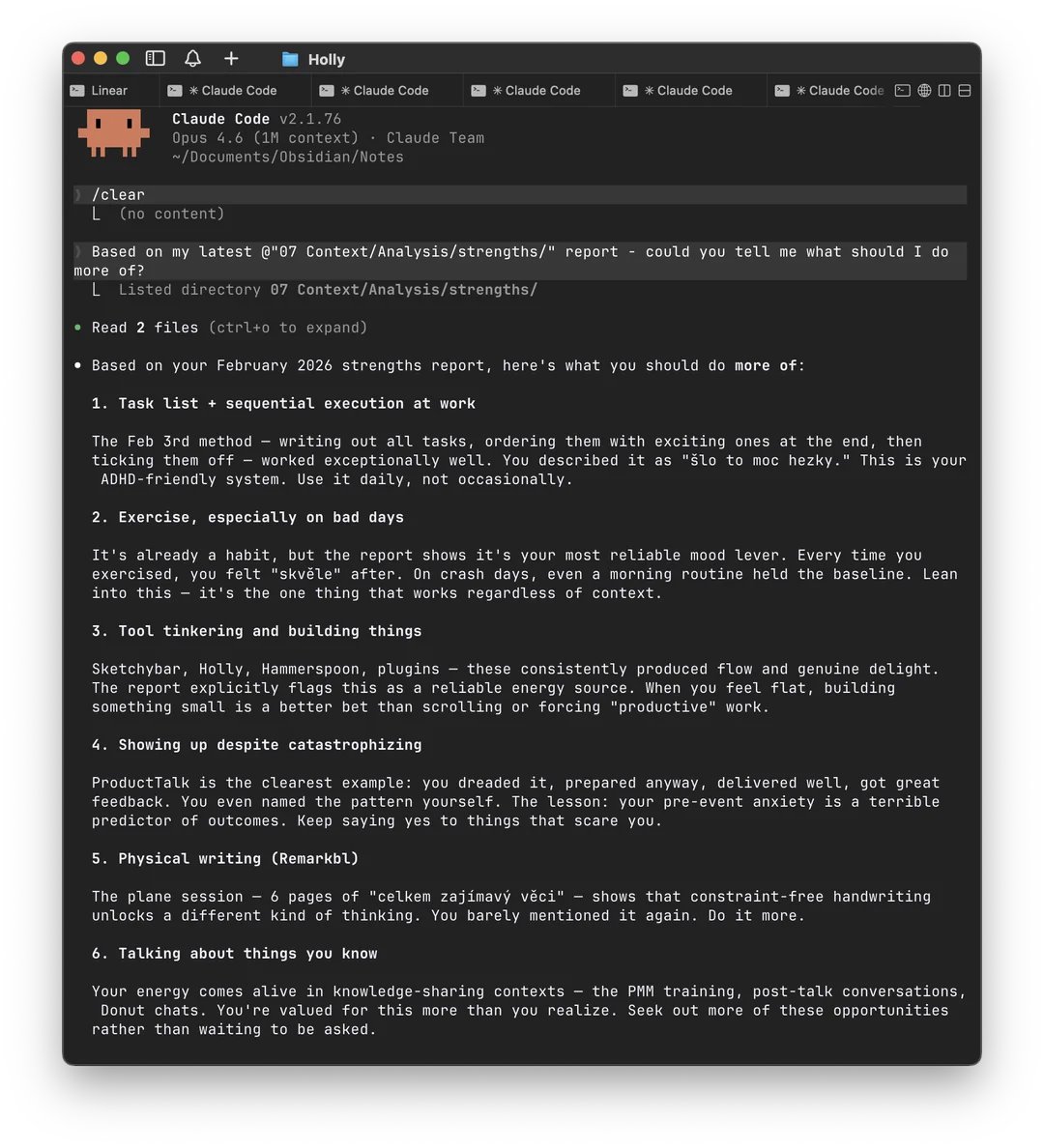
this guy fed 14 years of daily journals into Claude Code
turned it into 5,000 markdown files of random thoughts, brain dumps, and daily entries
he wasn't planning to ever read them again but figured Claude might find patterns he couldn't see
so he prompted it from different angles:
> therapist perspective
> life coach view
> relationship patterns
> month by month evolution
> year by year growth analysis
what he got was BRUTAL because his journals were super self-critical
Claude didn't even sugarcoat anything it called out patterns exactly as they were
> identified a 4-month cycle of project excitement (something we ALL have)
→ overcommit → burnout → ditch it
> spotted connections between health issues across 20 years of medical records
> found behavioral patterns he'd been blind to for over a decade
he's now using it as his main self-improvement tool
prompts Claude monthly for perspective checks and what things he can do better
the crazy part is how AI can see patterns in your own life that you refuse to accept or just can't spot
it's like having your very own therapist who's read every single thought you've had for as long as you can remember
he posted all his prompts on GitHub and wrote a whole blog breakdown
i would do this if I had a journal to see what patterns it can spot in my life
so you're telling me i can now...
embed a video
embed a voice memo
embed a PDF
embed an image
embed text
...all in the same space? with one model?
and search across all of them with a single query?
time to rebuild everything.
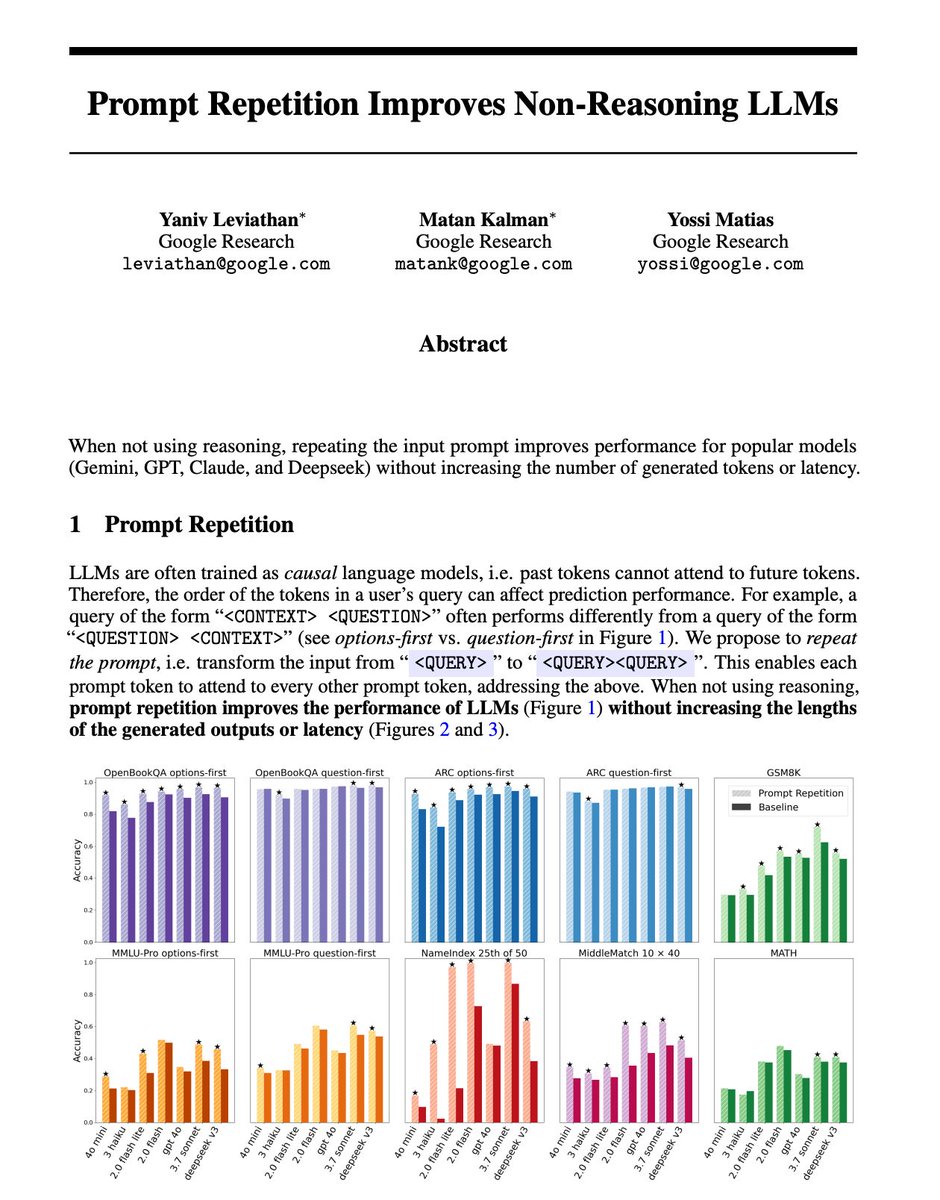
Google just proved that pasting your exact prompt twice beats every advanced prompting technique.
One model jumped from 21% to 97% accuracy with zero extra effort.
Here's the science behind AI's simplest hack:
LLMs like GPT-4o and Claude read your prompt left to right, one token at a time. Early words can't "see" later words on the first pass.
When information appears in an awkward order, like answer choices before the actual question, the model struggles to connect the pieces.
By repeating the prompt, every word in the first copy becomes visible context for the second copy. The model gets a "second read" with perfect attention across your entire input.
Like reading an exam question twice before answering. Same effort, better comprehension.
The results were staggering ↓
Google tested Gemini 2.0 Flash, GPT-4o, GPT-4o-mini, Claude 3 Haiku, Claude 3 Sonnet, and DeepSeek V3 across seven benchmarks.
Across all 70 combinations, prompt repetition delivered 47 statistically significant wins with zero losses.
But here's the result that broke the scale:
Google gave Gemini 2.0 Flash-Lite a task where the AI had to find a specific detail buried inside a massive prompt.
Without repetition, it got the right answer just 21% of the time. With one copy-paste, accuracy jumped to 97%.
Same model. Same task. The only difference was reading it twice.
Skeptics had a theory: maybe longer inputs just help in general?
Google tested that too. They padded prompts with periods to match the length, and it made zero difference. Only meaningful repetition works.
And the best part?
It adds almost no extra processing time because the repeated input runs in parallel.
But there's one scenario where it doesn't help ↓
Chain-of-thought prompts like "Think step by step" already re-read and rephrase your question internally.
They're doing the repetition for you. Out of 28 reasoning tests, only 5 showed improvement.
This means prompt repetition is most powerful for:
• Classification and multiple choice tasks
• Data extraction and short-answer Q&As
• Direct-answer tasks where order sensitivity matters
The practical takeaway:
1) Take your exact prompt
2) Paste it twice as one message
3) Send it and change nothing else
This works across every major model family. Gemini, GPT, Claude, DeepSeek. All of them.
The simplest trick in AI history: if you want a better answer, just ask twice.
—
Thanks for reading!
Enjoyed this post?
Follow Big Brain AI for more content like this.
It is hard to communicate how much programming has changed due to AI in the last 2 months: not gradually and over time in the "progress as usual" way, but specifically this last December. There are a number of asterisks but imo coding agents basically didn’t work before December and basically work since - the models have significantly higher quality, long-term coherence and tenacity and they can power through large and long tasks, well past enough that it is extremely disruptive to the default programming workflow.
Just to give an example, over the weekend I was building a local video analysis dashboard for the cameras of my home so I wrote: “Here is the local IP and username/password of my DGX Spark. Log in, set up ssh keys, set up vLLM, download and bench Qwen3-VL, set up a server endpoint to inference videos, a basic web ui dashboard, test everything, set it up with systemd, record memory notes for yourself and write up a markdown report for me”. The agent went off for ~30 minutes, ran into multiple issues, researched solutions online, resolved them one by one, wrote the code, tested it, debugged it, set up the services, and came back with the report and it was just done. I didn’t touch anything. All of this could easily have been a weekend project just 3 months ago but today it’s something you kick off and forget about for 30 minutes.
As a result, programming is becoming unrecognizable. You’re not typing computer code into an editor like the way things were since computers were invented, that era is over. You're spinning up AI agents, giving them tasks *in English* and managing and reviewing their work in parallel. The biggest prize is in figuring out how you can keep ascending the layers of abstraction to set up long-running orchestrator Claws with all of the right tools, memory and instructions that productively manage multiple parallel Code instances for you. The leverage achievable via top tier "agentic engineering" feels very high right now.
It’s not perfect, it needs high-level direction, judgement, taste, oversight, iteration and hints and ideas. It works a lot better in some scenarios than others (e.g. especially for tasks that are well-specified and where you can verify/test functionality). The key is to build intuition to decompose the task just right to hand off the parts that work and help out around the edges. But imo, this is nowhere near "business as usual" time in software.
gemini 3.1 pro dropped and nobody's talking about the real play here...
it's not the benchmarks or the reasoning scores
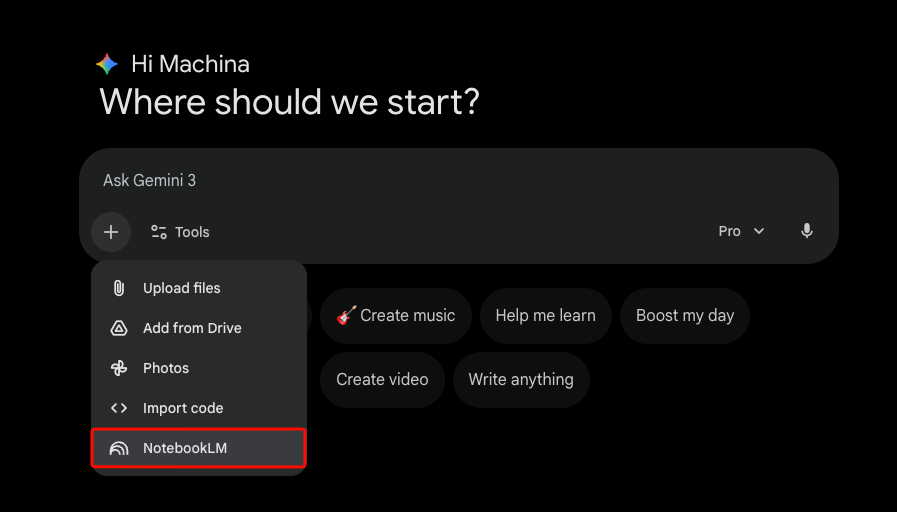
but what happens when you pair it with NotebookLM
here's how i use it for literally everything i work on:
1. open NotebookLM, run Deep Research on your topic
2. it pulls hundreds of sources from across the web automatically
3. review everything, cut the garbage, keep only what's good
4. now you have a curated knowledge base grounded in real sources
this is where it gets interesting...
> import that notebook directly into Gemini
> build a Gem with your notebook as context
> now every prompt you write is backed by YOUR research, YOUR sources
this thing was built to process massive context... 1M tokens, entire codebases, hundreds of documents at once
if you're prompting it with zero context you're wasting the most powerful part of the model
notebooks are the knowledge layer and gemini is the reasoning engine
stack them together and you have the best system to process large context files
4/ EXTENDED VERSION WITH GUIDANCE
"I'm interested in writing about [TOPIC].
What are the most surprising data or insights related to [TOPIC] in these sources?
Include key quotes. Focus on [SPECIFIC ASPECT], not [OTHER ASPECTS]."
Traditional search can't reveal what's interesting. This does.
Even till the end of my college life, I’ll stand by this:
2 hours on Codeforces > 5 hours on LeetCode
(For freshers & sophomores)
This may flip for pre-final and final year students-context matters.