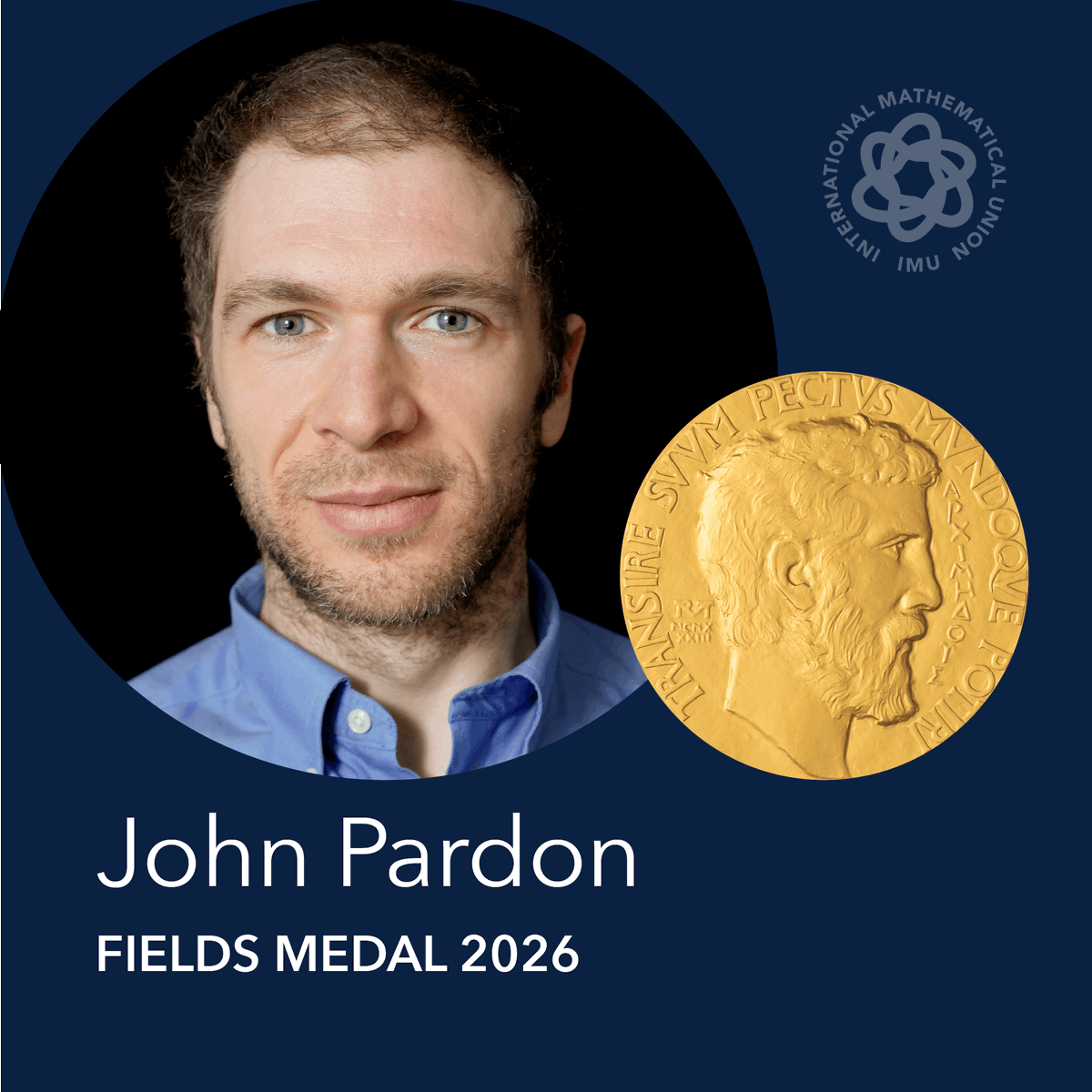
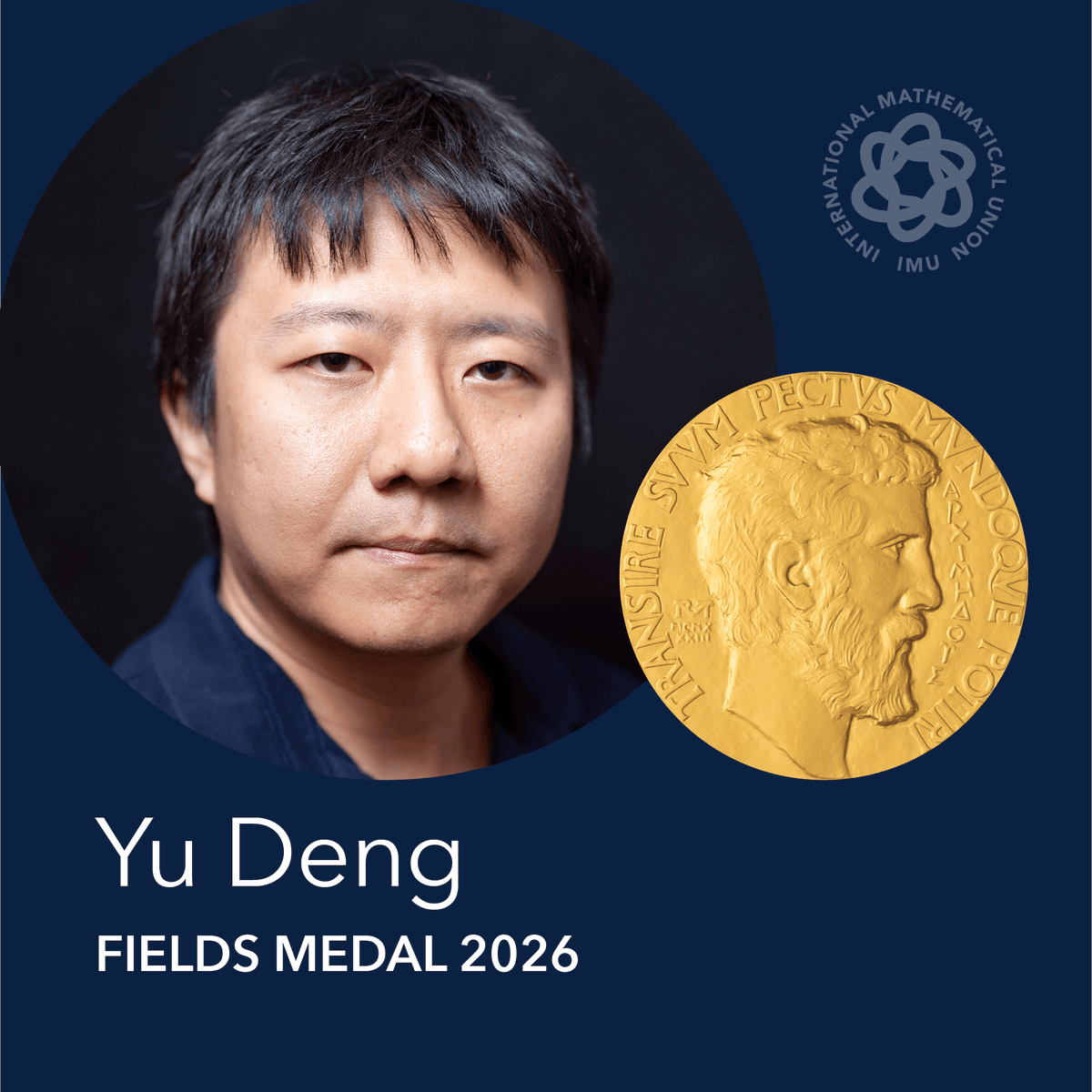
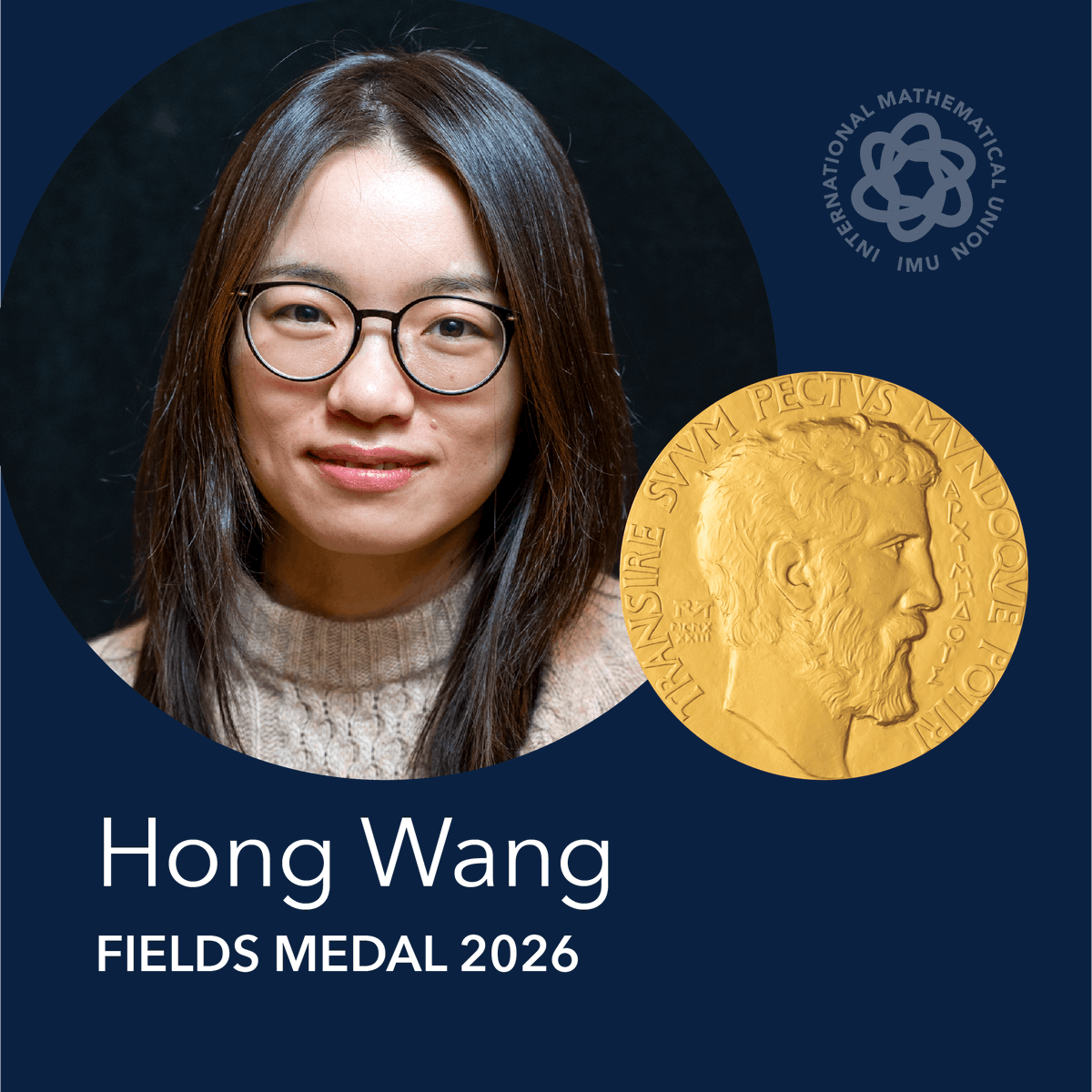
During today's #ICM2026 opening ceremonies, the IMU announced the 2026 Fields Medals recipients:
@UChicago's Yu Deng, @stonybrooku's John Pardon, @UofT's Jacob Tsimerman, and Hong Wang of @nyuniversity and @Institut_IHES.
Read more: https://t.co/oJARAI8I8j
Every four years, the math world’s preeminent awards are given to the finest minds of a generation. The young Fields and Abacus Medal winners — all under 40 on the first day of the year — have reshaped mathematics and theoretical computer science.
Here are the #ICM2026 winners:
Every four years, the International Mathematical Union honors the brightest stars in mathematics and computer science with the Fields Medal and Abacus Medal. Who will win this year? Follow our coverage this Thursday. #ICM2026
“AI’s solution to 87-year-old riddle takes mathematicians by surprise … Mathematicians have been trying to prove the Jacobian conjecture for nearly a century, but now the Claude Fable 5 AI has apparently found a counterexample that disproves it.”
https://t.co/Kaq8Gr3oqL
@AlexKontorovich Sadly I think AI will turn mathematicians into play by play announcers during sporting events, explaining to the public what AI has done but not engaging in the activity themselves.
@MrDanielBuck It buys you a better GPA, that’s for certain. It always amazing me how high GPAs are for transfer students but how little they actually know.
You bring up an excellent point. But the same is true with the other formula, as well. Constructing the parallelogram from the triangle requires some geometric concepts not taught at that level either. I’ve taught both over the years and have had success with both. I guess it just depends on the method of presentation and the goal of the presentation. Overall, I think Heron’s Formula is a must but we can debate when it is introduced. Excellent discussion.
@danposluns@hermitfriend It’s unnecessary nonsense. FOIL is just distribution. Watch students learn the FOIL method and then ask them to multiply a binomial and trinomial … like watching someone eat soup with a fork.
The triangle’s area would be half the area of the parallelogram that encloses it. And I think that’s a fine example that should be addressed, especially in a geometry class where derivation and proof is critical. But, in reality, most formulas are taught as “here … use this.” Textbooks then follow it up with carefully constructed examples that don’t exist in most instances of dealing with triangles.
Absolutely, let’s put it on notice that its days are numbered. Textbooks convince students that it’s the only wayto find the area of a triangle, taught from elementary through high school. In reality, it is basically useless unless you have the base and height of the triangle. Ask most students to find the area of a triangle with sides {5,6,7} and they can’t do it. Or worse, they just pick two of the values and use them as base and height. Heron’s Formula is far more useful because you need only the side lengths, which is more likely when dealing with a triangle.