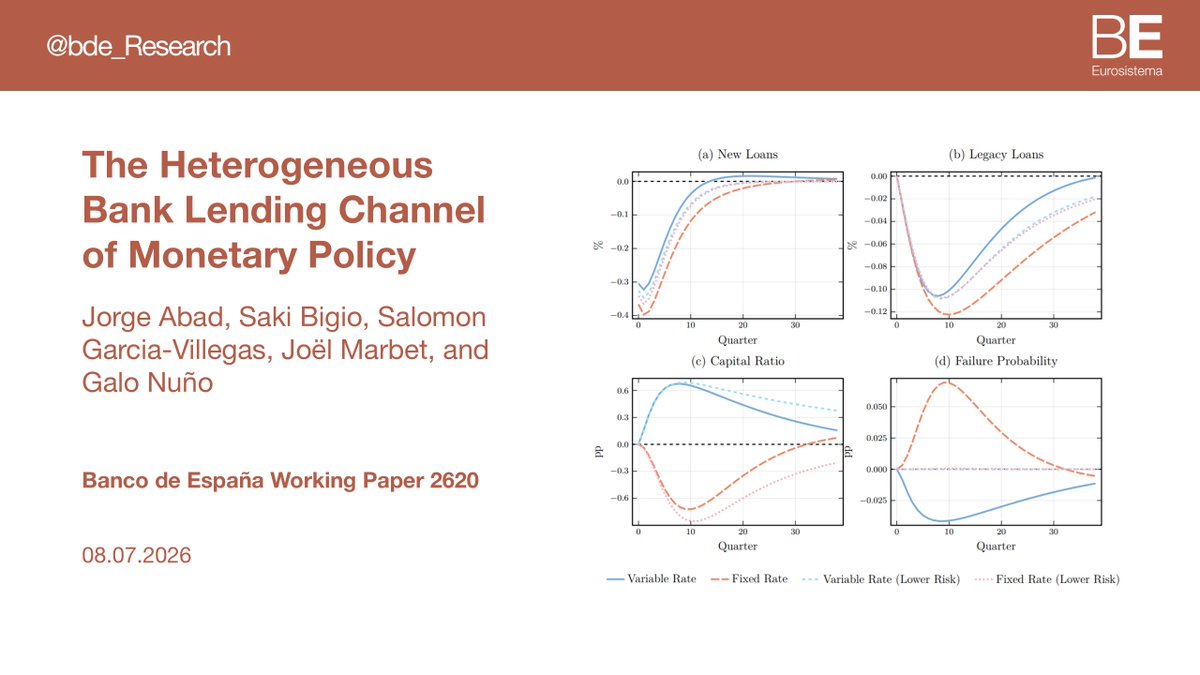
How does banks’ interest-rate risk exposure shape monetary policy transmission? This new paper shows that differences between fixed- and variable-rate banking systems can be amplified by banks' solvency risk. ➡️ https://t.co/R0Kjoyhz6n
📢@EJ_RES is pleased to announce the Special Issue on Climate Change and Inequality.
Edited by @albertobisin, 11 papers showcasing frontier research on one of the defining economic challenges of our time.
👉https://t.co/baAIKPKHUw
#EconTwitter@RoyalEconSoc
Slides for a new paper are now on my site (and below).
"Shockingly simple monetary shocks".
Joint work with Mu-Chun Wang.
Abstract: We identify monetary policy shocks by imposing that they produce a positive, monotonically declining path for nominal rates. We impose no restrictions on other variables, nor do we rely on external information. Nonetheless, this produces IRFs closely resembling those produced using high frequency instruments, with no price puzzle. We justify these restrictions by showing both that they are satisfied in a benchmark medium-scale DSGE model, and by showing that they are satisfied under optimal policy in simple models. Our shocks produce a large, immediate drop in the price level. Thus, the rapid response of prices to monetary shocks observed in recent studies is not an artefact of high frequency identification.
Global evidence from 33,262 mining sites shows that mineral price booms increase deforestation in nearby areas, beyond immediate mine sites. Investor origin shapes the size of these effects.
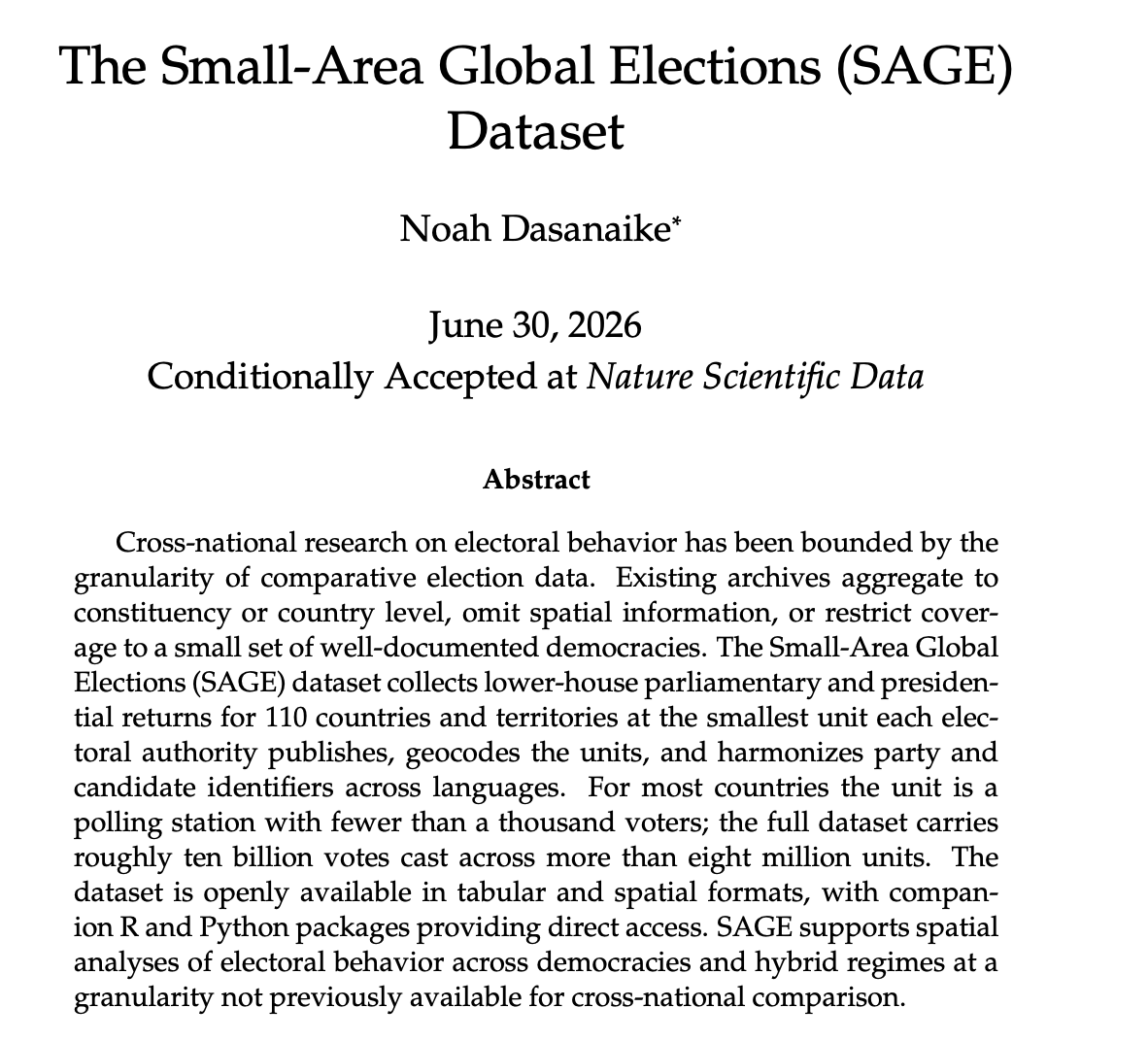
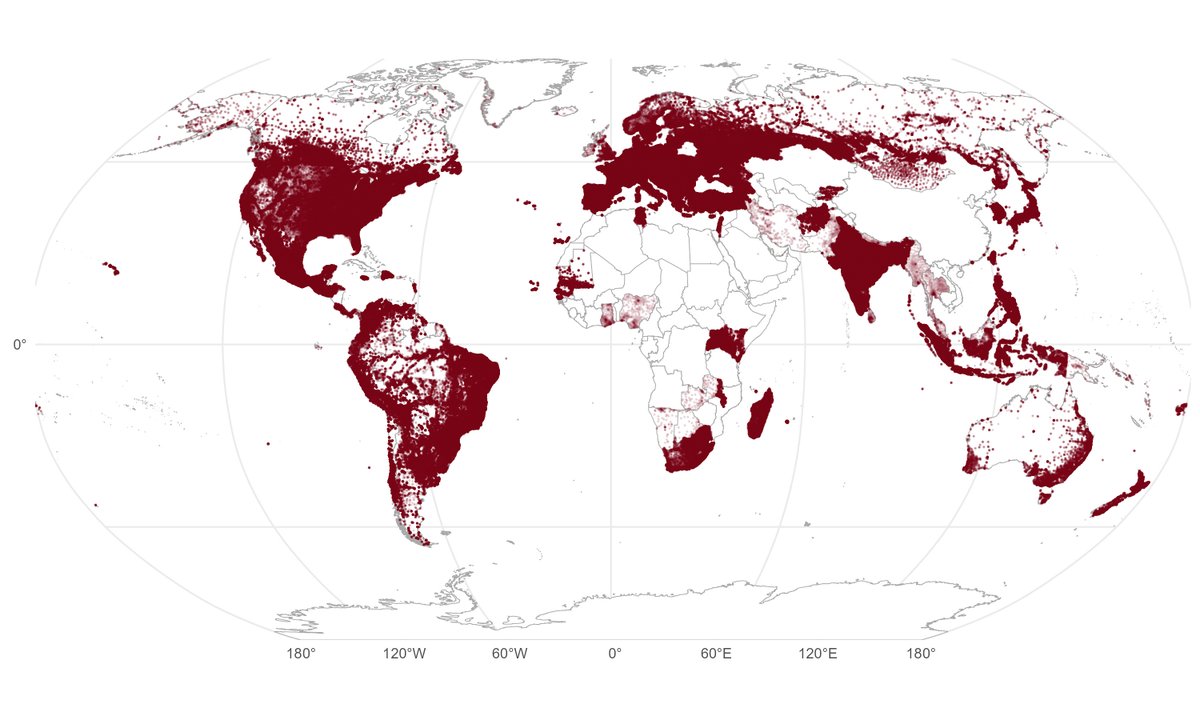
I'm proud to finally announce the first release of the Small-Area Global Elections (SAGE) dataset, encompassing global, granular, standardized, geocoded, polling station or equivalent-level election results for 110 countries, conditionally accepted at Nature Scientific Data. (1/n)
After staying near 63% for decades, the labor share—the fraction of output paid to workers as wages and salaries—now stands at an all-time low in the postwar period. How does the measure's post-COVID decline compare to earlier episodes? Read the post: https://t.co/GaufcB65LU
Submission deadine for LSE Environment Week is Sunday July 5, in just over a week.
Submission link: https://t.co/ZCIzhG5qIO...
The conference is Mon Sept 21 – Thurs Sept 24.
High-quality conference with great papers and people.
“Our planning ambition is to transform Uganda into a globally competitive, preferred tourism destination that significantly advances the Tenfold Growth Strategy achieving USD 50 billion by 2040.", Says @bugongaarnold, our Senior Planner, Cooperatives, Trade & Tourism
📚 The latest #EconomicBulletin is out!
It presents the economic and monetary information which forms the basis for our policy decisions.
Read the full issue of the Economic Bulletin https://t.co/B5TEmWk0lW
🌍 Announcing IDEA – the International Development Economics Association @ideadevecon
The field's first global, open, democratically governed professional association for development economists.
Sign up to join the community: https://t.co/LLcmUdECAx
🧵
🚨 Call for Volunteers - #AES2026 🚨
📣 Looking to gain hands-on experience at a high-level international event shaping #Africa’s economic future? Join us at the 4th edition of the Africa Economic Symposium, taking place in Rabat on July 13-14, 2026.
🔎 Held under the theme “Turning Transitions into Growth,” AES 2026 will bring together leading economists, policymakers, and academics to discuss Africa’s economic transformations and pathways for sustainable growth.
🎓 Open to Bachelor’s and Master’s students
🗣️ Languages: French, English, & Arabic
🗓️ Volunteer period: July 12-14, 2026
⏳ Deadline: June 26, 2026
🔗 Apply now:
https://t.co/zvW4iSZyWX
Chief Economist @thierrykalisa_ of the National Bank of Rwanda on how monetary policy evolves to keep inflation stable and maintain price stability in Rwanda.
"Monetary policy in #Rwanda is shaped by both global shocks, such as commodity price changes and external financial conditions, and domestic factors, including weather related disruptions and fluctuations in agricultural supply. Under the inflation targeting framework, the National Bank of Rwanda tailors its response to the nature and persistence of these shocks.
While temporary pressures may require limited intervention, more persistent inflationary risks call for timely and measured action to prevent broader spillovers and maintain price stability."
#BNREngage
#KnowYourCentralBank
Call for Papers & Participants - #Conference
The 16th Workshop on Exchange Rates will be held in Hong Kong on 10 – 11 December 2026.
Accepting applications through 13 September 2026 here: [email protected].
Full details here: https://t.co/H0LkRJH0YT
#AcademicChatter@hkimrhk
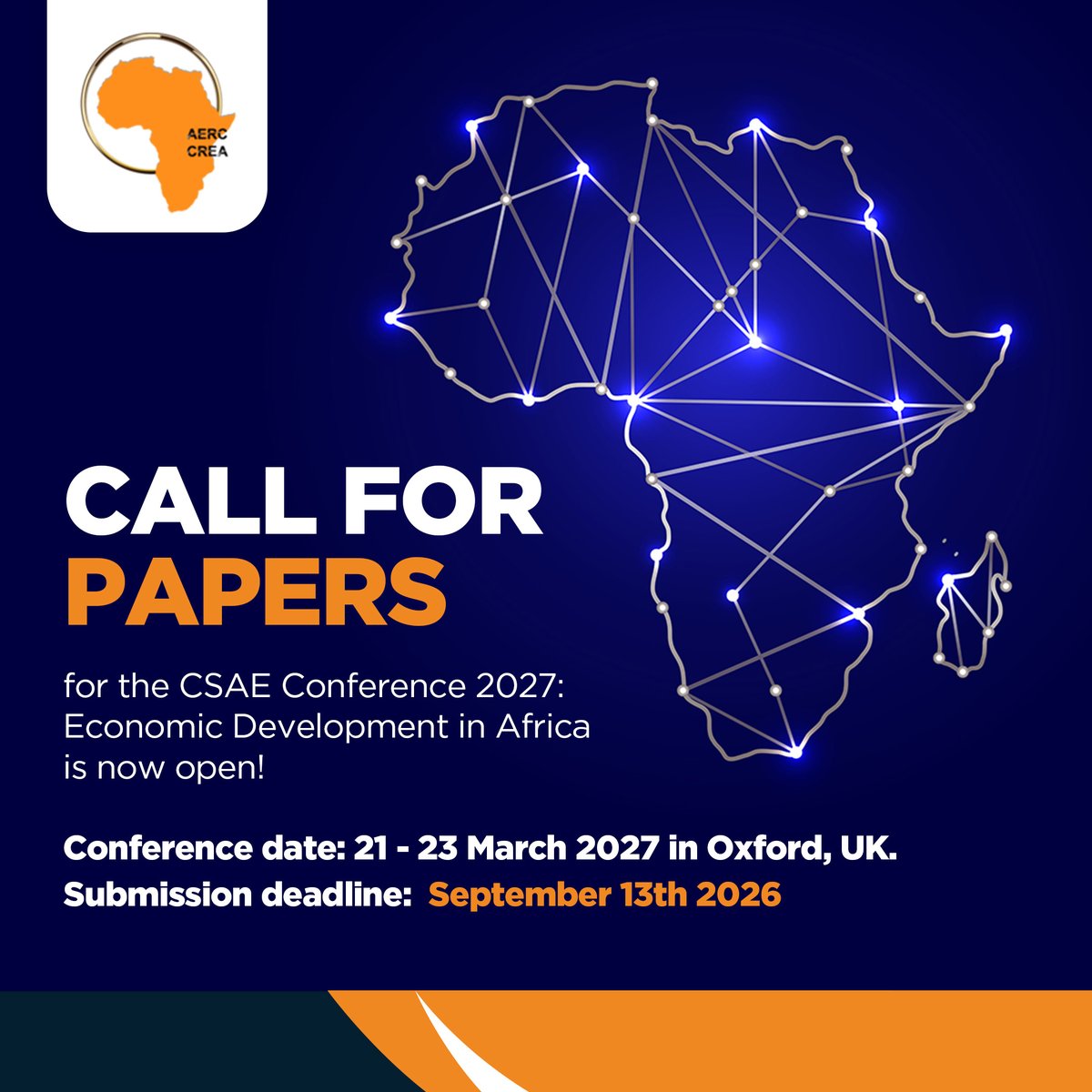
📢 Submissions are now open for the #CSAE2027 Conference, taking place 21–23 March 2027 at St Catherine's College, Oxford.
Researchers are invited to submit papers addressing Africa's key economic development challenges and opportunities.
Learn more and submit your paper: https://t.co/xJd5E4iMvb
#WeAreAERC #AERCImpact
Forecasting with Bayesian Panel Vector Autoregressions Using the R Package bpvars
Miguel Sanchez-Martinez, Tomasz Woźniak
https://t.co/wv2JSojycR [𝚎𝚌𝚘𝚗.𝙴𝙼 𝚜𝚝𝚊𝚝.𝙲𝙾]
Online Launch - Barcelona Report 8: Digital Money
CEPR & @iesebschool Banking Initiative present the 8th report in the Future of Banking Series.
15 June 2026 | 9:00 EDT/15:00 CEST
Speakers: Stephen Cecchetti, @DirkNiepelt, @helene_rey, Xavier Vives
Discussant: @LucreziaReichli
Register: https://t.co/Ddeu9LoX8t
Day 2 in Progress: STATA Training for Young Professionals in Addis Ababa!
Today, our junior professionals are diving into hands-on data exercises—mastering data cleaning, graphs, and making regression analysis simple and intuitive! 🔽 Join Us https://t.co/UMlclsBrmx
#STATA










![eBlogs's tweet photo. Forecasting with Bayesian Panel Vector Autoregressions Using the R Package bpvars
Miguel Sanchez-Martinez, Tomasz Woźniak
https://t.co/wv2JSojycR [𝚎𝚌𝚘𝚗.𝙴𝙼 𝚜𝚝𝚊𝚝.𝙲𝙾] https://t.co/MDkMvyuo1g](https://pbs.twimg.com/media/HK16EO1WMAAAc5_.png)


