Last week, we hosted the Athens Macroeconomics Workshop at the Athens University of Economics @AUEB and Business (Department of Economics).
Big thanks to our Keynote Speakers:
• Benjamin Born (@UniBonn ) @bornecon
• Ricardo Nunes (@UniOfSurrey )
Do you like economics? Are you an ambitious undergraduate or graduate student who wants to get to the frontier of research, and get there fast? I have created a suggested reading list — I think anyone could read every paper on it in less than two months. Link below:
A recent @JEconometrics paper by Team Scientists Susan Athey & @jannspiess and @nkeleher used machine learning to identify which students benefit most from digital nudges to renew financial aid. They found that nudging students who were least likely to renew was counterproductive—nudging those moderately likely to renew worked best: https://t.co/stflx2JQaJ
📈Thanks everyone for the amazing response to my first post!
I've uploaded the second stats lab with R for beginners on my webpage.
The topic is "What Does It Mean to “Control” in Regression Analysis?"
https://t.co/PS4vF6dg4x
#rstats#econ#stats#statistics#data
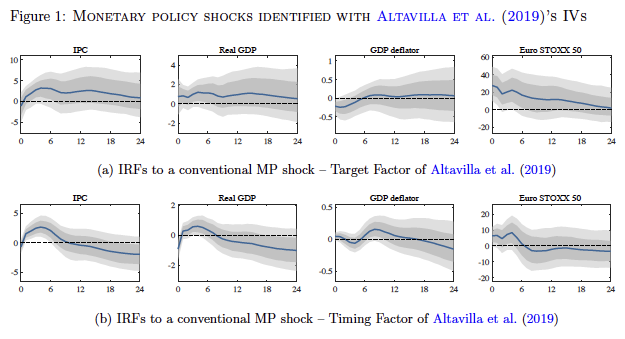
A new paper on "Monetary Policy, Information
and Country Risk Shocks in the Euro Area", with @sav_ema and @AnshumaanTuteja is out @cepr_org
What explains the puzzling responses to conventional MP tightenings identified with the @ecb policy surprises?
https://t.co/59GmBiwoQw
Yes! JEP paper shows that East Germany can be “spotted before it existed” in a whole range of economic and social data …. So you can’t just look at East/west patterns now and infer the lasting effects of living under communism /DDR
https://t.co/OimSVoxxq1
📣New WP alert📣
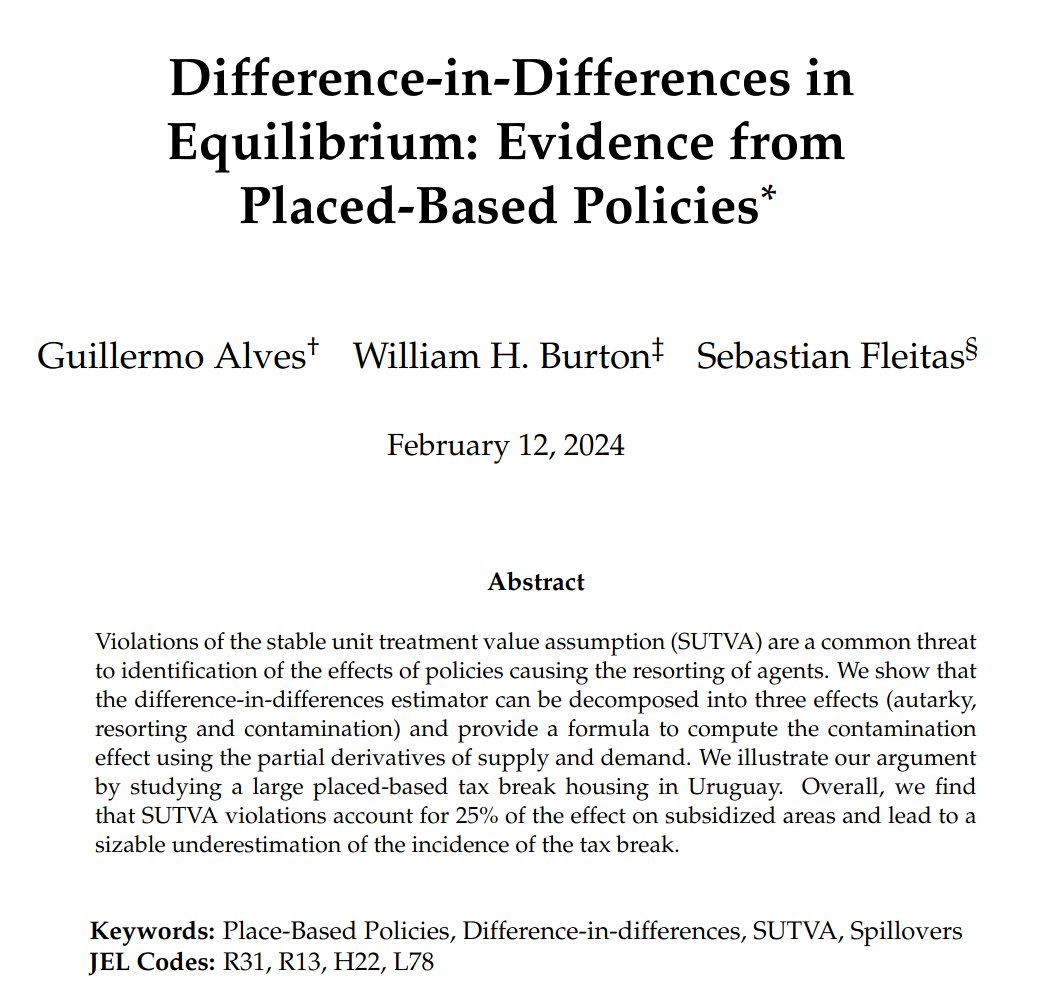
@guillermo_alves, @wh_burton and I study Differences-in-Differences under SUTVA violations caused by resorting of agents btw treatment & control.
We offer a bridge btw reduced-form & structural approaches & propose guidelines for applied research.
#DiD 🧵1/n
First paper of our new line of work combining Generative AI and Network Psychometrics: "Decoding Emotion Dynamics in Videos using Dynamic Exploratory Graph Analysis and Zero-Shot Image Classification: A Simulation and Tutorial using the transforEmotion R package".
In this paper, @atomasevic, Alexander Christensen, and I present several innovations:
1) Using Generative AI to compute emotion scores of videos,
2) Then modeling the emotion scores using Dynamic Exploratory Graph Analysis,
3) We validate the use of DynEGA as a way to model emotion dynamics via a simulation study.
In the simulation, we developed a new data-generation mechanism called the "Damped Linear Oscillator with a Measurement Model".
We implemented everything in a new SUPER COOL R package called "transforEmotion" (available on Github and on CRAN).
The paper also presents a method using OpenAI's CLIP transformer neural network for facial expression recognition in political speeches. Trained on a diverse dataset of 400 million image-text pairs, CLIP can execute various tasks, including emotion recognition, through natural language instructions, akin to the zero-shot capabilities of GPT models. To demonstrate this, the paper uses sampled frames from a public address by Boris Johnson. Using the transforEmotion R package, every 15th frame from the video was extracted, totaling 350 frames. These frames were then analyzed using CLIP's zero-shot image classification with labels for emotions like anger, fear, and happiness, focusing on Johnson's face. The analysis revealed predominant emotions of anger and fear, with their intensities changing across frames. This application produced six time series of Facial Expression Recognition (FER) scores, showcasing CLIP's effectiveness in capturing the emotional nuances in political speeches. Our proposed pipeline is summarized in the figure below:
Visual abstract. Top row: four frames of Boris Johnson's video; Second row: four bar plots showing the results of emotion detection procedure for each frame from the top row; Third row: time series of 6 emotions from 350 extracted frames of the video; Bottom row: network plot of dynamic EGA model of 6 time series with negative emotion dimension (red) and positive emotion dimension (blue).
The pre-print of our paper can be found here: psyarxiv [dot] com/hf3g7
This research was supported by the Fulbright Visiting Scholars Program (2023) and the Jefferson Trust (2024).
One of the best sources of real-time big data?
Google Trends.
However, despite what you may have heard, it can't simply be used off the shelf.
We need to make one important adjustment to it:
Inequality: The Deaton Review. The whole evidence volume of the Review, with clickable links to the remarkable set of commissioned articles across the many dimensions of inequality, is available here https://t.co/qIFO145Ixk
Using #causalinference and #satellite data, we quantify the protective effect of controlled fires on #wildfires in California’s forests, one step toward wildfire mitigation | @ScienceAdvances https://t.co/9N2UTw9w25
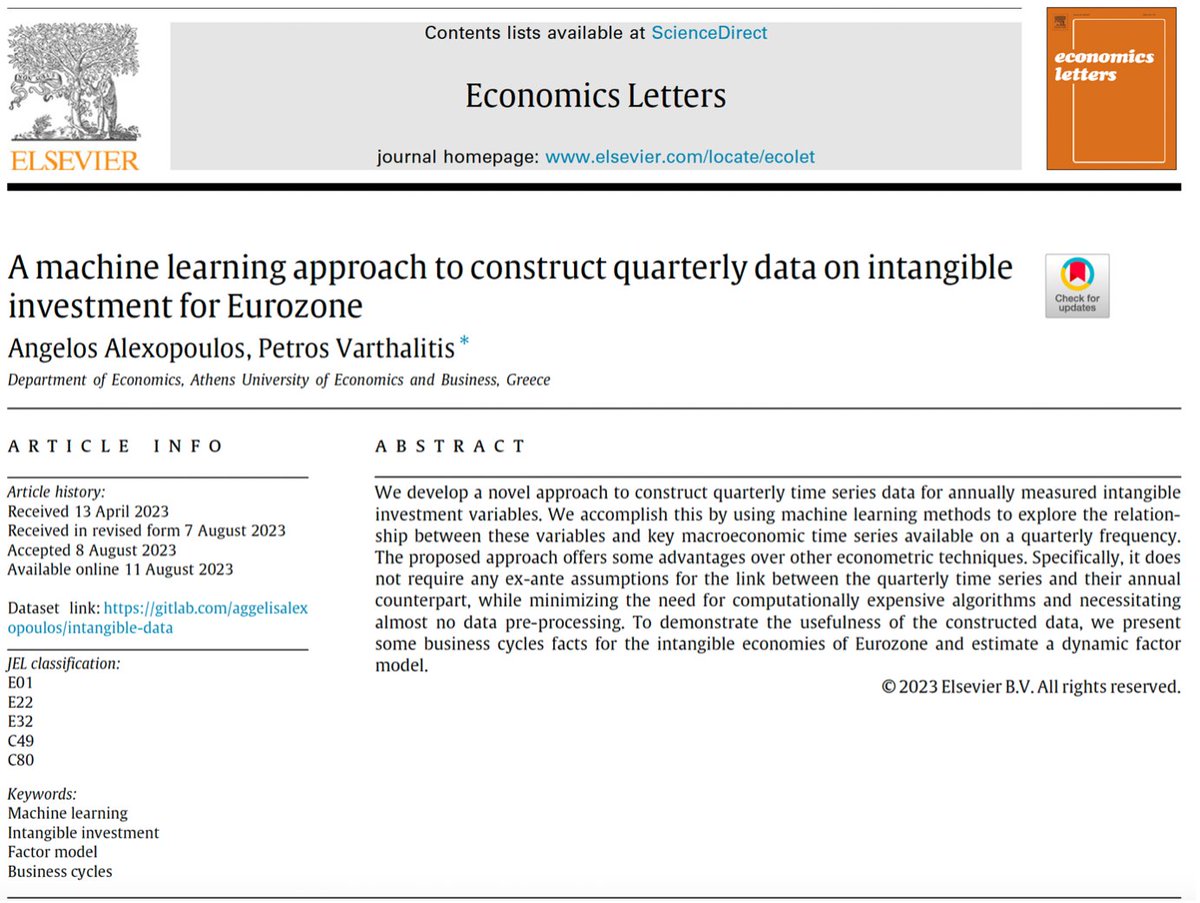
Our new paper with @p_varthalitis is online. We construct quarterly time series on intangible investment employing a machine learning approach. To do this, we utilize the newly integrated database #EUKLEMS & #INTANProd. (1/7)
Hi #EconTwitter!
Interested in #MachineLearning methods for causal inference?
The Summer Institute in Computational Social Science has a lot of interesting videos and tutorials on the subject.
Check it out! 👇
Links:
Playlist on DL, text analysis, etc: https://t.co/yKDH9VwBaA
SICSS main page: https://t.co/8eG7v4oqtk
Very happy to finally see this work with @guido_imbens published (after 6 years)!
The main message of the paper is that instead of using FE you can control flexibly for constructed group-level characteristics - the procedure that we call the Generalized Mundlack estimator.
Giulio Regeni was a Cambridge PhD student. He was murdered 8 years ago in Egypt because of his research.
Next week an academic event is to be held in Egypt. 27 other Italian colleagues, @giannetti_cate and me have written a letter to raise awareness.
https://t.co/H51i2Yjecd








![GolinoHudson's tweet photo. First paper of our new line of work combining Generative AI and Network Psychometrics: "Decoding Emotion Dynamics in Videos using Dynamic Exploratory Graph Analysis and Zero-Shot Image Classification: A Simulation and Tutorial using the transforEmotion R package".
In this paper, @atomasevic, Alexander Christensen, and I present several innovations:
1) Using Generative AI to compute emotion scores of videos,
2) Then modeling the emotion scores using Dynamic Exploratory Graph Analysis,
3) We validate the use of DynEGA as a way to model emotion dynamics via a simulation study.
In the simulation, we developed a new data-generation mechanism called the "Damped Linear Oscillator with a Measurement Model".
We implemented everything in a new SUPER COOL R package called "transforEmotion" (available on Github and on CRAN).
The paper also presents a method using OpenAI's CLIP transformer neural network for facial expression recognition in political speeches. Trained on a diverse dataset of 400 million image-text pairs, CLIP can execute various tasks, including emotion recognition, through natural language instructions, akin to the zero-shot capabilities of GPT models. To demonstrate this, the paper uses sampled frames from a public address by Boris Johnson. Using the transforEmotion R package, every 15th frame from the video was extracted, totaling 350 frames. These frames were then analyzed using CLIP's zero-shot image classification with labels for emotions like anger, fear, and happiness, focusing on Johnson's face. The analysis revealed predominant emotions of anger and fear, with their intensities changing across frames. This application produced six time series of Facial Expression Recognition (FER) scores, showcasing CLIP's effectiveness in capturing the emotional nuances in political speeches. Our proposed pipeline is summarized in the figure below:
Visual abstract. Top row: four frames of Boris Johnson's video; Second row: four bar plots showing the results of emotion detection procedure for each frame from the top row; Third row: time series of 6 emotions from 350 extracted frames of the video; Bottom row: network plot of dynamic EGA model of 6 time series with negative emotion dimension (red) and positive emotion dimension (blue).
The pre-print of our paper can be found here: psyarxiv [dot] com/hf3g7
This research was supported by the Fulbright Visiting Scholars Program (2023) and the Jefferson Trust (2024).](https://pbs.twimg.com/media/GFWarjDXUAAF6Lq.jpg)