Today, we remember the Uganda Martyrs whose faith remained stronger than fear. Their sacrifice continues to remind us of the power of conviction and the courage to remain true to our beliefs.
Wishing you a blessed #MartyrsDay.
🚨🚨HIGH COURT WARNS FAMILIES - YOU CANNOT PUSH OUT A WIDOW AND TAKE OVER HER LATE HUSBAND’S ESTATE
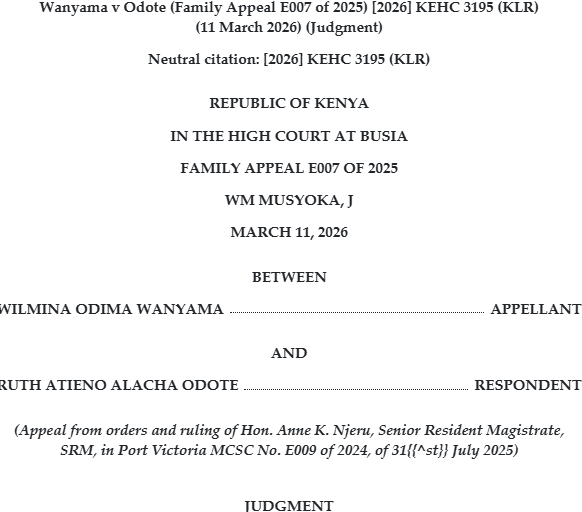
In a decision that quietly speaks to a common but rarely confronted family practice, the High Court of Kenya at Busia in Wanyama v Odote delivered a firm message: families cannot sideline a widow and quietly take control of her late husband’s estate. After the death of Sebi Alacha Wanyama, his mother swiftly petitioned for letters of administration and transferred the only known family land entirely to herself, leaving behind the widow and eight children. The widow later moved to court, arguing she had not been consulted and that the process had unfolded behind her back. The magistrate revoked the grant, and the matter escalated to the High Court.
In dismissing the appeal, Justice W. M. Musyoka emphasized a principle many families often ignore: the law places the widow first. Under Section 66 of the Law of Succession Act, the widow has priority over everyone else, including parents of the deceased. The Court found that the mother-in-law had not obtained the widow’s mandatory consent as required under Rule 26 of the Probate and Administration Rules, rendering the entire process defective. The judge further observed that knowledge of proceedings elsewhere could not cure this failure; compliance with succession law is not optional, especially where the effect is to disinherit a surviving spouse and children.
The Court also noted that the mother-in-law had earlier attempted to claim ownership of the land through a separate land case that had already been dismissed, cautioning against using succession proceedings as a backdoor to reclaim property. The appeal was dismissed with costs, and administration ordered to proceed under the widow’s case. The ruling lands as a quiet but powerful reminder: when grief strikes, the law expects families to protect widows, not replace them. And where families move quickly to take control of a deceased son's estate, the courts are increasingly willing to step in and restore order.
Please retweet.🙏
Happening Now: The Resident Judge of Kabale High Court, Justice Karoli Lwanga Ssemogerere, has commenced the hearing of Attorney General cases in the Kabale region, with a total of 20 files cause-listed for determination in a day-long session.
The matters before court arise from various litigants seeking relief, compensation, and other remedies against different government entities operating within the region.
The session follows recent efforts by the Chief Justice, Justice Dr. Flavian Zeija, who opened chambers for the Attorney General in the region. This development has significantly improved access to the Office of the Attorney General, enabling litigants and legal practitioners to engage more efficiently with government legal services.
The commencement of the hearing has drawn a notable influx of litigants and their legal representatives from greater Kabale. Among the law firms represented are M/s Muhangi Justus & Partners Advocates, Beitwenda & Co. Advocates, FIDA-Uganda, M/s Elgon & Co. Advocates, and M/s Bikangiso & Co. Advocates, among others.
Justice Ssemogerere is presiding over the matters, with litigants expressing expectation for timely relief and resolution of their cases
Caretaker who remains on land after the owner withdraws consent without justification, becomes a trespasser.
A caretaker cannot claim compensation for property maintenance where there is insufficient evidence of an agreement with the landowner.
Details👇
https://t.co/oUB4k3X3mL
On this special day, We celebrate the strength, resilience, and achievements of women everywhere. We appreciate the women who lead, inspire, and make a difference in our communities and professions.
To our valued clients and partners, thank you.
#HappyWomensDay! ✨#Remember 👇
Mr. Musiimenta Alex advised that individuals should explore alternative forms of dispute resolution, suggesting that Alternative Dispute Resolution (ADR) mechanisms be considered before resorting to formal court proceedings, promoting efficient and harmonious resolution
HIV jurisprudence on criminal negligence in Uganda;
1. Rosemary Namubiru vs. Uganda; H/C Cr. App. No.50 of 2014 (November 28, 2014) per Rugadya, J (Criminal Division).
2. Komuhangi Silvia vs. Uganda; H/C Cr. Appn. No.19 of 2019 (August 29, 2019) per Mubiru, J (Gulu).
In today’s @newvisionwire , the. URA Commissioner General- John R. Musinguzi @URA_CG , delves deeper about the waiver.
Take a read! ⬇️ & share with others.
#AskTheCG#FfeBanno