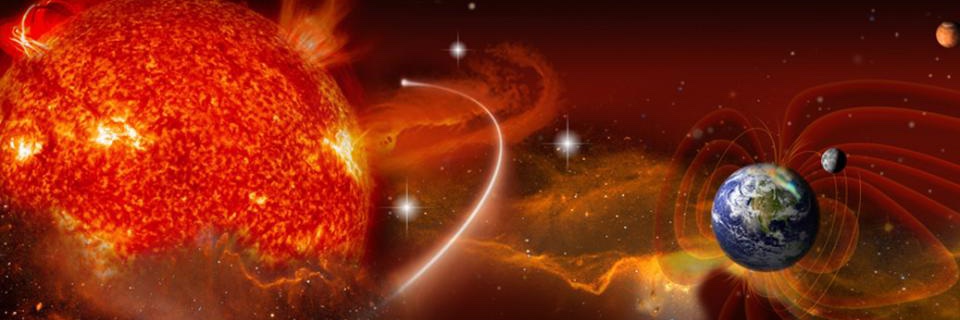
The NASA Heliophysics Education Activation Team (NASA HEAT) brings engaging educational programs about the Sun and its impact to communities across the nation.
We’ve changed our name! NSSEC is now the NASA Heliophysics Education Activation Team (NASA HEAT). ☀️ Here we’ll share educational activities and programs about the Sun and how our star affects the solar system!
Happy Pre-anniversary! 🎉
In exactly one year – on Oct. 14, 2023 – an annular solar eclipse will cross North America. An annular eclipse is when the Moon passes in front of the Sun and makes the Sun appear as a “ring of fire” in the sky.
(1/2) We’ve hit the end of the line – for now. Parker Solar Probe will continue venturing closer to the Sun in the coming years, bringing us new science & insight about our star.
Until then, we invite you to sing along as we recap the 12 days of the #SolarTour in a festive song!
NASA HEAT member Aurorasaurus is a great example of how citizen scientists contribute to scientific research, as seen from their many presentations at AGU
Today is the 2021 #NASAStem-a-Thon! 💫 Tune in all day until 8 p.m. ET for the live event. You can also access the content and resources through Friday, Nov. 26! Learn more here: https://t.co/aAb0cyZHuV
It's never safe to look directly at the Sun — but you can create a solar viewer at home so you can safely observe our star! Download this activity from @uafairbanks Museum of the North so the whole family can learn about the Sun: https://t.co/MRz71hH7QG
Citizen science can help answer questions like "why was last night's aurora so wild?" Please help us fill the map with backdated aurora reports that scientists can compare with satellite data, so we can all learn more! Pass it on! 🦕✨
It's #NativeAmericanHeritageMonth! Recordings of the Indigenous Education Institute's webinar series "A Sense of Place: Indigenous Perspectives on Earth and Sky" are available online. Watch them here: https://t.co/cNH2cUCFmg
#Mentoring365 is working to create a diverse, equitable, and inclusive workforce equipped to address the challenges our environment and planet are facing.
Learn more: https://t.co/fRa5DvkRb3
NASA’s #LucyMission is on its way to the Trojan asteroids, which formed when our Sun was but a wee baby star. 👶 ☀️
But the Trojans have changed since then -- partly from the Sun’s influence.
More on our Sun’s effect on these ancient asteroids: https://t.co/DbpeWye8ep
Physics teachers, want to bring more educational content about the Sun to your classroom? Join @AAPTHQ’s “Physics in an Astronomy Context” workshop, taking place Oct. 23 at 1pm ET. Learn more & check out upcoming @NASA science education activities: https://t.co/8dT0rtrnvx
What do you think we’ll discover when we #UnfoldTheUniverse? Show @NASA what you believe the @NASAWebb telescope will reveal by creating art. More info, including deadline: https://t.co/RcMdl5QLj6
We are SO excited to announce the Space Apps 2021 Global Nominees! These nominees represent the top projects from the local virtual events and the Universal Event. Congratulations! 🎉
360+ were selected as Global Nominees! See our Global Nominees here: https://t.co/eGpgyM8kfz.
Earth sails the solar wind in a ship of its own making: the magnetosphere, the magnetic field that envelops and protects our planet. ⛵️ New research using @NASA data shows unexpected waves in the magnetosphere that form in response to the solar wind. https://t.co/322AGo5Qhm
It’s that time again… For ~two weeks every two years, the Sun lines up between Mars and Earth, blocking reliable communication.
For Mars robots, this solar conjunction means a break from new commands.
Have a great vacation, @NASAPersevere & friends!
https://t.co/0vjXPj75E9
The NASA citizen science leaders workshop series is coming back on September 30, so more people can @DoNASAScience! This fall, the series will focus on strong data practices for NASA citizen science projects. Learn more: https://t.co/IxJX0FCbCb
Have you ever wondered what the Sun is made of?
The Sun is not a great ball of fire. It’s made of plasma, a state of matter made up of atoms that have broken down into ions and electrons. Plasma is rare on Earth but it makes up over 99% of all observable matter in the universe.
NASA HEAT member @arisa_lab has a new blog up on the @perkinsvision Paths to Technology website! Learn more about the @EclipseSoundUDL Mobile Application and their work to create an accessible solar eclipse experience using innovative technologies. https://t.co/qEIOKajhrh
New blog post: Magnetosphere, Bz, & plasma, o my! 😮 The language of aurora science can be a learning curve for newbies, so we’ve created a list of some of the most common terms at a beginner level. Read more and please share! 🦕✨ Photo: @aurorachaseryyc
https://t.co/2Evu7tb4Rd
This video about the beauty and science of auroras from NASA HEAT members @scifri and @uafairbanks was shared by @WPBSTV. Watch to learn more about auroras and how scientists study them: https://t.co/gxzQfDBXU6