The National Council of Applied Economic Research, India’s largest independent economic think tank, supports policymaking through research and data collection.
NCAER faculty member and IEPF Chair Professor @csmohapatra_dr delivered a Special Address to the Core Group on NSFE 3.0 (2026–31) at NCFE, Vashi on 2-3 August 2026, calling for more targeted, actionable and behaviour-oriented financial education. He proposed four additional Cs—Class-Orientation/Categorization, Cyber Safety, Claim and Convergence—to complement the existing 5C approach, with emphasis on life-stage needs, digital safety, AI-enabled frauds, credit-score literacy and financial inclusion. Senior Research Analyst, IEPF Chair Unit, @Depannita2 presented on “Reducing Unclaimed Financial Assets through Financial Education: Priorities for NSFE 3.0.”
NCAER faculty member and IEPF Chair Professor @csmohapatra_dr and Senior Research Analyst @Depannita2 participated in an NSE Investor Awareness Session at NSE Exchange Plaza, Mumbai on 1 August 2026, on “Investor Protection and Market Development: Advancing the Depth, Breadth and Inclusiveness of Capital Markets.” Prof. Mohapatra delivered the keynote on investor awareness, protection, and informed investing, while Ms. Depannita highlighted the importance of greater investor awareness for a more inclusive and resilient financial ecosystem.
Looking to make an impact in governance and institutional affairs? Join NCAER as Manager – Governance, Legal & Secretarial Affairs.
Apply now: https://t.co/kPfaq7lmPg
Local and global factors that sustain the primacy of the dollar continue to be in play despite geopolitical faultlines, Professor @B_Eichengreen told delegates at the NCAER-ICAP Lecture.
Drawing from his latest book, Money Beyond Borders: Global Currencies from Croesus to Crypto published by @PrincetonUPress, Professor Eichengreen explored the rise of potential alternatives, such as the euro, renminbi, gold, the Indian rupee, CBDC networks, Project Agora and non-traditional currencies.
Watch the full lecture here: https://t.co/B3gSpwgxxe
Why are many households cooking dal on LPG but roti on a chulha?
NCAER faculty members Suvajit Banerjee and Madhura Chowdhuri examine what Kharif-season cooking patterns reveal about the affordability and sustainability of India’s transition to clean cooking. Their findings show that households often respond to the costs and practical constraints of clean fuels by reverting to a mix of traditional and modern cooking fuels.
Read more: https://t.co/cExnVGnrRb
NCAER faculty member @Nishat_1495 was invited as a speaker at the Behavioural Insights for Policy (BiP) India Workshop, held on 25–26 July 2026 at IIM Kozhikode. In her presentation, “Colourism, Confidence and Productivity: Experimental Evidence from India,” she shared experimental evidence on how skin colour, as a visible identity marker, can shape confidence, productivity, and experiences of discrimination.
How prepared are students for NEET’s shift to computer-based testing?
NCAER faculty member @DibyasreeG examines India’s digital preparedness for NEET’s transition to computer-based testing from 2027, drawing on the NCAER–The Quantum Hub report based on NCAER’s IHDS-III (2022–24) data. She highlights persistent digital disparities and underscores the need for sustained investment in digital preparedness, alongside stronger examination security and transparency to ensure all students can adapt to the new format.
Read more: https://t.co/0wLR9otAt1
What does “good mothering” actually mean to married women in Delhi?
A new study by NCAER faculty member @Iamjyotithakur draws on Hays’ Intensive Mothering Ideology to explore how married women in Delhi understand and negotiate the ideals of motherhood.
The study examines how culture, religion, age, education and employment shape whether women internalise, negotiate or contest prevailing norms of “good” motherhood.
Read more: https://t.co/M8cHjUCUhd
Join NCAER’s Centre for Economic Growth (CEG) as a Research Associate and contribute to policy-oriented research through data analysis, research, diagnostics and evidence-based policy work on India’s growth, productivity, jobs, trade and urban development.
Apply here: https://t.co/LNPaOwEtop
Humankind is at an inflection point, we must act now to protect future generations - Arunava Majumdar, Dean, Stanford Doerr School of Sustainability (@stanforddoerr), Stanford University told delegates at IPF 2026.
Join NCAER’s new Centre for AI, Digital Public Infrastructure and Digital Futures (CADF) as a Fellow and contribute to cutting-edge research and policy work on AI, DPI, digital transformation and the digital economy.
Apply here: https://t.co/1Z92QFLIxY
AI should make knowledge accessible across languages for a billion Indians.
@NandanNilekani, Co-Founder and Chairman, Infosys; Chairman, NCAER Governing Board, said in his keynote address at the India Policy Forum, hosted at our campus last week.
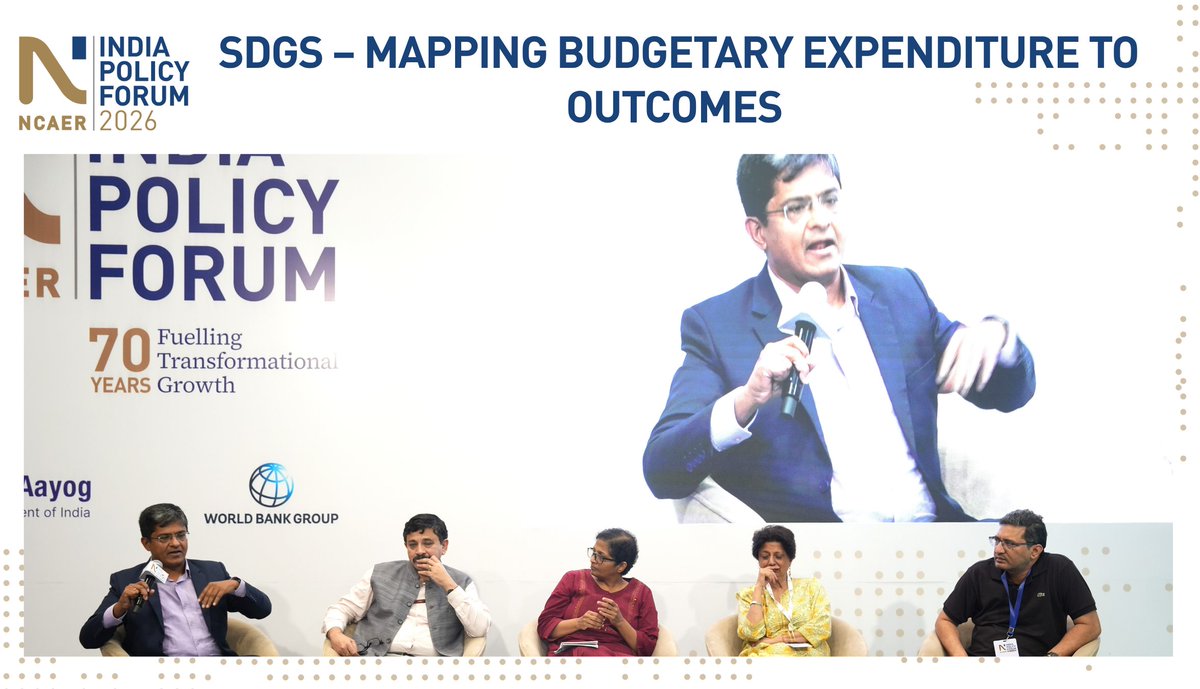
Speaking on “Gender Inequality in India, SDGs, and Link with Macroeconomy,” Professor Ratna Sahay (@ratna_sahay) of NCAER said that the key outcome targets should include women’s full participation in economic life, with equal rights to economic resources, land and property; greater access to and use of technology; stronger representation in leadership and decision-making; and universal access to sexual and reproductive health.
She made these observations at IPF 2026, hosted by NCAER in collaboration with NITI Aayog and the World Bank, during a session on “Accelerating Human Development: Systems and Interventions.”
An annual independent district-level household survey could be a game-changer for governance, said @karthik_econ, Tata Chancellor’s Professor of Economics at the University of California, San Diego, at IPF 2026, hosted by NCAER in collaboration with NITI Aayog and the World Bank.
Sharing his conviction that such a survey could enable the regular measurement of key Sustainable Development Goal (SDG) outcomes, Professor Muralidharan said it would provide independent indicators of development and growth, as well as learning outcomes, nutrition, health, and employment. Speaking on “Accelerating Human Development: Systems and Interventions,” he noted that the Telangana survey model provides a proof of concept for conducting similar surveys in aspirational districts across different states.
While India has made a significant progress in reducing maternal and child mortality, we need to focus our attention on the next major challenge: nutrition. Speaking at the IPF 2026, which was hosted by NCAER in collaboration with NITI Aayog and the World Bank, Santosh Kumar Gautam (@santosh_econ), Professor of Development and Global Health Economics at the University of Notre Dame, noted at a panel discussion on states and the Sustainable Development Goals. In his remarks he highlighted that children born with low birth weight are less likely to attend school, less likely to achieve better educational outcomes, and more likely to suffer from ill health as adults.
These disadvantages, he said, have far-reaching consequences for productivity, educational attainment, and poverty reduction. He also drew attention to anaemia, describing it as a “silent epidemic” that is undermining physical development and, ultimately, the quality of India’s growth.
A core takeaway from the session on ‘Industrial Policies’ was that industrial policy is most likely to succeed when it facilitates learning and technological upgrading, enables firms to achieve scale, builds domestic linkages, and exposes them to international markets. The session was organised as part of the ongoing India Policy Forum (IPF) Conference, jointly organised by NCAER, NITI Aayog, and the World Bank. It was moderated by Franziska Ohnsorge, Chief Economist for Asia at the World Bank.
The panel featured Shekhar Aiyar, Director and Chief Executive, ICRIER; Nagesh Kumar, Director and Chief Executive, ISID; Laveesh Bhandari, President and Senior Fellow, CSEP; and Rana Hasan, Director, Centre for States Economic Growth, NCAER. The panellists also critically examined the importance of administrative capacity, strategic and national security considerations, foreign direct investment, and ‘learning by doing’ in shaping the effectiveness of industrial policy.
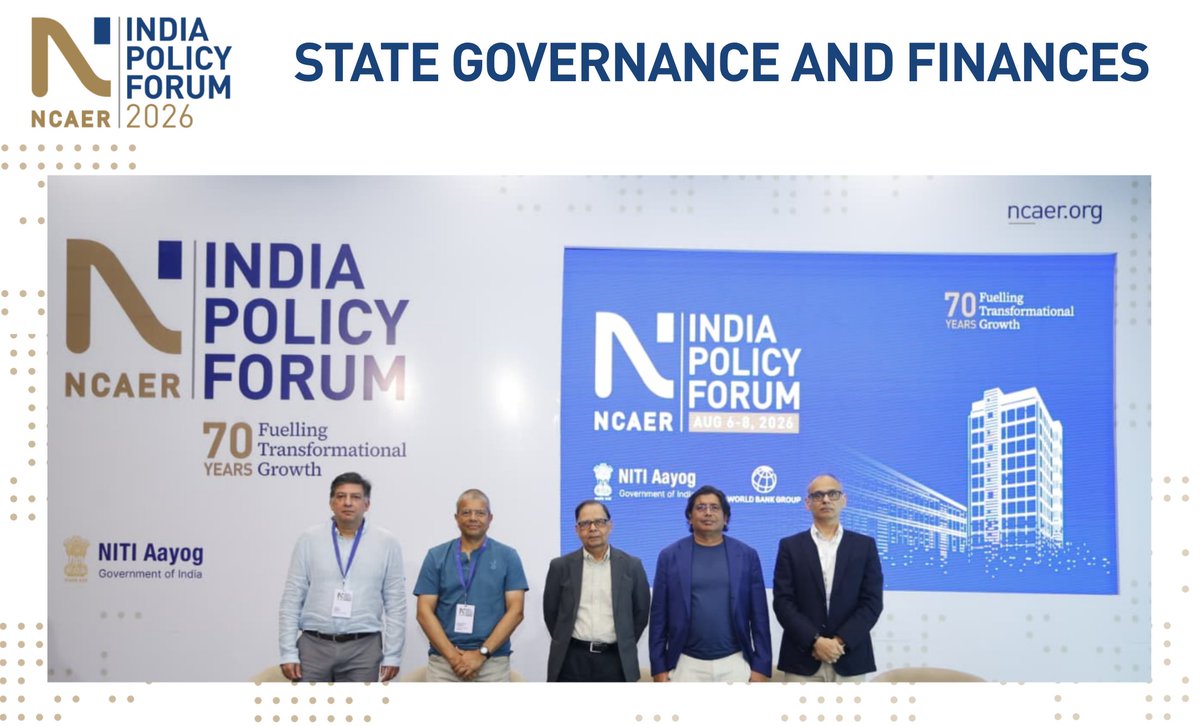
Per capita income depends critically on a country’s structural transformation, with urbanization being one of the most important drivers. India’s pace of urbanization remains relatively slow, and achieving at least the 60 per cent threshold should be a key priority for states. Dr @APanagariya, Professor, Columbia University and Former Chairman, 16th Finance Commission, made this observation while chairing a panel discussion on State Governance and Finances at the IPF 2026 hosted by @ncaer jointly with @NITIAayog and the @WorldBankIndia. The other distinguished speakers who participated in the panel were: Professors Alok Johri, McMaster University; Amartya Lahiri, University of British Columbia; Ravi Bapna, University of Minnesota; and, Mr Suresh Goyal, Director General of NCAER.