The opponents seem to miss two important points: the railroad tracks were there long before most of the residents, and the service will benefit many more people than simply the private investors.
High speed rail to O'Hare sounds like a good idea, right? Not everyone thinks so.
STOP - Stop The O'Hare Passthrough | Protect Communities Now - Take Action
Four slides. Four serious questions about the proposed UP-NS merger.
Yesterday, BNSF filed its opposition to the transaction with the Surface Transportation Board, supported by a 250+ page brief, more than 130 exhibits, declarations from three BNSF executives and five expert witnesses, and terabytes of supporting data and workpapers.
Among the evidence:
➡️ Is Committed Gateway Pricing really a competitive remedy? CGP is a claim that a railroad will charge fair, pre-set prices when handing freight over to competing railroads so that customers will have affordable options. But UP/NS's own CGP sponsor could not identify a single shipper that would receive increased access or a better rate through the program.
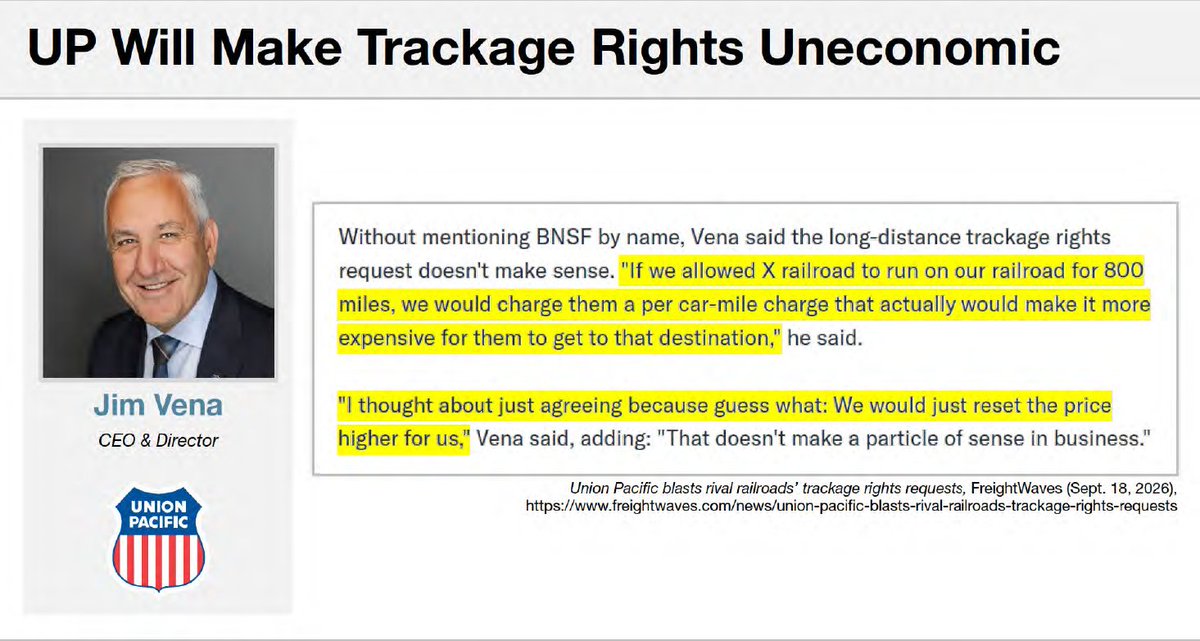
➡️ Can trackage rights preserve competition? UP CEO Jim Vena has openly described how Union Pacific could charge rates that make a competitor's long-distance access uneconomic, exposing the truth that trackage rights are not a reliable way to replace competition lost through the merger.
➡️ What happened to the growth story? Union Pacific initially promoted the merger as a way to “unleash growth” and take trucks off the highway. Later, UP/NS argued that achieving the merger’s public benefits shouldn’t be measured by traffic diversions from trucks to rail.
➡️ Can the traffic forecasts be trusted? Six iterations, hundreds of corrections, more than 214 replacement workpapers and thousands of individual workpaper errors raise serious questions about UP/NS’s traffic analysis.
Taken together, the evidence reinforces what BNSF and many others have said from the beginning: this merger would not enhance competition, it would reduce it.
And this is only a small part of the evidence. See BNSF’s full Summary of Evidence and other materials examining the merger’s potential impacts on competition, customer choice and the freight rail network under STB Filings at the BNSF Merger Resource Center: https://t.co/7IE15XURbm
BLET locomotive engineers and conductors launched and won a nine-hour strike at the Wheeling & Lake Erie Railway (W&LE) earlier this week. The BLET’s 140 engineers and conductors shut down the W&LE after the railroad insisted on using managers to work as conductors, even though BLET crews were rested and available for work. This was a clear violation of the union’s contract and violated a 2013 order from the federal courts, specifically related to this issue at this railroad.
“It’s important for someone to stand up for the little guys and make sure their voices are heard,” said Owen Perry as he walked the picket line in Brewster, Ohio. “We have our rights, and they’re being protected.” Perry is a W&LE engineer who serves BLET as President of Division 292 in Beach City, Ohio.
Picket lines were set up at key locations in Ohio and Pennsylvania beginning at noon on November 11. W&LE, one of the largest regional railroads in the nation, operates trains on 840 miles of track from Hagerstown, Maryland, across West Virginia and Pennsylvania, servicing Pittsburgh and cities in Northeast Ohio, terminating in Toledo.
BLET General Chairman Scott Bunten said the decision to strike was not made lightly. But with legal precedent on its side, BLET was able to put a strike plan into effect quickly. “Management ran those trains Sunday and we were on strike at noon on Wednesday,” said Bunten, whose Norfolk Southern-Eastern Lines General Committee of Adjustment represents the W&LE members. “We had strike captains in each location that we picketed, and all were on location at 12 noon. They got on radios, told everybody to shut it down. Everybody secured their equipment, secured their engines, put off, and joined the picket lines. The response from our members was awesome.”
In launching the strike, President Mark Wallace said the W&LE members had the full support of the National Division and the International Brotherhood of Teamsters. President Wallace, First Vice President Gary Best, and several employees of the BLET National Division walked the picket lines in Akron, Canton, Brewster, and Norwalk, Ohio.
The brief but successful strike ended around p.m. Wednesday after management capitulated to BLET’s demands. The railroad agreed in writing to abide by the contract, stop using managers to perform the work of union engineers and conductors, financially compensate the crewmembers who were replaced by carrier officials, and not pursue discipline against BLET members who participated in the strike. A PDF of the settlement letter is available here: https://t.co/tYpShOxgeO.
“We’re pleased that the railroad’s management has agreed to honor the contract, comply with the federal court order and return to best safety practices,” President Wallace said. “Conductors play a critical role in a two person crew and in keeping trains safe. Both crafts represented by the BLET, engineers and conductors, stood together to protect the work of the conductor. That is how we preserve the two-person crew requirement and help keep our communities safe by standing together, united as one.”
@UnionPacific@nscorp If only it were that simple. Never mind the fact that most of the goods go to a warehouse and not directly on store shelves.
It's a shame that UP thinks consumers are so stupid.