CNBC interviewer asked Palantir CEO Alex Karp how he would defend Wall Street’s concern that AI could replicate what Palantir is doing.
Karp defended by basically saying that AI companies may have great engineers, but they do not deeply understand the messy, high-stakes enterprise problems Palantir solves on the ground.
------
Alex Karp: "No one in enterprise factually is worried.
I've spent all my life, for better or worse, dealing with the most complicated, most interesting enterprises. I'm on the ground floor of that, probably like no one else. Those kinds of engineers are great engineers, and I'm telling you, they don't talk to the enterprises or understand the technical challenge.
If you want to manufacture a car and you need a part, or you want to send a rocket to the moon, or you want to put a missile on your adversary's head and bring America home safely, that stuff doesn't ship.
And by the way, there is not a single high-end enterprise like that that would ever put that in place. That is before you even get to the cultural impasse."
----
From "CNBC Television" YouTube channel, (link in comment)
📢 Great News for All OCI Cardholders!
The e-OCI (Electronic OCI Card) has been officially launched!
No more carrying your physical OCI booklet everywhere. You can now download your digital e-OCI Card on your mobile phone and present it at Immigration Check Posts and to airlines.
How to Download Your e-OCI Card (For Existing OCI Cardholders)
1️⃣ Log in to the OCI Services Portal: https://t.co/iJeqCUBzXJ using your existing User ID and Password. If you are not already registered, complete the registration process using the e-mail address provided at the time of your OCI application.
2️⃣ Once logged-in, click on the e-OCI tab on the dashboard.
3️⃣ Your application details will now appear. In the last column, click on Generate e-OCI Card.
4️⃣ Your e-OCI Card will be generated and made available for download.
5️⃣ Download and save the e-OCI Card on your mobile phone. You can present the digital version at Immigration Check Posts and to airlines whenever required.
Your existing physical OCI Card remains valid.
Download your e-OCI Card today and enjoy the convenience!
Share this information with your family and friends who are OCI Cardholders.
#OCI #OCICard #India #Immigration #FRRO #OCIServices
Stop bookmarking 50 guides you'll never read.
You can skip all of it with these 15 free guides:
Claude 101: https://t.co/jw2qdIcjnh
Claude Code: https://t.co/UgE9xBXVbE
Claude Skills: https://t.co/6cHYYfjXEA
Stop prompting: https://t.co/j1LATSJiat
Claude in Excel: https://t.co/mfcXYSACWR
1M followers with AI: https://t.co/jZwxZr4ZhU
Claude for your team: https://t.co/qxlcqhf8bM
No prompt saves you: https://t.co/SDKJWylftC
AI Slides (PPT in 2026): https://t.co/L0bPMgXci6
Set up Claude Cowork: https://t.co/uWTpOI3Woc
Claude to sound like you: https://t.co/99RzxXU3p0
Claude interactive charts: https://t.co/ebCHGZqOF1
Claude as your computer: https://t.co/TxYuHPjgbV
Claude Cowork + Project: https://t.co/Q7AN9CZAbO
Set up AI before prompting: https://t.co/pE3OF72A04
___
1. Save this list for later (three dots, top right).
2. Share it with a friend by ♻️ reposting this image.
3. Subscribe to my free newsletter: https://t.co/psB7XxB2Y4.
Instead of watching an hour of Netflix, watch this 2 hour hour Stanford lecture will teach you more about how LLMs like ChatGPT and Claude are built than most people working at top AI companies learn in their entire careers.
🚨BREAKING: Claude has a feature called Learning Mode.
You can use it to learn literally anything, step by step, like a personal tutor.
Here’s how to access it.
2026: AI models hit 10 trillion parameters
2028: Humanoid robots in every warehouse
2030: Bioprinted organs in transplant centers
2033: Longevity escape velocity achieved
We're not predicting the future. We're building it. Which timeline are YOU on?
Christina Koch was a firefighter at the South Pole at -111°F before she ever applied to be an astronaut. That was maybe the fourth most interesting line on her resume. She grew up in North Carolina, got three degrees from NC State, and her first real job was building deep-space instruments at NASA.
Then she left for Antarctica. Spent three and a half years bouncing between the Arctic and Antarctic as a research scientist, including a full winter at the South Pole base. That means going months without sunlight or fresh food, with a crew of about 50 people and no way out until flights resume. While she was down there, she also joined the glacier search-and-rescue team.
After coming back, she went to Johns Hopkins and built instruments for two NASA missions (one of them is still orbiting Jupiter right now). She figured out how to start a tiny vacuum pump that NASA designed for a future Mars rover. Johns Hopkins nominated it for their Invention of the Year in 2009. Then she went back to the field. More time in Antarctica and a stretch up in Greenland. A government research station in northern Alaska, near the top of the world. Then she ran another one in American Samoa, near the equator.
In 2013, NASA selected her from 6,300 applicants. Eight people got in. Her first space mission was supposed to be a normal rotation on the International Space Station, but NASA extended it. She ended up staying 328 straight days and orbiting Earth 5,248 times, covering about 139 million miles (roughly 291 round trips to the Moon). Up there, she ran over 210 experiments, including tests of cancer drugs in zero gravity and 3D printers that can build structures close to human tissue. Six spacewalks, 42 hours floating outside the station. She learned Russian for the training. She flies supersonic jets.
Right now, Koch is on Artemis II, heading for a flyby behind the far side of the Moon. The crew launched on April 1 and is on track to travel about 252,000 miles from Earth, which would break the all-time human distance record of 248,655 miles set by Apollo 13 in 1970. That record has stood for 56 years, and it was set during a disaster that nearly killed the crew. Fred Haise, one of the Apollo 13 astronauts, is 92 now. He told Koch: "I heard you're going to break our record."
Nobody had left Earth's neighborhood since December 1972. Koch and her three crewmates are the first in 53 years, and they are coming home at about 25,000 mph. That is faster than any crewed spacecraft has ever come back through the atmosphere.
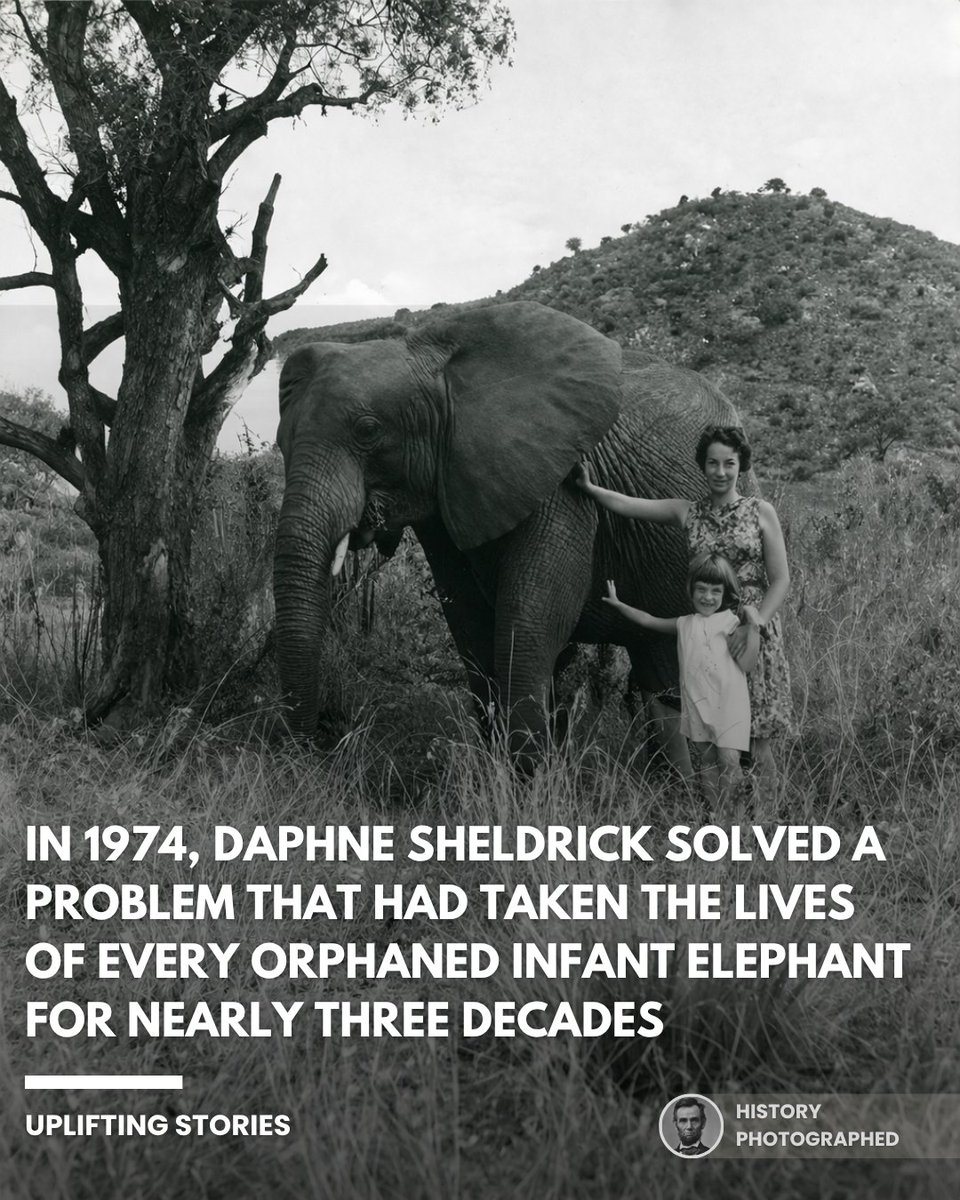
In 1974, Daphne Sheldrick achieved something that had eluded conservationists for nearly 30 years she found a way to keep orphaned infant elephants alive.
For decades, rescuers had tried and failed to raise baby elephants without their mothers. No matter what they fed them, the calves would weaken and die. Elephant milk is incredibly complex, and without it, survival seemed almost impossible. Every orphaned calf faced the same fate.
Daphne refused to accept that.
Working in Kenya, she dedicated herself to understanding what these elephants truly needed—not just physically, but emotionally. She spent years experimenting with different milk formulas, adjusting ingredients over and over again, determined to replicate what nature had perfected.
After countless failed attempts, she finally discovered the missing piece: a formula that worked, with coconut oil playing a critical role. For the first time, orphaned calves began to survive.
But Daphne’s work went far beyond nutrition. She realized baby elephants needed constant care, affection, and companionship just like human children. She and her team became their family, raising them, protecting them, and eventually preparing them to return to the wild.
What started as one breakthrough turned into a legacy.
The elephants she saved grew up… and many went on to have calves of their own—new lives that would have never existed if she had given up.
One woman’s persistence didn’t just save a few animals.
It changed the future of an entire generation.
Photo Credit: Daphne Sheldrick and her daughter, Angela, with Eleanor, an elephant raised by Daphne. Photograph: The David Sheldrick Wildlife Trust @sheldricktrust
🚨BREAKING: Claude has a secret mode called "Benjamin Franklin Persuasion & Leverage Machine."
It diagnoses exactly why your pitch, email, or argument isn't landing then rewrites it using the 7 psychological levers Franklin used to charm kings, unify colonies, and engineer the American empire through persuasion alone.
Here's how to activate it:
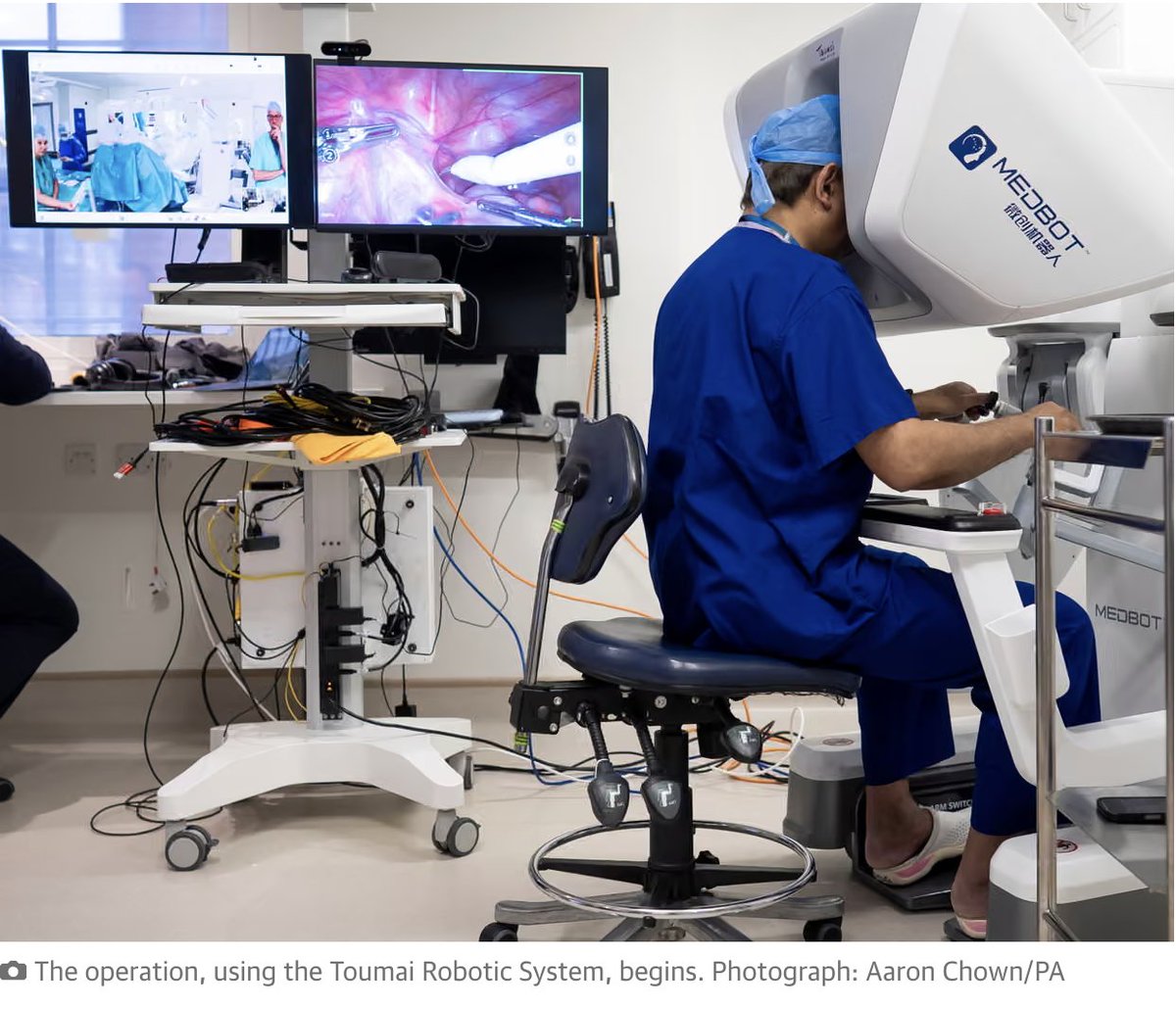
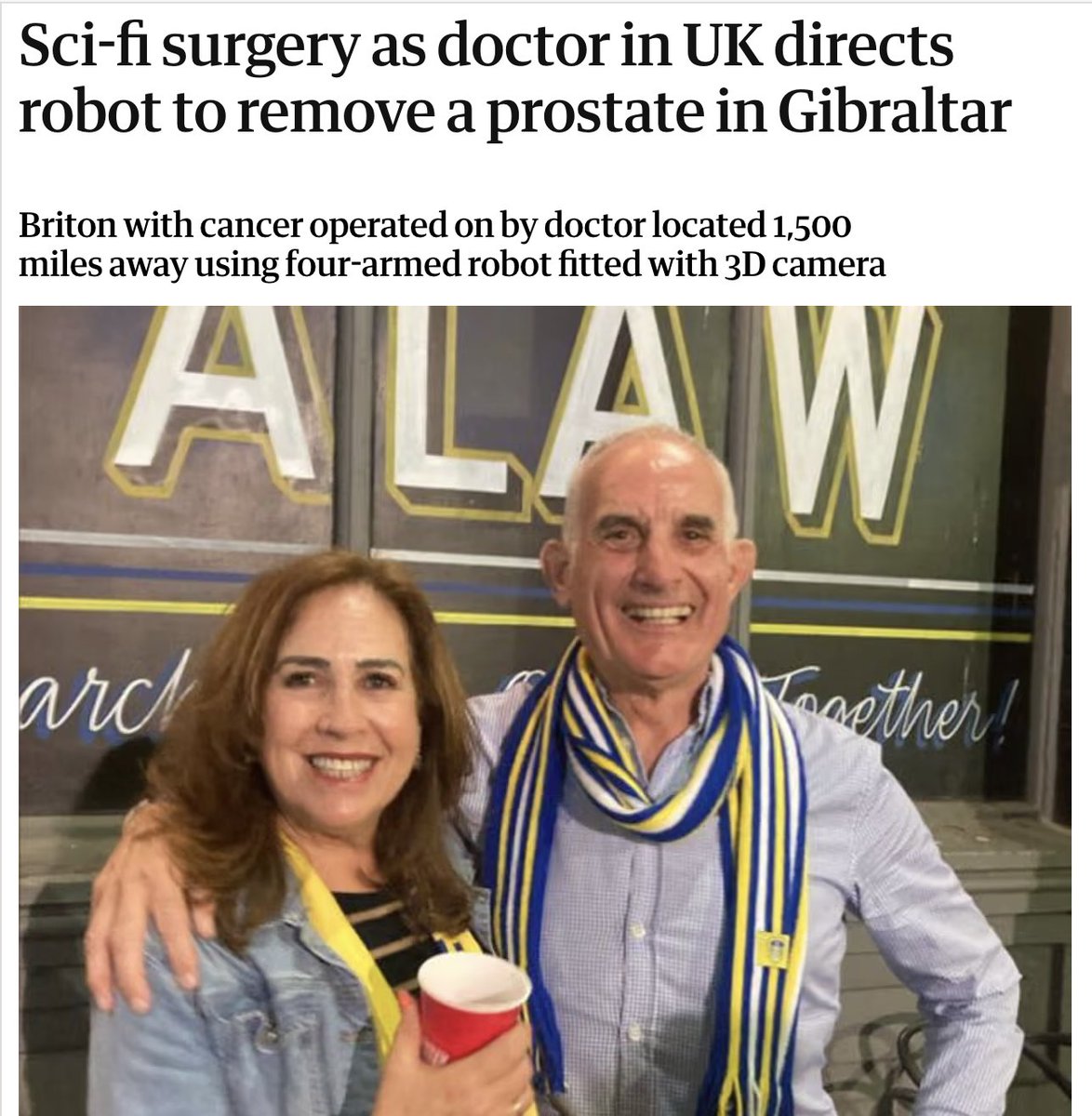
A surgeon just removed a man's prostate ...and he was 1,500 miles away.
From an office in London, Dr. Prokar Dasgupta controlled a 4-armed robot at a hospital in Spain.
The robot was fitted with a 3D camera and connected to London via fiber optic cable with a backup 5G connection (lag was just 0.06 seconds).
The story is wild:
> 62-year-old Paul Buxton had expected to fly to England and wait months on the NHS list.
> Instead, the surgeon came to him... through a fiber optic cable.
> Dasgupta is already scheduled to perform the procedure again on March 14th, with around 20,000 surgeons watching live.
Access to care is going to look so different in the future.
For context, in many low-income countries, there are fewer than 1 trained surgeon per 100,000 people.
The US alone is projected to face a shortage of up to 20,000 surgical specialists by 2036.
...Remote surgery doesn't just make medical care more convenient, it may be the only way some patients ever receive it one day.
The computational power in your iPhone is >100 million times more powerful than the computers that landed Apollo 11 on the Moon. And yet, most people use it primarily to argue with strangers on the internet.
The future's already here—we just need to deploy it better.
This paper checks how close LLM thinking really is to human style reasoning.
Finds LLM thinking is still quite far from human style reasoning.
Humans naturally use a rich mix of skills like planning, setting subgoals, checking their own work, and changing strategy when something feels off.
LLMs mostly follow a straight, step by step pattern, and they rarely show this kind of self checking or flexible restructuring, especially on messy real world problems.
The paper shows that when humans succeed on hard questions, they lean heavily on these extra skills, but models usually do not.
The authors then show that if you explicitly tell a model which thinking moves to use and when, its performance can jump a lot.
----
The authors collect a large set of human and model reasoning traces across many tasks.
They tag each trace with 28 simple cognitive building blocks, like planning, checking, and restructuring.
Human traces usually mix several blocks at once, using goals, subgoals, and regular self checking.
Model traces mostly move forward in a straight line, with little self awareness or problem reframing.
This gap becomes largest on messy, ill structured problems, where success needs richer knowledge structures and strategy changes.
They also show that current LLM reasoning work mainly studies easy stepwise behaviors and rarely studies meta thinking.
Finally, they build test time instructions that force certain block sequences and lift accuracy on complex tasks by up to 60%.
---
Paper – arxiv. org/abs/2511.16660
Paper Title: "Cognitive Foundations for Reasoning and Their Manifestation in LLMs"
Hope the new labour codes will help these बुनकर of Bihar @PMOIndia@narendramodi
Inside The IIT Village Of India ft. Medha | Bihar Elections | Jist https://t.co/3DOnAXJSSn via @YouTube
After 2 years of using ChatGPT, I can say that it is the technology that has revolutionized my life the most, along with the Internet.
So here are 10 prompts that have transformed my day-to-day life and that could do the same for you: