"What people choose from the space of all possible financial transactions" is almost always an extremely bad measure of preferences because it presumes full rationality and information about finance. (1/n)
In my keynote, I argued that economics has an “access trap”: distance from the profession’s gravity centers limits network access, and low access reproduces distance. Talent and effort are not enough. Mentoring and deliberate design can make access less dependent on luck.
🎓 ¡Nueva convocatoria #PostgradosUOH 2026!
Postula al Magíster en Metodología de Investigación Social Interdisciplinaria 🧩
📅 Hasta el 30 de noviembre de 2025
💻 Conoce becas y beneficios en 👉 https://t.co/ZeL1Ecu36d
With apologies, a long tweet, about the likely macroeconomic outcomes of Liberation Day.
Tariffs can be imposed for understandable if not necessarily good reasons: Protect a sector, right or wrong. Extract rents from foreign producers if there are rents to be extracted. Sure, if there is retaliation, everybody will be worse off, but it maybe worth taking the risk.
Across the board tariffs, which sounds like what we are going to get, are however the worse possible tariffs. They are bad for the country that imposes them, even without retaliation.
Standard scenario: The initial effect of higher tariffs may look good: Lower imports. Higher demand for domestic goods. Smaller trade deficit.
But, with the smaller deficits, and the higher interest rates needed to keep demand under control, appreciation of the dollar (say), less competitive exports. Until trade deficit is back to square one.
So: Useless? Worse. Costly reallocation from exports to import competing sectors. Misallocation. And for the revenues from tariffs: They are there, but in the end, they are paid mostly by US consumers.
A relevant twist, which changes the standard scenario: The enormous uncertainty about Trumps’s tariff policy: Are the tariffs transactional or permanent? Will they remain/increase/decrease?
In that environment, if I am a firm, what do I do? Build a plant in Mexico or in the US, in Vietnam or in China, etc. I do not know, and so I wait. We all wait. Investment comes down, aggregate demand falls, and the effect is a recession.
Now the trade balance improves, for two reasons. The direct effect of tariffs, and lower activity means lower imports. As the Fed tries to maintain activity, lower interest rates and a lower dollar mean more exports. Looks great. Claim of success on the trade front (if you can make people forget the recession)
But only for a while. Over time, as the economy recovers, you go back to the first scenario. The depreciation eventually turns into an appreciation, activity recovers, the trade deficit returns to square one Overall result: a recession, no gain. A general mess.
We shall see how it all turns out.
Hello researchers, do you know of any experimental economics papers where the authors tested a sequential-move game or a repeated game, and the dataset is publicly available?
Could you please refer me to such datasets?
This new paper uses machine learning to detect political leanings in economists' academic writing and shows: partisanship shapes research fields, journals, and even key policy estimates, e.g. optimal top tax rates vary from 77% (left) to 60% (right) based on imputed partisanship
I’m on the Job Market! 🚨
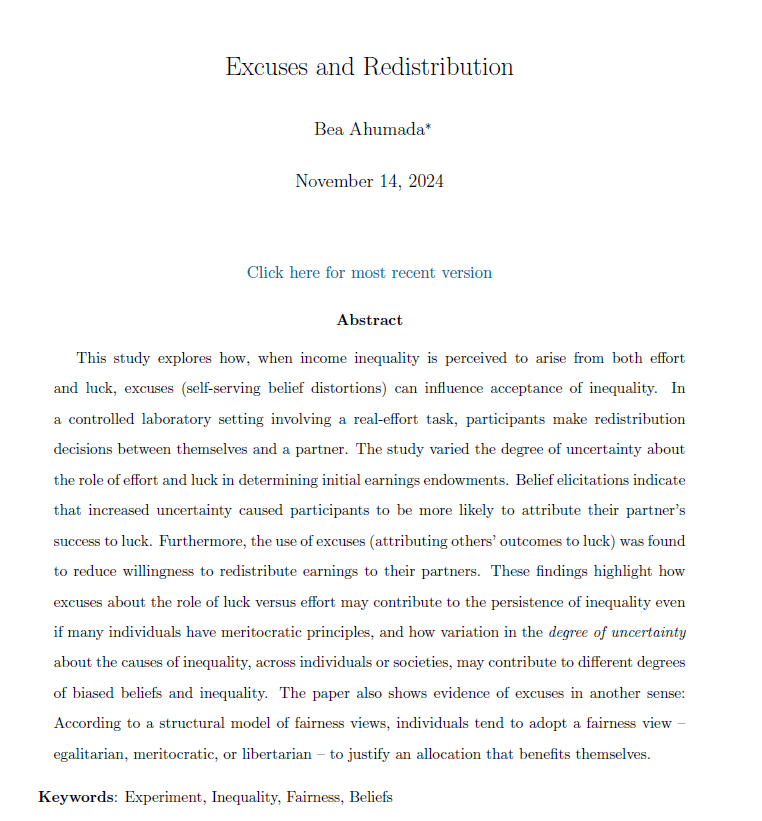
Ever wondered how does uncertainty about sources of inequality affects redistribution? In my jmp, Excuses and Redistribution, I explore how people use excuses to distort beliefs about merit and luck, justifying self-serving behavior. 🧵(1/7)
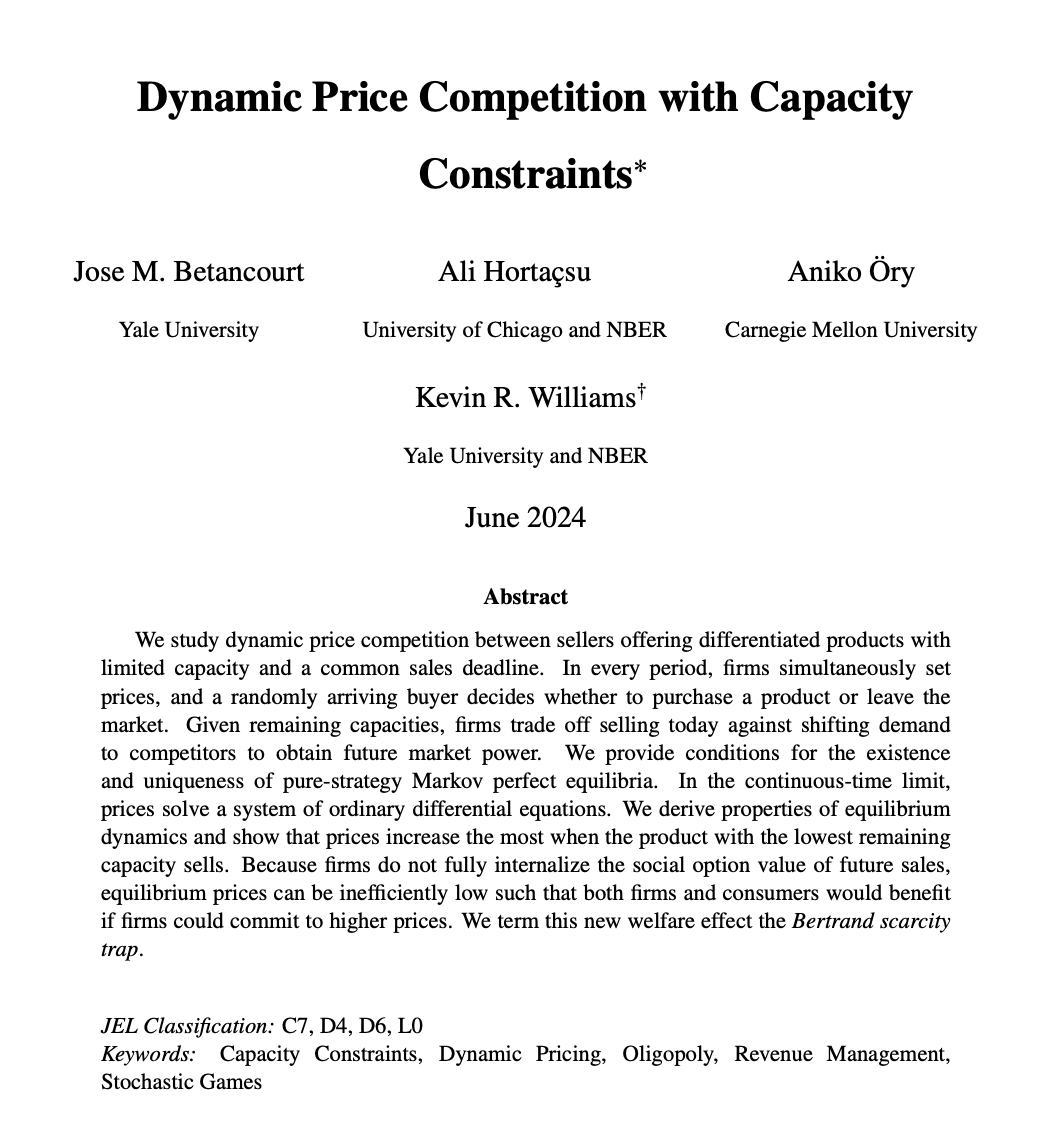
I’m very happy to share a “new" working paper on the dynamic/learned complementarity that arises between different products. This is joint work with @adamnsmith__ and Max Pachali (@TilburgU) and its been really years in the making! 1/12
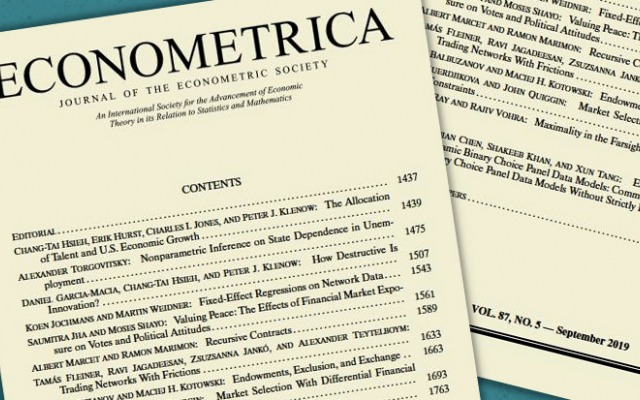
(1/3) Excited to share that our paper 'Ambiguous contracts' has been accepted to Econometrica💫.
I know I'm supposed to play it cool, but as a computer scientist this is very exciting.
https://t.co/FPyLpyUtgX
A sneak peek of our findings below👇👇👇
If you have work on market power, consider this workshop! It will be an exciting line-up of presentations (I promise!) with insightful discussions. Also: Zurich, baby!!!!
Last year's workshop was amazing, so will this year's.
Submit: 📆 August 31!
#EconTwitter#MarketPower
📢CALL FOR PAPERS
Collegio Carlo Alberto and @cepr_org
invite submissions for their 4th annual joint workshop on ‘Contracts, Incentives and Information', which will take place in Turin on December 2-3, 2024.
Deadline 👉 September 6, 2024
Details:
https://t.co/wADsWZPmwl
#CCA #CCAResearch #workshop #CEPR #contracts #incentives #innovation #economics #research #learning
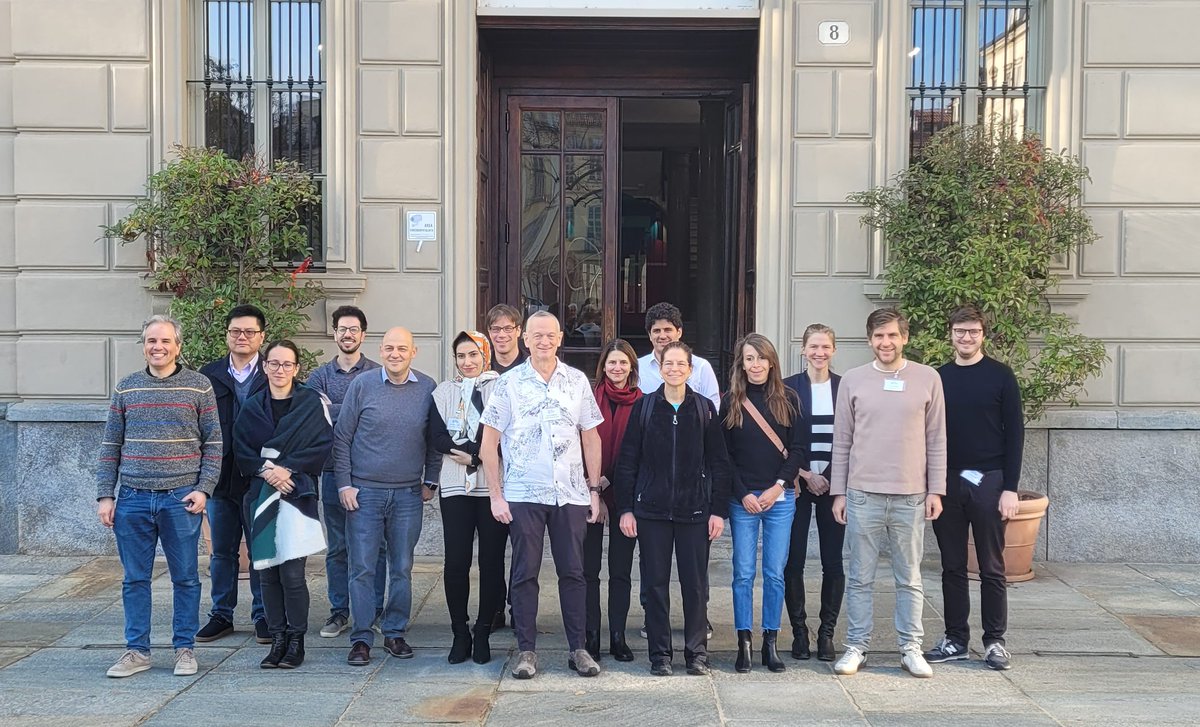
Come to Turin in December for our fourth Theory Workshop (jointly organized @CollegioCA
and @cepr_org). This year with Aislinn Bohren (@aislinnbohren) and Navin Kartik as keynote speakers. Deadline for submissions: Sep 6th. Last three editions were great!
Econometrica is happy to announce that the 2024 Arrow Prize for the best economic theory paper has been awarded to Laura Doval and Vasiliki Skreta for their paper, "Mechanism Design with Limited Commitment” https://t.co/zCyJS1gd4F
NEW VIDEO! Upgrading our WORST Setup
https://t.co/wkqzTPw7Bf
#Sponsoredby#nvidia
To win your own 4080 Super use the link below: https://t.co/3SBZFCYUID