🚀Award-winning chapter of the National Space Society @nss.
🚀Follow to keep up with news on Space Exploration & the Space Economy & local Space events in DFW.
This week in space:
• ESA/JAXA's BepiColombo is in orbit around Mercury
• Voyager 1 reached one light-day from Earth
• CRS-35 Dragon splashed down off California
• Texas A&M opened its Space Institute near JSC
• Shenzhou-24 finished its launch rehearsal
Image Credit: ESA
China's Tianwen 3 has moved into prototype hardware. The Mars sample return mission targets a launch around 2028 on two Long March 5 rockets and a return of at least 500 grams of samples around 2031.
Image Credit: NSS of North Texas
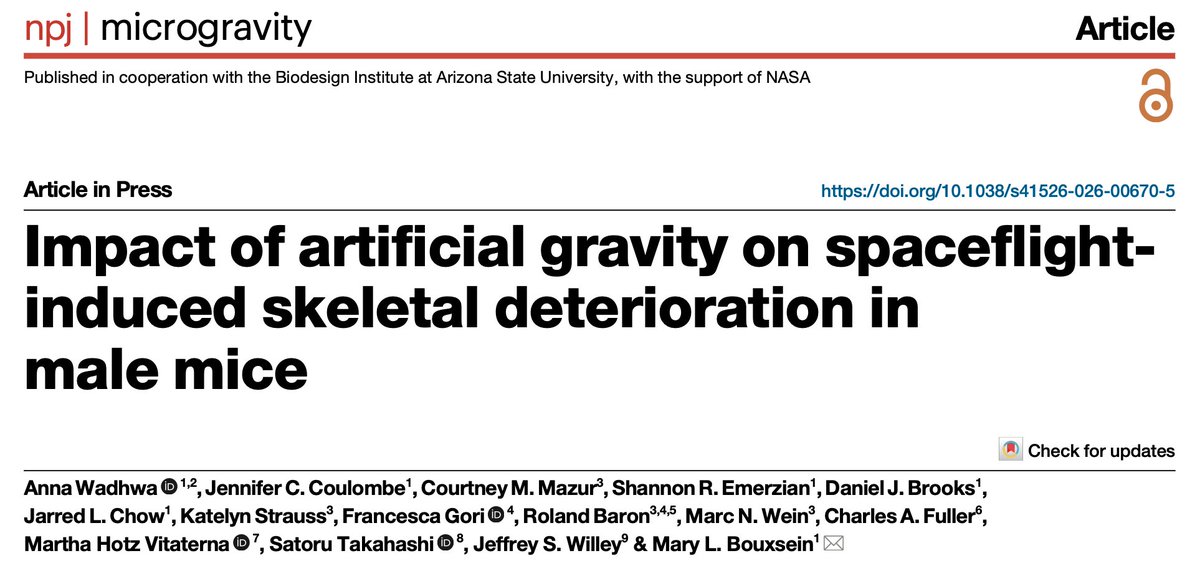
An ISS study tested artificial gravity on mice. For 30 days in orbit, centrifuges gave them one third, two thirds, or full Earth gravity. Only full 1 g kept bone mass, structure, and strength equal to ground controls. Lower levels helped partly.
Image Credit: npj Microgravity
BepiColombo update: ESA says the braking burn that captured the spacecraft into orbit around Mercury on Saturday was shorter than planned, following a software issue. The spacecraft is safe, and teams at ESOC are working to understand what happened.
Image Credit: ESA
Did you know? More than 3,800 aircraft are now equipped with Starlink, SpaceX reported in its Q3 2026 results, as airlines old and new switch on its in flight internet.
Image Credit: NSS of North Texas
ESA and JAXA's BepiColombo is in orbit around Mercury. After Saturday's 37 minute braking burn, contact returned and ESA confirmed orbital capture.
Only the second spacecraft to orbit Mercury. MPO and Mio separate Dec 9 to 10, science starts April 2027.
Image Credit: ESA
SpaceX's CRS-35 cargo Dragon splashed down in the Pacific off California at 4:03pm CT today, completing the 35th commercial resupply mission to the International Space Station. Teams will recover the capsule and its returning hardware and science experiments.
Image Credit: NASA
ESA's Rosalind Franklin rover is still targeting a late 2028 launch on a Falcon Heavy. ESA's full size twin, Amalia, drove off a lander platform more than 20 times on a 20 degree slope in a two month test.
Image Credit: ESA
Did you know? Rocket Lab space solar cells power more than 1,000 spacecraft. Its SolAero team, acquired in 2022, powered Parker Solar Probe and Mars InSight and built the solar panel on the Ingenuity helicopter.
Texas A&M opened its Space Institute Friday, just outside NASA's Johnson Space Center in Houston. Backed by $200 million from the Texas Legislature, it has simulated Moon and Mars landscapes, each big enough for a football field.
Image Credit: Emily Oswald/Texas A&M Engineering
Did you know? China's first Mars rover, Zhurong, drove about 1,921 meters before going dormant on May 18, 2022. NASA orbiter images showed it had not moved between Sep 2022 and Feb 2023.
Image Credit: NASA/JPL-Caltech/UArizona
SpaceX's CRS-35 cargo Dragon undocked from the International Space Station at 11:05am CT today, bringing completed science experiments and lab hardware back to Earth. Splashdown off California is targeted about 29 hours later, Saturday afternoon.
Image Credit: NASA
SpaceX had about 11,100 Starlink satellites in orbit as of Sep 30, with Starlink coverage in 174 countries. That total includes roughly 400 satellites already approved for deorbit.
Image Credit: NSS of North Texas
SpaceX had about 11,100 Starlink satellites in orbit as of Sep 30, with Starlink coverage in 174 countries. That total includes roughly 400 satellites already approved for deorbit.
Image Credit: NSS of North Texas
The Texas A&M Space Institute is recreating the moon and Mars outside of NASA’s Johnson Space Center to prepare people and robots headed for those destinations. https://t.co/C6S7ML1pZ1
Do you know a K-12 student who dreams of building a @NASAMoonBase? Boost their creativity with the Power to Explore Challenge! 🔋⚛️
Learn about nuclear energy & how it can power exploration, then illustrate your ideas!
Get details in this week's EXPRESS: https://t.co/9nBGCrg8T6
NASA Administrator Jared Isaacman toured JAXA's Tsukuba Space Center today with JAXA President Yamakawa.
He called Japan one of NASA's closest Moon Base partners, citing the Pressurized Rover JAXA is building so astronauts can travel farther on the Moon.
Image Credit: JAXA
Finally news after 13 days about what happened with Perseverance Rover on Mars: The 400 MHz UHF transmitter failed on October 30. That triggered automatic switch over to the backup transmitter, which for yet unknown reason only delivered half the expected radio signal power to the relaying Mars Odyssey spacecraft. 5 days later, the Odyseey spacecraft went into safe mode due to its 3rd reaction wheel failing. The UHF antenna is the large silver gray cylinder visible in below image from October 11. Currently the rover is using its hexagon shaped high gain 8 GHz antenna, but that doesn't provide the 2 MBit/s data rate of the relay system. More details in today's NASA article: https://t.co/jSzcey86tm
📷 https://t.co/bwAXbyVgil
Saturn and the Moon tonight. The bright waxing gibbous Moon sits about 12 degrees right of Saturn. Look southeast after sunset, then due south around 8:30 pm CST when Saturn rides about 49 degrees high. It shines as a steady golden star, and a small telescope shows its rings.
NASA has paused Perseverance rover science on Mars while engineers troubleshoot both of its UHF relay radios. The rover is stable, talking directly to Earth, and could return to science by the end of November.
Image Credit: NASA/JPL-Caltech