New Trinitarian Ontologies is a new movement in philosophical theology exploring ontology or metaphysics in imitation of the Trinity
@Cambridge_Uni @CamDivinity
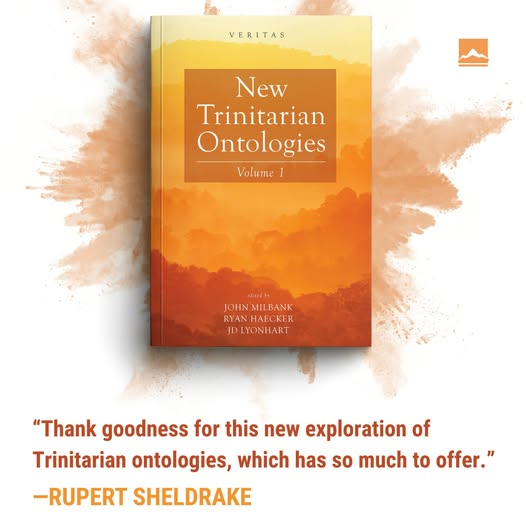
New Trinitarian Ontologies, Vol. 1
Edited by John Milbank @johnmilbank3, Ryan Haecker @RyanHaecker, and Jonathan Lyonhart @jdlyonhart
Order today:
https://t.co/DMm14afnWi
As it is Holy Trinity Sunday, we must defend the proto-trinitarian reading of Plato's Parmenides.
When the dialectical exercises (137c-166c) of the Parmenides are read as a linear sequence of hypothetical deductions, they appear individually and collectively to produce innumerable contradictions (cf. G. Priest 2014).
Yet this central aporia invites re-readings that recycle both its form and its content. Since, for Plato, the One is simply itself beyond space and time, it cannot simply be known by such discursive arguments in lines or duration of reason, but rather can only be approached elliptically.
The aporetic conclusion of the First Hypothesis (137c–142a, esp. 142a) of Plato's Parmenides should not, therefore, be read to permanently foreclose knowledge of the One, but rather, as Plotinus shows in Enneads 5.1.10., invites a dialectical analysis of its contradictions from within the Second Hypothesis, the division of the forms, that correlates with the divine Intellect (Nous), and, like Origen, Plato assigns to Zeus (Philebus 30d).
Once the contradictory aporiae of the former dialectical hypotheses can be analysed in and by the latter and Second Hypothesis, and the Third Hypothesis is recognized as the 'sudden' (exaiphnes) instant of transition between all hypotheses and categories, the contradictions in Plato's Parmenides can recycled by dialectical analysis in Nous, through a trans-categorematic circuit that pivots upon the instant of their communication.
The Parmenides can, as Maximus effectively showed, thus be read as a proto-trinitarian exercise in speculatively constructing the divine hypostases: the Hen is the unity of the Father; the Nous is the divine Intellect communicated by the Son; and the exaiphnes instant is the perichoretic sharing of each that enters through the Spirit of the world. The central tragic aporia of Plato's Parmenides, and Platonism generally, is thus not simply the problem of participation, but rather the Incarnation of Christ, in whom this perichoretic communication could be known by a human face.
3 of 6 short clips from our interviews with E. Falque and W. Desmond about our Revelation and Finitude conference @StMarysSem_Balt May 2027. Please watch, share, and register now for the early bird special! https://t.co/3dUmf8Fi4D via @YouTube
This collection of 70 video recordings from the @TRIERTIUM conference held in Olomouc in 2025 offers a comprehensive introduction to Trinitarian ontology.
Take advantage of this opportunity and enjoy the videos.
https://t.co/kwVkmOHLcf
It was a pleasure to welcome John Milbank to Olomouc for the @TRIERTIUM 2025 Conference and to listen to his lecture on how the doctrine of the Trinity has been an ontology from the very beginning.
Watch the video: https://t.co/N4uFfUvcGM
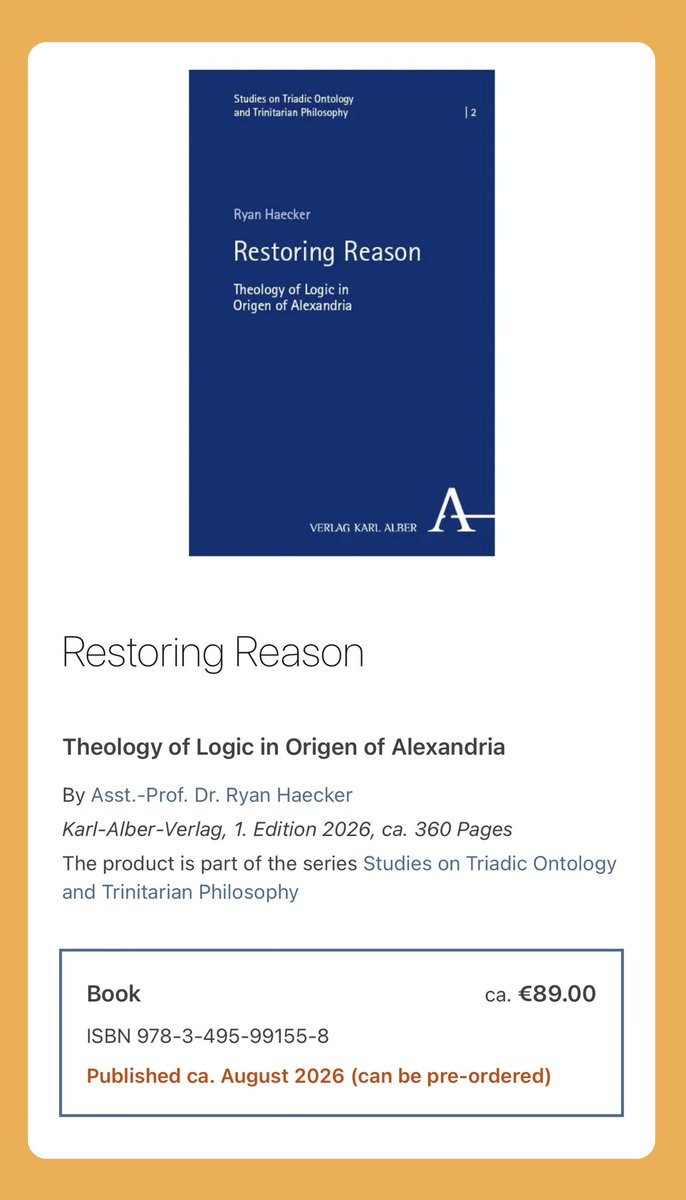
I am delighted to announce that my forthcoming book 'Restoring Reason: Theology of Logic in Origen of Alexandria' will be published as the auspicious *THIRD* volume of the series 'Studies on Triadic Ontology and Trinitarian Philosophy'.
Pre-Order Today =>
https://t.co/xmDRNp8ZMP
The @TRIERTIUM 2025 conference in Olomouc is spreading its message further through video recordings of all keynote speeches and presentations on YouTube.
You can find everything here:
https://t.co/kwVkmOHLcf
Upcoming Book Release
Fall-ish / August-ish 2026
@TRIERTIUM@RyanHaecker@johnmilbank3@robertdryer@NTOntologies@EduardFiedler
Studies on Triadic Ontology and Trinitarian Philosophy
Restoring Reason:
Theology of Logic in Origen of Alexandria
—by Ryan Haecker
Cover PDF: https://t.co/CBH7FMC7lP
Link: https://t.co/uTJQkGfJKe
📖👇📖👇📖👇📖👇📖
Schelling wanted a chair in theology rather than philosophy. He read philosophy as theology by introducing into it the negative-positive oscillation that is mystical-theological. His doctrine of 3 potencies is a Trinitarian ontology. His account of God is analogical not univocal.
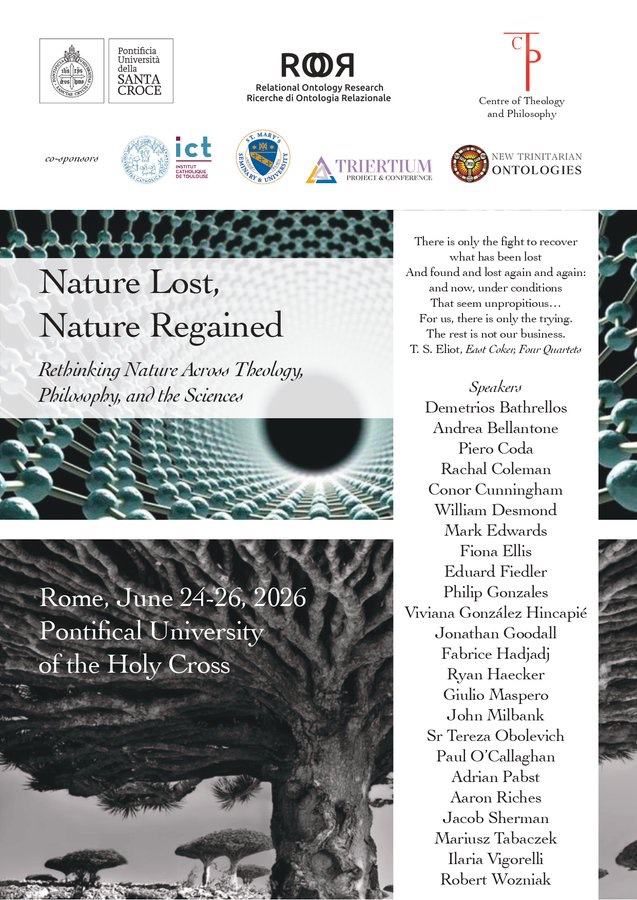
At the 24-26 June 'Nature Lost, Nature Regained' conference, I am delighted to have been invited to deliver an invited speaker talk titled 'Angel-Oriented-Ontology: Angelic Physics after Speculative Realism'.
Abstract:
Before Nature, the angels were created on the 'First Day' of creation. As messengers of God, the angels (ἄγγελοι) have, since Philo and Origen of Alexandria, been classically regarded as ontological intermediaries, who, by aiding in the subsequent 'Days' of creation, uphold the deep structure of being. Following, however, the Latin Scholastic reduction of angels to subsistent forms (e.g. Aquinas), and the Nominalist collapse of universal forms to either concepts or things (e.g. Ockham), mechanical 'nature' could be evacuated of formal causality (e.g. Newton), and held in a fixed correlation of the 'subjectivity' of conceptual thinking to the 'objectivity' of real things (e.g. Kant). As early, however, as F.W.J. Schelling's 'Freedom Essay', G.W.F. Hegel's 'absolute identity' of Nature eternally sublated as the externality of Logic was first exploded by a metaphysical positivism that demanded a higher principle of divine and personal freedom (e.g. Kierkegaard), before the ground of all positive elements were subverted by a metaphysical negativism, which, from Heidegger to Derrida, carried out the nihilistic subversion of identity into difference, and being into nothing. In its most acute form, Alain Badiou's subtractive mathematical ontology has released the 'multiple' of calculative situations to be reified by 'Speculative Realism' as a subject-less manifold of objects: first, in Quentin Meillasoux's hyper-chaos of ancestral objects, then in Graham Harman's 'Object-Oriented-Ontology', but, most recently, in new Speculative Realist philosophies of nature, including Iain Hamilton Grant, Timothy Morton, Ben Woodard, Eugene Thacker, and Reza Negarestani. Following Tyler Tritten, the common mistake of all these Speculative Realist philosophies of nature is, I contend, the Badiouian subtraction of Schelling's personal freedom of substances into subjectless-objects. To recover a more free and felicitous vision of visible Nature, this lecture will seek to develop a Neo-Origenian critique of recent Speculative Realist philosophies of nature, and propose an angelic physics, in which the angels uphold the holy middle of all things.
As Prologue to a Metaphysics of Patmos is appearing later this year here is an early version/part of chapter 3 in @ChurchLifeND@cosmostheinlost, along with a keynote @TRIERTIUM on vol 1 of the ensuing Trinitarian trilogy:
https://t.co/4teLX2qJ0E
https://t.co/GF3zvjucfy
Look out for @johnmilbank3's forthcoming book 'Most Entanglings: Trinity', which promises, alongside my book 'Restoring Reason: Theology of Logic in Origen of Alexandria', to revive Origenian trinitarian speculation at the highest theological level.
I am finishing the final editorial revisions of my Czech translation of Klaus Hemmerle’s groundbreaking text Theses Towards a Trinitarian Ontology.
It will be published in the second half of the year. This year marks the 50th anniversary of the original German edition (1976).
In a new episode of 'Spiritually Incorrect', @jdlyonhart interviews @RyanHaecker about the New Trinitarian Ontologies conference their recently published co-edited book 'New Trinitarian Ontologies, Vol. 1'.
https://t.co/YqRYtWQJPd
As Prologue to a Metaphysics of Patmos is appearing later this year here is an early version/part of chapter 1 in @ChurchLifeND@cosmostheinlost, along with a keynote @TRIERTIUM on vol 1 of the ensuing Trinitarian trilogy: https://t.co/dsH3lyeirg
https://t.co/7CDBkt9O24