For my first post, I’m sharing a letter @NVIDIA signed on why open models matter.
AI will transform every industry, power every company, and be built by every country.
Open models strengthen safety and cybersecurity, accelerate innovation and diffusion, and enable sovereignty.
The world needs both frontier closed models and frontier open models.
https://t.co/AUKzoQ5Ikb
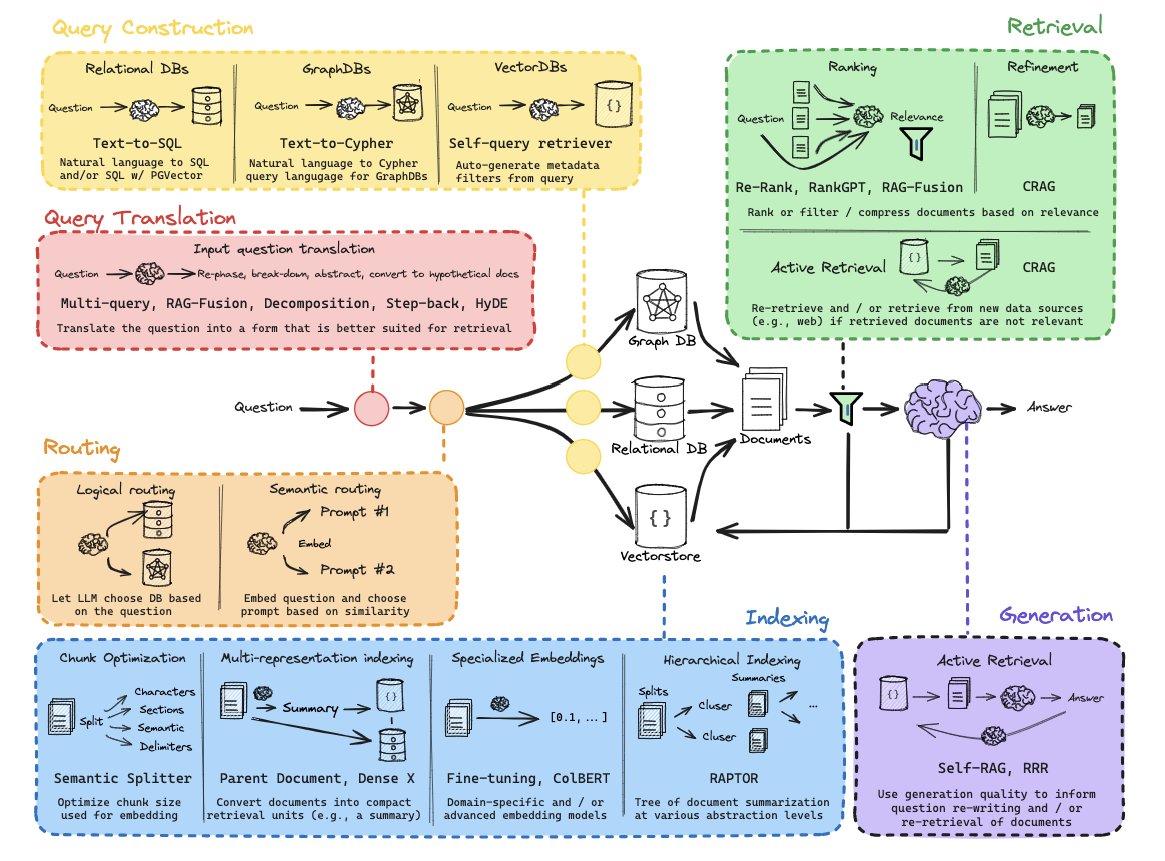
RAG From Scratch
Here's a set of short (5-10 min videos) and notebooks explaining > a dozen of my favorite RAG papers. Took a stab at implementing each idea myself (all code open source) and grouped according to the diagram.
Repo:
https://t.co/WDN9Tsy84t
Video playlist:
https://t.co/ctSTXXWJ49
Some highlights:
Is RAG Really Dead?
How RAG might change with long context LLMs.
Video:
https://t.co/z1ntvtWFWL
Adaptive-RAG
Dynamically route queries based on complexity to different RAG approaches. Implemented in LangGraph w/ @cohere cmd-R.
Video:
https://t.co/3hKVdSQ0Zf
Code:
https://t.co/KjcqtCL0bW
Paper (@SoyeongJeong97 et al):
https://t.co/4bIO5km1jn
Corrective-RAG
Self-correct retrieval errors in-the-loop unit tests for doc relevance and fallback to web-search. I implemented in LangGraph w/ @MistralAI-7b + @ollama for running locally.
Video:
https://t.co/8T06OVnmW4
Code:
https://t.co/jATwYQuqaN
Paper (@Jiachen_Gu et al):
https://t.co/nBO5ZxWfvU
Self-RAG
Self-correct RAG errors with in-the-loop unit tests for doc relevance, answer hallucinations, and answer quality. Implemented in LangGraph w/ @MistralAI-7b + @ollama for running locally.
Code:
https://t.co/7bEwbcY9jv
Code (local):
https://t.co/BQZ2LxEHJ3
Paper (@AkariAsai et al):
https://t.co/lTIlj4rpoT
Query Routing
Various approaches for directing questions to the correct datasource (e.g., logical, semantic, etc).
Video:
https://t.co/Ffg7Dyx6jA
Code:
https://t.co/nMLCCYEOzB
Query Structuring
Use an LLM to convert from natural language-to-<DSL> where DSL is a domain specific language required to interact with a given database (SQL, Cypher, etc).
Video:
https://t.co/LQB5zVdA2R
Code:
https://t.co/nMLCCYEOzB
Blog:
https://t.co/Z5ynzlzmWK
2/ Deep dive on graphDBs (c/o @neo4j): https://t.co/4FvtlQXl7F
3/ Query structuring docs: https://t.co/ZcgucoC4jf
4/ Self-query retriever docs: https://t.co/FBZ7OlwFCp
Multi-Representation Indexing
Use an LLM to produce document summaries ("propositions") that are optimized for retrieval. Embed these summaries for similarity search, but return full documents to the LLM for generation.
Video:
https://t.co/XU44LDd3X7
Code:
https://t.co/102QR15FSb
Paper (@tomchen0 et al):
https://t.co/ltzx6n0BUy
RAPTOR
Cluster docs in the corpus and summarize similar ones recursively. Index them all together, resulting in lower-level docs and summaries that can be retrieved to answer questions that span detailed-to-higher level.
Video:
https://t.co/bzLQRRRtQk
Code:
https://t.co/SXqOLhxAgk
Paper (@parthsarthi03 et al):
https://t.co/0aSDyiU24H
ColBERT
Improve embedding granularity w/ a contextually influenced embedding for each token in the document and query.
Video:
https://t.co/JZ6VTl24kV
Code:
https://t.co/102QR15FSb
Paper (@lateinteraction & @matei_zaharia):
https://t.co/MuTGFlAerv
Multi-Query
Re-write the user question from multiple perspectives, retrieve documents for each re-written question, return the unique documents for all queries.
Video:
https://t.co/WiHg60yDC4
Code:
https://t.co/cxsjcvPO9a
Paper:
https://t.co/GCH3lgUjT0
RAG-Fusion
Re-write the user question from multiple perspectives, retrieve documents for each re-written question, and combine the ranks of multiple search result lists to produce a single, unified ranking w/ Reciprocal Rank Fusion (RRF).
Video:
https://t.co/DWlBCu2duf
Code:
https://t.co/cxsjcvPO9a
Repo (@Raudaschl):
https://t.co/zn5iZRNaYg
Decomposition
Decompose a question into a set of sub-problems / questions, which can either be solved sequentially (use the answer from first + retrieval to answer the second) or in parallel (consolidate each answer into final answer). Various works such as Least-to-Most prompting (@denny_zhou et al) and IR-CoT present ideas that be utilized.
Video:
https://t.co/VzxTWhnNoD
Code:
https://t.co/cxsjcvPO9a
Papers:
https://t.co/ZGRt9Gqid3 https://t.co/JhGK1vHwro
Step-back prompting
First prompt the LLM to ask a generic step-back question about higher-level concepts or principles, and retrieve relevant facts about them. Use this grounding to help answer the user question.
Video:
https://t.co/JOjfkghYC2
Code:
https://t.co/cxsjcvPO9a
Paper (@denny_zhou + colleges):
https://t.co/ZIc6uaNBDx
HyDE
LLM to convert questions into hypothetical documents that answer the question. Use the embedded hypothetical documents to retrieve real documents with the premise that doc-doc similarity search can produce more relevant matches.
Video:
https://t.co/Kiy2EFCRBT
Code:
https://t.co/cxsjcvPO9a
Paper:
https://t.co/wDCkSwuK3o
We’re all still grappling with the richness of @michaelxpettis’ insights today, plus all the outstanding audience Qs, so for sure we’ll be listening back to the recording of this morning’s conversation too, available at the link below for the next 30 days: https://t.co/QkNyqbzgTr
On behalf of @FLOTUS Melania and I, THANK YOU for an unforgettable afternoon and evening at the Forbidden City in Beijing, President Xi and Madame Peng Liyuan. We are looking forward to rejoining you tomorrow morning! https://t.co/ma0F7SHbVU