Lady of python, machine learning & causality | ex Teva | PhD from @WeizmannScience | expertise in biomedical data science | red wine, spinning, trance music.
ייקח עוד כמה שנים עד שאנשים יתחילו לחשוב במונחים האלו, אבל מה שאתם רואים בסרטון זה מטוס קרב, וספייס אקס היא החברה החשובה ביותר לביטחון הלאומי של ארה״ב.
אתמול חללית סטארשיפ השלימה לראשונה מסע מלא משיגור לחלל ועד נחיתה חזרה על כן השיגור.
השימוש החוזר במשגר וחללית רב-פעמיים מוריד את עלות השיגור לחלל למספרים חסרי תקדים.
סביר שבעוד עשור או שניים, ארה״ב תוכל לשגר אלפי טונות ביום למסלול סביב כדור הארץ בעלות של עשרות אלפי דולר לטון בלבד.
כשהיום הזה יגיע יתחילו התהיות למה ארצות הברית צריכה להחזיק חיל אוויר כל כך גדול. התפקיד של חיל האוויר, במובן הפשטני ביותר, הוא לשנע מטען מהר ורחוק ובשרידות גבוהה. בין אם זה מטוס תובלה שלוקח חיילים ואספקה, ובין אם זה מטוס קרב שמביא פצצות וטילים כל הדרך אל המטרה.
סטארשיפ מספקת אלטרנטיבה - תציב את המטען בחלל ותעטוף אותו בשכבות הגנה שיאפשרו לו לחזור חזרה לכדור הארץ לכל מקום שנדרש. היום זה יקר, לא אמין, לא המוני ומסורבל. כמו שהמטוס היה כשהוא הומצא בתחילת המאה הקודמת. אבל לא רחוק היום בו החסמים האלו יוסרו וזו תהפוך לשיטה המועדפת.
כי אם ניתן לשנע כל מטען לכל נקודה בעולם בתוך חצי שעה וכמעט בלי יכולת לעצור אותו, ולעשות את זה מאדמת ארה״ב, אז אין צורך לפרוס בכל העולם מטוסים יקרים בבסיסים מרוחקים ופגיעים.
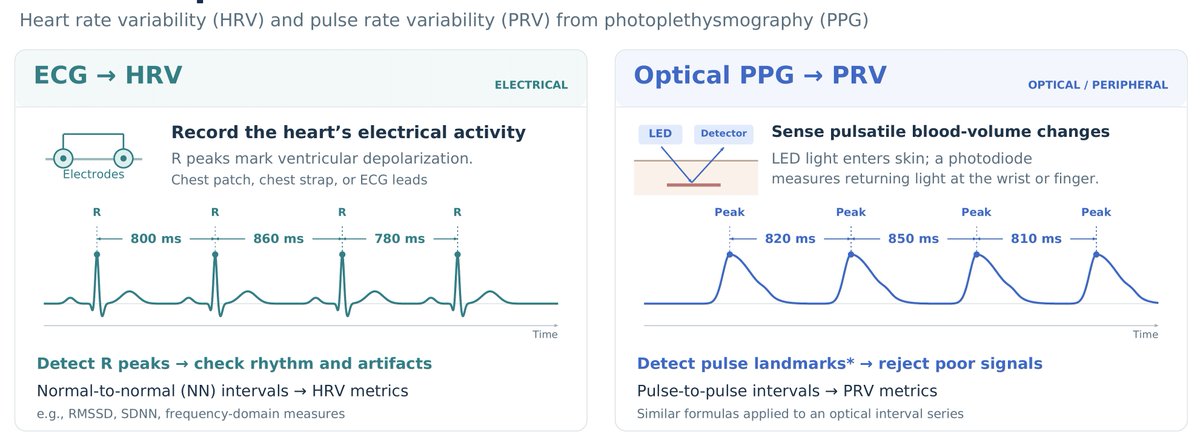
Over 100 million Americans use wearable sensors, including smartwatches, rings, and wrist bands. They provide data for HRV and Readiness scores. What is the story with these metrics?
Around 30 robots demonstrated outside Poland's Digital Affairs Ministry in Warsaw, chanting 'we want law, we want rules' to demand stronger AI oversight
@agingroy It was my daughter. Mitochondria has amazing potential. We are working on a method to inject her eyes with more frequency. We have seen a sustained benefit from the initial injection, but not as strong as the immediate response.
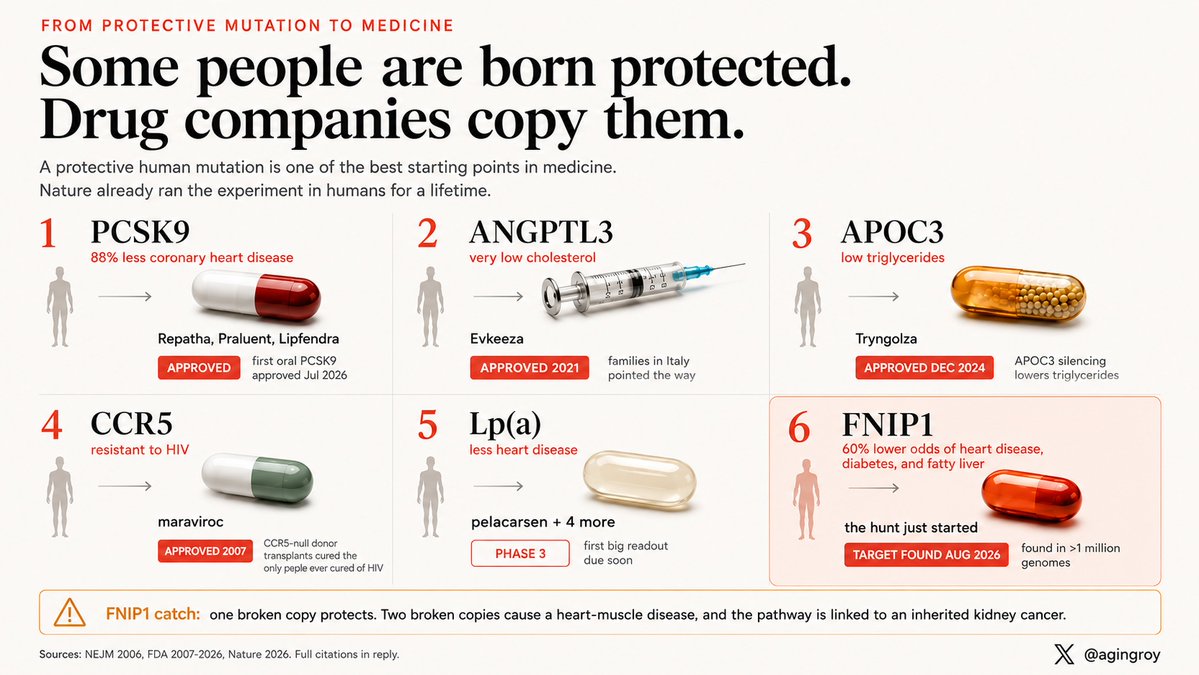
Some people are born with a faulty gene that protects them from disease. Drug companies find those people, figure out what the broken gene does, and build a drug that copies it. It is the most reliable way to invent a medicine, because the experiment already ran in humans for a lifetime.
1. PCSK9. In 2006, researchers found that people born with this gene disabled had 88% less coronary heart disease. That discovery led to the injectable cholesterol drugs Repatha and Praluent, and three weeks ago, the first PCSK9 pill.
2. ANGPTL3. Families in Italy with this gene broken had very low cholesterol and clean arteries. The copy is Evkeeza, approved in 2021 for severe inherited high cholesterol.
3. APOC3. Broken copies mean very low triglycerides and less heart disease. The copy, Tryngolza, was approved in December 2024.
4. CCR5. About 1% of Europeans carry two broken copies and are essentially resistant to HIV, because the virus uses that protein as its door into cells. The copy is the drug maraviroc, and the only people ever cured of HIV got transplants from those donors.
5. Lp(a). People born with low levels of this particle get less heart disease. Five drugs copying that state are in late trials; the first big readout is due any week now.
6. FNIP1. Found on Tuesday, in a million genomes. One broken copy, 60% lower odds of heart disease, diabetes, and fatty liver. The hunt for the copy has just started, with a catch: the pathway it works through, when fully broken, causes a kidney cancer.
One gene taught us to lower cholesterol. Another taught us to block HIV. The next lesson was published this week.
In a genome-wide association analysis of fibromyalgia across 2.5M, the top signal was a coding variant in HTT, part of the common Huntington's Disease germline risk haplotype A1 https://t.co/cnu1vl7aAF @NatureMedicine
In our new paper we show that a quick, noninvasive retinal scan may help flag cardiovascular risk early, a promising step for oculomics in predictive and preventive care
We applied AI-based retinal image analysis to images from >8,000 people in the Human Phenotype Project, extracting 12 quantitative vascular features and found strongly associations with cardiometabolic risk, including blood pressure, lipids, glycemic markers, body composition, and sleep apnea
These features also improved prediction of future cardiovascular events, with findings replicating in >16,000 UK Biobank participants
https://t.co/DD7IpAtWlQ
Google hid a fully working flight simulator inside Google Earth back in 2007 and never told anyone.
You unlocked it with a secret keystroke: Ctrl+Alt+A. No menu, no announcement. One user stumbled onto it, the combo spread, and it got popular enough that Google made it official the next year. Two planes, an F-16 and a Cirrus SR22, flying over real satellite imagery of the entire planet.
Then it stayed locked inside the downloadable desktop app for 18 years. The browser version was a stripped-down viewer that couldn't run it. Today that changed.
Here is the part that makes it impressive. A flight simulator is the single hardest thing you can ask a 3D map to do. Panning is easy, the software has all the time it wants to load the terrain ahead of you. Flying low and fast strips that away, forcing it to fetch, decompress, and render the world faster than you are crossing it. The hardest possible job for every part of the system at once.
So "just for fun" is carrying a lot of weight in that sentence. Getting this to run in a browser tab is the cleanest proof that the web version finally matches what used to need a desktop app.
The toy is the benchmark.
Do single-cell foundation models obey scaling laws?
A somewhat thought-provoking new Nature Methods study by the Crawford lab suggests that, for current single-cell foundation models, the answer may be “not really.” Across a broad range of architectures and downstream tasks, increasing pretraining data from hundreds of thousands to tens of millions of cells yielded surprisingly limited gains, with performance often saturating much earlier than expected.
This is interesting and provides exactly the kind of rigorous benchmarking our field needs. As Felix Fischer and I commented in the accompanying Research Briefing, such studies help move the discussion beyond model size and computational budgets toward actual scientific utility.
At the same time, I am not convinced the key conclusion is that scaling does not work in biology. Rather, it may be that current objectives are not extracting enough information from additional data.
Interestingly, in our recent scConcept work, we observe a markedly different scaling behavior, with continued gains as training data grows toward hundreds of millions of cells. The key difference may be the training objective itself: instead of reconstruction-based masked modeling, scConcept uses a contrastive objective that directly optimizes biologically meaningful cell representations.
https://t.co/CR8DSUmHi3
This raises an interesting question for the field: Have we reached the limits of data scaling, or only the limits of current objectives?
-> My guess is that the next generation of biological foundation models will depend less on simply collecting more cells and more on finding the right representation learning principles for biology.
Nature Methods paper:
https://t.co/ArtUo1fcPE
Research Briefing:
https://t.co/5er4vGJiAJ
#SingleCell #FoundationModels #AIforBiology
New Science Blog: Why has AI advanced faster in coding than in biology?
To agents, bio databases are like cities built before cars—maddening to drive in because they're designed for different traffic.
How do we build infrastructure agents can use?
https://t.co/PQaNQ4GRJZ