Sharing Gluformer, our latest paper @Nature: The first generative foundation model for blood glucose data, trained on data from 10,812 adults of the Human Phenotype Project
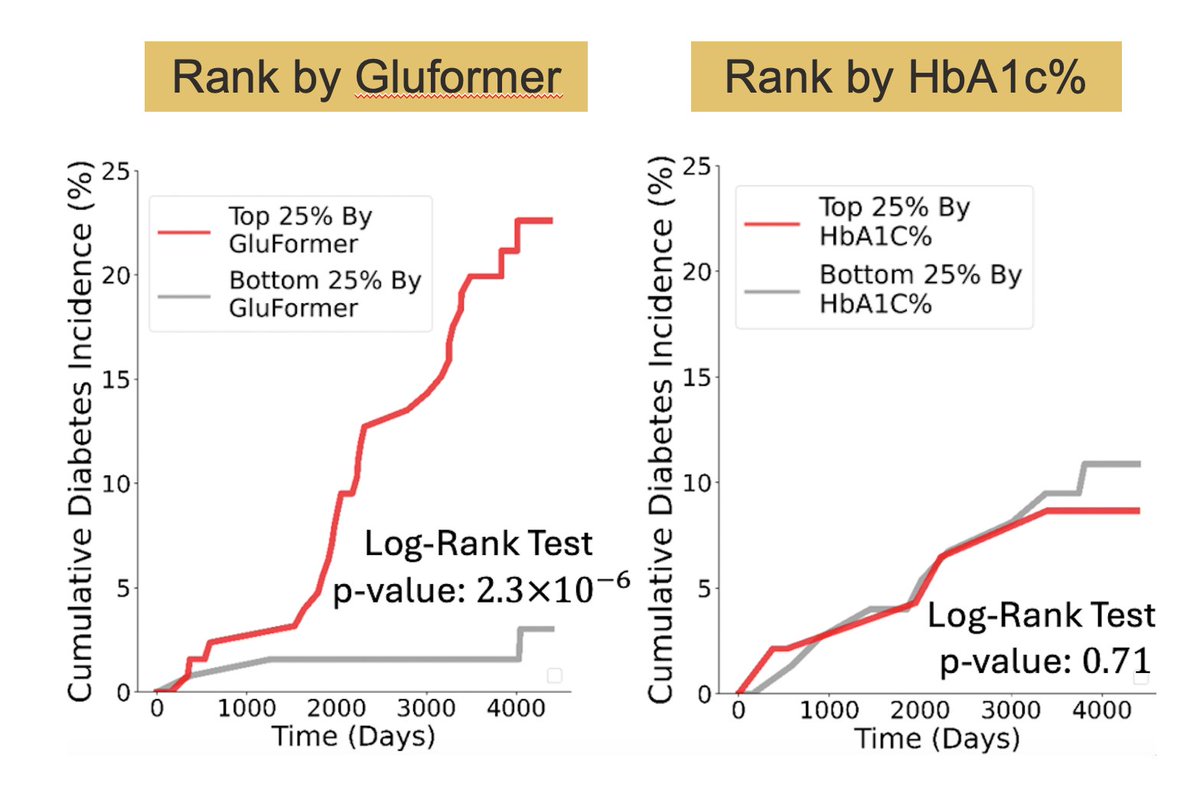
Gluformer predicts risk of diabetes and cardiovascular outcomes better than the standard of care
Full paper: https://t.co/SrdxDzftYU
Collaboration of @WeizmannScience@mbzuai@nvidia@Pheno_AI
Work by @GLutsker Gal Sapir, @smadarshilo, Jordi Merino, @nastya_godneva, Jerry R. Greenfield, Dorit Samocha-Bonet, Raja Dhir, Francisco Gude, Shie Mannor, Eli Meirom, @ericxing, Gal Chechik, and @H_Rossman
We present our work "Teaching VLMs to localize specific objects from in-context examples" tomorrow at 15:15-17:15, Poster #888!
VLMs have trouble learning from visual examples - but our data-centric approach changes that!
#ICCV2025@SivanDoveh@jmie_mirza@Eli_Schwartz@RGiryes
Happy to share two brief updates:
1. New role: I’m joining @mbzuai as an Affiliated Assistant Professor of Personalized Medicine. Excited to tackle fresh challenges with new colleagues
2. New paper: Our latest @NatureMedicine paper on the Human Phenotype Project -- a flagship collaboration between Pheno-ai , the Segal Lab at Weizmann Institute of Science, & MBZUAI
—just went live:
https://t.co/tTA6Tyb2Ym
It reflects years of hard work from @segal_eran , @AdinaBlueBird , Ori Cohen, Hila Saranga, Orit Kolker, Maya Lotan, @nastya_godneva, @YeelaTalmor and many many other dear students, researchers, teammates at Pheno-ai , and of course our participants. Kudos to @smadarshilo & @Lee_Reicher1 for spearheading this manuscript!
Stay tuned for more insights and real-world applications as we expand this unique dataset worldwide
Excited to share a milestone published in @NatureMedicine from our decade-long effort to build The Human Phenotype Project, a unique longitudinal cohort with unmatched depth of clinical and multi-omic profiling, enabling truly predictive, personalized medicine.
Led together with @ericxing, it is a global collaboration between @WeizmannScience, @MBZUAI, and Japanese partners, spanning 30,000+ participants and continuing to grow internationally
By devising AI models trained on individuals deeply profiled with genetics, microbiome, glucose, sleep, bone density, and more, we can now forecast diseases before symptoms appear and simulate treatment or lifestyle outcomes.
Key findings:
• Re-defined metabolic risk thresholds
• Predicted menopause impact via biological aging
• Mapped organ-specific aging trajectories
• Developed models for early detection of diabetes & heart disease
This dataset is a blueprint for digital health twins, AI-driven tools grounded in real-world, longitudinal data
Data access: https://t.co/qRrFPaY4as
Full paper: https://t.co/dayU9YYIlC
Thanks to all the people who led this work: Lee Reicher, Smadar Shilo, Anastasia Godneva, Guy Lutsker, Liron Zahavi, Saar Shoer, David Krongauz, Michal Rein, Sarah Kohn, Tomer Segev, Yishay Schlesinger, Daniel Barak, Zachary Levine, Ayya Keshet, Rotem Shaulitch, Maya Lotan-Pompan, Matan Elkan, Yeela Talmor-Barkan, Yaron Aviv, Maya Dadiani, Yonatan Tsodyks, Einav Nili Gal-Yam, Haim Leibovitzh, Lael Werner, Roie Tzadok, Nitsan Maharshak, Shin Koga, Yulia Glick-Gorman, Chani Stossel, Maria Raitses-Gurevich, Talia Golan, Raja Dhir, Yotam Reisner, Adina Weinberger, Hagai Rossman, and Le Song
And special thanks to all participants of the Human Phenotype Project
Come say hi!
📅 Tue 15 Jul, 4:30 - 7 pm PDT
📍 East Exhibition Hall A-B, poster #E-1903
We’d love to chat about survival analysis, causal inference, IVs, and making ML more useful in the clinic.
Across semi-synthetic EHR benchmarks, MISTR:
• Cuts treatment-effect error by up to 50% vs. today’s best models
• Stays robust even when >60% of outcomes are censored
For the new kids in back: If you hate statistics, you'll love my free lectures. Putting science before statistics, from basics of inference & causal modeling to multilevel models & dynamic state space models. It's all free, made with love and sympathy. https://t.co/GnOYGex9Yg
We have an *opening for a PhD student* in my group on machine learning generalization "out-of-table". Help build methods that learn from large volumes of tabular data to generate models for new tasks! Apply here: https://t.co/mFLtcrrfVn
📚: Causal Machine Learning is a practical introduction to building AI models that can reason about causality.
Get the book now: https://t.co/dHkZ6CuOjg
#AI#causalML
🎉 Thrilled to share that my latest paper (w/ @segal_eran) on the gut microbiome's role in host metabolic health has just been published in @NatureComms!
Dive into our insights📄✨
https://t.co/WhrNfuLN7o
1/5
📢@DanielNevo and I have a new WP out📢
In the paper, we present a general framework for identification in RD designs when continuity is violated using multiple time period data, which we term RD-DID
A thread 1/n
https://t.co/vA7SfLJWRb #EconTwitter#Econometrics
Check out our new working paper on correcting invalid regression discontinuity designs.
Led by talented Econ PhD student Dor Leventer (@DorLev3) !
📜https://t.co/nHVblkAbys
Need a new benchmark for causal effect estimation? Have a look at IncomeSCM—a time-series simulator based on the well-known Adult data set: https://t.co/6sJFARS9R4, https://t.co/DO23o9Hu5q.
📽️ New 4 hour (lol) video lecture on YouTube:
"Let’s reproduce GPT-2 (124M)"
https://t.co/QTUdu8b0qh
The video ended up so long because it is... comprehensive: we start with empty file and end up with a GPT-2 (124M) model:
- first we build the GPT-2 network
- then we optimize it to train very fast
- then we set up the training run optimization and hyperparameters by referencing GPT-2 and GPT-3 papers
- then we bring up model evaluation, and
- then cross our fingers and go to sleep.
In the morning we look through the results and enjoy amusing model generations. Our "overnight" run even gets very close to the GPT-3 (124M) model. This video builds on the Zero To Hero series and at times references previous videos. You could also see this video as building my nanoGPT repo, which by the end is about 90% similar.
Github. The associated GitHub repo contains the full commit history so you can step through all of the code changes in the video, step by step.
https://t.co/BOzkxQ8at2
Chapters.
On a high level Section 1 is building up the network, a lot of this might be review. Section 2 is making the training fast. Section 3 is setting up the run. Section 4 is the results. In more detail:
00:00:00 intro: Let’s reproduce GPT-2 (124M)
00:03:39 exploring the GPT-2 (124M) OpenAI checkpoint
00:13:47 SECTION 1: implementing the GPT-2 nn.Module
00:28:08 loading the huggingface/GPT-2 parameters
00:31:00 implementing the forward pass to get logits
00:33:31 sampling init, prefix tokens, tokenization
00:37:02 sampling loop
00:41:47 sample, auto-detect the device
00:45:50 let’s train: data batches (B,T) → logits (B,T,C)
00:52:53 cross entropy loss
00:56:42 optimization loop: overfit a single batch
01:02:00 data loader lite
01:06:14 parameter sharing wte and lm_head
01:13:47 model initialization: std 0.02, residual init
01:22:18 SECTION 2: Let’s make it fast. GPUs, mixed precision, 1000ms
01:28:14 Tensor Cores, timing the code, TF32 precision, 333ms
01:39:38 float16, gradient scalers, bfloat16, 300ms
01:48:15 torch.compile, Python overhead, kernel fusion, 130ms
02:00:18 flash attention, 96ms
02:06:54 nice/ugly numbers. vocab size 50257 → 50304, 93ms
02:14:55 SECTION 3: hyperpamaters, AdamW, gradient clipping
02:21:06 learning rate scheduler: warmup + cosine decay
02:26:21 batch size schedule, weight decay, FusedAdamW, 90ms
02:34:09 gradient accumulation
02:46:52 distributed data parallel (DDP)
03:10:21 datasets used in GPT-2, GPT-3, FineWeb (EDU)
03:23:10 validation data split, validation loss, sampling revive
03:28:23 evaluation: HellaSwag, starting the run
03:43:05 SECTION 4: results in the morning! GPT-2, GPT-3 repro
03:56:21 shoutout to llm.c, equivalent but faster code in raw C/CUDA
03:59:39 summary, phew, build-nanogpt github repo