Sourav Chatterjee: Michel Talagrand and the Rigorous Theory of Mean Field Spin Gl... https://t.co/uBr0bmHU0J https://t.co/9i3aydYK5P https://t.co/3Lo6VJqV1i
Mathematicians finally understand the behavior of an important class of differential equations that describe everything from water pressure to oxygen levels in human tissues. Paulina Rowińska reports: https://t.co/WkJLzXEaDv
EPL: EPL 40th anniversary highlight: Percolation theory on interdependent networks based on epidemic spreading by Seung-Woo Son et al.
https://t.co/XAPXV74jbW
Phys. Rev. X: Statistical Physics Analysis of Graph Neural Networks: Approaching Optimality in the Contextual Stochastic Block Model
https://t.co/rJxfiH7GDg
You like Dynamics? Nonlinearity? Networks?
We offer an open position as
➡️Research Associate in Network Dynamics
- Postdoc or PhD student level
- focus on non-autonomous systems
- develop cool toobox (computational) & challenging new theory
APPLY NOW.
https://t.co/y1HZuOf2o7
@cfaed_TUD @stevenstrogatz@adilson_motter@florian_dorfler@gin_bianconi@thilogross@DirkBrockmann, please help distributing
A graph theory framework for the statistical mechanics of geometrically frustrated assemblies offers a concise mathematical relation between frustration and structure https://t.co/1P5tYLoxvi
Something big is afoot. A new suggestion that complexity increases over time, not just in living organisms but in the nonliving world, promises to rewrite notions of time and evolution. Philip Ball reports: https://t.co/ck3DIZiwPe
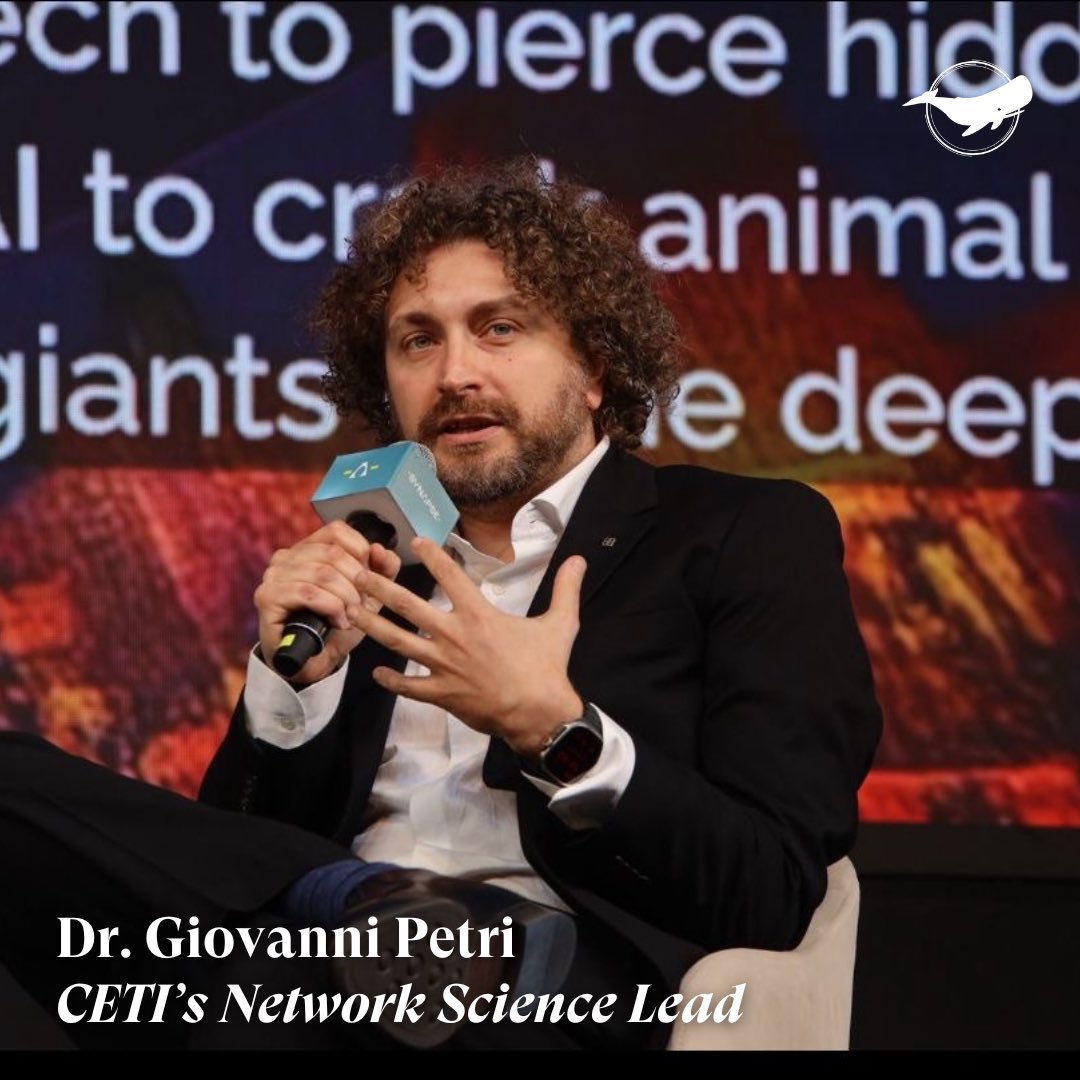
👨🏻🔬Introducing #CETIScientist, Dr. Giovanni Petri (@lordgrilo), CETI’s Network Science Lead! Giovanni is a Professor at @NUNetsci in London and a Principal Researcher @CentaiInstitute. Learn more about Giovanni and his work here: https://t.co/uP0RzMrN2N
📸: @SynapseConclave
Networks are a powerful mathematical abstraction for any relational system. However the application of Renormalization Group methods to understand their behavior at the largest scales poses a number of challenges which we try to summarize here https://t.co/bL0xHJ8Kt6
@NatRevPhys
"Topology shapes dynamics of higher-order networks" glad to share my klogW talk covering the wonderful recent Nature Physics paper with a fastastic team of collaborators https://t.co/aSF2RIVsYt This is the link to our paper https://t.co/rAPs8F3Xrj
Wonderful to see our latest work "Topology shapes dynamics on higher-order networks" now published in Nature Physics @SpringerNature https://t.co/rAPs8F3pBL
Our new paper is out!😀Hoping the interest cascades as fast as my relatives sharing it without reading past the title!🥴Check it out before they inflate the citation count.😁https://t.co/FHkjMtslW1
Reminder: Join us for the 2nd edition of “Network Geometry: Theory & Applications” Satellite at @NetSciConf.
Submit your abstract by Feb 10: https://t.co/DClc5bHEIr
Growing obsession with citations among PhD students, and worrying about who else is churning out a higher number of papers is an undesirable trend. What students should worry about, mostly, is the quality of scientific advance they are producing and whether they are deriving pleasure out of their research. Everything else is noise.
The impact of a new work on a field is often not immediately obvious. Publishing with small teams, just students + supervisors does not usually attract a lot of citations very quickly. Working in a field which has a small community implies commensurately fewer citations. Working from a developing nation and not being able to travel often to reach out to the global community reduces visibility and citations. Not being able to publish open access reduces citations. In other words, you could have written a wonderful paper - providing fundamental new insights - but still have received fewer citations because any or all of the above factors were in play.
For students, stop worrying about the noise, invest in and enjoy the science.
For faculty sitting in hiring, promotion and recognition committees (that is us!)l), read into the work and try to judge quality, rather than focussing on metrics alone. We should be able to discriminate between excellence and sub-par by reading and understanding the manuscripts of those we are judging; we should also be cognizant of the boundary conditions in which those contributions have come.
Perhaps our inability to do so, and our blind reliance on metrics alone, has in turn created this environment where many #PhD students are more worried about numbers rather than the quality and content of their scientific output and the happiness of discovering new knowledge.
Happy to announce that the second edition of "Frontiers in Non-equilibrium Physics (FNEP)" -- an international conference with an engaging line of speakers is ready to kick-off from Jan 7 at IMSc.
Details: https://t.co/vfjLa1cn6p
YT: https://t.co/7EtmDxyuZH