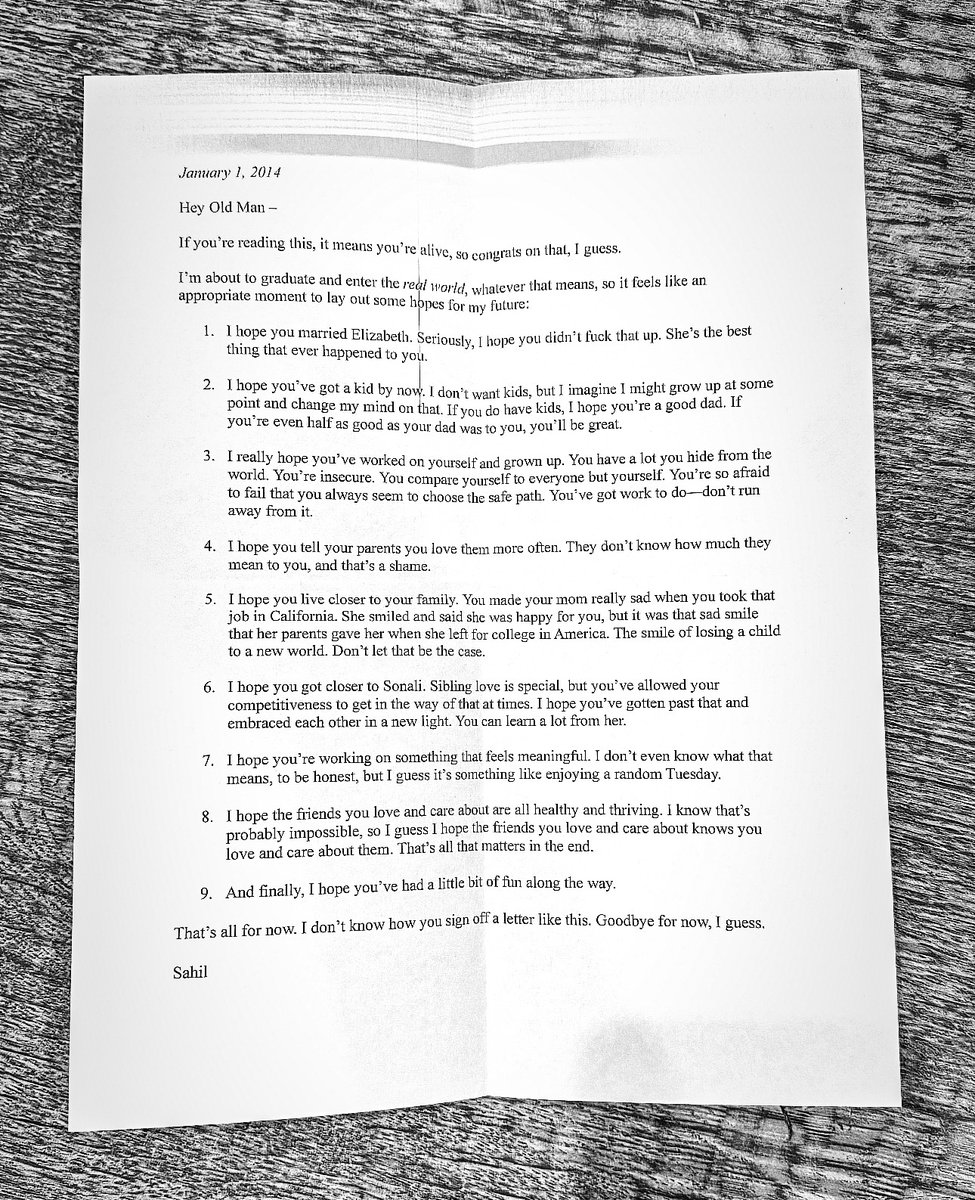
On January 1, 2014, I wrote a letter to my future self just before graduating.
Today, 10 years later, I opened it.
This hit me hard.
Everyone should do this.
On June 26th, 1998, a 21-year old Martin says the entire world will know of Coldplay in 4 years.
He was rocking braces and hand’t even finalized the band’s name.
4 years and 3 days later, Coldplay headlines the Glastonbury Festival in front of 140,000 people.
Legendary call.
I recently came across an old Cherokee story of the Two Wolves:
A grandfather takes his grandson on a walk to share his wisdom for life.
"A fight is going on inside me, a terrible fight between two wolves. One is bad, he is anger, fear, hate, jealousy, and envy. One is good, he is hope, kindness, joy, love, and optimism."
The boy asks his grandfather which wolf will win.
The grandfather replies:
"The one you feed."
I can't stop think about this story.
We all have the two wolves inside of us.
Each day, we have a choice: Which wolf will you feed?
Feed the dark wolf, you'll be filled with anger, fear, hate, jealousy, and envy.
Feed the light wolf, you'll be filled with hope, kindness, joy, love, and optimism.
The choice is yours.
one way to help curb the excesses of fast fashion is to encourage ppl to value the patina and wear-and-tear that good clothes develop. that way, they: 1) buy less, buy better; 2) buy vintage; 3) wear things. examples
1. King Charles' patched-up suit (see hem)
2. King Charles' patched-up shoes
3. Vintage Lee 101-J trucker jacket with a repaired collar (collar has been repaired by hand with a bit of oxford cloth). Vintage denim garments are also great in that they're softer and often have natural fades (rather than pre-distressed fades that don't always look very convincing)
4. Old sweatshirts (easy to find vintage; just search eBay and Etsy for vintage Russell Athletic). Looks great with old jeans and boots
As a rule of thumb, if you ever say “I’ll be happy when I get X”, it’s safe to assume you won’t be.
Happiness is an inside job.
You’ll be happy when you’re happy, not when you achieve some external reward.
Siddhartha by Hermann Hesse is recommended by many of my podcast guests.
There is one takeaway that Naval Ravikant (@naval) has reinforced with me several times on our long walks.
The protagonist, Siddhartha, a monk who looks like a beggar, has come to the city and falls in love with a famous courtesan. He attempts to court her, and she asks, “What do you have?” A well-known merchant similarly asks, “What can you give that you have learned?” His answer is the same in both cases, so I’ve included the latter story below.
Merchant: “. . . If you are without possessions, how can you give?”
Siddhartha: “Everyone gives what he has. The soldier gives strength, the merchant goods, the teacher instruction, the farmer rice, the fisherman fish.”
Merchant: “Very well, and what can you give? What have you learned that you can give?”
Siddhartha: “I can think, I can wait, I can fast.”
Merchant: “Is that all?”
Siddhartha: “I think that is all.”
Merchant: “And of what use are they? For example, fasting, what good is that?”
Siddhartha: “It is of great value, sir. If a man has nothing to eat, fasting is the most intelligent thing he can do. If, for instance, Siddhartha had not learned to fast, he would have had to seek some kind of work today, either with you, or elsewhere, for hunger would have driven him. But, as it is, Siddhartha can wait calmly. He is not impatient, he is not in need, he can ward off hunger for a long time and laugh at it. ”
***
I think of Siddhartha’s answers often and in the following terms:
“I can think” → Having good rules for decision-making, and having good questions you can ask yourself and others.
“I can wait” → Being able to plan long-term, play the long game, and not misallocate your resources.
“I can fast” → Being able to withstand difficulties and disaster. Training yourself to be uncommonly resilient and have a high pain tolerance.
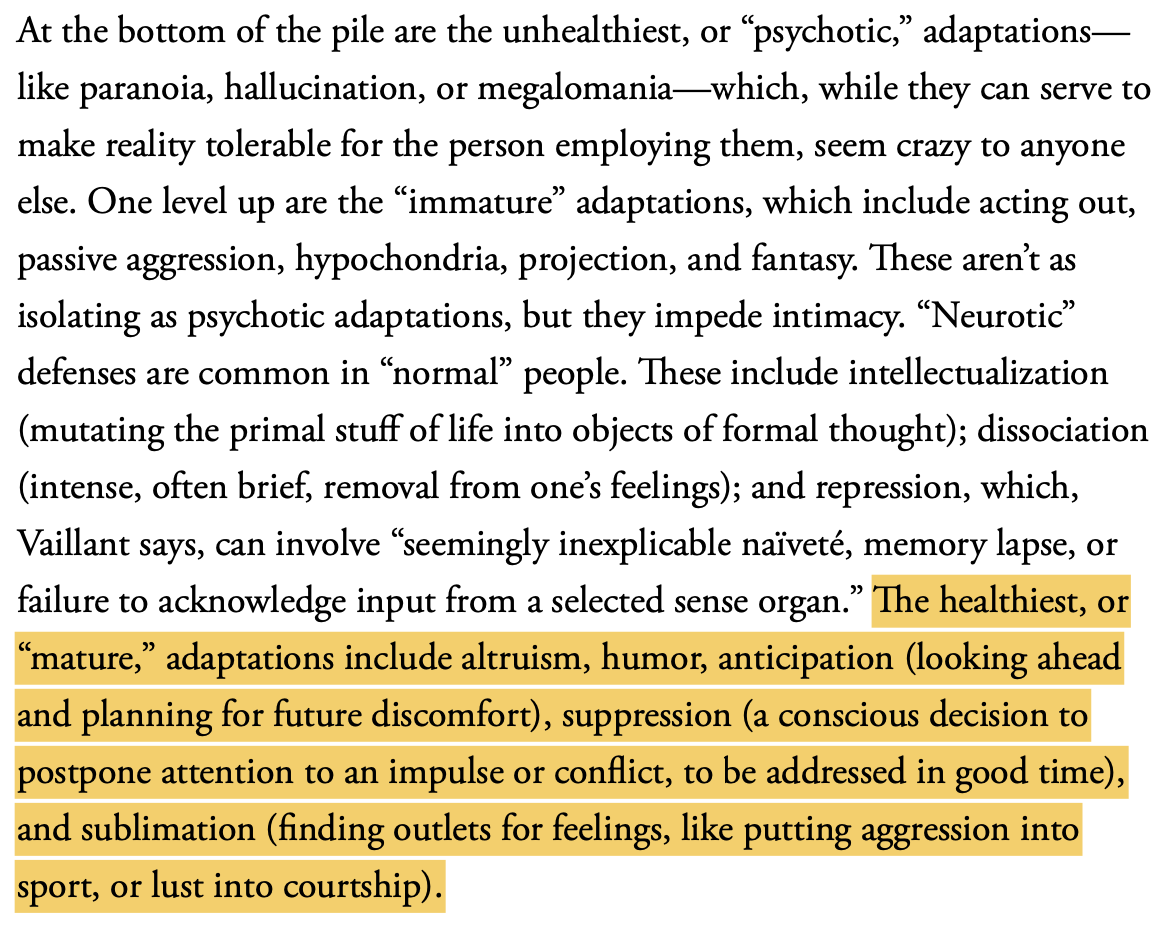
The Harvard Study of Adult Development is considered the longest running study on adult life, health, and happiness.
The study looked at mechanisms through which participants dealt with life's challenges.
These 5 "healthy adaptations" were correlated with health and happiness:
1. Altruism: Focus on the wellbeing of others over the self. Empathetic behavior.
2. Anticipation: Looking into the future and anticipating the inevitability of discomfort. Maintaining a realistic, balanced view of the future.
3. Sublimation: Finding a productive outlet for negative emotions like aggression, such as through sports or exercise.
4. Humor: The ability to laugh at life's trials and setbacks.
5. Suppression: Delaying the confrontation with stress or struggle beyond the initial, impulsive, emotional reaction.
Charles Darwin is often paraphrased as saying, "It's not the strongest or the most intelligent species that survives. It's the one that is most adaptable to change."
By embracing these 5 healthy adaptations, we can all become more effective at riding the inevitable waves of life.
If you learned something or enjoyed this, follow me @SahilBloom for more.