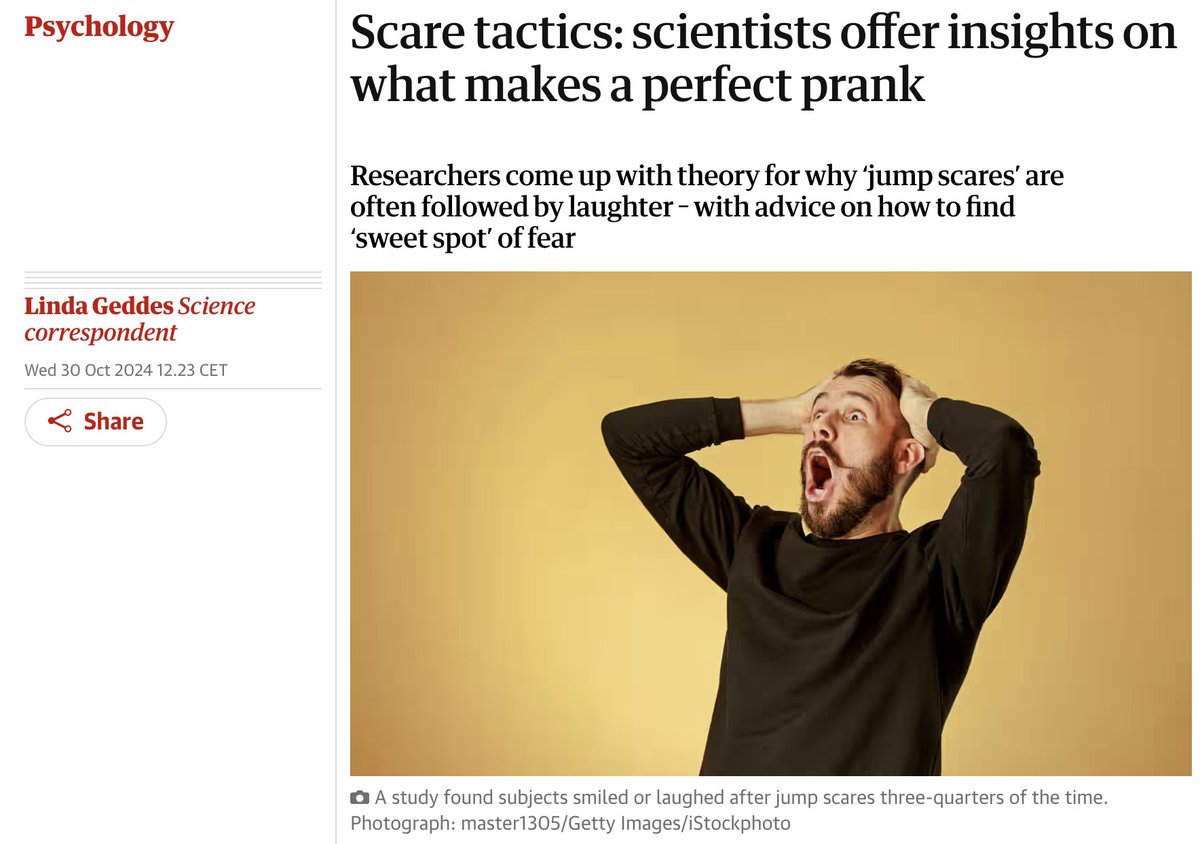
Why do people enjoy scaring others for fun? Why do people often laugh after jump scares? Why do children find peek-a-boo so funny?
In honour of Halloween, @guardian has covered our recent paper on the cognitive intersections of humor and fear:
https://t.co/mxGyiEBnkX
2327 citations, untold millions of dollars spent chasing a non-existent result based on manipulated images that were easily spotted in post-pub peer review.
In addition to retraction, it would be nice to prevent things like this in the future. Can haz quality assurance plz?
I am happy to share our recent paper in Behavior Research Methods to present my first published R package!
eyeScrollR: A software method for reproducible mapping of eye-tracking data from scrollable web pages
https://t.co/OINNnj8XfI
RTs greatly appreciated! #psynomBRM
🧵
@flourn0 It's easy to p-hack, but it still takes more time & skills than good old fraud. How could one even take the time to p-hack and end up with enough groundbreaking publications for a career at Harvard? 😁
(Thanks to this event, I can proudly tell the entire world that there is an absolutely microscopic me visible in an online lecture where the great @rlmcelreath talked live. I can now die in peace)
Last week I was here. And yes, really, it was great. A full room of brilliant and genuinely kind people (+ me, somehow) all dedicated to ensuring we do science the right way, great lectures and well-designed workshops. We need more of that around the world!
If we already don't have the time to review articles for journals in a centralized way, how can we expect to have the time to review them individually with an even larger amount of papers out there? Am I missing something?
I think slow science is a better solution
Apparently a bold opinion : what if the big problem with publication times in social sciences is not journals so much than the fact that we can't help but write a 15 pages article every time we find a correlation, to convince readers that correlation-is-not-causation-except-now?
We famously don't have enough time to review articles correctly. I don't think that the idea to bypass the review process, then publish more & faster in fields with already too many methodological mistakes (documented for the past 50 years) is the right way to go unfortunately
All in all, I think we are much better off with good quant methods skills but poor knowledge of theory than the opposite. Because that's probably what got us in this situation for oh so many years!
I must say I agree with this one. Our fields are so riddled with fraud, p-hacking and poor methodology that I get an ever growing sense of skepticism when I read anything, even consensual stuff (ego depletion taught us how an entire body of literature could be wrong)
And at the risk of being controversial, I would say that when researchers in quant' fields can sometimes cite hundreds of papers (with authors and year) by heart but don't get the very basics of stats, it sometimes feels more like intellectual pedantry than field expertise to me
@lakens I like that way of putting it! I think I concur. And that makes a very solid argument to say that it is absolutely necessary that we tackle this problem now, with great attention. Otherwise, researchers in 50 years will wonder how this could have gone on for 100 years 😬
@lakens Considering the similarities, do you think should they really be referred to as separate crises, or just as a single, very long crisis that just had different levels of publicity/recognition in time?