@GoogleResearch Inb4 they contrast it with natural language to do multimodal search:
> give me the location with the most tim hortons in walking distance possible
@marvindiazjr@contextkingceo exactly. And really just shows me they don’t know ball, considering context-dependent embeddings have been a thing since early 2010s
I agree. My hypothesis is ATS systems being inundated with AI slop resumes such that they simply can’t find the right candidates and miss real talent. Lots of people coming into interviews who can hardly form sentences or just drastically over exaggerating qualifications. I predict a trend toward in person networking and (ironically) tactics like: “just go in with a firm handshake and a smile”
@ReplyGrinder@qdrant_engine Hey! I agree with whats mentioned at the end of the article: start small and local if possible, then migrate things when you are fully ready:
> test Qdrant with a single non-critical collection. First, run it for a few weeks, evaluate the performance and operational overhead
@IdoIrani@joreyn82@JohnHolbein1 Ha! very interesting. Abstract click-bait. Also meta-clickbait in the original post claiming the abstract-only distribution is equivalent to "z-values from medical research"
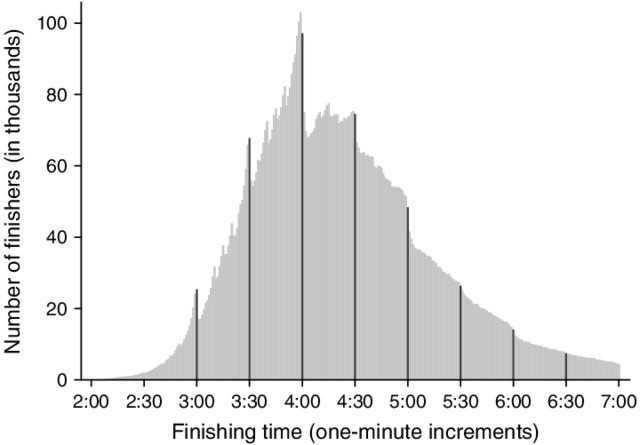
@IdoIrani@joreyn82@JohnHolbein1 I like the explanation of a "psychological barrier." -- thanks for that. Reminds me of the distribution of marathon times histogram. Huge spike at 4:00 hrs... There's nothing magical about it other than it's some arbitrary barrier people really want to surpass.
@IdoIrani@joreyn82@JohnHolbein1 Maybe I am dense, but why? If 1.95 is not significant using a two-tailed test, it doesn't get reported. However, 2.05 will. Is that not exactly the survivorship bias? (Genuinely asking because I feel like I'm still not getting it)
@mtlushan What does each point represent? Something feels off about this -- like your embedding dimensions are all highly correlated and therefore not that informative. Every time I get a UMAP like this it usually means somethings not right on my end...
@EIFY@percyliang Interesting! If I saw this during a training (I don't train LLMs), I'd think this was clearly me not shuffling my dataset, or some artifacts with my LR scheduler. Wonder if anyone has looked into the actual batches in these steps to see what might have caused a spike.