Also … we are hiring at @NTTDATA_AIVista for full-time, post-doc and interns to join us in Palo Alto with the following focus areas (copied from @Nathaniel_Weir). DM me if you are interested!
– neurosymbolic AI, doc-to-logic autoformalization, and formal methods
– knowledge representation and automatic ontology construction
– large-scale synthetic evaluation and environment building
– LLM agents and verification harnesses
– multimodal document intelligence
– process intelligence
– LLMs for code, automated research and self-improvement
– structured reasoning under uncertainty
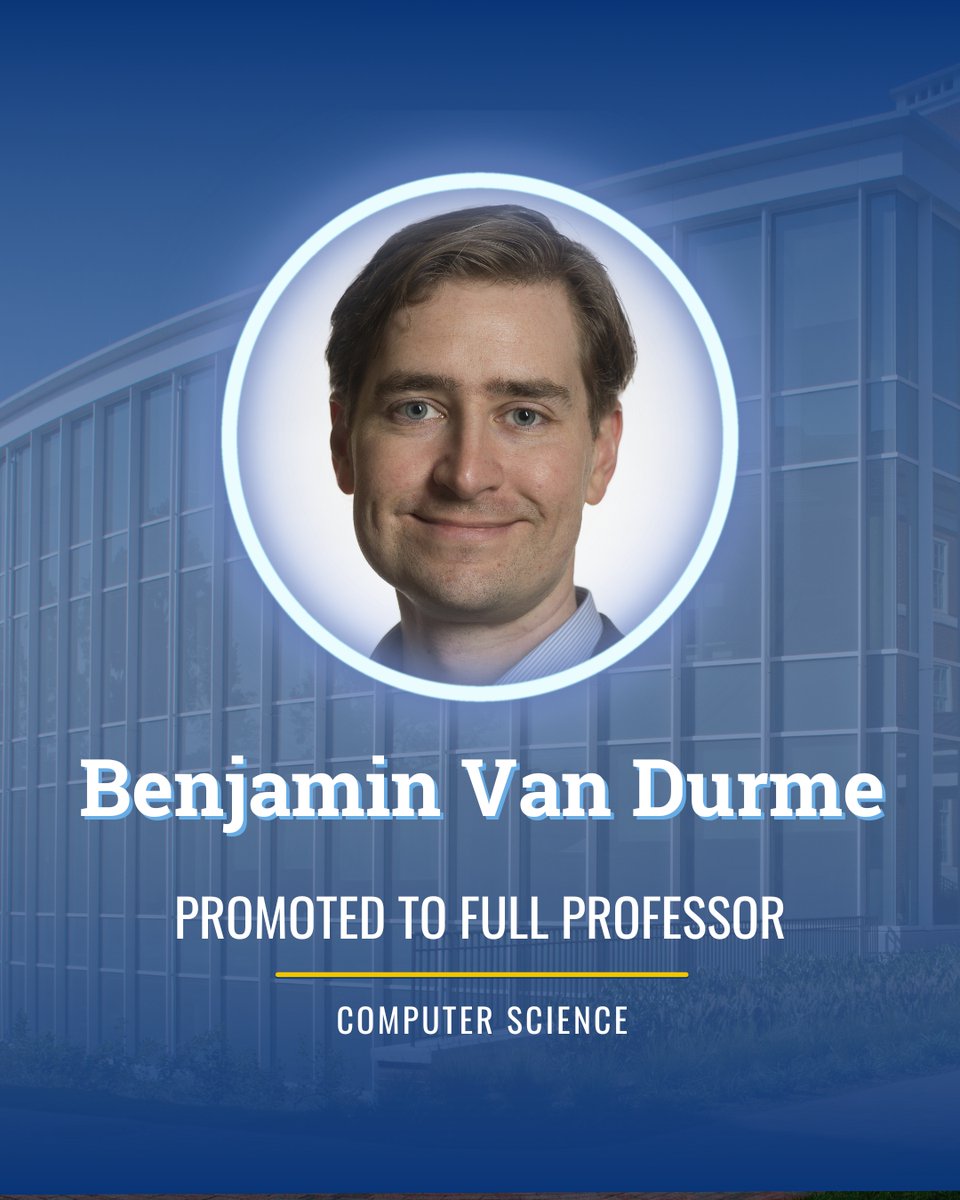
Congratulations to @ben_vandurme on his promotion to full professor! His research focuses on helping people work w/ large amounts of info—understanding what info is present in docs & images, helping people find that info, & being able to help answer questions about that content.
I’ve joined @NTTDATA_AIVista to work on problems in neuro-symbolic AI and governance for high-stakes domains!
We are looking for PhD research interns (3 to 6-month engagements) and postdocs to join us in Palo Alto and work alongside us on open problems as early as this Fall. We are broadly interested in candidates across various areas:
– neurosymbolic AI, doc-to-logic autoformalization, and formal methods
– knowledge representation and automatic ontology construction
– large-scale synthetic evaluation and environment building
– LLM agents and verification harnesses
– multimodal document intelligence
– process intelligence
– LLMs for code, automated research and self-improvement
– structured reasoning under uncertainty
Feel free to reach out and send me your CV! https://t.co/gUhdWc2izc <at> https://t.co/g7JRjbJ7EN
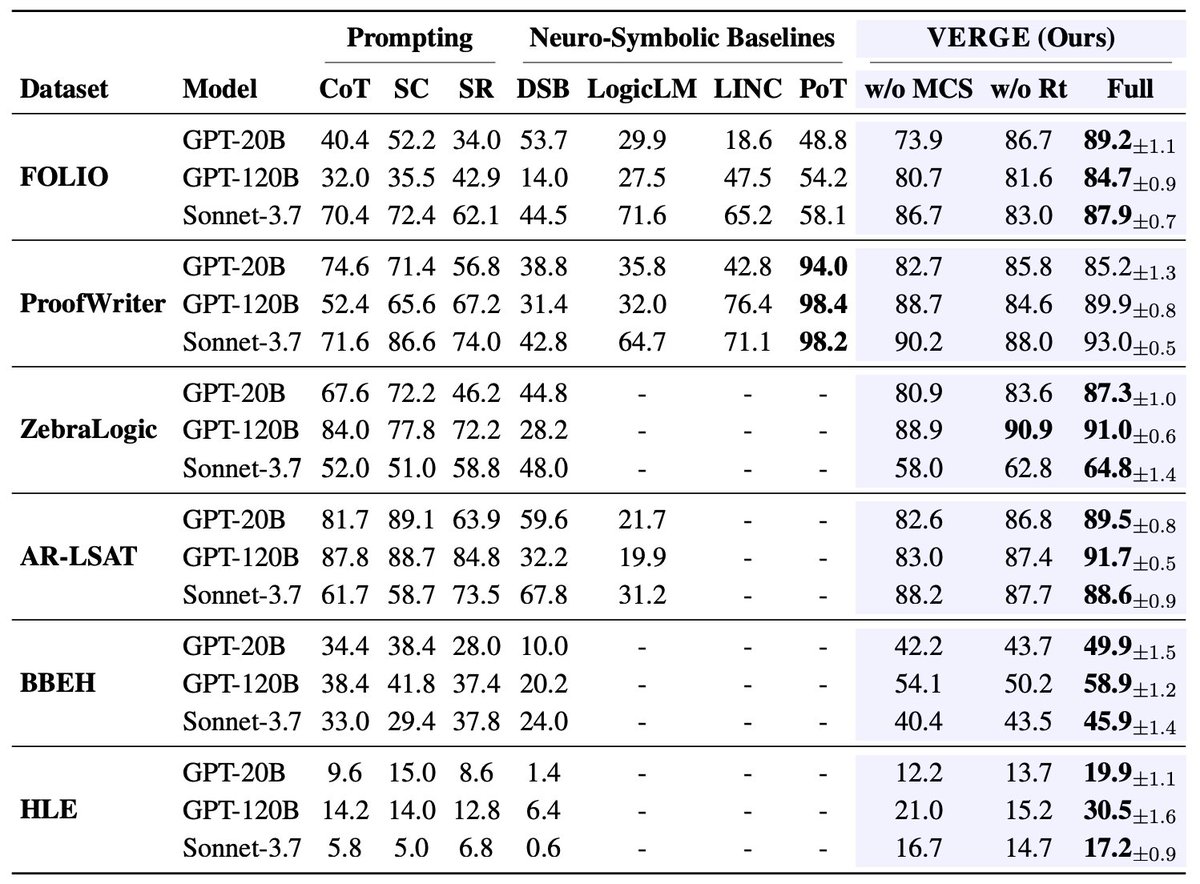
Check out @vikash_joh60795's new work at #AWS on enhancing LLMs with formal reasoning tools!
Impressive performance improvements across various reasoning benchmarks.
Excited to share "VERGE," my latest work from my internship at AWS! ☁️
We tackle the "Semantic Gap" in Neuro-Symbolic AI: How do we get the formal guarantees of SMT solvers without breaking on the ambiguity of natural language? 🧠🤝📐
📄 Paper: https://t.co/kjUqbm0PX0
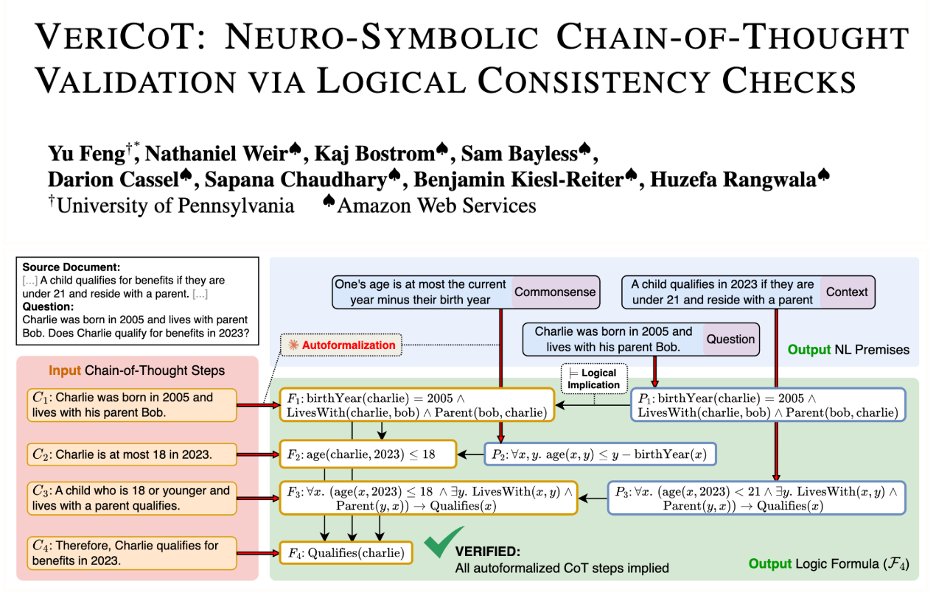
LLM CoT reasoning looks smart but can be logically flawed or... just made up. It's time to hold reasoning accountable!
We built VeriCoT to do just that. VeriCoT extracts the core argument of the CoT using well-formed symbolic notions of logical support. It formalizes every CoT step into first-order logic and finds the exact premise it's built on. This gives us two superpowers:
🤖Automated Proof: Solvers can automatically verify if the logic is valid.
🧑🔬Human-Readable Audits: Natural language premises let you pinpoint ungrounded leaps or fallacies.
Best of all, all these can be used as signals to learn more verifiable models!
To our knowledge, VeriCoT is the first neuro-symbolic validator of CoT traces in non-math/code domains.
📄 Paper: https://t.co/6NUYuQumdt
Our team at #AWS is hiring PhD Interns for Summer 2026! We are looking for strong candidates interested in
- LLM reasoning
- Neuro-symbolic learning, inference + verification
- Synthetic data generation
- Post-training, RL + verifiers
- Code generation + search
and more!
🔗 Apply: https://t.co/fim7DCfi1l
📧 Send CV to [email protected] to get on our radar!
I'm on the job market and at #neurips2025! Looking for research roles around data for foundation models and would love to chat with folks - resume/site in my bio. I've recently worked @AIatMeta and @databricks and publish papers with my awesome collaborators @jhuclsp!
I'm recruiting my first group of PhD students at TTIC! If you're interested, please apply! If you know people who might be interested, please spread the word!
Application deadline is Dec 9, 2025, and there is no application fee: https://t.co/kTqSsvV4EJ
This kind of natural argument autoformalization system, with the ability to build a schema on-demand, has been kind of a holy grail of mine since start of PhD. Was so sick to see Yu pull it off in the span of a summer! Grateful to have played a part!
Super excited about this work headed by our amazing #AWS intern @AnnieFeng6 on neuro-symbolic verification of CoT reasoning!
Truly verifiable reasoning needs something like logical implication as its verification mechanism—formal logic provides guarantees that stochastic text generation simply doesn't.
Our paper poses that a CoT is verifiable if an LLM can extract out a core, autoformalized symbolic reasoning chain where
1️⃣ Each NL reasoning step has a formal analogue and 2️⃣ Each formal step is logically entailed by a set of well-formed premises that gets spit out at the end the extraction process.
Our algorithm, VeriCoT, shows you
➡️ Here are the underlying premises in support of your answer
➡️ Here is a formal logical trace explaining how the premises explain your answer
Setting this high bar of formal verifiability poses a challenge to automatic verification algorithms, but VeriCoT is able to verify a substantial portion of reasoning chains while serving as a strong predictor of answer correctness.
Check out the paper! https://t.co/p8SKl8o1uA
LLM CoT reasoning looks smart but can be logically flawed or... just made up. It's time to hold reasoning accountable!
We built VeriCoT to do just that. VeriCoT extracts the core argument of the CoT using well-formed symbolic notions of logical support. It formalizes every CoT step into first-order logic and finds the exact premise it's built on. This gives us two superpowers:
🤖Automated Proof: Solvers can automatically verify if the logic is valid.
🧑🔬Human-Readable Audits: Natural language premises let you pinpoint ungrounded leaps or fallacies.
Best of all, all these can be used as signals to learn more verifiable models!
To our knowledge, VeriCoT is the first neuro-symbolic validator of CoT traces in non-math/code domains.
📄 Paper: https://t.co/6NUYuQumdt
What makes machine-based reasoning so hard to get right? 💡🧠🎯
Amazon VP & Distinguished Scientist Byron Cook shares 3 top challenges & how #AWS is tackling them with Automated Reasoning checks in #AmazonBedrock Guardrails. #ResponsibleAI
👉 https://t.co/NHK0AMn0Jr
Our work will be presented today at ACL 2025 on Monday, July 28, 18:00-19:30 in Session 5. In this work, we created an environment to benchmark LLM agents on productivity tasks that doesn't just require tools, but also getting information from various people in the organization.
**Certified Mitigation of Worst-Case LLM Copyright Infringement**
TL;DR: We propose BloomScrub a framework to certifiably remove long verbatim quotes to reduce the risk of copyright violations.
Challenge: Most existing copyright mitigation techniques for LLMs address average-case risks (e.g., reducing the average overlap with copyrighted content), but fail to account for **worst-case** scenarios involving [potentially few but] long, verbatim reproductions of copyrighted material.⚠️
Why is this important? Extensive copying (even if there are few of them) is unlikely to meet the “transformativeness” requirement under the fair use doctrine, thereby exposing model outputs to significant legal liability. ⚖️
Our approach: We propose BloomScrub 🧽, a framework that certifiably mitigates worst-case infringement risks while maintaining output utility.
* It's simple: Rewrite content by targeting and transforming the few longest quotes.
* Efficient detection: Detecting copied content is done with Bloom filters for efficient, scalable detection across large corpora.
* Certified safety: We define "certificates" as formal guarantees that no quote exceeds a chosen length, reflecting a model designer’s tolerance for verbatim output.
Highlighting a related work: Our approach builds on insights from MemFree decoding, the excellent work by @daphneipp, @yocarlini, @florian_tramer, and collaborators. Like MemFree, we use Bloom filters to block verbatim n-gram copying. However, MemFree blocks all n-grams found in the copyright corpus while keeping the already-generated (n-1)-gram prefix unchanged, risking utility (e.g., text quality) while potentially failing to remove the (n-1)-gram quote.
See our preprint for details:
https://t.co/BgbaAjY2bZ
https://t.co/SyFSIoOXcE
Work lead by Jack Jingyu Zhang @jackjingyuzhang, with many contributions from Marc Marone @ruyimarone, Jiacan Yu, and Ben Van Durme @ben_vandurme at @jhuclsp@JHUCompSci@HopkinsEngineer@HopkinsDSAI
I'm recruiting a PhD student in AI & Scientific Discovery (start August 2025), particularly where scientific discovery intersects with code generation. If interested, please e-mail your CV. I'll also be at @naacl organizing the AI & Scientific Discovery Workshop (AISD) & can chat
Feel free to reach out during the conference if you want to talk about verifiable reasoning, knowledge grounding, neurosymbolic AI, and the like!
My team at AWS works on these topics and is looking for full-time junior and senior scientists!
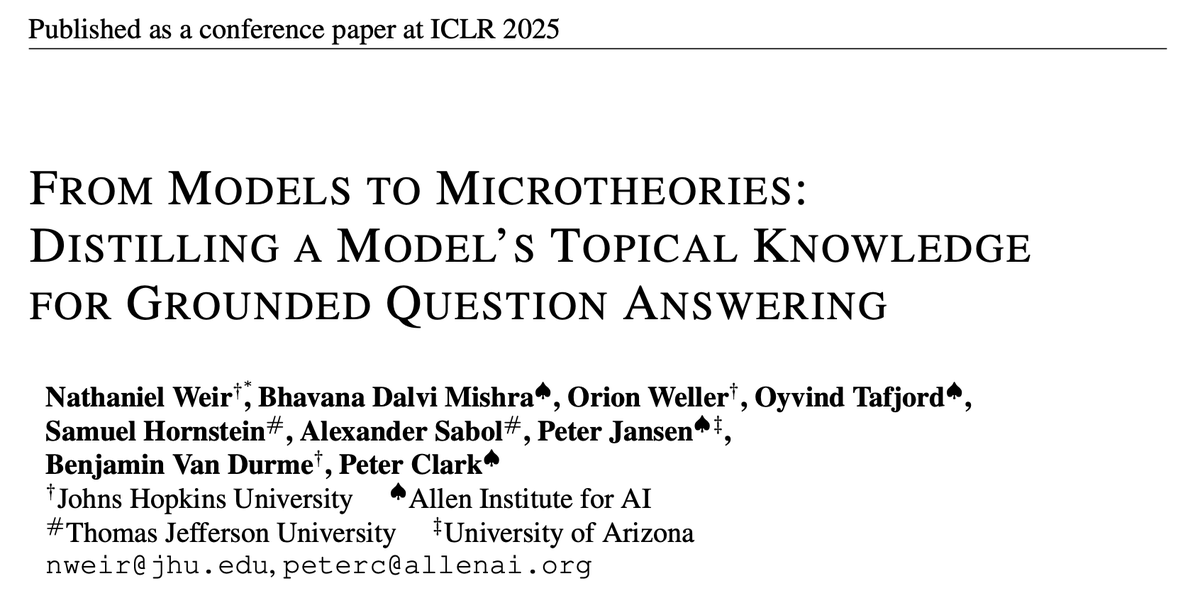
I will be at #ICLR2025 to present the final project of my PhD (🥲):
Chain-of-thought prompting elicits an LLM's knowledge for answering a single question. What about a whole ~set~ of questions?
We explore ways to build an LLM's discrete microtheory about a topic of questions.
Check out the paper (https://t.co/EkmwIadZlZ) and come say hi at the poster session tomorrow afternoon!
Huge thanks to my mentors @ai2_aristo, my advisor @ben_vandurme, and my collaborators.




![DanielKhashabi's tweet photo. **Certified Mitigation of Worst-Case LLM Copyright Infringement**
TL;DR: We propose BloomScrub a framework to certifiably remove long verbatim quotes to reduce the risk of copyright violations.
Challenge: Most existing copyright mitigation techniques for LLMs address average-case risks (e.g., reducing the average overlap with copyrighted content), but fail to account for **worst-case** scenarios involving [potentially few but] long, verbatim reproductions of copyrighted material.⚠️
Why is this important? Extensive copying (even if there are few of them) is unlikely to meet the “transformativeness” requirement under the fair use doctrine, thereby exposing model outputs to significant legal liability. ⚖️
Our approach: We propose BloomScrub 🧽, a framework that certifiably mitigates worst-case infringement risks while maintaining output utility.
* It's simple: Rewrite content by targeting and transforming the few longest quotes.
* Efficient detection: Detecting copied content is done with Bloom filters for efficient, scalable detection across large corpora.
* Certified safety: We define "certificates" as formal guarantees that no quote exceeds a chosen length, reflecting a model designer’s tolerance for verbatim output.
Highlighting a related work: Our approach builds on insights from MemFree decoding, the excellent work by @daphneipp, @yocarlini, @florian_tramer, and collaborators. Like MemFree, we use Bloom filters to block verbatim n-gram copying. However, MemFree blocks all n-grams found in the copyright corpus while keeping the already-generated (n-1)-gram prefix unchanged, risking utility (e.g., text quality) while potentially failing to remove the (n-1)-gram quote.
See our preprint for details:
https://t.co/BgbaAjY2bZ
https://t.co/SyFSIoOXcE
Work lead by Jack Jingyu Zhang @jackjingyuzhang, with many contributions from Marc Marone @ruyimarone, Jiacan Yu, and Ben Van Durme @ben_vandurme at @jhuclsp @JHUCompSci @HopkinsEngineer @HopkinsDSAI](https://pbs.twimg.com/media/GqxuI0cbAAIEu3e.jpg)