Neuroscience: Your brain on psychedelics
https://t.co/WqJ6BwtlXp
@NatureNeuro#OA#OpenAccess paper by Manesh Girn, Danilo Bzdok et al.
An international mega-analysis of psychedelic drug effects on brain circuit function
https://t.co/4cCchg3bo7
@ucsf@mcgillu
Hundreds of scans hint at how substances such as psilocybin, LSD and ayahuasca alter connections between key areas of the brain
https://t.co/NCvIUFR0r2
Medicine: Genetic differences may influence GLP1 treatment outcomes
https://t.co/LtmDSnzmc3
@Nature#OA#OpenAccess paper by Adam Auton et al.
Genetic predictors of GLP1 receptor agonist weight loss and side effects
https://t.co/vsxw7poTaV
@23andMeResearch
Scientists have identified a set of genetic variants that could help to explain why responses to obesity drugs vary markedly from person to person
https://t.co/Pkzg5IkLN3
Artificial intelligence: AI research assistants that may accelerate scientific discovery
https://t.co/bNnNEJwkvg
@Nature by Samuel Rodriques et al.
A multi-agent system for automating scientific discovery
https://t.co/1i2nzyCEOe
For reading: https://t.co/0PnTsa7Hw4
@futurehousesf
Two papers in Nature present AI systems that can assist throughout multiple processes involved in scientific research. The systems are designed to assist researchers in accelerating scientific discovery, not to replace them.
https://t.co/JuvyumVGPN
https://t.co/wztQgV2Ist
A catalyst with two cobalt components potentially opens the way to sustainable processes for manufacturing light olefins — key ingredients for making plastics and detergents
https://t.co/HOAFnnbwYH
Strong analgesia, fewer side effects Rethinking opioid drug design
@Nature#OA#OpenAccess paper by Michael Michaelides et al.
A µ-opioid receptor superagonist analgesic with minimal adverse effects
https://t.co/ai0Q3csOZ8
@NIDAnews
Modified nitazenes, opioids 1,000 times stronger than morphine, show remarkably few adverse effects in rodents, renewing the potential of these drugs for pain relief
https://t.co/9W8J7Oex1h
Distribution of extraterrestrial nucleobases, other N-heterocycles, and their precursors in a sample from asteroid Bennu
https://t.co/glTRsobNNu
@CommsChem#OA#OpenAccess paper by Yasuhiro Oba et al.
@HokkaidoUnivPR
Astrophysics: Confirming a forbidden range of black-hole masses
https://t.co/UzmkCgxjJU
@Nature paper by Hui Tong et al.
Evidence of the pair-instability gap from black-hole masses
https://t.co/oiCC1N5w8x
For reading: https://t.co/T7gmLAK4y6
@MonashUni
Epigenetic rewiring in parasite-transformed macrophages
@CommsBio#OA#OpenAccess paper by Takaya Sakura, Michel Wassef & Gordon Langsley et al.
Epigenetic landscape of the H3K27me3 mark in macrophages transformed by Theileria annulata
https://t.co/NDPjCDgpdc
@NU_kouhou
Epigenetic landscape of the H3K27me3 mark in macrophages transformed by Theileria annulata: Communications Biology, Published online: 24 February 2026; doi:10.1038/s42003-026-09735-3H3K27me3 marks are heavily remodeled in attenuated Theileria-transformed… https://t.co/XuXg6wMTDY
A study in Nature Health analyzes Reddit posts between 2019 and 2025 that mentioned semaglutide or tirzepatide and finds a spectrum of associated reported side effects extending beyond the commonly known safety profile of these two drugs. https://t.co/bL6qCWesMP
Chemistry that forms an omnipresent type of carbon–carbon bond enables the modular synthesis of 3D organic molecules — a boon for drug discovery and materials design
https://t.co/IRwCJifK8y
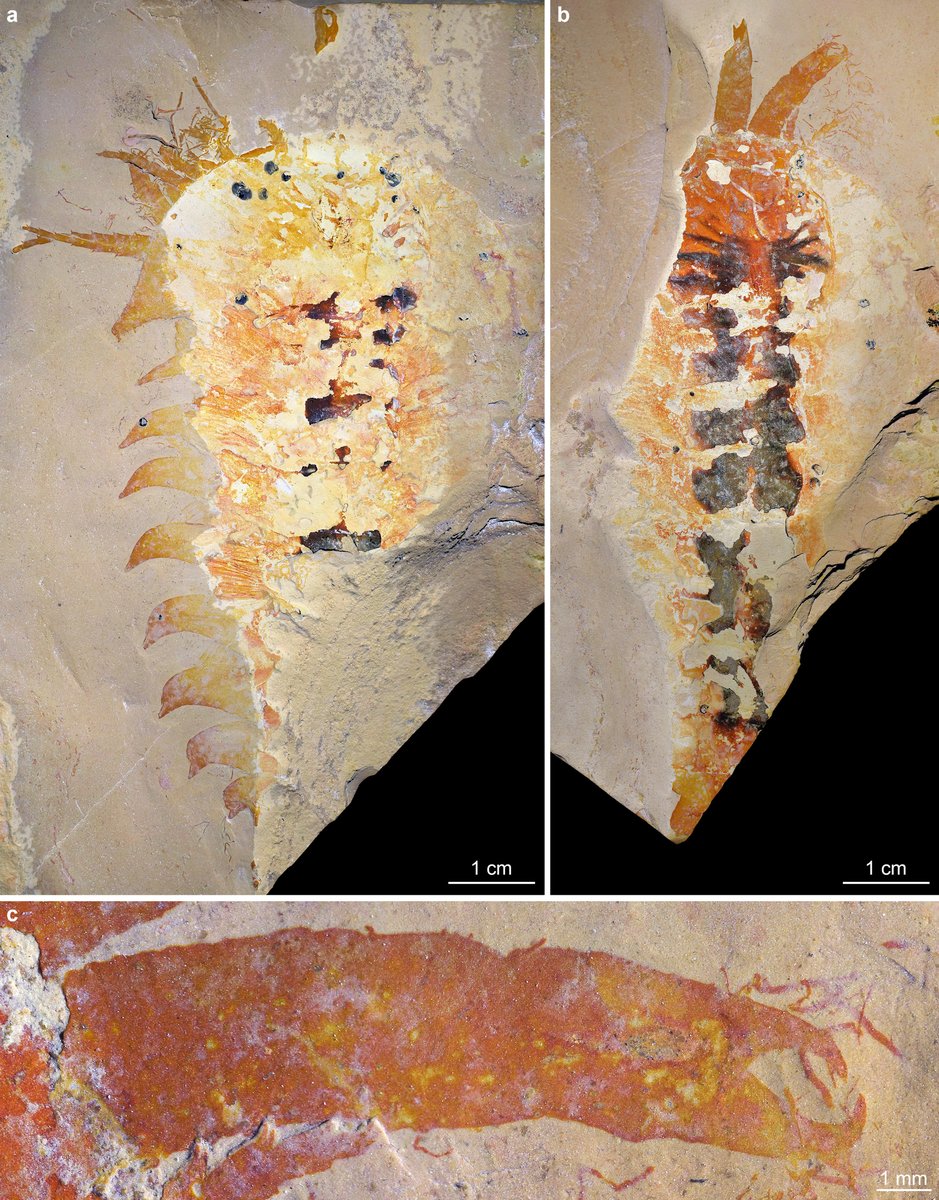
Palaeontology: Early spider relative claws its way into the family tree
https://t.co/gFcLGgjEcI
@Nature by Rudy Lerosey-Aubril et al.
A chelicera-bearing arthropod reveals the Cambrian origin of chelicerates
https://t.co/gGg4Jh3trR
For reading: https://t.co/A3gPtGYObp
@Harvard
Spiders and scorpions belong to a group called chelicerates, which are arthropods with pincers at the front of their head. Fossil evidence reveals how this group evolved
https://t.co/BEvSoViNcw
Economics: The costs of climate change
https://t.co/B21aMJRzkP
@Nature#OA#OpenAccess paper by Marshall Burke et al.
Quantifying climate loss and damage consistent with a social cost of carbon
https://t.co/KbGHocdvkC
@Stanford@nberpubs
A paper in npj Women’s Health presents three machine learning models for the early detection of intimate partner violence in clinical settings. The authors report that the models can identify risk years before patients seek help. https://t.co/kuEiE0Y16L
Investigating the reproducibility of the social and behavioural sciences
https://t.co/0VNL9PpB2N
For reading: https://t.co/NrA1l9W7Lx
@Nature by Brian A. Noseket al.
@OSFramework@UVA
Collection
Reliable research in the social and behavioural and sciences
https://t.co/wRlhDC5FfU
Climate science: Low-soot aircraft engines do not reduce contrails
https://t.co/dz3UQYcqD0
@Nature#OA#OpenAccess paper by Christiane Voigt et al.
Substantial aircraft contrail formation at low soot emission levels
https://t.co/u4N0lgxqaI
@DLR_en@uni_mainz_eng
Press Release: Wellcome launches world’s largest global prize for mental health science
https://t.co/CnVJveZ8IS
Apply for the Wellcome Prize for Mental Health Science with Nature by 18 September 2026
https://t.co/Typ5qrTx4f
More than one billion people worldwide are estimated to live with a mental-health condition. Yet, the outcomes of mental-health research do not always reach those who could benefit. A new award from @wellcometrust and @Nature aims to change that: https://t.co/C0PmuzcoQy
Astronomy: A direct black-hole mass measurement in a little red dot at high redshift
https://t.co/e28aUmwf3W
@Nature#OA#OpenAccess paper by Ignas Juodžbalis et al.
https://t.co/k7yv0jyREM
#オープンアクセス@cambridge_uni
A paper in Nature reports a direct measurement of a black hole mass in a distant object known as a little red dot, found in a galaxy dating back to when the Universe was just 700 million years old. https://t.co/hFp3qU6pui
Climate science: A 3-million-year-old tale of ice and climate
https://t.co/IKn5XIIU5s
@Nature paper by Sarah Shackleton et al.
Global ocean heat content over the past 3 million years
https://t.co/v47DfO08jd
For reading: https://t.co/DohoRCvdXc
@whoi@princeton
Antarctic ice cores hint that changes in the ocean might have played a larger part than have greenhouse gases in key climate shifts of the past three million years
https://t.co/B37U55ttgm
Mapping the brain across life: how neocortical hierarchy evolves from birth to old age
@Nature#OA#OpenAccess paper by Hoyt Patrick Taylor IV & Pew-Thian Yap et al.
Functional hierarchy of the human neocortex across the lifespan
https://t.co/13LyFC81Id
@unc
Neuroscientists have created a continuous atlas showing how patterns of functional connectivity between brain regions change from birth to old age
https://t.co/aGCRWBTkfX