🚨 Our labor-of-love pandemic project is now out in pre-print! 🚨
📖 Read it here: https://t.co/SuTVHo2uLr
With @saralahue we uncover immune signatures associated with delirium onset and resolution in COVID19 patients.
#delirium#COVID19#NeuroICU
We took advantage of the UCSF COMET study's invaluable prospectively collected PBMC RNAseq data, and rigorously defined delirium through careful chart review. It is one of the largest delirium studies with serial transcriptomic data!
Importantly, we generated fun visualizations!
#GroundSquirrel develop “reversible #cataracts” during #hibernation, with their lenses quickly clearing upon waking. Using GS-#iPSC-derived lens epithelial cells, we explored the molecular mechanism behind this, pointing to a potential treatment target. https://t.co/UQxZ5lnQ2O
Happy this paper is out in the world—we performed an external validation of IMPACT, comparing the original coefficients to updated coefficients in our patient datasets. #TBI#Neurotrauma#DataScience ⚡️📊 https://t.co/yrOgeOCTST
Check out our lastest! A second X chromosome improves cognition in aging male and female mice. Spearheaded by Francesca Marino. https://t.co/vxMtFU1SAX
Studies of stroke recovery have found that improving vascular repair can help improve neurorecovery. So in future work we hope to further understand PATJ ties to metabolism and how this pathway can be taken advantage of to enhance neurorecovery after stroke! (6/6)
Sharing our Lab's first preprint led by Mengqi Zhang and in collaboration with @DengkeMa! I became interested in PATJ after it turned up in human genetic studies as associated with circadian rhythms and obesity. What we found below! (1/6)
https://t.co/kCxigH01ZP
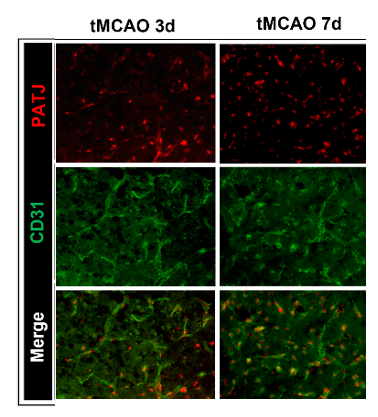
We observed induction of the worm orthologue in response to hypoxic stress in C. elegans. And in mice we observed endothelial-specific over the days and weeks following stroke (tMCAO). (5/6)
Our first foray into extracellular vesicles and stroke biomarkers is finally out! with @FannyElahi, Bharti Manwani, @EdAmorimMD, and many others.
https://t.co/p4du6qivPG
What we did, learned, and hope to do in the thread!
We don't really know what they're all doing...but as a first step we used machine learning and other analyses to find out which ones might be particularly related to stroke.