I am a doctor
I am a surgeon
Despite the many imperfections in medicine today and the vast problems in healthcare…..
I sincerely love my job.
I love surgery and I find no greater satisfaction in life, other than my family, ….
Helping and improving the life of my patients.
Stopping GLP-1 treatment linked to twice the risk of heart attack, stroke or death compared with continuing, in people with type 2 diabetes and no cardiovascular disease, according to a new study.
Find out more in @LancetRH_Europe: https://t.co/iNJmDhOPAU
Schematic of the processes by which gut microbes produce deupleted hydrogen gas and then use it to reduce carbon dioxide to acetate (acetogenic bacteria). Ultimately, further microbial enzymatic action converts acetate to butyrate.
Between college, medical school and residency plus often a fellowship, physicians give up a ton of years and a lot of money. Further we are horribly short physicians. Pay physicians more. Pay them what they are worth. We are better off if more if the best and brightest go to medical school.
An excellent new study in @AnnalsofSurgery illustrates the point vividly: surgery and medicines for obesity are complementary therapies. People who don't respond fully to meds can get a lot of benefit from surgery.
HT: @Ali_Aminian_MD
https://t.co/8xnfkJcAKI
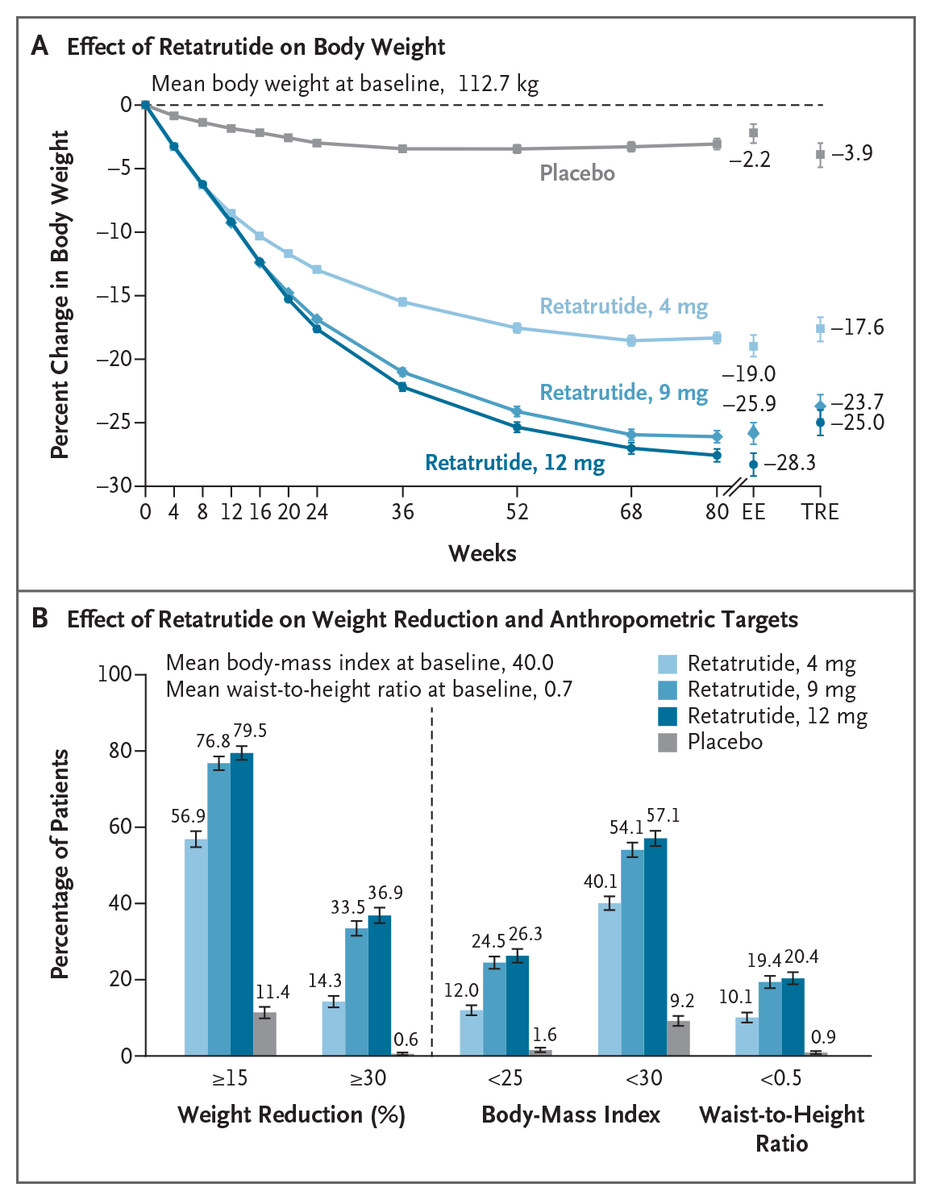
Original Article: Retatrutide, a Triple Hormone Receptor Agonist, for Treatment of Obesity (phase 3 TRIUMPH-1 trial) https://t.co/kzuY57bUTX
Editorial: A Triple Incretin Agonist for Obesity, Osteoarthritis, and Sleep Apnea https://t.co/AiXLT7r80k
#Endocrinology#Rheumatology
Obesity medications that act through multiple mechanisms may lead to greater weight reduction, along with improvement in specific measures of health. Research findings from the phase 3 TRIUMPH-1 trial are summarized in a new Quick Take video. https://t.co/LH7fdezFZl
Metabolic Bariatric Surgery's Safety Problem: A Messaging Opportunity, Not Just a Clinical One. The problem is the PERCEPTION of safety. National data indicates MBS safer than MOST abdominal surgery including gallbladder surgery, hernia, hysterectomy, appendectomy, hiatal hernia BUT also extends life! https://t.co/2DszfPo2pb @shanu_kothari@mattars77@JerryDangMD@TeresaLamasters@NeilFlochMD@JaimePonceMD@metabolic_knife@Ali_Aminian_MD
Today there's a special outstanding @ScienceMagazine issue on GLP-1 drugs, obesity and adipose tissue
https://t.co/DkvIdt0d5u
A thread below to summarize some of the papers
What's next if GLP-1 medications don't work for you?
A new Cleveland Clinic study finds patients can still achieve substantial weight loss after bariatric surgery.
Read more: https://t.co/TtHnKAs0xZ
@Ali_Aminian_MD@ClevelandClinic Useful framing. Do you have a sense of how outcomes differ between patients who stopped GLP-1s because of intolerance versus those with insufficient response, particularly regarding weight regain after surgery?
MASH cirrhosis is NOT an irreversible disease.
Paired liver biopsies showed cirrhosis regression in 40% of patients after bariatric surgery.
Published today in @AnnalsofSurgery
https://t.co/hndoRSzIDq #TLM26
Coverage of GLP-1 by “Medicare net spending fell in every scenario, with cumulative savings of $21.2 - 27.1 billion, including $31.9 billion in diabetes drug price savings. Return on investment was 117 - 216% for Medicare and 198 - 346% for society.” https://t.co/tVRKy9FLUm
In other news, US projected to save billions expanding access to Obesity care according to independent group at USC 👇🏻@DrOz@DrOzCMS
https://t.co/7SIZ54bImz
There is a new goal for obesity and its associated disease… normal weight and disease remission.
The time of…. Just making it a little better is no longer good enough.
We have the tools and the medical and surgical trends of treatment are moving in the right direction for medications. Surgery remains necessary and most effective for higher bmi and many medical conditions.
Metabolic Surgery and gut hormone medications such as GLP-1/GIP work together in an additive effect. Let’s use all the tools to achieve
🎯 Target weight!!!
This is a brilliant strategy as patients need to have access to multiple options. Some patients will respond to one drug and not another. Patients will need to switch drugs if they stop losing weight or hunger returns. Others will be able to “add on” a drug like Amalyn - yet others may need metabolic surgery in the mix when overall response is simply not enough, especially starting at a bmi of 50.
Lilly’s view of a consumer-driven obesity market is becoming very clear:
Build a portfolio, then let patients move through it.
Foundayo as an on-ramp or maintenance option. Tirzepatide as the cornerstone. Retatrutide for greater power. Amylins as another pathway entirely.
Lilly says the goal is to let patients “start, switch and step up” to whichever medicine works best for them.
Consumers will ultimately be choosing from an entire therapeutic ecosystem.
$LLY
In this world, we are short of great leaders.
Great leaders in sports teach most effectively about life.
In real life we don’t always see the cause and effect of leadership- as we are not always privy to the facts. Facts are often exaggerated or dampened but sports don’t lie. We see real events unfolding live on television.
Leaders perform and are self-evident.
One such leader, is not always the most successful on the field but always the role model in the club house and locker room.
That is Jameis Winston @Jaboowins of the @Giants
Despite losing the starting job, he vigorously teaches the new starting quarterback, he motivates the players, and commands the team.
A lesson for leaders in every walk of life…
Effective obesity treatment is mostly composed of diet change, exercise, gut hormone based therapy (GLP-1/GIP). It also includes metabolic bariatric surgery in a much smaller percentage. All are needed to effectively treat society.