Fokker F.XXIIs of No. 1 Air Observer and Navigation School getting loaded at Prestwick, Ayrshire. The aircraft were used to drop food supplies to army camps in southwest Scotland which were cut off by snow drifts during the severe winter of 1939-40.
28 December 1745: Field Marshal Wade dispatched eight infantry battalions from Newcastle to reinforce Edinburgh after receiving a copy of the resolutions of the Council of War held by Lieutenant-General Joshua Guest at Edinburgh Castle on Christmas Day. RA CP/MAIN/8 f.143-143b
28 December 1745: Six 18-pounder guns began the bombardment of Carlisle Castle under the direction of Major William Belford. Cumberland reported to Marshal Wade that the foundry of Whitehaven could not keep up the supply of shot as fast as they were using them.
BREAKING Major incident declared by Highland Council because of “miles of vehicles” stuck in the snow on the A9 between Drumochter and Dalwhinnie with motorists trapped in “very severe conditions.” #StormGerrit
https://t.co/EQSph2rkf0
Fokker F.XXIIs of No. 1 Air Observer and Navigation School getting loaded at Prestwick, Ayrshire. The aircraft were used to drop food supplies to army camps in southwest Scotland which were cut off by snow drifts during the severe winter of 1939-40.
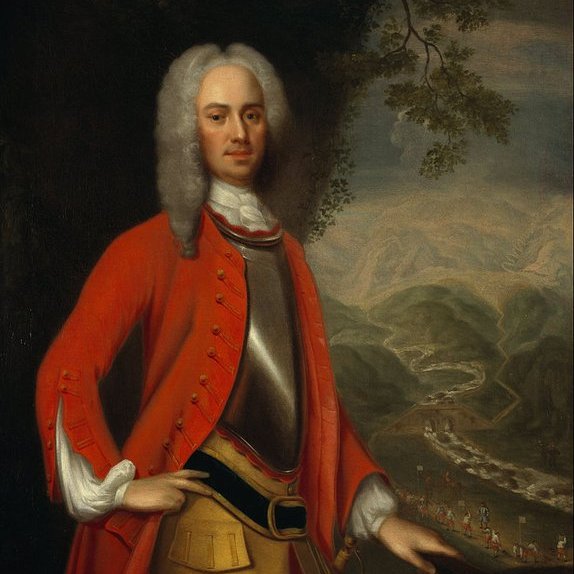
On 24 December 1724, Westmeath-born Major-General George Wade, MP for Bath, was appointed Commander-in-Chief, Scotland following his investigation and intelligence report on the situation in the Highlands. He took over from Lieutenant-General George Carpenter.
On 24 December 1724, Westmeath-born Major-General George Wade, MP for Bath, was appointed Commander-in-Chief, Scotland following his investigation and intelligence report on the situation in the Highlands. He took over from Lieutenant-General George Carpenter.
23 December 1745: Government highlanders commanded by Norman MacLeod of Dunvegan were defeated by a numerically superior Jacobite force led by Lord Lewis Gordon at Inverurie. Gordon's Jacobite force was predominantly lowlanders along with regular soldiers from the Royal Ecossais.
First it was Moussa Koussa who was supposedly holding the key to #Lockerbie. Now it’s Abdullah Senussi. By now there is enough evidence in the public domain for even the dimmest journalist or police officer to realise that the key to Lockerbie most probably does not lie in Libya.
"Former CIA operations officer John Holt, the one-time handler of Giaka, agrees. "I have no doubt it was Iran," he says, adding that the PLFP-GC carried out the attack on their behalf." #lockerbie
https://t.co/a7h2eurBGO
NEW FACILITY: BAE Systems is building a new assembly hall at its Govan shipyard as part of a wider £300 million investment programme.
Designed to accommodate up to 500 workers per shift, the vast facility - measuring 170m long and 80m wide - will be large enough for two Type 26 frigates to be constructed side-by-side.
The new hall is a key element of BAE Systems' £300m modernisation and digitalisation of its shipbuilding facilities at Govan and Scotstoun. #UKmfg
Took this photo yday when the wind was starting to get up. Tomorrow's looking a shocker. However, I have the @KellyKettle so if the power goes out I'll still be able to have a cuppa and I might cook some marshmallows too. Stay safe folks.
#TireeRanger@SCRAOnline@NatureScot
20 December 1745: The Earl of Loudoun dispatched a force of pro-Hanoverian highlanders from Inverness under Norman MacLeod of Dunvegan, George Munro of Culcairn, and James Grant of Grant to confront Lord Lewis Gordon and his Jacobite forces at Aberdeen.
18 December 1745: As Charles Edward Stuart's army continued its withdrawal back to Scotland, Jacobite forces under Lord George Murray fought a rearguard action against pursuing government dragoons commanded by Lieutenant-Colonel Philip Honeywood at Clifton, south of Penrith.
RMS Empress of Britain arriving at Greenock on 17 December 1939 with the first Canadian soldiers to arrive in Britain. The vessel was one of four liners of Canadian troop convoy TC.1. In the background is the battlecruiser HMS Hood that escorted TC.1.