What makes crypto and blockchain tech so special and valuable? In my opinion it is decentralization. That's where ETH and BTC shine.
Without decentralization it is just a big centralized database with tokens.
Also see this video (full length): https://t.co/1SzbgokGw6
I think ETH is starting to look really uniquely positioned from a macro perspective. A few thoughts:
1) Store-of-valueness + quantum: Quantum is a real long-term threat. Maybe not “next 10 years,” but markets are forward-looking. If you want an asset you can set-and-forget for 20+ years, you want quantum on the roadmap. The Ethereum Foundation making it a priority matters a lot for ETH’s SOV credibility.
2) AI makes “immutable forever” a tougher sell: With LLMs cranking out code (and finding bugs) at insane speed, the idea that any complex system can be perfectly safe and never need upgrades is getting harder to believe. Better tooling will mean better software, but also faster vulnerability discovery.
3) ETH has the cleanest monetary policy in crypto: No obvious long-term security budget problem, and it’s not running ~5% annual inflation like SOL (or most L1s). Net inflation has been ~0.8% over the last 30 days and ~0.21% since the Merge. Gold’s historical supply growth is ~1.5%/yr.
4) From an energy & infrastructure perspective: ETH also doesn’t compete with AI data centers for power or capital, it’s not exposed to the same security-budget pressure that will come as AI spend intensifies. That structural separation matters and will only become more important over time.
5) Upside optionality: ETH’s economics look sustainable even with historically low fees and without “native/based rollups” yet. If stablecoins + tokenized assets + agentic payments really scale, fee burn could ramp and ETH could go deflationary again. That’s a pretty unique macro setup.
ethereum is hard to replicate for many reasons:
- ICO sale open for all at low valuation
- years of PoW for fair coin distribution before switching to PoS
- one in a million founder who is not motivated by money, keeps hustling 10 years in
- lowest inflation of any chain
The most interesting part for me is where @karpathy describes why LLMs aren't able to learn like humans.
As you would expect, he comes up with a wonderfully evocative phrase to describe RL: “sucking supervision bits through a straw.”
A single end reward gets broadcast across every token in a successful trajectory, upweighting even wrong or irrelevant turns that lead to the right answer.
> “Humans don't use reinforcement learning, as I've said before. I think they do something different. Reinforcement learning is a lot worse than the average person thinks. Reinforcement learning is terrible. It just so happens that everything that we had before is much worse.”
So what do humans do instead?
> “The book I’m reading is a set of prompts for me to do synthetic data generation. It's by manipulating that information that you actually gain that knowledge. We have no equivalent of that with LLMs; they don't really do that.”
> “I'd love to see during pretraining some kind of a stage where the model thinks through the material and tries to reconcile it with what it already knows. There's no equivalent of any of this. This is all research.”
Why can’t we just add this training to LLMs today?
> “There are very subtle, hard to understand reasons why it's not trivial. If I just give synthetic generation of the model thinking about a book, you look at it and you're like, 'This looks great. Why can't I train on it?' You could try, but the model will actually get much worse if you continue trying.”
> “Say we have a chapter of a book and I ask an LLM to think about it. It will give you something that looks very reasonable. But if I ask it 10 times, you'll notice that all of them are the same.”
> “You're not getting the richness and the diversity and the entropy from these models as you would get from humans. How do you get synthetic data generation to work despite the collapse and while maintaining the entropy? It is a research problem.”
How do humans get around model collapse?
> “These analogies are surprisingly good. Humans collapse during the course of their lives. Children haven't overfit yet. They will say stuff that will shock you. Because they're not yet collapsed. But we [adults] are collapsed. We end up revisiting the same thoughts, we end up saying more and more of the same stuff, the learning rates go down, the collapse continues to get worse, and then everything deteriorates.”
In fact, there’s an interesting paper arguing that dreaming evolved to assist generalization, and resist overfitting to daily learning - look up The Overfitted Brain by @erikphoel.
I asked Karpathy: Isn’t it interesting that humans learn best at a part of their lives (childhood) whose actual details they completely forget, adults still learn really well but have terrible memory about the particulars of the things they read or watch, and LLMs can memorize arbitrary details about text that no human could but are currently pretty bad at generalization?
> “[Fallible human memory] is a feature, not a bug, because it forces you to only learn the generalizable components. LLMs are distracted by all the memory that they have of the pre-trained documents. That's why when I talk about the cognitive core, I actually want to remove the memory. I'd love to have them have less memory so that they have to look things up and they only maintain the algorithms for thought, and the idea of an experiment, and all this cognitive glue for acting.”
Bitcoin miners capitulating on mining, to turn towards ETH accumulation is a canary for Bitcoin's future security problems
If it were more profitable to participate in Bitcoin security, this wouldn't be happening
Daily transactions on Ethereum is approaching ATH for first time since 2021.
Gas is 5-6 gwei today, compared to >300 gwei back then
Congrats all - we scaled the chain!
Solana can’t compete with Ethereum on decentralization and censorship-resistance, and it can’t compete with single-sequencer L2s on latency and performance.
They are right to feel worried.
Hot take: this is a dogshit take.
Decentralization is the reason we're all here. You think these apps NEED to be on a blockchain? You could build https://t.co/SpVoS4FNG0 with SQL in 4 days flat. Name any app, same deal.
Except then you have no permanence guarantees, no censorship resistance, no transparency, no self sovereignty.
You may not care about decentralization, but I promise you it matters to every single app you interact with onchain.
The Everything Code TL;DR.
The labor force participation rate isn’t going to rise anytime soon – it’s set to keep declining over time. This is a structural problem…
We’ve got aging demographics, falling birth rates, and now the rise of automation.
Humans are already being replaced by AI and robots at a staggering pace, and that shift is only just beginning. This is deflationary.
It also reinforces the need for ongoing stimulus to keep the system afloat.
Fewer workers. More tech. Same debts…
At the @NFCsummit this past week, I got asked on stage about my thoughts on the latest OP_RETURN drama. I answered that it’s probably a “nothing burger”.
If you want affordability when minting then there is the witness data (Ordinals).
If you want unprunable permanence when minting then there is bare pubkeys (Stamps).
OP_RETURN seems to offer no real advantage over witness data (and lacks the witness discount).
In light of the Sui decision to undo the hack, I've written a lengthy post arguing why this is a mistake.
Blockchains need to be like gravity
One of the best things about a fully decentralized blockchain is the fact that good transactions can’t be reversed. One of the worst things about a fully decentralized blockchain is the fact that bad transactions also can’t be reversed.
What too few people appreciate is how you can’t have one without the other. You must tolerate the bad to enjoy the good, because once you open the door to reversibility, the distinction begins to fade away.
I say this in light of the controversial decision by the validators of the Sui blockchain to undo a major hack. With sympathy, I condemn this decision. It violates one of the few things blockchains do well, which is to provide guaranteed outcomes. As it currently stands, Sui is not a legitimate blockchain. It’s a bad database.
Maybe it can grow past this, as Ethereum did from its decision to do something similar years ago. That too was a mistake, and not just because the semi-botched execution of it pushed Ethereum to the brink of failure.
It was a mistake because it showed — at least in that moment in time — that there are no decentralization maximalists in foxholes. Just kids cosplaying as people who believed in the power of immutability, until it impacted them in a negative way.
I lost money in the DAO hack, and watched the value of my ETH fall in half as a result. But I was still a strict constitutionalist on the question of what to do about it. To me, those of us who live by the sword of “code is law” should also die by it when something goes wrong.
A decade later, I feel even more strongly about this, and am more disappointed than ever as to how few of my colleagues agree.
For blockchains to be successful, they need to be neutral, even in a crisis. Otherwise, people should just use a database. The non-crypto world has plenty, and they are superior in every other way. The opportunity for crypto is to build something bigger: a global trust layer upon which lots of different activities reside, financial and otherwise.
But to get there, a chain must be neutral, for better or for worse. Especially for worse. The global trust layer must be perfectly predictable, like gravity.
Gravity, depending on your experience, can be both good or bad. If you are building a skyscraper, it’s good, without a predictable downward force, the whole thing might come apart. But If you trip and fall, it’s bad. Importantly, the force is always the same.
As are the other laws of physics. And thank god for that, because if they weren’t, there may never have been an industrial revolution. There would be no power plants or cars or iPhones. I’m not sure there’d be a human civilization.
Perfect predictability is a necessary condition for building foundational systems, be they the skeleton of a skyscraper or the core transactions of a financial system. The other solutions that get built on top of such systems can be more flexible. In a financial system, they can be more discretionary and allow for outside intervention. But the foundation must be rock-fucking-solid. You can’t have one without the other, because a flexible solution built on top of an unpredictable foundation is just chaos; it’s not a system at all.
And that’s not just my opinion. It’s also the opinion of the architects of the legacy financial system. Most of the complexity of that system — the payment systems and clearinghouses that the crypto bros seldom understand — exist to provide reliable outcomes, at least at the core. They don’t always succeed, but the north star is clear.
For example, the most important payment system in most countries is the central-bank run RTGS system, like FedWire. Such “real-time gross-settled” systems are designed to provide real-time finality and irrevocability. Once a payment goes through, it can’t be reversed, even if it was the result of an obvious error, and the recipients got money that they clearly didn’t deserve.
The logic here is simple: if a payment can be reversed, then all the corresponding activity tied to it lives on economic quicksand, at least until the reversibility window closes. This is why we don’t do real estate transactions with ordinary payment methods. Otherwise, a seller could sign over the deed, then have the payment be contested, ending up with neither.
Are there cases where the payment should be reversed? Definitely. A few years ago, I cashed out a small investment in a startup in a new funding round. But instead of just wiring me the proceeds from my shares, the administrators on the deal accidentally sent me the proceeds from all the shares sold in that round, several million dollars instead of a few thousand.
It was an obvious screwup — easily proven with the documents we all signed — but the only thing the administrator could do was request a voluntary refund from my bank, one that I had to authorize by signing a form.
Honest mistakes like this happen every day, but the wire system is nevertheless designed to be neutral. If it wasn’t, then any refund mechanism would become ripe with fraud, as credit cards — the most popular form of ungravity-like payments — already are.
There would have to be a dispute resolution system, putting the operators of the system in an awkward position, and at risk of behing held liable for making the wrong choice. A lot of people don’t seem to get this, although ironically, Satoshi did — he mentions it in the opening paragraph of the Bitcoin white paper.
In my early years of defending Bitcoin, a common critique I’d hear from otherwise knowledgeable TradFi types was that they’d heard Bitcoin transactions were immutable, and thought that to be dangerous. “What about mistaken transactions?” they’d say. You can probably imagine the smirk on my face when I responded with “forget Bitcoin, tell me what you think of FedWire?”
Although the notion of immutable transactions has existed in finance for a long time, all the pre-crypto versions of it are limited in scope. They tend to be single asset (FedWire doesn’t handle Euros), permissioned (it’s only available to certain institutions), and not continuous (it’s closed on weekends). They are neither programmable nor composable.
A Layer-1 blockchain, like Sui or Ethereum, is a sophisticated and multi-dimensional version of an established idea. It can extend finality and irrevocability to any asset, as dictated by code. That’s a pretty powerful primitive for derisking every kind of economic activity, and certain non-financial ones too.
Importantly, not every kind of interaction needs or benefits from such bulletproof guarantees. There are many kinds of activities that improve with more flexibility, just as there are times we wish to be free from the shackles of physics.
In TradFi, credit card and ACH payments — both of which are reversible — ultimately settle via FedWire. Flexibility that gets eventually recorded in an immutable record is the best of both worlds.
In crypto, one can always build an application or Layer 2 that offers more flexibility in case something goes wrong. But such solutions are only viable if they settle to a Layer-1 that does not. Otherwise, best to just use a database.
The Ethereum community learned a lot from the DAO hack and the fateful decision to break immutability. It has embraced a culture of decentralization in the years since, partly to protect itself from ever having to make a hard decision again.
We know that this worked because the overwhelming response to the $1.5b ByBit hack — one of the largest thefts in human history, by hackers tied to North Korea no less — was a big fat shrug.
There were still certain critics, including cosplayers from within the industry, who said things like “the fact that Ethereum didn’t respond to the hack will hamper institutional adoption.” I disagree.
The fact that Ethereum stayed neutral will help it attract even more institutional adoption in the long run — capital that will stay away from a more unpredictable blockchain like Sui.
The kind of people and institutions who don’t get why are not going to make it anyway — they’ll keep spinning their wheels on entirely pointless solutions like permissioned blockchains. The appeal of a totally neutral chain might be subconscious, but it’s there, and it will be appreciated, in the same way we all appreciate gravity.
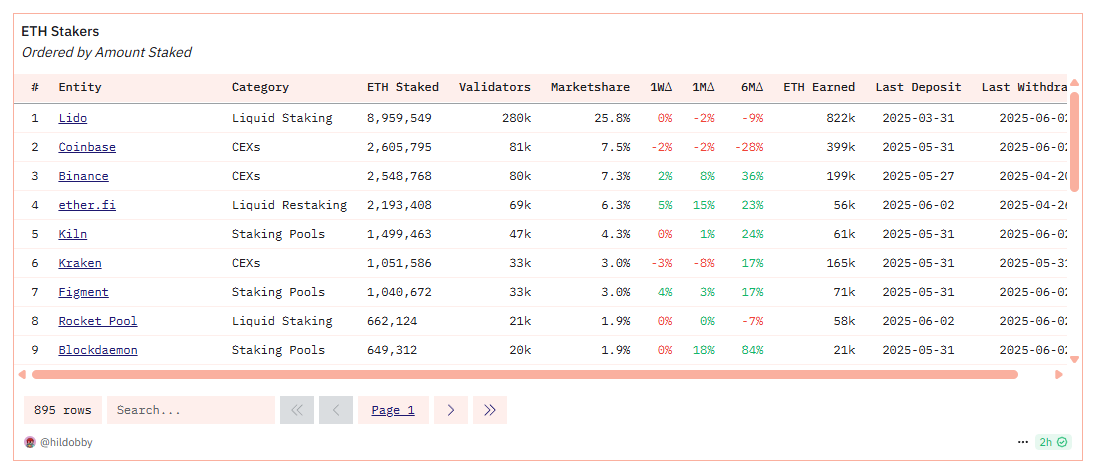
Ethereum staking diversity has greatly improved over the last 6-12 months with Lido's marketshare now down to <26%.
Increased competition + social awareness around the risks of staking centralization = healthy beacon chain
have been listening to BitcoinMechanic's takes on OP-RETURN
couldn't be a more different guy from me (he literally thinks Ethereum is "evil") but I do think he's quite intelligent and his views are internally coherent (and maybe even good for Bitcoin--Bitcoin may have its highest value as the purest of pure appchains devoted to a stateless money)
anyway, one point he made in a recent video is that on Bitcoin (and, I'll add, I think almost every other blockchain currently) relaying or mining transactions is not required, and (from the protocol's POV) there is nothing 'wrong with' either not relaying or mining transactions or selectively relaying or mining some transactions (aka 'filtering')--it's up to each node's discretion (or one might even say, 'conscience')
AFAIK Ethereum is the *only* blockchain that currently has an opinion within the protocol itself on this--it's basked into the inactivity leak rule because if enough nodes 'filter' by refusing to build on top of some particular block, the protocol will punish them ("inactivity leak")
when Ethereum adds FOCIL, this will get even stronger--blocks that don't pass the internal anti-censorship-quality-assurance rule will literally be *invalid*...and because there is also an inactivity leak rule, if too many validators (>1/3rd) censor for too long, they will not only lose the opportunity cost of block rewards for those blocks, they will actually start getting slashed
this means Ethereum will be the only chain that embeds the anti-censorship 'norm' into its actual protocol, making it in fact the only censorship-resistant *blockchain* (rather than censorship-resistant-norm-holding validator community)
the word "decentralization" gets thrown around a lot, recently a fellow lawyer has been talking about a "spectrum of decentralization" and how institutions only need 'a certain level' of decentralization, no more--but this completely misses the point, of what properties are desired through decentralization, and whether most blockchains even have some of those properties *at all*--Ethereum is the only one with real censorship resistance (currently partial, about to get much better with FOCIL)--the ticker is ETH , whether you are an institution or a cypherpunk
A hacker stole $223M from Sui yesterday.
Then something unprecedented happened.
Sui validators literally banned him from the network and froze his funds mid-escape.
This changes everything we thought we knew about "decentralized" blockchains.
Here's the wild story 🧵
It should not be lost how impressive it is for Ethereum to upgrade the entire network without a hiccup.
This is already hard for centralized systems to do, it's magnitudes harder for a decentralized network to pull off.
It's like upgrading an airplane's engines mid flight.