Nefertari's mummy was also robbed for the valuable jewelry and amulet of gold and precious gemstones layered between the wrapping.
The only trace of her mortal remains are parts of her legs at the knee joints. As Tutankhamun's mummy shows, the legs had few if any valuables on them compared to other body parts. Her feet are also missing which may have had golden sandals like Tutankhamun's.
#Egypt
#Egyptology
#Ancient
#Archaeology
#archaeohistories
#AncientHistory
#antiquity
#history
#hieroglyphs
#art
#hieroglyphics
#Egypte
#Egitto
#Ägypten
#埃及
#埃及
#Egito
#エジプト
#Египет
#이집트
#Egipto
#อียิปต์
#Mısır
#Єгипет
Ta Miu, whose name literally means “The She-Cat,” was the beloved pet of Crown Prince Thutmose, the eldest son of Pharaoh Amenhotep III. She is one of the earliest known pets in history whose name has been recorded.
Ta Miu (also spelled Ta-Miut), whose name literally means “The She-Cat,” was the beloved pet of Crown Prince Thutmose, the eldest son of Pharaoh Amenhotep III.
She lived during Egypt’s 18th Dynasty around 1380 BC and was buried in an elaborately carved limestone sarcophagus decorated with hieroglyphs and scenes of her seated before an offering table. One inscription calls her “Osiris Ta Miu,” following the traditional ancient Egyptian funerary formula that signified she had entered the afterlife under the protection of Osiris.
Some modern writers have suggested that her name may have carried an affectionate meaning similar to “Miss Kitty,” though this is a modern interpretation rather than an accepted scholarly translation. While Ta Miu is often mistaken for the first named cat in history, that distinction generally belongs to Nedjem (“Sweet One”), a cat that lived roughly a century earlier.
Even so, Ta Miu’s burial remains one of the earliest and best-preserved examples of a named pet receiving royal funerary honors, reflecting the special status cats held in ancient Egyptian society.
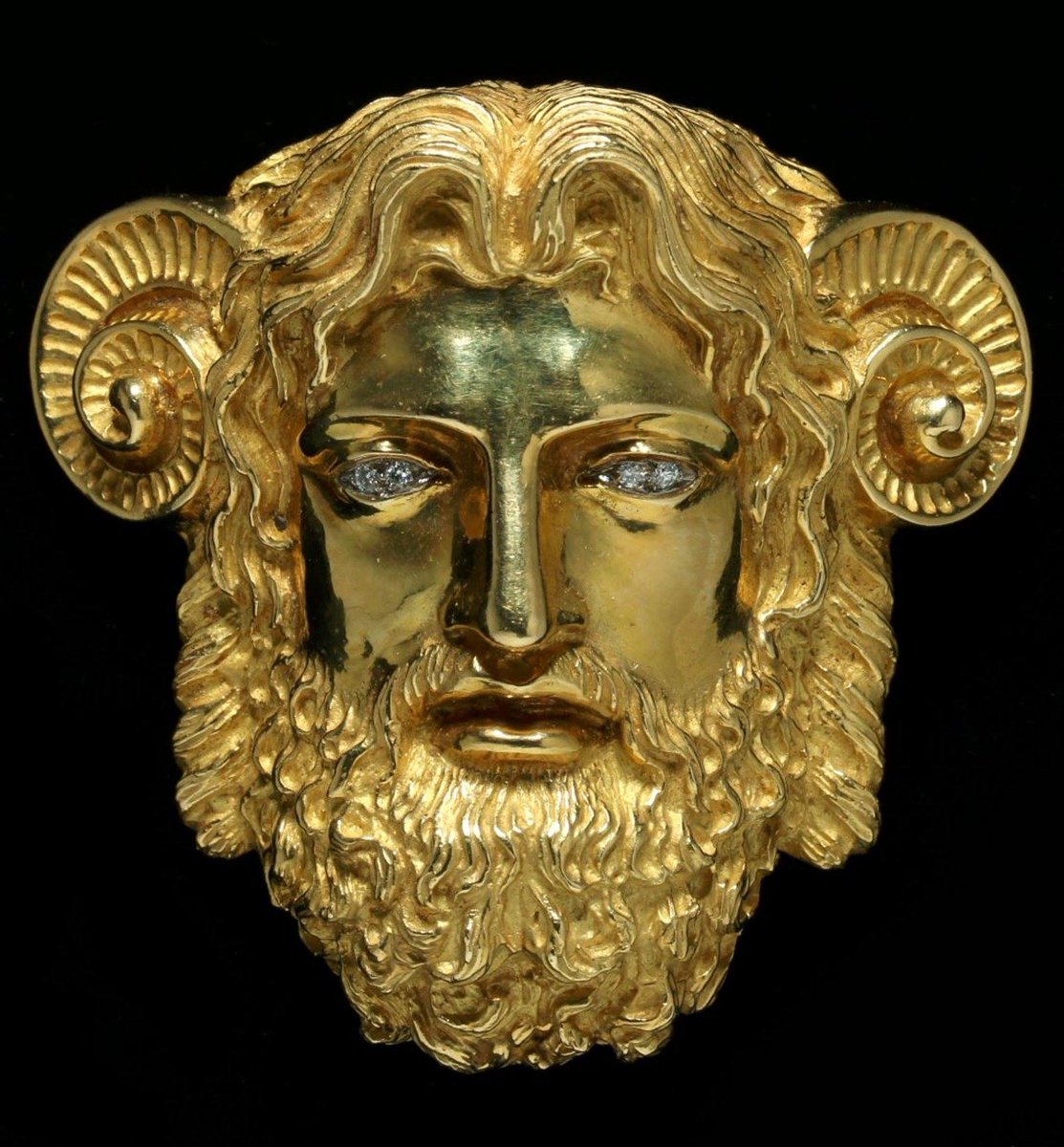
Zeus–Ammon (Syncretic deity of Greek and Egyptian tradition)
▫️Zeus–Ammon represents the fusion of the Ancient Egyptian god Amun with the #Greek god Zeus, arising through Greek contact with #Egypt and #Libya during the Late Period (from c. 5th century B.C. onward).
Through interpretatio graeca, Amun (who rose to prominence as a supreme creator and chief deity of Egypt during the Middle and New Kingdoms) was identified with Zeus, sharing attributes of divine authority, kingship, and oracular power.
The association gained wider prominence following the visit of #AlexandertheGreat to the oracle of Amun at Siwa Oasis in 332 B.C., where he was said to have been acknowledged as the son of the god. Thereafter, Zeus–Ammon was frequently depicted with ram’s horns, symbolising Amun’s sacred animal and reinforcing the combined identity.
Rather than a newly created deity, Zeus–Ammon reflects a theological convergence, understood as Amun by Egyptians and as Zeus in Egyptian guise by the Greek world.
✨Image:
Head of Zeus–Ammon (modern jewellery piece)
18k gold, set with diamonds. Signed “Wander France”
Dimensions: 2.5 × 2.5 in (c. 6.3 × 6.3 cm). Weight: 87 g
Bull’s Head Ornament of Lapis lazuli, likely from #Mesopotamia, yet decorated with an Ancient Egyptian Golden Mount of Lotus and Uraeus design, c. 1069–664 B.C.
▫ This striking object, features a vivid bull’s head carved from lapis lazuli and is thought to be of #Mesopotamian origin. The piece is set within a delicately crafted Ancient Egyptian gold mount adorned with lotus motifs, while two cobra uraeus' flank the bull.
The fusion of materials and styles is highly significant, suggesting a vibrant exchange between Mesopotamia and Ancient Egypt during the Third Intermediate Period (c. 1069–664 B.C.), though this dating remains tentative.
The use of lapis lazuli, a precious stone sourced primarily from regions near modern-day Afghanistan but widely traded in Mesopotamia, alongside quintessentially Ancient Egyptian floral iconography, reflects not only the movement of luxury goods but also the mingling of artistic traditions.
This object stands as tangible evidence of cross-cultural connections (whether through trade, diplomacy, or the circulation of exotic heirlooms) demonstrating that even during Ancient Egypt’s politically fragmented Third Intermediate Period, its elite continued to value and acquire foreign treasures of high prestige.
Now at the British Museum, EA1445.
The Armor of Sultan Mustafa III of the Ottoman Empire.
Mustafa III ruled the Ottoman Empire from 1757 to 1774, stepping onto the throne after years of confinement following his father Ahmed III’s deposition. He focused on justice, economic stability, and modern infrastructure, showing early promise as a reform-minded sultan. His reign, however, would be defined as much by ambition as by the limits of Ottoman power.
Born in Edirne Palace in 1717, Mustafa was the son of Ahmed III and Mihrişah Kadın. His childhood included grand ceremonies, but his youth was overshadowed by the 1730 revolt that dethroned his father, placing Mustafa and his brothers under palace confinement. Only after the death of his elder half-brother in 1756 did he become heir, eventually succeeding his cousin Osman III in 1757.
As ruler, Mustafa placed strong emphasis on justice and prosperity. He repaired aqueducts, built grain depots, regulated coinage, and enforced fiscal discipline. He traveled often to observe conditions firsthand, attempting to bring order and efficiency to the capital and surrounding provinces.
Admiring Frederick the Great, Mustafa forged closer ties with Prussia and sought military modernization through Prussian expertise. Diplomatic exchanges began in the early 1760s, reflecting his hope that European alliances and reforms could strengthen the empire in an age of rising Western power.
His decision to wage war against Russia in 1768 proved disastrous. Despite attempts to modernize artillery and naval training, the Ottoman military was unprepared for a long conflict.
25 stunning pieces of armor from throughout history: https://t.co/yEJy9MXrlK
Amarna Princess Perfume Bottle
New Kingdom, 18th Dynasty, c. 1353–1336 B.C.
This perfume bottle (Met Museum. 40.2.4), with a depiction of an Amarna princess stood upon a lotus blossom, is in the shape of a hes-vase. It is made from Egyptian alabaster, with an inlay of coloured glass, carnelian, obsidian and gold.
This was once in the collection of Howard Carter.
https://t.co/i8xykCUU8I
A thousand years before modern boats crossed the waters of Lake Waccamaw, Native craftsmen were building vessels that could carry people, goods, and knowledge across the region. ....
Archaeologists recently recovered a remarkable 28-foot dugout canoe from Lake Waccamaw in North Carolina, a discovery believed to be connected to the ancestors of today's Waccamaw Siouan Tribe. Estimated to be around 1,000 years old, the canoe offers a rare look at the skill, engineering, and craftsmanship of Indigenous peoples long before European contact.
Carved from a single massive tree trunk, the vessel demonstrates an impressive understanding of woodworking, transportation, and life on the waterways that connected Native communities throughout the Southeast.
Because the canoe remained preserved beneath lake's waters for centuries, experts have been able to study details that are rarely found in artifacts of this age. The discovery is helping researchers learn more about how Native peoples traveled, traded, fished, and interacted with neighboring communities.
For the Waccamaw Siouan people, the canoe is more than an archaeological find. It is a connection to ancestors whose knowledge, innovation, and traditions helped shape the region for generations.
Discoveries like this remind us that Native history is not buried in the past. It continues to emerge, teaching us new lessons about the ingenuity and achievements of the first peoples of North America.
#archaeohistories
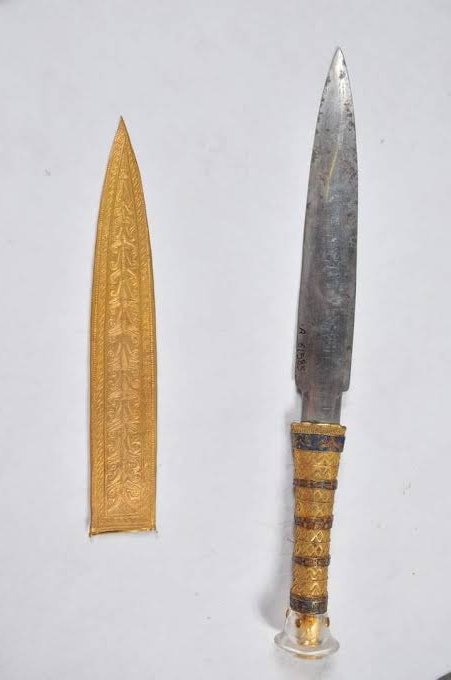
Researchers have uncovered new details about the origin of King Tut's iron dagger forged from a meteorite...
King Tutankhamun, became ruler of Ancient Egypt more than 3300 years ago when he was just 9 years old. He died just a decade later, ending a rather unmemorable rule. In fact, only remarkable thing about Boy King is his death itself — specifically his burial. After years of excavation, British archaeologists found King Tut’s tomb in 1922, and nothing could have prepared them for “wonderful things” they found there.
Tutankhamun’s tomb had been filled with precious objects to aid Pharaoh on his journey into afterlife. These included numerous exquisite artifacts such a crook and flail (fundamental symbols of royal power in Ancient Egypt) made of gold and colored glass, elaborate pieces of jewelry, musical instruments, and even board games. This sensational trove of artifacts instantly turned King Tut into most famous pharaoh on the planet.
Among these unprecedented riches, archaeologists also uncovered two beautiful daggers: one made almost entirely of gold, other from iron with a hilt and sheath made of gold. While gold blade is fitting for a man of King Tut’s status, dagger made of iron seems rather perplexing at first glance since this was still Bronze Age, a time when craftsmen had yet to perfect their metallurgical methods required to work with iron ore’s high melting point (over 1500° C or 2700 ° F).
But later investigations performed with modern analytical tools showed that iron dagger was actually forged from meteorite rather than from inaccessible iron ore deposits. This makes sense, considering the historical context. In 2017, Albert Jambon from Institut de minéralogie, de physique des matériaux et de cosmochimie in France showed that all iron used during Bronze Age was meteoric. Space artifacts, as it turns out, aren’t as rare as we might think.
In other words, Boy King’s blade was literally extraterrestrial — most fitting final parting gift for a royalty who was thought to descend from divinity.
In 2016, researchers from Polytechnic University of Milan, confirmed dagger was truly made of a meteorite, which contained ratio of nickel and cobalt that matched well with composition of 11 iron-bearing meteorites analyzed in same way. However, while this study answered what original meteorite must have looked like, it didn’t tell us where it came from.
To better understand origin of King Tut’s dagger, researchers from Chiba Institute of Technology in Japan conducted a non-invasive chemical analysis of the premised artifact by shining X-rays onto it. Analysis revealed elements like iron, nickel, manganese, and cobalt, with sulfur, chlorine, calcium and zinc found in greater abundance in the blackened spots on the blade, Gizmodo reported.
A similar elemental composition was reported by previous studies, but this time around researchers also reported a cross-hatched texture, known as Widmanstätten pattern, on both sides of dagger. Widmanstätten pattern has a chemical structure typical of an octahedrite, largest and most common group of iron meteorites. Most originate from Asteroid Belt between Mars and Jupiter.
To investigate if their hunch was correct, Japanese researchers compared results of chemical analysis with pattern on Shirihagi, a 22kg octahedrite that was found in Japan in 1890, whose iron was used to forge a number of premium katanas acquired by Taisho Emperor. Apparently, weapons made from meteorites were in great demand by royalty the world over.
Widmanstätten pattern also hints at how meteorite was processed by ancient Egyptians. Cross-hatched texture, along with presence of iron sulfide, hints that the dagger was forged at low heat, likely under 950 °C (1,742° F).
Grand Egyptian Museum, Cairo
#archaeohistories
The large gold diadem with pendants from the collection known as "Priam's Treasure," dating back to approximately 2400-2200 BC. It was discovered by archaeologist Heinrich Schliemann during his excavations at the site of ancient Troy.
The piece is currently housed in the Pushkin State Museum of Fine Arts in Moscow, having been acquired by the Soviet Union after World War II.
#drthehistories
Father and Daughter in Eternity: Heads of Thutmose I and Hatshepsut
New Kingdom, 18th Dynasty, c. 1504–1483 B.C.
▫️These heads, displayed side by side at the Sharm el-Sheikh Museum, unite a royal lineage that shaped Egypt’s golden age.
The head of king Thutmose I, carved from sandstone and once part of an Osirian (mummiform) statue at Karnak’s Wadjet Hall, bears the confident serenity of early Thutmoside art with wide, alert eyes, a faint smile, and the graceful curve of the ceremonial beard proclaiming divine rebirth.
Beside him, his daughter Hatshepsut (the female pharaoh) gazes forward in painted limestone, once adorning the colonnade of her splendid funerary temple at Deir el-Bahari. She wears the Red Crown of Lower Egypt and the same Pharaonic beard; symbols of kingship she assumed in her own right.
Photograph by Galal Messery
تاج أوزوريس الثلاثي ( تاج هيمهيم )
اكتشفت ان تم اكتشاف تاج من الحضارة المصرية نادر جداً لأوزوريس في قاع البحر المتوسط في المدينة الغارقة أمام الاسكندرية ..
و دا حقيقي اكتشاف مهم جدا لان معناه ان كان في تيجان فعلاً و مفقودة بعد ما كنا بنشوفها علي الجدران مرسومة فقط
التاج مصنوع من البرونز
التاج يعرض في متحف الحضارة المصري