🚨 Silent Ransom Group escalates social engineering attacks ⚠️ FBI warns #SRG now targets law firms using IT impersonation 💻 Fake IT support calls and phishing used to steal sensitive data #CyberSecurity#SocialEngineering#CyberAttack 👉 https://t.co/GmMzYkX9bC
🚨 #Oglethorpe hit by #cyberattack affecting 92k+ individuals ⚠️ Exposed data reportedly includes SSNs, DOBs, driver’s licenses & medical records 📂 Behavioral health information among compromised data #DataBreach#Healthcare#CyberSecurity 👉 https://t.co/CUDJzRL8QD
🔍 Lawsuit targets use of Meta #Pixel, Google #Analytics & similar tracking tools on patient-facing systems ⚠️ Southern Illinois Healthcare sued over alleged use of tracking pixels on healthcare websites #HIPAA#Privacy#Healthcare 👉 https://t.co/Y631ZcPUgC
🚨 Former hospital pharmacist indicted for 8-year cyber spying campaign 👨⚕️ Nearly 200 victims including healthcare employees and associates 🏥University of #Maryland Medical Center faces civil claims #Privacy#Surveillance#DataTheft#Healthcare#HIPAA 👉 https://t.co/cjsC3vX0BF
🚨 #DoveHealthcare settles litigation tied to July 2024 #cyberattack 💻 Patient & employee data exposed, including SSNs and health information🏥Multiple lawsuits consolidated into one class action #DataBreach#HIPAA#Privacy#Healthcare 👉 https://t.co/zTqqoV9DvR
⚠️Even small compliance failures can trigger #OCR investigations 🔍Complaints and breach reports often lead to penalties 📂Common #HIPAA violations: failure to provide patient records on time ⏳Lack of safeguards and risk analysis also cited #Compliance 👉 https://t.co/xQbpJA3Okn
🚨 Brockton Hospital hit by #ransomware attack ⚠️ April 6 incident forced switch to paper records 💻IT systems down, ambulances diverted, treatments canceled🔒Anubis ransomware group claims attack #Healthcare#CyberAttack#DataBreach#SignatureHealthcare👉 https://t.co/0d5IobSLDr
📢 OCR highlights risk management as core HIPAA Security Rule requirement 🔐 Organizations must reduce risks to ePHI, not just assess them 📊 #HIPAA#Compliance#CyberSecurity Read more 👉 https://t.co/DTTC2Yc9ub
🚨 #Stryker medical device manufacturer hit by Iran-linked cyberattack 💻March 11 incident disrupts global operations across 61 countries 📊200K+ systems wiped, 50 TB data extracted 🏥Patient-related medical devices unaffected #Iran#Cyberattack👉 https://t.co/w8DWrVLgPo
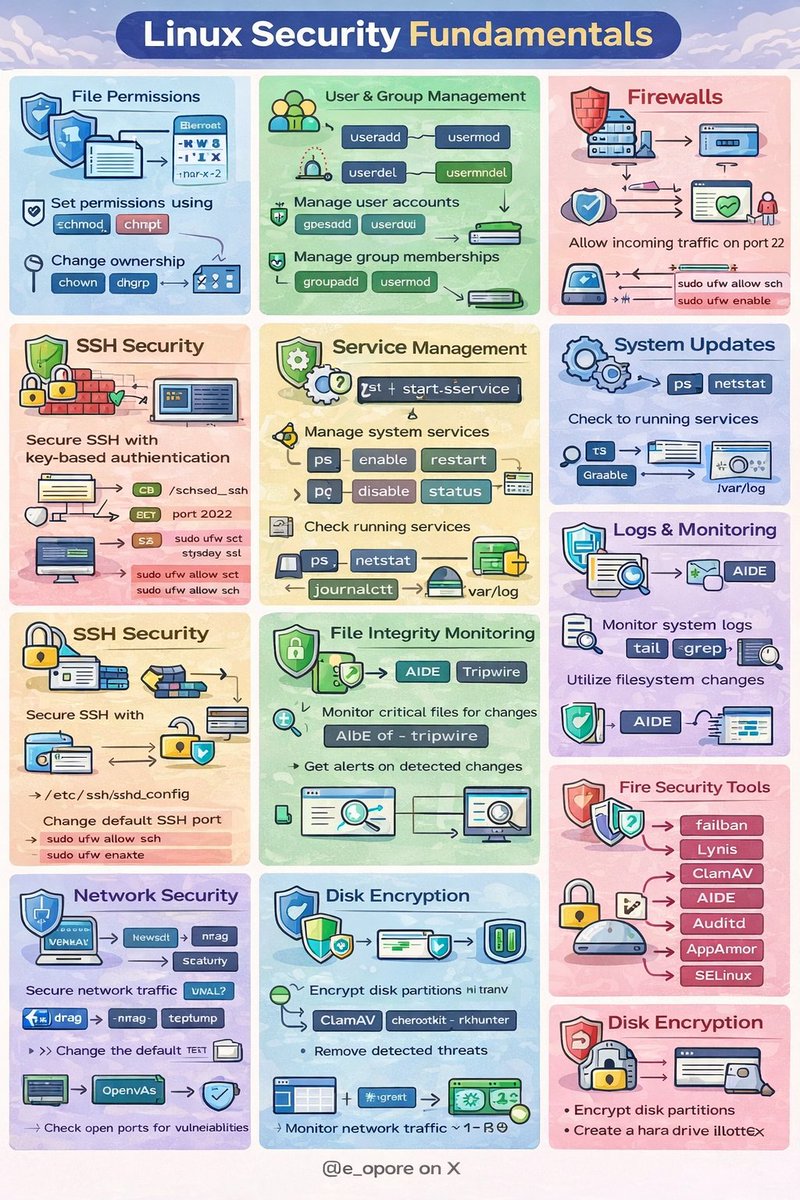
Linux Security Fundamentals
1. Introduction
→ Linux security focuses on protecting the system, data, and services from unauthorized access, attacks, and misuse.
→ Linux is known for its strong security architecture, but proper configuration and management are essential.
→ Security involves controlling access, monitoring activities, and protecting system resources.
2. Core Security Principles
→ Confidentiality → Protect sensitive information from unauthorized access.
→ Integrity → Ensure data remains accurate and unchanged.
→ Availability → Ensure systems and services remain accessible when needed.
3. User and Permission Management
→ User Accounts
→ Each user has a unique User ID (UID).
→ Users belong to groups identified by Group IDs (GIDs).
→ Proper user management prevents unauthorized system access.
→ File Permissions
→ Linux uses three permission types:
→ Read (r) → Allows viewing file contents.
→ Write (w) → Allows modifying files.
→ Execute (x) → Allows running files as programs.
→ Permissions apply to:
→ Owner
→ Group
→ Others
→ Commands used:
→ chmod → change file permissions
→ chown → change file ownership
→ chgrp → change group ownership
4. Authentication Mechanisms
→ Linux authenticates users through several methods.
→ Password Authentication
→ Stored securely in /etc/shadow.
→ Passwords are hashed for security.
→ SSH Key Authentication
→ Uses public-private key pairs.
→ More secure than password authentication.
→ Multi-Factor Authentication (MFA)
→ Combines password with additional verification methods.
5. Access Control Systems
→ Discretionary Access Control (DAC)
→ Default Linux permission system.
→ File owners decide who can access their files.
→ Mandatory Access Control (MAC)
→ Enforces stricter security policies.
→ Examples:
→ SELinux
→ AppArmor
6. System Hardening
→ System hardening reduces attack surfaces.
→ Disable unnecessary services.
→ Update packages regularly.
→ Use strong password policies.
→ Restrict root login access.
→ Use SSH instead of insecure protocols.
7. Firewall Protection
→ Firewalls control network traffic entering or leaving the system.
→ Common Linux firewall tools:
→ iptables
→ nftables
→ UFW (Uncomplicated Firewall)
→ Firewalls protect against unauthorized network access.
8. Intrusion Detection
→ Detect suspicious activities in the system.
→ Tools include:
→ Fail2Ban → blocks repeated login attempts.
→ OSSEC → host-based intrusion detection.
→ AIDE → file integrity monitoring.
9. Software Updates and Patch Management
→ Regular updates fix vulnerabilities and bugs.
→ Commands used:
→ apt update && apt upgrade
→ yum update
→ dnf update
→ Keeping the system updated reduces security risks.
10. Logging and Monitoring
→ Monitor system logs to detect unusual activity.
→ Important log files:
→ /var/log/auth.log → authentication attempts
→ /var/log/syslog → system events
→ /var/log/kern.log → kernel messages
→ Tools like journalctl help analyze logs.
11. Security Best Practices
→ Use least privilege principle.
→ Enable firewall protection.
→ Monitor system logs regularly.
→ Use strong passwords and SSH keys.
→ Disable unused ports and services.
→ Backup important data.
12. Tip
→ Linux security relies on permissions, authentication, and monitoring.
→ Proper configuration significantly reduces vulnerabilities.
→ Combining system hardening, firewalls, and intrusion detection creates a strong defense.
→ Continuous monitoring and updates maintain system security.
📘 Linux Mastery Ebook
→ Master Linux internals, security, system monitoring, logging, process management, and architecture step-by-step.
🔗 Grab the Linux Mastery Ebook
https://t.co/mCaIRlvD0A
⚠️ Shadow AI-linked breaches cost $670K more than average incidents 📊 Two-thirds of affected organizations lack AI governance policies 📋 PII and intellectual property disproportionately exposed #DataBreach#AI#CyberSecurity 👉 https://t.co/DZ6wHkuwEp
🏥Granite Wellness Centers settles #ransomware case for $725K 💊 15,600 addiction treatment patients affected in Northern California 📋SSNs, bank accounts, treatment records compromised 📅Claims submission deadline: April 27, 2026 #DataBreach#Compliance👉https://t.co/e2fjIb5P5e