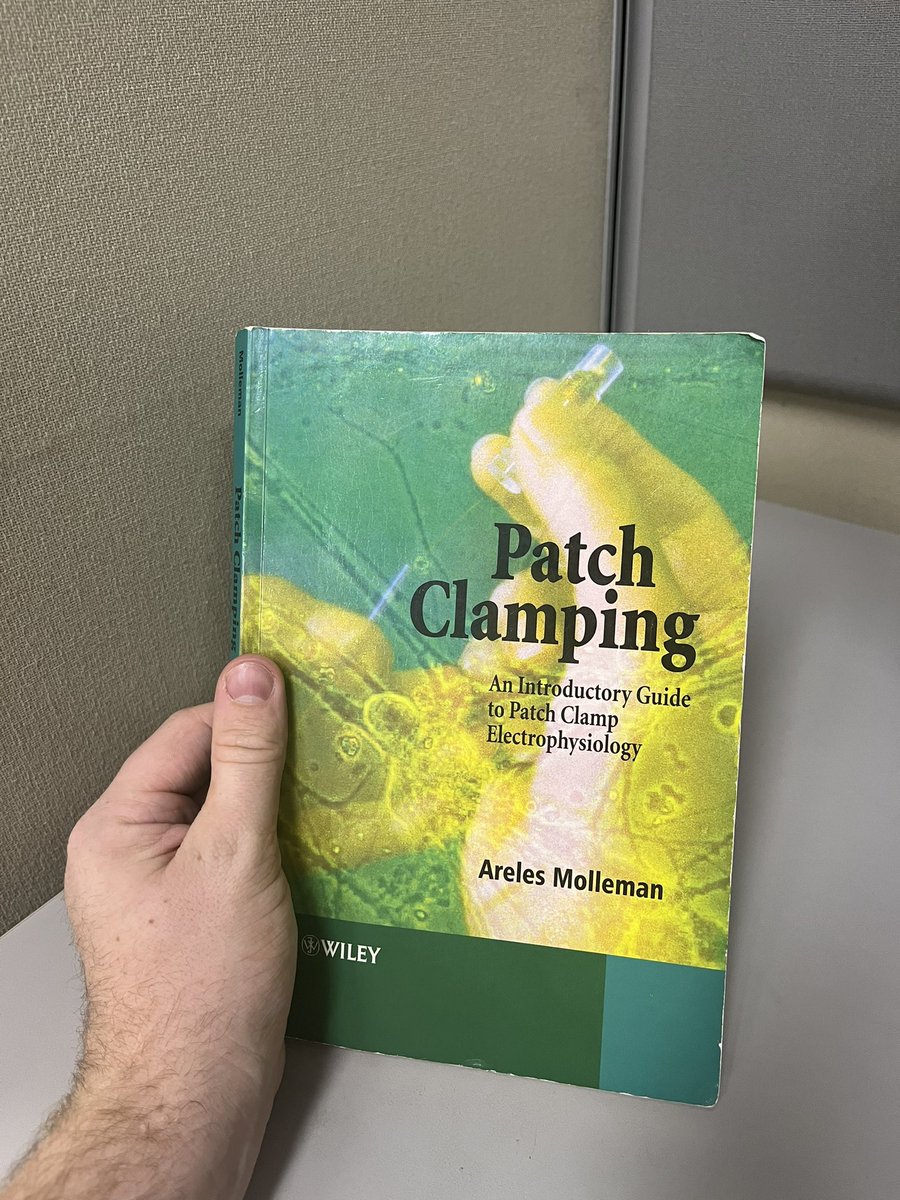
Hello #neurotwitter ! I would like to move from acute patch clamp ephys to patching cell cultures from my colleagues - first ofSH-SY5Y cells. Can anyone give me any tips/pitfalls?
Do you keep reading about the 'typecasted' substantia nigra and Parkinson's? What is this mysterious place in the brain that is so important to this syndrome. Really amazing teaching video on youtube from 2-minute neuroscience. Also reviewed in Stat Pearls by Sonne.
Key points:
- Where is it? Midbrain posterior (back region) to the crus cerebri fibers of the cerebral peduncle (motor fibers).
- Substantia nigra functionally and morphologically divided into two regions.
- Pars compacta (SNpc): dopaminer neurons
- Pars reticulata (SNpr) gamma-aminobutyric acid- (GABA) neurons.
- Why is it dark or black? It has a lot of neuromelanin from the L-DOPA precursor it contains.
- In Latin means dark substance or black substance.
- Compacta has dopamine projections to a region of the brain called the striatum.
- The ventral tegmental area is another place in the brain with dopamine and it is more implicated in behavior and thinking.
My take: Many folks read about nigra and should appreciate it's multiple regions. Most important is to appreciate that #Parkinsons is not just a disease of dopamine. There are multiple motor and non-motor circuits affected. Actors on TV get stereotyped (type casted) into roles and we have stereotyped dopamine as the only character important for Parkinson's. False!
https://t.co/wV5mJyGLi0
https://t.co/LqWsPMqO6A.
Today in @naturemethods: our new positively tuned voltage indicator, ASAP4e, for extended electrical recordings in the brain.
ASAP4e achieves greater responsivity (>200% per 100mV vs 50% for other fluorescent voltage sensors) and better photostability.
https://t.co/wOq1fAtx5h
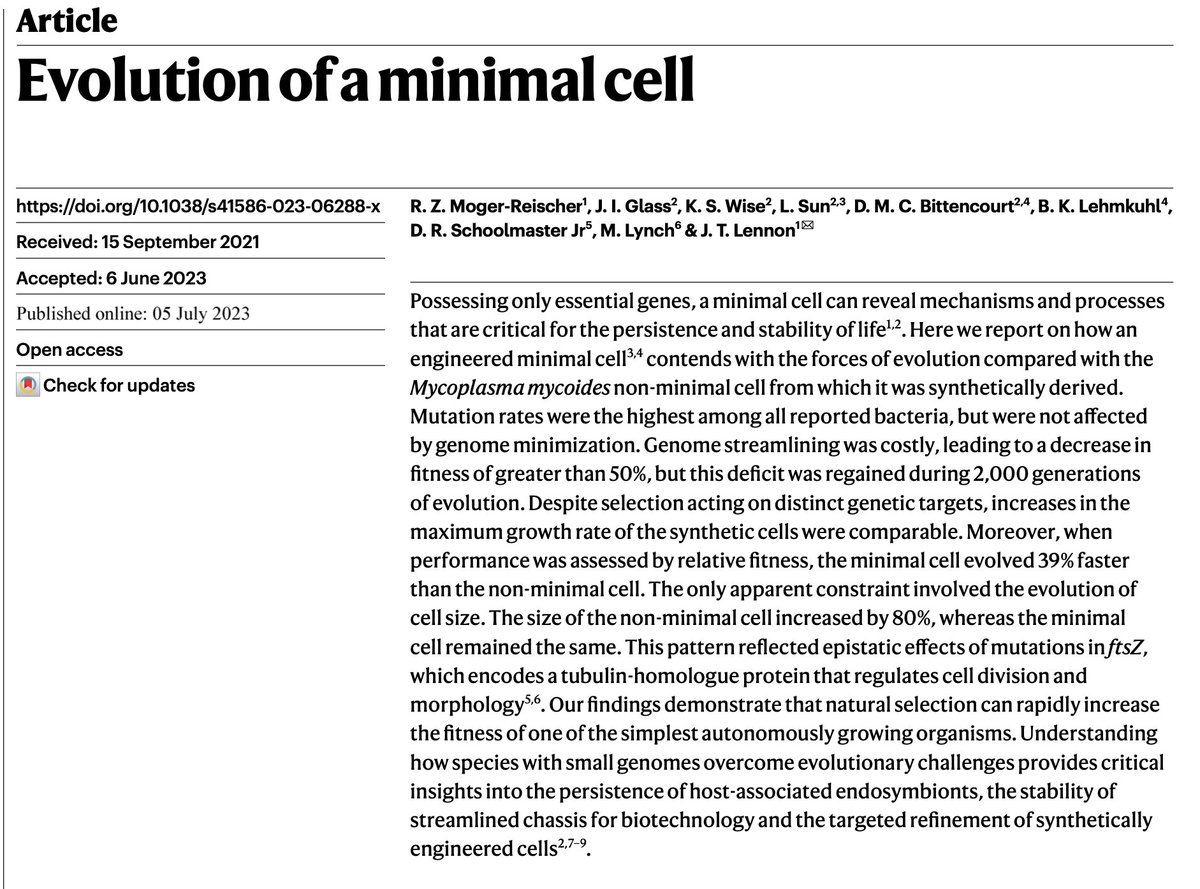
A mind-blowing paper has come out today in @Nature
In 2016, JC Venter Institute scientists trimmed a bacterial genome to its barest minimum required for life to synthesize what they called a "minimal genome" (https://t.co/Rk8oZJ0bUj).
Today, a group of scientists from Indiana University reports how that minimal genome evolved over 2000 generations in comparison to the non-minimal genome.
The authors found that even when you reduce a bacterial genome to its absolute minimum where every nucleotide matters, the genome undergoes mutational events generation after generation as much as the non-minimal genome. One simply cannot stop the evolution.
Just over 300 days of evolution (equivalent to 40,000 years in humans) the minimal cell has gained everything it lacked in fitness on day one in comparison to the non-minimal cell.
When comparing the evolved traits between the minimal and non-minimal cells, the scientists found something striking. The evolutionary process increased the cell size of non-minimal cells but not that of the minimal cell. But that is not the striking part.
The scientists were able to identify the key mutation that resulted in cell size evolution. And it turned out that the mutation that helped the non-minimal cells to grow bigger is the same that helped the minimal cells to stay smaller. Growing bigger had a survival advantage for non-minimal cells and not growing bigger had a survival advantage for minimal cells. So, the mutation had a context-dependent effect. This just demonstrates that the evolutionary effects on traits have no absolute direction. All that matter is what is beneficial for the organism's survival.
The conclusion of the paper is metaphorically a quote from the Jurassic Park movie:
“Listen, if there’s one thing the history of evolution has taught us is that life will not be contained. Life breaks free. It expands to new territories, and it crashes through barriers painfully, maybe even dangerously, but . . . life finds a way". (https://t.co/UlxRlb86CT)
https://t.co/zA9OAqSoAu
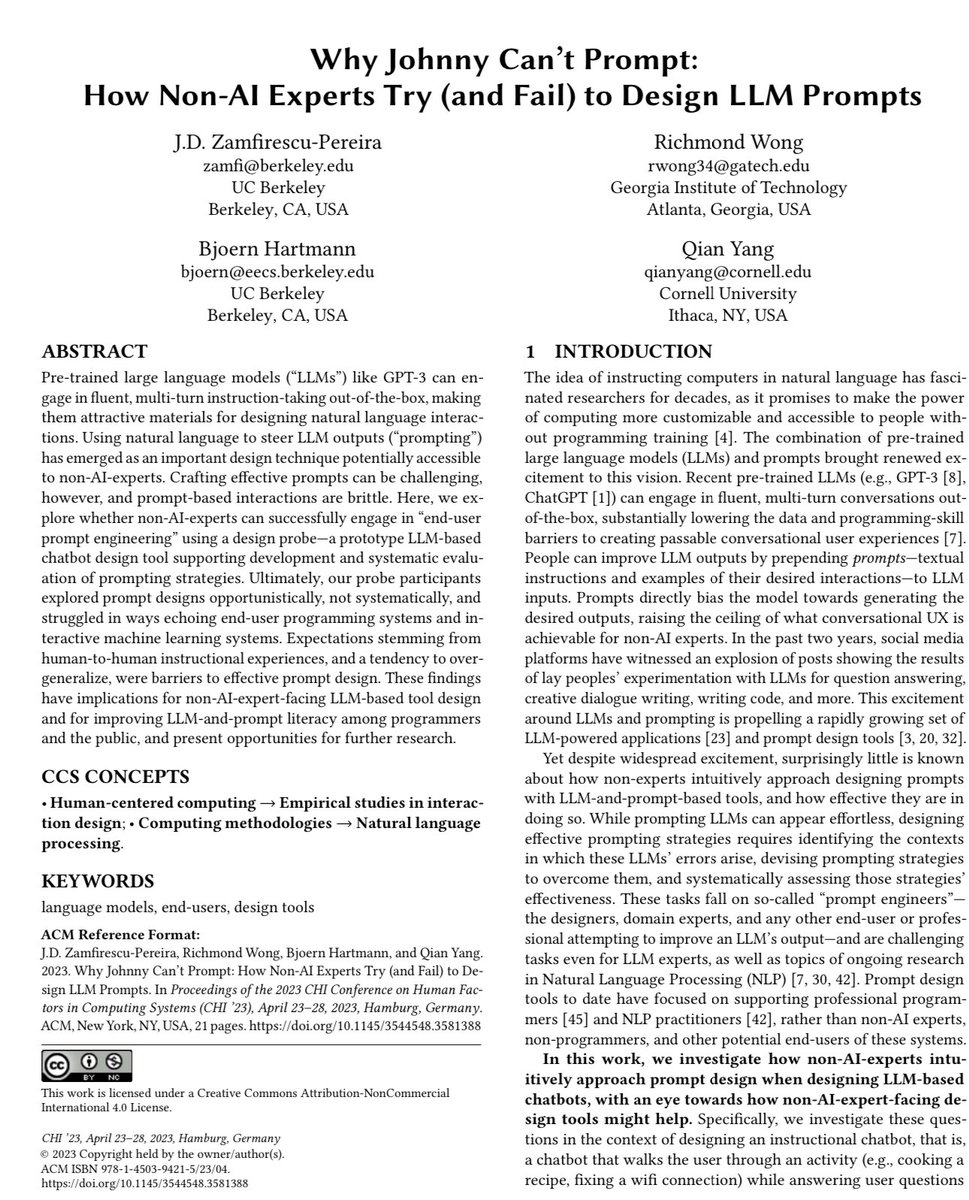
Paper shows some common errors folks make when first using AI:
1) Assuming a prompt that works in one circumstance will work in all cases
2) Assuming if AI doesn’t do something the first time, it can’t do it
3) Not systematically testing and experimenting https://t.co/Di08SwDw7f
I've been wondering about this for a while, glad someone finally did the experiments! If you recursively train a model on its own outputs, you get model collapse, exactly analogous to the "jpeg" artifacts that Ted Chiang brought up in his New Yorker piece. https://t.co/7MIXgr0PVp