We know there are differences between the left and right sides of the brain, known as brain asymmetry.
But it’s not yet clear how or why this comes about.
@stevewilsonfish and @ibianco3 from @ucl aim to find answers, with support from our Discovery Research Awards ⤵️
Three positions opened in our lab:
1 post doc and 1 phD position for two neurophysiologists.
1 position for an engineering with background in optics and microscopy.
If you are interested, please write @
[email protected]
Delighted to share our latest preprint using GEVIs to image action potentials along axons. A great effort led by @VicGSB and @markrigbu studying the role of Kv channels in shaping the action potential in distal axons. #GEVIs#VoltageImaging https://t.co/FxwKvJFZEw
Our paper on voltage imaging in distal axons 🔬 and how Kv channels help keep the action potential in check 👮♀️ is now live on #BioRxiv! 🎉 Big thank you to @markrigbu, @jbneuro and lab ❤️ @dev_neuro@KingsIoPPN
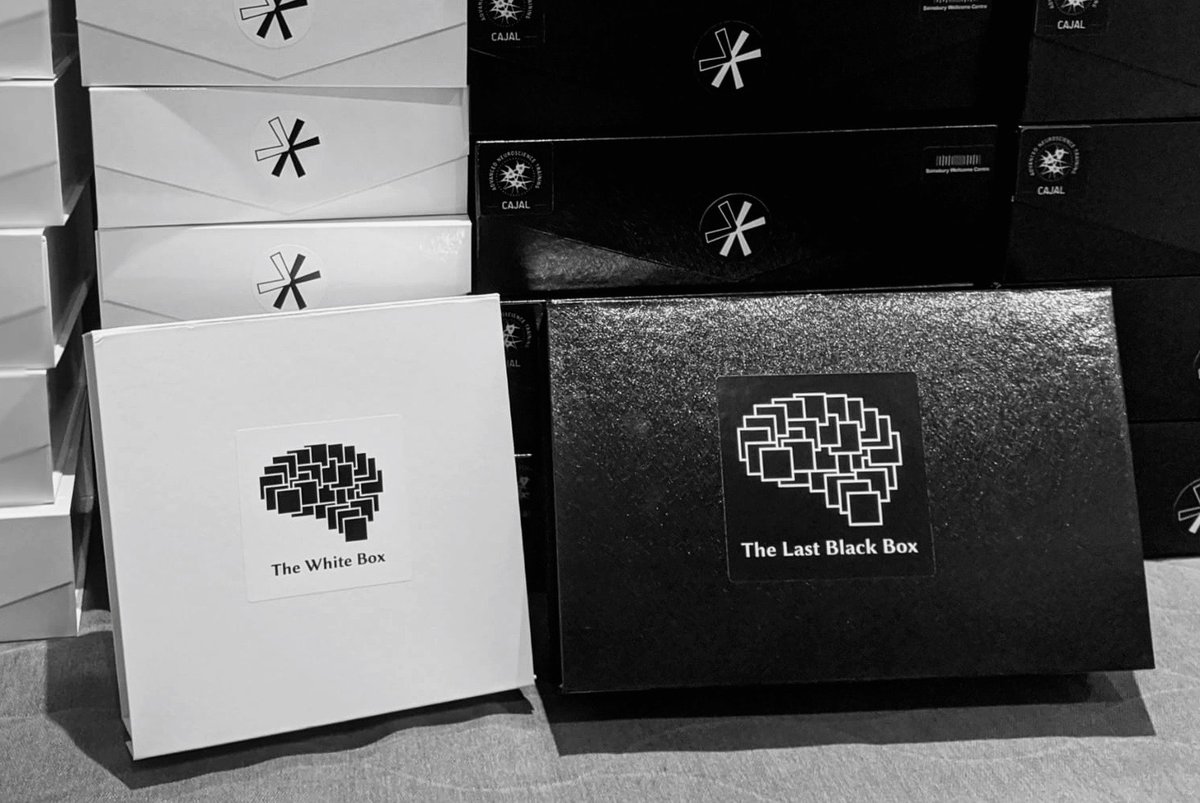
The Neurokit boot-camp equips new PhD students with state-of-the-art tools to tackle “The Last Black Box”...the brain! For the next 3 weeks, students at @SWC_Neuro will build an increasingly sophisticated robot while learning the fundamentals of both neuroscience and technology.
The #Cajal#Neurokit#TheLastBlackBox is now fully online...but still hands-on. Twelve students around the world are learning to program their NB3 robots!
Our latest paper is out @NatureNeuro – we align neural population imaging with gene expression labeling, and find that multiple peptidergic cell types in the zebrafish hypothalamus jointly drive defensive behaviors to threats. https://t.co/0b94SFiy9J 1/4
Are you finding it difficult to start up a social life again after lockdown? You're not alone. Elena Dreosti told @bbc5live about how isolation has an unexpected impact on our desire to socialise. Listen here from 57:00 https://t.co/wRBZOzbLjN
Happy to announce our pre-print is on #bioarxiv: We report that early experience enhanced prey capture success in larval #zebrafish and that we identified malleable aspects of their hunting sequence that predicted capture success.
@ZebrafishRock
Interesting insights to the mechanism of the social deficits of isolated fish. Very happy to have been involved! The lonely fish is not a loner fish: whole-brain mapping reveals abnormal activity in socially isolated zebrafish https://t.co/beYDsRVISH