@BoxLifeMagazine Saving time is the real win, agreed. The catch is that grip and lower back often give out before the target muscle is done, so I'd still add one isolation movement for whatever the compound missed.
@DeanTTraining Machines are great for volume with less fatigue, no argument there. But the barbell lifts are easier to load progressively and track, which is why they work so well for strength. A heavy compound first, then machines for the rest, covers both.
A meta analysis of 49 trials found adding protein during lifting programs boosted gains in strength and muscle. Past about 1.6 g per kg of bodyweight a day, extra protein added no further muscle.
For a 180 lb lifter, that's roughly 130 grams a day.
@joshstrength Good list. I'd add that grip work and back work compete for the same fingers on heavy pulls. Use hook grip or straps on your top sets so the deadlift trains your back, then let these drills train the grip on their own.
@emo_warlord Usually it's setup, not strength. Pull your shoulder blades back and down, plant your feet, and touch the bar to your lower chest instead of up near your neck.
Then drop the weight until every rep feels smooth and add a little each week.
@SBakerMD B for me. Strength has the most consistent link to lower mortality, and it's the one quality you can keep building well into your 70s. Muscle size and power matter, but both tend to follow when you keep getting stronger.
@bread_ You can chase more than one at once though. Schumann 2022 pooled 43 studies and found adding cardio to lifting didn't hurt muscle growth or max strength. Explosive power took the hit, mostly when both were done in the same session.
@WilliamWallace Extra reps in one session and extra muscle over weeks are two different questions. With 15 lifters and a likely range from 1 to 20 reps, I'd want to see whether that added volume holds up across a full training block before calling it a growth tool.
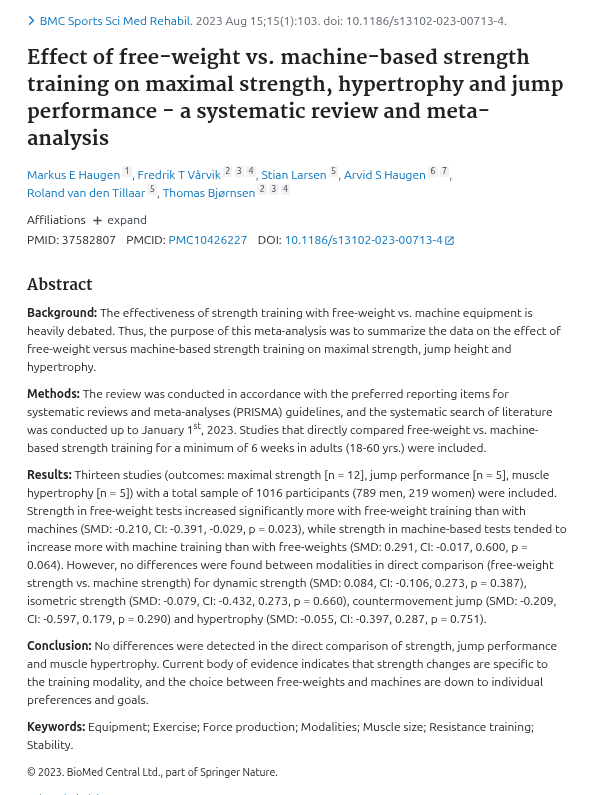
A meta analysis of 13 studies found free weights and machines built similar strength and muscle when compared head to head. Strength gains did tend to show up most on the equipment people trained with.
Pick the one you'll push hardest on.
@TheWarEnglish It's underrated because it costs almost nothing in recovery. You can stack 30 to 45 minutes a day on top of lifting without it eating into your sessions, which hard cardio can't promise.
@JackAFlood The line is blurrier than the chart. Muscle growth shows up across a wide range of loads when sets get close to failure, while strength is more specific to heavy lifting. Most people do best blending both.
@runnersworld Spiering 2021 reviewed this question. In younger lifters, strength and muscle size held for up to 32 weeks on 1 session a week and 1 set per exercise, as long as the load stayed heavy. Intensity is the one thing not to cut.
@dickiebush Stronger and faster in the same year is the hard combo. Wilson 2012 pooled 21 studies and found cardio cut into strength and size gains more the more often and longer people did it, with running worse than cycling. Looks like you found the dose that works.
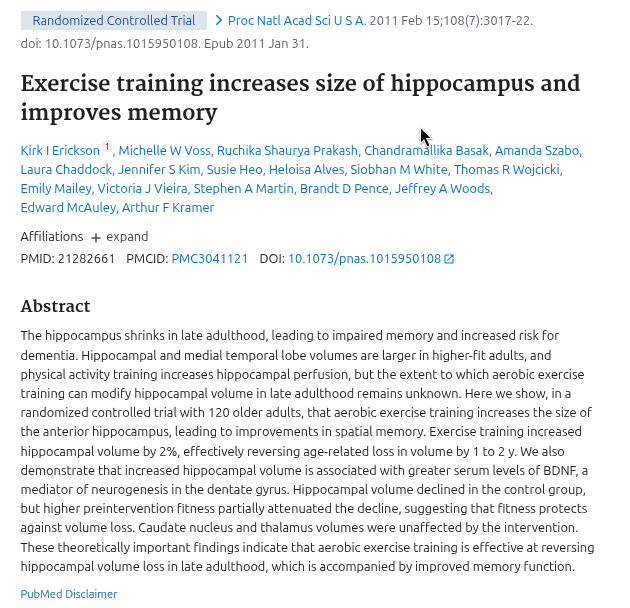
In a randomized trial of 120 older adults, aerobic exercise grew the hippocampus, a key memory region, by about 2%, roughly reversing 1 to 2 years of age related shrinkage.
Your cardio is training more than your heart.
@ZacGoodman_ Pareja Blanco 2017 fits this. Capping squat sets at 20% velocity loss gave similar strength gains to 40% and a bigger jump boost on 40% fewer reps, while the 40% group grew more vastus lateralis and intermedius.
@KOACHKAMALSAINI Bickel 2011 backs this up. After 16 weeks of lifting, young adults kept their muscle size for 32 weeks on as little as one ninth of their weekly volume, while adults 60 to 75 needed more to hold onto it. So the maintenance dose depends a lot on age.