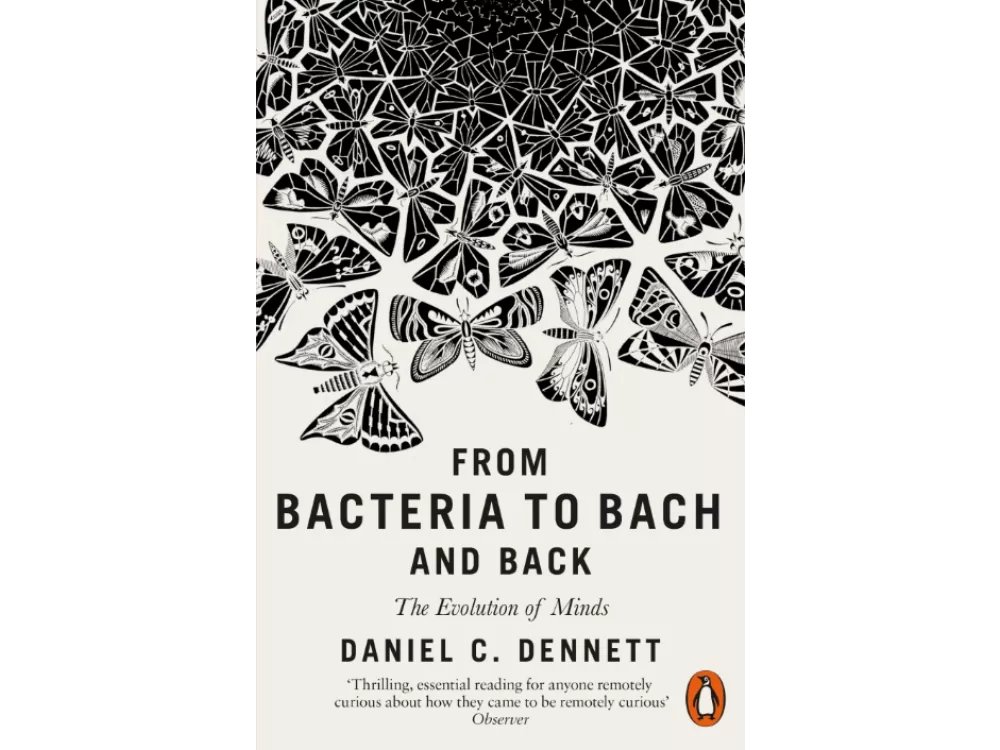
Daniel Dennett, who recently passed away, is an inspiration for people like me who love grand ideas that connect many different fields at a deep level (and be rigorous about that; well as rigorous as grand theories can be). His thinking is difficult to categorize: part philosopher, part scientist, he had many good ideas on topics ranging from evolution to consciousness to God.
The #book From Bacteria To Bach And Back had been lying on my shelf for many years and I recently picked it up because I’ve been thinking a lot about evolutionary constraints on brain and consciousness.
The book is hard to summarize because it spans so many topics, but perhaps the central idea is this: competence without comprehension is not only possible, but is the norm; but when comprehension slowly develops, it leads to an explosion of artifacts and culture that we see around us. Dennett argues that there’s a difference between performing a behavior and having a (manipulable) representation in the mind of that behavior such that you can “think” and “reflect” on that behavior to fix a particular context or to make it better.
For example, a bird making an intricate nest displays a startling case of competence but is debatable whether she understands what it’s doing. The bird nest works well because it is an adaptation to the environment the bird finds itself in, so there’s a rationale behind design of the bird nest but nobody designed it. This is what Dennet calls as a design without a designer where rationale for the designed objects are free-floating. So reasons exists but not in someone’s minds.
Humans, on the other hand, seem to understand what they’re doing as they can flexibly change their behavior depending on context. Our entire society and technology is a proof of us transcending beyond our evolved instincts.
How did that happen?
Dennett argues that this transition was gradual and links it to languages (and memes, in general). Our ancestors, like birds, would have instincts for performing various behaviours without understanding them. Imagine if one such biased behavior is copying the elders or copying the most successful. This kind of copying behavior could initially bootstrap rudimentary form of language as a group settles on some sort of shared signals. It also bootstraps knowledge-sharing (aka culture) as copying allows spread of successful discoveries much faster than what genetic reproduction cycles would allow.
Once rudimentary culture and language is in place, the benefits of having these capacities would allow for co-evolutionary process where the brain and biology of humans could change in order to absorb language and culture faster. However, this is still competence without comprehension. One can imagine sophisticated behavior in a primitive group of homnids but nobody knowing what they’re doing. Even proto-language (like most animal calls) could have been “mindless” in the sense of it eliciting the right behavioral responses, but individuals not comprehending what they’re doing.
So how did competence then led to comprehension? The road to comprehension wasn’t a step change, though. There’s a continuum of instinct to flexible behavior (which is a hallmark of comprehension). You could have behaviors that work well but you only sort-of understand why (for example, the impulse to do art or driving a car well).
Dennett suggests that gradually comprehension could have become better and better due to the need to justify our actions to others (or deceive others) in a social settings. Once a shared proto-language has taken hold in a group, everyone has an incentive to take advantage over others by giving false information. This creates a pressure to justify and convince through giving reasons and that required having a representation of reasons in the mind. Such representations of “why am I doing this” were glimmers of comprehension which became stronger thanks to the arms-race between deceivers and questioners.
This dynamic also explains where a sense of self comes from. In order to decieve others, you need to model others and their behavior in the situation at hand. And that model includes how you yourself will behave in response to their responses. As you can see here, self emerges within the theory of mind because social dynamics require identification of distinct selves including oneself. (This does make me wonder if solitary animals have an explicit sense of self that they feel as strongly as we feel.)
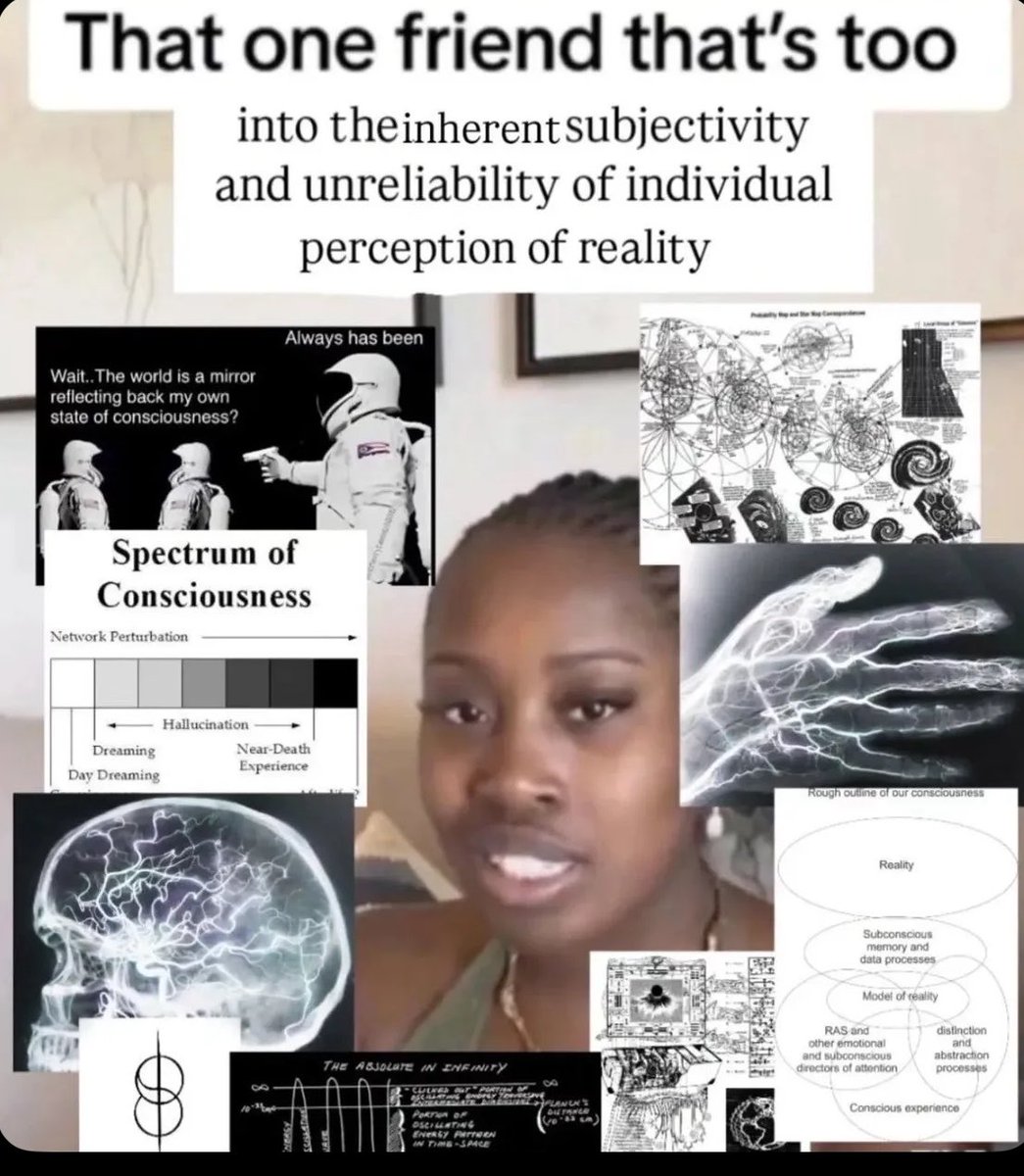
The last part of the book is about consciousness. Dennett is an illusionist, which means he believes that there’s no hard problem of consciousness to be solved. He says that our experienced reality is like a user-interface constructed by evolution on top of the raw reality. The user interface exists because it is beneficial to the organism’s survival but we must not mistake it for “truth”, which only a scientific investigation can reveal (and not introspection).
Over time, I’ve grown sympathetic to the illusionist position but haven’t yet come around to embracing it fully. My current feeling is that the hard problem will not be solved but will gradually dissolve as neuroscience progresses (just like the problem of “what is life” got dissolved as we made advances in biology).
There’s definitely an air of mystery around consciousness, but is it because evolution hides complexity of brain processes that compose it from us (which science will eventually reveal) or is it because consciousness is in some way fundamental in the universe?
Dennet argues it is the former and he calls this as the Cartesian Gravity. Our inner experience is so vivid that we mistake it for truth but we find it mysterious because evolution had no incentive to represent how it’s built. The more we probe internally, the more we find it as a given, which seems unexplainable and baffling. This also prevents us from being scientifically objective about consciousness as we keep gravitating to first-person experience (which could have holes that we’d never see unless we study it from a third person point of view). This is why Dennet advances his approach of studying consciousness, heterophenomenology, which treats first-person reports of consciousness as a third-person scientific object of analysis.
Dostoevsky was right; “Every self-betrayal is a sin. Whenever you go against your nature, your body reminds you.”
If you spend enough time with anything, you start liking it, even sadness. So let’s choose people and spaces that truly elevate us. Your peace is worth it.