Denying Sheikh Hasina's Right to Return: Bangladesh in Breach of Its Constitution and International Law
---
A passport is not a favour granted by any government. Under the Constitution and international treaties, the right to return to one's own country belongs to every citizen.
Sheikh Hasina, five-time Prime Minister of Bangladesh and daughter of Bangabandhu Sheikh Mujibur Rahman, the founding architect and Father of the Nation, has been compelled to remain outside the country since August 2024. The trial held in her absence has raised serious concerns internationally: the UN High Commissioner for Human Rights expressed regret over the sentence, and Human Rights Watch stated that the trial failed to meet international standards.
Her resolve, however, remains firm. Determined to stand beside a people in distress, she has decided to return in December. On 9 November, through lawyers at London-based Matrix Chambers, she applied to the Bangladesh High Commission in New Delhi for a new passport and national identity card.
Yet State Minister for Foreign Affairs Humaiun Kobir has declared that Bangladesh does not give "a passport to a terrorist". The Delhi-based Rights and Risks Analysis Group (RRAG) has described this position as a violation of fundamental rights and has called on the United Nations to intervene.
The question, then, is a single one: can a citizen be denied the right to return to their homeland without any basis in law, solely on the word of a minister? The Constitution, the higher judiciary and international law give the same answer: no.
▪️ What the Constitution says
• Article 36: Subject to reasonable restrictions imposed by law in the public interest, every citizen has the right to leave and re-enter Bangladesh.
• Article 7: All powers of the Republic belong to the people, and may be exercised only under, and by the authority of, the Constitution. The Constitution is the supreme law of the Republic; no ministerial declaration or executive decision stands above it.
• Article 31: To enjoy the protection of the law is the inalienable right of every citizen "wherever he may be". Even while abroad, Sheikh Hasina remains within this protection.
• Article 27: All citizens are equal before the law.
• Article 32: No person shall be deprived of life or personal liberty save in accordance with law.
• Article 26: Any law inconsistent with fundamental rights is void.
▪️ Judicial precedent
In Durnity Daman Commission v. G.B. Hossain and Others [74 DLR (AD) 1], decided on 27 September 2021, the Appellate Division held that restrictions under Article 36 may be imposed only through enacted law and only where reasonably necessary in the public interest; restricting freedom of movement by executive order without the backing of law is unconstitutional. Since then, the higher judiciary has applied this principle as settled law.
There is no law in Bangladesh prohibiting a citizen from entering the country, and the government has so far cited none. On what legal basis, then, can a state minister's verbal declaration strip a citizen of a constitutional right?
▪️ The national identity card: recognition of citizenship
Sheikh Hasina is a citizen of Bangladesh by birth; no legal process has ever been initiated to revoke her citizenship. A national identity card is not a favour; it is the state's recognition of a citizen's identity. To withhold it while her citizenship remains intact is to deny a citizen the state's recognition of who she is.
▪️ What international law says
• Universal Declaration of Human Rights (UDHR), Article 13(2): Everyone has the right to leave any country, including their own, and to return to their country.
• UDHR, Article 15: No one shall be arbitrarily deprived of their nationality.
• UDHR, Articles 10 and 11: The right to a fair hearing by an impartial tribunal, and to be presumed innocent until proved guilty.
• ICCPR, Article 12(4): No one shall be arbitrarily deprived of the right to enter their own country. Bangladesh acceded to the Covenant in 2000 and is legally bound by it.
• UN Human Rights Committee, General Comment No. 27: The right to return includes the right to obtain a passport; there are few, if any, circumstances in which depriving a person of this right could be reasonable.
• ICCPR, Article 14: The state is obliged to guarantee every person a fair trial in full.
▪️ The extradition treaty is no excuse to withhold a passport
According to RRAG's analysis, the India-Bangladesh Extradition Treaty contains no provision allowing a state to refuse a passport to a person subject to an extradition request. On the contrary, Article 20 of the treaty provides that it shall not affect the rights and obligations of the two states arising from international conventions. Both countries are parties to the ICCPR, so the right to return remains intact even in the context of extradition. Moreover, issuing travel documents to a citizen who wishes to return home is established international practice.
▪️ The state's contradiction
On 5 August 2024, Sheikh Hasina was flown to India under military arrangement, aboard a Bangladesh Air Force C-130 aircraft. Since 23 December 2024, first the interim government and then the BNP government have sought her extradition, repeatedly blaming India.
Yet when she herself announced her return and her intention to take part in the legal process, the same state refused her the documents to come home. The question arises: does the government genuinely want a legal process, or does it simply want to prevent her return? From a government that came to power promising to restore human rights and the rule of law, yet under whose watch people are remanded on allegations of chanting "Joy Bangla", it may be hard to expect respect for a former Prime Minister's rights. But it is essential to demand it.
▪️ The right to return: the role of the international human rights system
Without a passport and national identity card before December, Sheikh Hasina's right to return will be rendered meaningless in practice. As a State Party to the ICCPR, Bangladesh is bound to protect this right; where the state fails, the international human rights system must act swiftly. The following is expected of the relevant institutions:
• Office of the UN High Commissioner for Human Rights (OHCHR): Under its mandate pursuant to General Assembly resolution 48/141, to engage with the government before December and, through public statements, remind it of its obligations under Article 12(4) of the ICCPR and General Comment No. 27.
• UN Special Rapporteurs: For the Special Rapporteur on the independence of judges and lawyers to issue an urgent appeal asking under what law the application is being refused, and how the state will guarantee the fair trial standards of Article 14 of the ICCPR.
• UN Human Rights Committee: To include the matter in the List of Issues and Concluding Observations in its review of Bangladesh under Article 40 of the ICCPR.
• UN Human Rights Council: Within the Universal Periodic Review established under General Assembly resolution 60/251, to recommend that Bangladesh guarantee its citizens' right to return.
• The Commonwealth: In light of the human rights and rule of law commitments of the Commonwealth Charter (2013), to open an immediate dialogue with Bangladesh.
• The European Union: Given that the "Everything But Arms" trade preferences (Regulation (EU) No 978/2012) are linked to compliance with the ICCPR, to raise the matter urgently in the EU-Bangladesh dialogue and in the European Parliament.
• Amnesty International and Human Rights Watch: To monitor and document, impartially, the handling of the application in light of the right to return and international fair trial standards.
These expectations take no side on any verdict; they stand for a universal right. If the international community does not act now, a citizen's right to return will yield to executive decision, setting a troubling precedent for the international human rights system itself.
▪️ Final word: law or power?
For nearly two years, the state, first under the interim government and now under the BNP government, has sought Sheikh Hasina's return while blaming India. Today, when she herself seeks to come back, that same state stands in her way. No law has been cited so far; there is only a state minister's word and a demeaning label. This is the face of governance today: people are remanded on allegations of chanting "Joy Bangla", lives are lost to mob violence, and arbitrary arrests are used to suppress dissent.
It is from this reality that Sheikh Hasina has decided to return. She will not walk away from her duty to stand beside people who today feel unsafe and voiceless. As the daughter of Bangabandhu, her bond with this land and its people cannot be severed by an executive declaration.
Articles 7 and 36 of the Constitution are on her side. The principle laid down by the Appellate Division is on her side. Article 12(4) of the ICCPR is on her side. Against her stands only the obstinacy of power. If the government does not abandon that obstinacy and return to the path of law before December, it will bear responsibility not only for depriving a citizen of her rights, but for breaching its own Constitution and its international commitments. The world is watching, and so are the people of Bangladesh.
Returning to one's own country is no one's favour to grant; it is a right. And it is with that right that she seeks to return, head held high, to her own people.
— Roudra Rudra, Political Analyst
References: Reuters (9 November 2026); Associated Press (9 November 2026); Rights and Risks Analysis Group and Asian Centre for Human Rights (9 November 2026); Human Rights Watch (5 October 2026); Constitution of the People's Republic of Bangladesh; Durnity Daman Commission v. G.B. Hossain, 74 DLR (AD) 1; UDHR; ICCPR; UN Human Rights Committee, General Comment No. 27; India-Bangladesh Extradition Treaty (2013); Regulation (EU) No 978/2012; Commonwealth Charter (2013).
References:
• Reuters, 9 Nov 2026: https://t.co/o7ax5L3Kj1
• Associated Press, 9 Nov 2026: https://t.co/PnZSOOZfyR
• RRAG & Asian Centre for Human Rights, 9 Nov 2026: https://t.co/ThxxH1CVry
• Human Rights Watch, 5 Oct 2026: https://t.co/SxXb7YrVz4
• Constitution of Bangladesh: https://t.co/MJ3UgK89zL
• ACC v. G.B. Hossain, 74 DLR (AD) 1: https://t.co/GVXoQBfcug
• UDHR: https://t.co/vmjXynBrJF
• ICCPR: https://t.co/agUzZhiGtu
• UN Human Rights Committee, General Comment No. 27: https://t.co/LuIYrlyoIt
• India-Bangladesh Extradition Treaty, 2013: https://t.co/tynp03KdFP
• Regulation (EU) No 978/2012: https://t.co/O6Of61nfxA
• Commonwealth Charter, 2013: https://t.co/vLwBpKrL2w
#SheikhHasina #Bangladesh
“Two Bodies, One Mother’s Arms”: A Mother’s Heartbreaking Account of a Double Murder in Bangladesh
On 20 September 2026, Ahad Ahmed Etu, convener of the Bashtuli Union Chhatra League in Rampal, Bagerhat, and his father were brutally attacked, allegedly by BNP activists.
In a devastating account, Ahad’s mother, Nazma Begum, recalls rushing from her kitchen to find both her son and husband bleeding from machete wounds. With no immediate help, she carried both on a single van, holding one in her arms and the other on her lap. Her son died before reaching the hospital.
“Who should I take, and where?” she asks, recounting the unimaginable agony of a mother forced to carry her husband and son together.
Her plea is simple: Let no other mother lose her child this way. Let justice be served.
How many more lives must be lost before political violence ends in Bangladesh?
#BNPJamaatViolence #BangladeshCrisis
📷 Hindu Persecution Intensifies Ahead of Durga Puja in Bangladesh
A Hindu businessman, Manik Chakraborty, has reportedly lost his home to a late-night arson attack ahead of Durga Puja. The incident marks the second such attack in the Hindu-majority locality, leaving three other families homeless.
As families face the prospect of spending their biggest religious festival under the open sky, serious questions arise over minority safety, accountability and the growing climate of religious hatred in Bangladesh.
No family should lose its home or its right to celebrate in peace because of its faith. Where is justice?
#Bangladesh #DurgaPuja #HindusUnderAttack
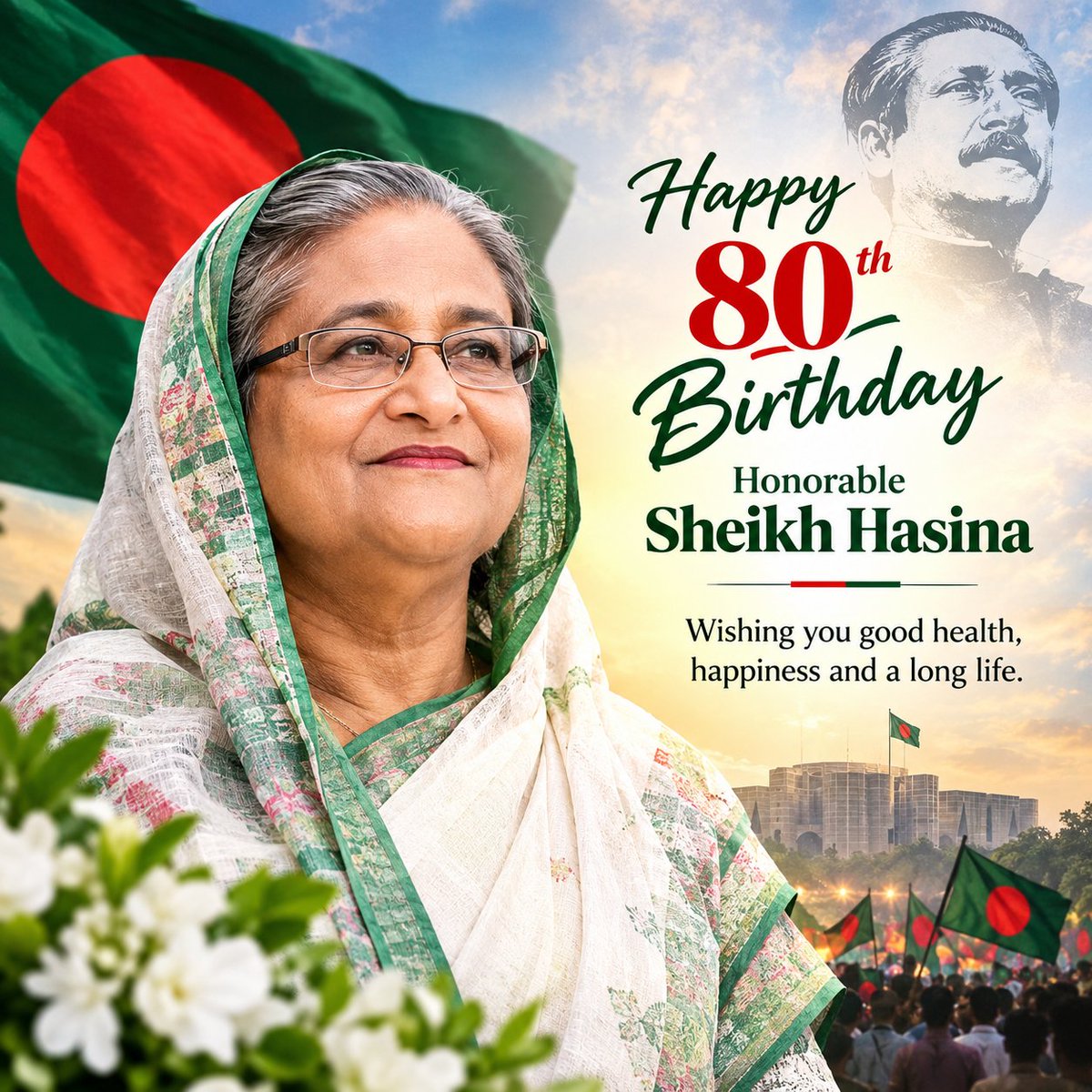
On the 80th birthday of Bangabandhu’s daughter, the Honorable Sheikh Hasina, we extend our heartfelt wishes and deepest respect.
A symbol of hope for millions of people, she has endured countless challenges and adversities with determination and resilience.
On this special day, we wish Sheikh Hasina good health, happiness, and a long life.
Happy 80th Birthday, Honorable Sheikh Hasina!
#SheikhHasina
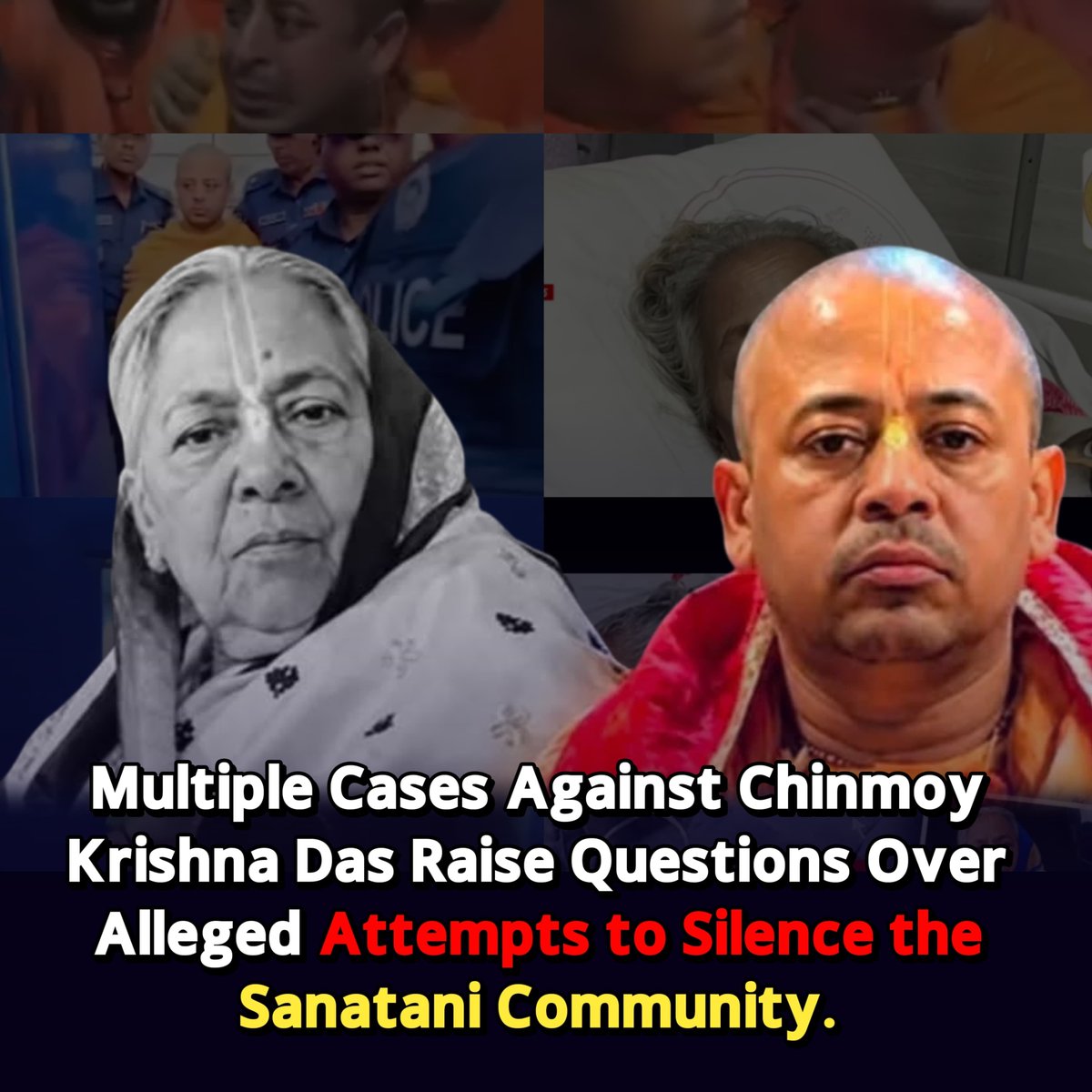
Multiple Cases Against Chinmoy Krishna Das Raise Questions Over Alleged Attempts to Silence the Sanatani Community
Chinmoy Krishna Das Brahmachari, spokesperson for the Bangladesh Sammilito Sanatani Jagaran Jote, has been facing multiple criminal cases and prolonged detention, raising concerns about whether legal proceedings are being used to suppress the voice of the Sanatani community.
One of the major cases against him is a sedition case related to allegations of disrespecting the national flag. The High Court granted him bail in the case, but the bail was later stayed following an appeal by the state.
Chinmoy has subsequently been shown arrested in several other cases. Although the High Court recently granted him bail in two cases, he remains in custody because of other pending cases.
The situation has also raised serious humanitarian concerns. His mother, Sandhya Rani Dhar, was reportedly seriously ill and wanted to see her son for the last time. His family sought parole so that Chinmoy could meet his dying mother, but he was not allowed to see her while she was alive.
After her death, arrangements were made for him to attend her final rites.
The circumstances have prompted an important question: Are the cases against Chinmoy Krishna Das solely part of a legitimate judicial process, or are they also being used—intentionally or otherwise—to silence a prominent voice speaking on behalf of the Sanatani community?
The allegations against Chinmoy should be decided through a fair and transparent judicial process. At the same time, the state has a responsibility to ensure that criminal cases are not used as a means of political or religious persecution or to suppress legitimate demands for minority rights.
The controversy surrounding Chinmoy Krishna Das therefore goes beyond the courtroom. It has become a broader test of Bangladesh’s commitment to equal rights, religious freedom, due process and the protection of minority voices.
#Bangladesh
#BangladeshMinorities
#MinorityRights
#HinduRights
#Sanatani
#HumanRights
#ReligiousFreedom
#JusticeForMinorities
#ProtectMinorities
#BangladeshHindus
You may break brick after brick at #Dhanmondi32, but you cannot erase what it represents. A building can be demolished; history, memory and the place it holds in the hearts of millions cannot. Attacks and intimidation cannot rewrite Bangladesh’s history.
https://t.co/RCvEAVjW9R
#15thAugust #HumanRights #BangabandhuKilling
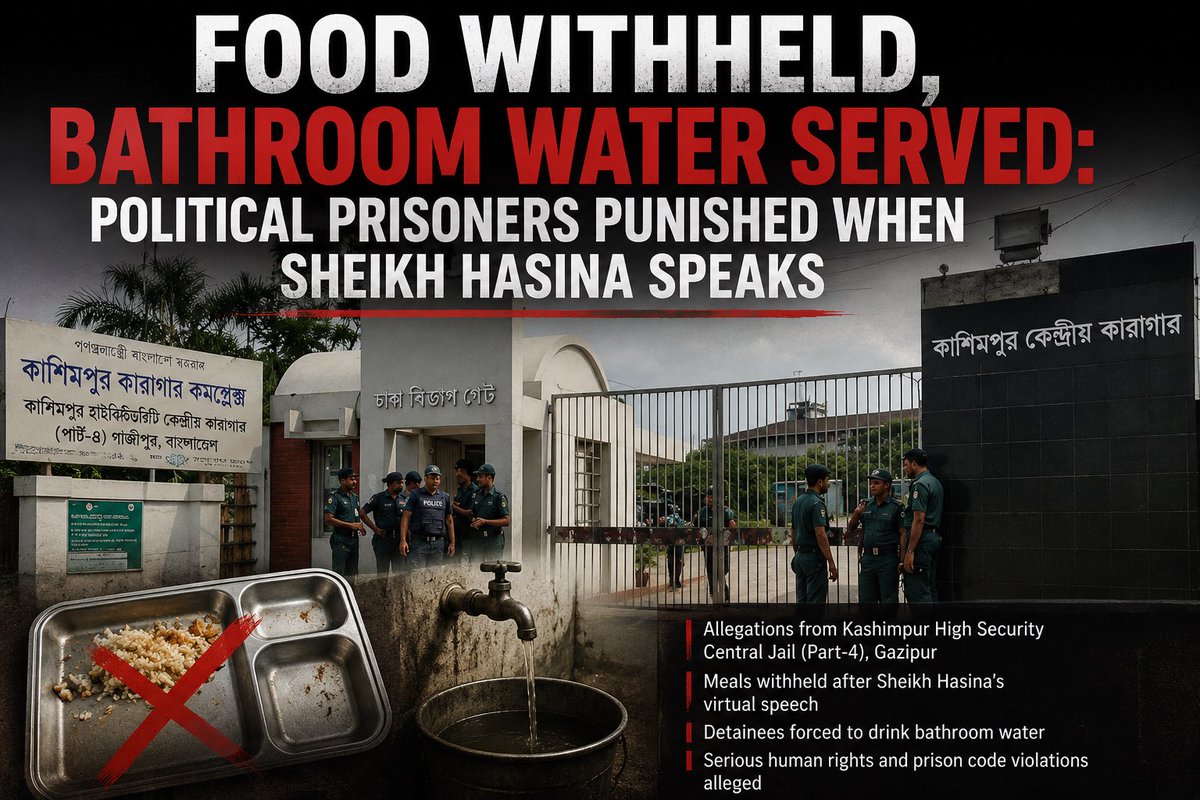
Families Allege Political Detainees Denied Food and Safe Drinking Water at Bangladesh High-Security Prison
Fresh allegations of serious human rights abuses have emerged from Kashimpur High Security Central Jail (Part-4) in Gazipur, where families and former inmates claim that political detainees linked to the Awami League were deliberately deprived of food and access to safe drinking water following a virtual address by former Prime Minister Sheikh Hasina.
According to accounts from prison sources and former detainees, punitive measures are allegedly imposed whenever Sheikh Hasina delivers a public statement. They claim that political prisoners are subjected to collective punishment, including the suspension of regular meal distribution and restrictions on access to essential services.
Relatives of detainees say inmates spent much of the day without food after Wednesday’s speech. Former prisoners further allege that those attempting to purchase food from the prison canteen with their own money faced repeated obstacles.
One former detainee also alleged that prisoners were, at times, forced to drink water from washroom facilities instead of being provided with safe drinking water, describing the practice as degrading and incompatible with basic standards of humane treatment.
If verified, such allegations could amount to violations of internationally recognized human rights standards, including the UN Standard Minimum Rules for the Treatment of Prisoners (the Nelson Mandela Rules), which require that prisoners receive adequate food, clean drinking water, and be treated with dignity, without discrimination or collective punishment.
Human rights advocates have long maintained that all detainees, regardless of their political affiliation or the charges they face, are entitled to fundamental protections under both domestic law and international human rights norms.
Families of those detained have called for an independent investigation into the allegations and urged the authorities to ensure that all prisoners are provided with adequate food, safe drinking water, medical care, and protection from abuse. They have also appealed for independent monitoring of detention conditions to determine whether the reported practices are occurring and to hold those responsible accountable if the allegations are substantiated.
#Bangladesh #HumanRights
[Urgent Announcement]
Fearing the announcement of Awami League President Sheikh Hasina’s upcoming press conference, Bangladesh’s so-called government is reportedly spending public money to hire PR firms to spread false information to journalists around the world, claiming that Sheikh Hasina’s press conference will not take place and that she will not participate.
At the same time, they have continued to intimidate media outlets in Bangladesh, threatening journalists with lawsuits and other forms of harassment.
We would like to inform the people of Bangladesh and journalists from media organizations around the world that tomorrow, August 5, at 6:30 PM Bangladesh time (6:00 PM India time), Awami League President Sheikh Hasina will virtually join and address a press conference regarding the announcement of her return to Bangladesh.
The press conference will begin as scheduled. Bangladesh Awami League will broadcast it live across all of its social media platforms.
Awami League President Sheikh Hasina will personally respond to all conspiracies and misinformation.
Joy Bangla.
Joy Bangabandhu.
#SheikhHasina
#Bangladesh
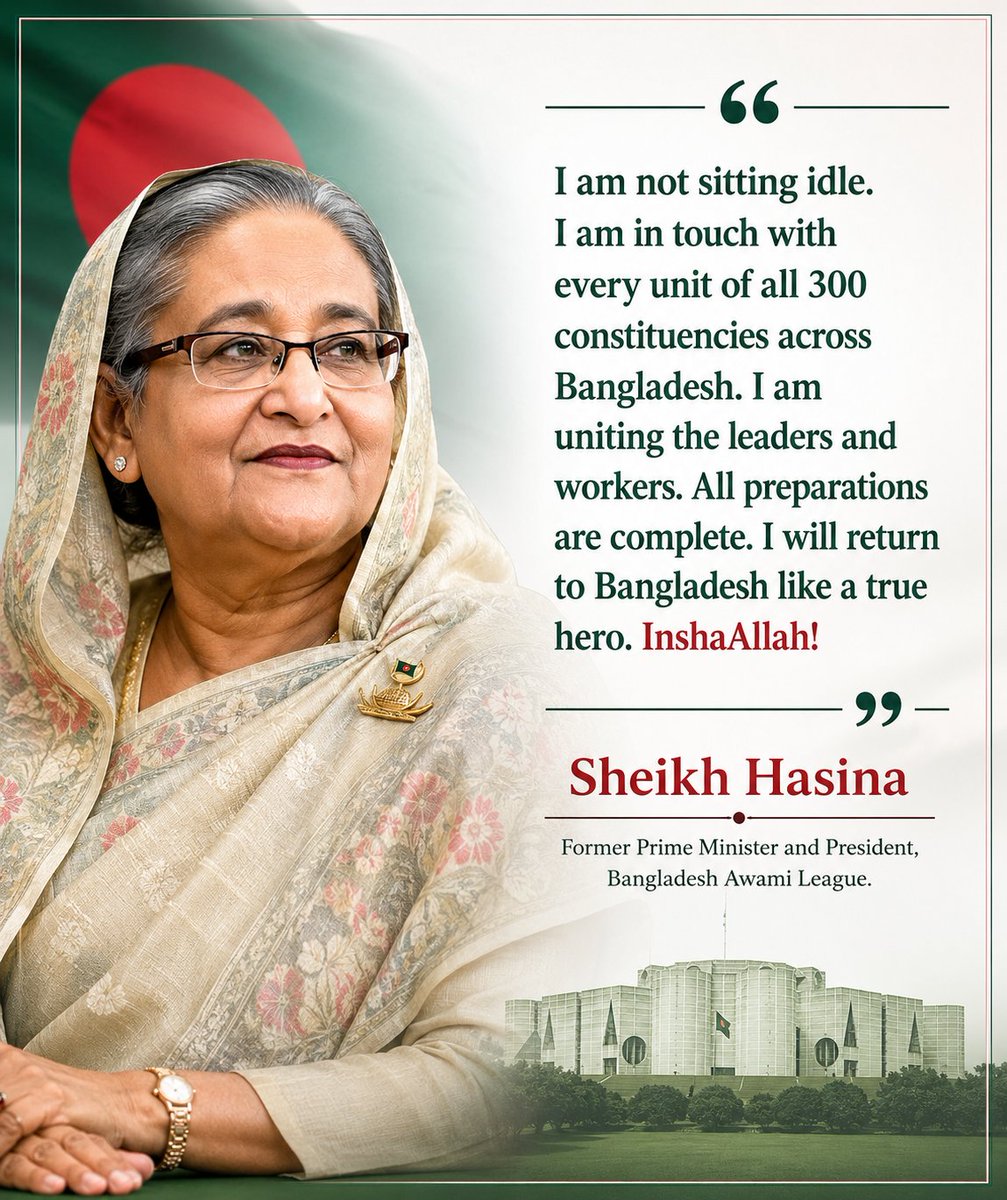
Sheikh Hasina: “I Will Return to Bangladesh Like a Hero”
Sheikh Hasina, President of the Bangladesh Awami League and former Prime Minister of Bangladesh, said:
❝ I am not sitting idle. I am in communication with every unit across all 300 constituencies of Bangladesh. I am uniting party leaders and activists. After completing all preparations, I will return to Bangladesh like a hero. InshaAllah! ❞
These remarks were made by Sheikh Hasina during a virtual meeting of the Bangladesh Awami League.
During the meeting, she urged party leaders and activists to remain united and continue strengthening organizational activities while standing beside the people of the country.
Sheikh Hasina
President, Bangladesh Awami League
Former Prime Minister of Bangladesh.
A Series of Deaths of Awami League Leaders After Arrest: Illness or Alleged Torture in Law Enforcement Custody?
In recent months, members and leaders of the Awami League and its affiliated organizations have been arrested in a series of cases. Since then, the deaths of several party activists following their arrests have raised questions among their families and across the country.
Authorities have generally described these deaths in prison or law enforcement custody as resulting from illness or natural causes. However, the families of the deceased allege that the deaths were caused by torture while in custody. As a result, each incident has sparked public debate and concern.
Most recently, the deaths of two Awami League and Chhatra League activists within 24 hours of their arrests have intensified those concerns. Their families, along with many observers, have called for independent, transparent, and impartial investigations, saying such unusual deaths cannot simply be ignored.
Among the latest cases is that of Mirza Ishtiaq Ahmed (28), also known as Pranto, a Chhatra League activist from Madhukhali in Faridpur, who died while in Detective Branch (DB) custody. The following day, Nurul Alam, a local Jubo League leader from Chattogram, died in prison after being arrested.
According to reports, Nurul Alam died on Wednesday morning, one day after being sent to Chattogram Central Jail. He was known as the Joint Convener of the Dhemsha Union Jubo League in Satkania Upazila, Chattogram.
Prison authorities stated that Nurul Alam fell ill on Wednesday morning and was taken to Chattogram Medical College Hospital, where doctors declared him dead. His death certificate listed respiratory complications as the cause of death.
Senior Jail Superintendent Md. Iqbal Hossain said Nurul Alam had been arrested in connection with a case on Tuesday afternoon and sent to prison. According to him, the detainee became ill after arriving at the jail. As his condition deteriorated on Wednesday morning, he was rushed to Chattogram Medical College Hospital, where the attending physician pronounced him dead at around 7:30 a.m.
However, Nurul Alam's family has questioned the official account of his death and demanded an independent investigation. The recent deaths of several Awami League activists following their arrests have fueled nationwide debate and renewed calls for transparency, accountability, and impartial investigations into such incidents.
#BangladeshCrisis
Attention: @UNinBangladesh@volker_turk@EUinBangladesh@UNHumanRights@CWhiteleyEU@eu_eeas@kajakallas@antonioguterres@Lacroix_UN@Ginitastar@LingOrm@DrSJaishankar@amnestysasia@meeganguly@PearsonElaine@ESandersFCDO@HCSarahCooke@usembassydhaka@State_SCA@StateDRL@SecRubio@KanchanGupta@englot@KerryKennedyRFK@deepscribble@AusHCBangladesh@GwynLewis12@FCDOGovUK@AndrewRosindell@Ginitastar@DKAmbBD@BobLancia@CatherineWest1@NorwayAmbBD@BHR_FIDH@SwedeninBD@Ethereum@TheDavidBergman@nomhossain@hrw@omctorg@EURightsAgency@paulocasaca1@HumanRightsCtte@IBAHRI
Another Chhatra League Leader Dies in Law Enforcement Custody; Family Alleges Death Resulted from Torture.
Faridpur: Mirza Ishtiaq Ahmed (28), also known as Pranto, a Chhatra League activist from Madhukhali in Faridpur, has died while in the custody of the Detective Branch (DB) of the police. His family alleges that he died as a result of torture in custody, while police claim he became ill and died during treatment.
Pranto was a resident of Paschim Gondardiya in Madhukhali Municipality. He was the son of the late Eskander Haider and a student at Faridpur Law College.
According to his family, a team identifying themselves as DB police officers detained Pranto from in front of his home at around 6:00 p.m. on Saturday (20 June). They allege that he was beaten during the arrest and that officers later searched the family home, ransacking rooms and damaging household belongings.
Pranto's uncle, Md. Sakhawat Hossain, said no narcotics were found during either the body search or the house search. The family disputes the subsequent claim that drugs had been recovered.
His mother, Khadija Akter, said, “My son was taken away in good health. No drugs were found on him or in our house. I want to know how he died after being taken into custody. We demand a fair, impartial, and transparent investigation.”
However, DB Officer-in-Charge Md. Alamgir Hossain said that after completing the legal formalities, Pranto was brought to the DB office at around 3:30 a.m. He said Pranto had breakfast and offered the Fajr prayer before suddenly falling ill. He was first taken to Faridpur General Hospital and later transferred to Faridpur Medical College Hospital, where he died at approximately 7:45 a.m. on Sunday (21 June).
The incident has raised fresh concerns over deaths in law enforcement custody. While the family maintains that Pranto died as a result of torture, police deny the allegation and insist that he died after suffering a sudden illness.
The family has called for an independent, impartial, and transparent investigation to determine the actual cause of his death.
#Breaking
The reckless actions of the newly formed "Bangladesh Azad Party" in Dhaka's Gulshan area represent a dangerous brand of street-level politics that actively harms our national interests . By organizing a chaotic "torch march" toward the Indian High Commission and burning the effigy of India’s Home Minister, this fringe group is prioritizing cheap political stunts over national security.
Carrying open fire into a highly secure diplomatic zone like Gulshan is not patriotism—it is an irresponsible, lawless act that could have easily escalated into violence. The Azad Party’s aggressive posturing exposes their complete lack of diplomatic understanding and political maturity.
Provoking a neighboring state with amateurish stunts achieves absolutely nothing on the negotiating table. Instead, it risks isolating Bangladesh and undermining official channels of communication. These actions seem less about state sovereignty and more about using hostile rhetoric to gain quick local traction. Furthermore, such hostile acts invite dangerous counter-reactions across the border, potentially putting Bangladeshi nationals, students, and travelers in India in harm's way. There is a growing concern that these fringe platforms are being used as proxies by larger, opportunistic elements to deliberately sabotage stable bilateral relations.
True sovereignty is defended through strong, dignified, and strategic diplomacy, not through arson and chaotic street marches. The authorities must take a firm stance against the Azad Party’s attempt to hijack the country's foreign policy for their own reckless and self-serving agenda.
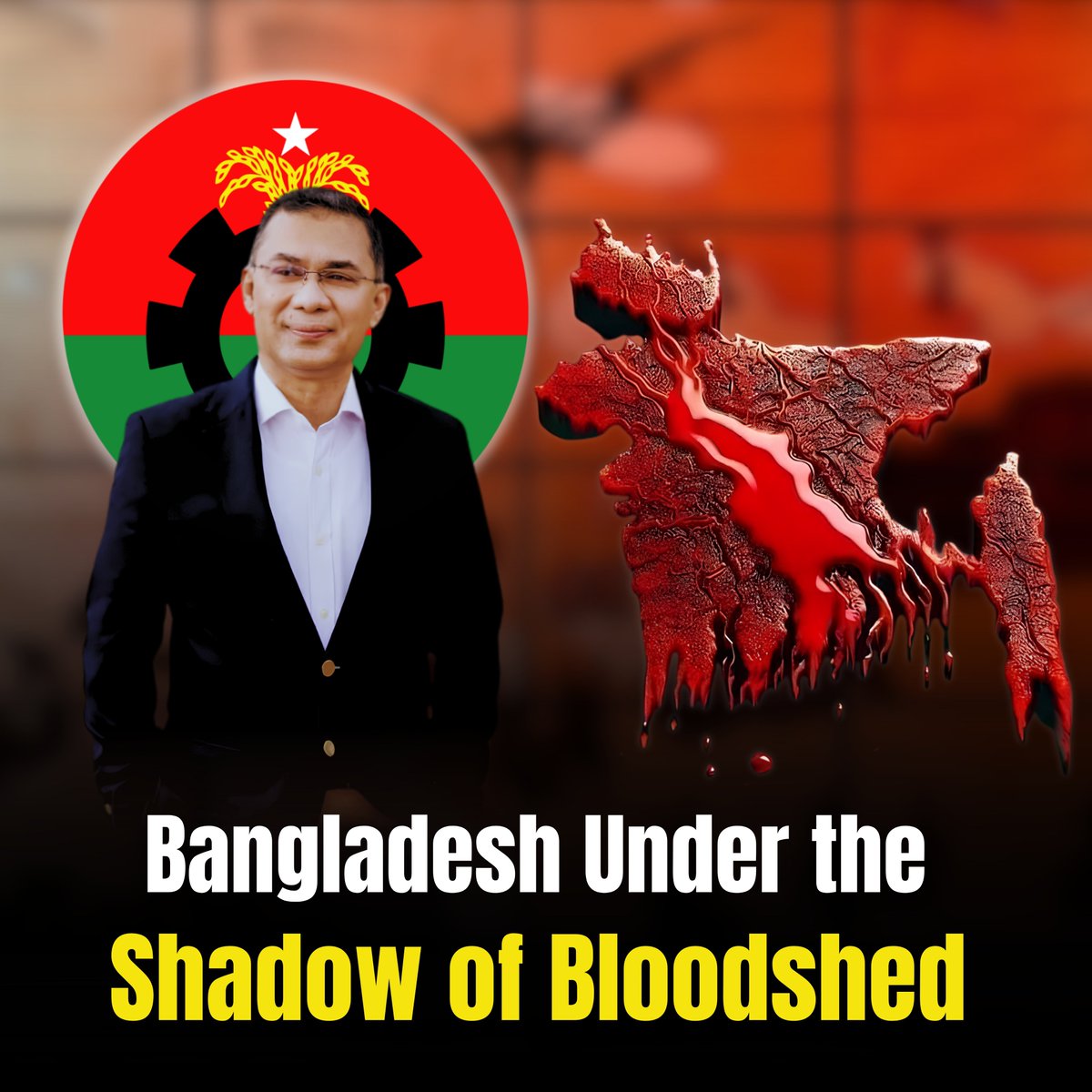
📍𝐁𝐚𝐧𝐠𝐥𝐚𝐝𝐞𝐬𝐡 𝐔𝐧𝐝𝐞𝐫 𝐭𝐡𝐞 𝐒𝐡𝐚𝐝𝐨𝐰 𝐨𝐟 𝐁𝐥𝐨𝐨𝐝𝐬𝐡𝐞𝐝
In just three months, 915 lives have been lost to murder, painting a grim picture of a nation increasingly haunted by violence. From the streets of Dhaka to the towns of Chattogram and Khulna, gunfire, political clashes, targeted killings and criminal turf wars have become alarmingly common.
Since the 2024 political transition and the BNP-led government's assumption of power, concerns over law and order have intensified. Intelligence reports suggest that previously dormant criminal networks have resurfaced, while political rivalries and armed confrontations continue to fuel bloodshed across the country.
Despite mass arrests and security operations, public confidence remains shaken. The failure to recover looted weapons, the influence of politically connected criminals, and weak accountability mechanisms have all contributed to a growing sense of insecurity.
As communities mourn hundreds of victims and fear spreads through neighborhoods, Bangladesh faces a critical challenge: Can the rule of law prevail, or will the sound of gunfire continue to define daily life?
#BangladeshCrisis @LemkinInstitute@paulocasaca1@HumanRightThane@CJBdingo25@UNHumanright@mrubin1971@EURightsAgency@MAarafat71@OHCHRAsia@avarakai@UNPeacekeeping@theAshleyMolly@amnesty@amnestysasia@StowNIGDYWIECEJ@humanrights@CHR