The BNP administration detained a father again right at the prison gate under the pretext of a new case, even after he had been released on bail.
On the eve of Eid, there seems to be no end to BNP’s dirty politics.
A father walks out of the prison gate after securing bail. His children have come to take him home, to celebrate Eid together as a family. But that moment of freedom did not last long. The moment he crossed the prison gate, he was detained once again in the trap of another so-called case.
For a family, Eid is meant to be a time of joy, anticipation, and love. But for Awami League families, Eid has instead become another symbol of uncertainty, harassment, and relentless psychological torment.
If the courts repeatedly grant freedom on paper, but reality keeps putting the chains back on, then the question must be asked: where is justice?
Through politically motivated and unlawful cases, the BNP has begun a politics of domination and intimidation across the country.
#Bangladesh #BangladeshCrisis #HumanRights
#Bangladesh is facing an alarming rise in violence against children, with hundreds of cases of rape, murder and abuse reported over the past 16 months. According to the Human Rights Support Society (HRSS), at least 580 children were raped and 483 killed between January 2025 and April 2026.
The organization also documented 318 cases of sexual harassment and said that a total of 1,890 children and adolescent girls faced various forms of violence during this period.
Human rights activists warn that the repeated incidents reflect deep failures in child protection, law enforcement and access to justice.
Key Statistics from HRSS
Reported Cases (Jan 2025 – Apr 2026)
580 children raped
483 children killed
318 sexually abused
1,407 subjected to physical and psychological violence
1,890 total victims of child abuse and violence
HRSS says the scale of violence indicates a worsening national crisis that requires urgent state intervention.
@POTUS@icsforum@StateDept@VP@StateDRL@MediaFreedomC@UN_HRC@UN_News_Centre@WSJ@sajeebwazed@nytimes@amnesty@article19org@pressfreedom@AFP@HRF@omctorg@saddamhussainbd@UNHumanRights@ALBDMedia@UN@BBC@Reuters@UN_SDG@AP@hrw
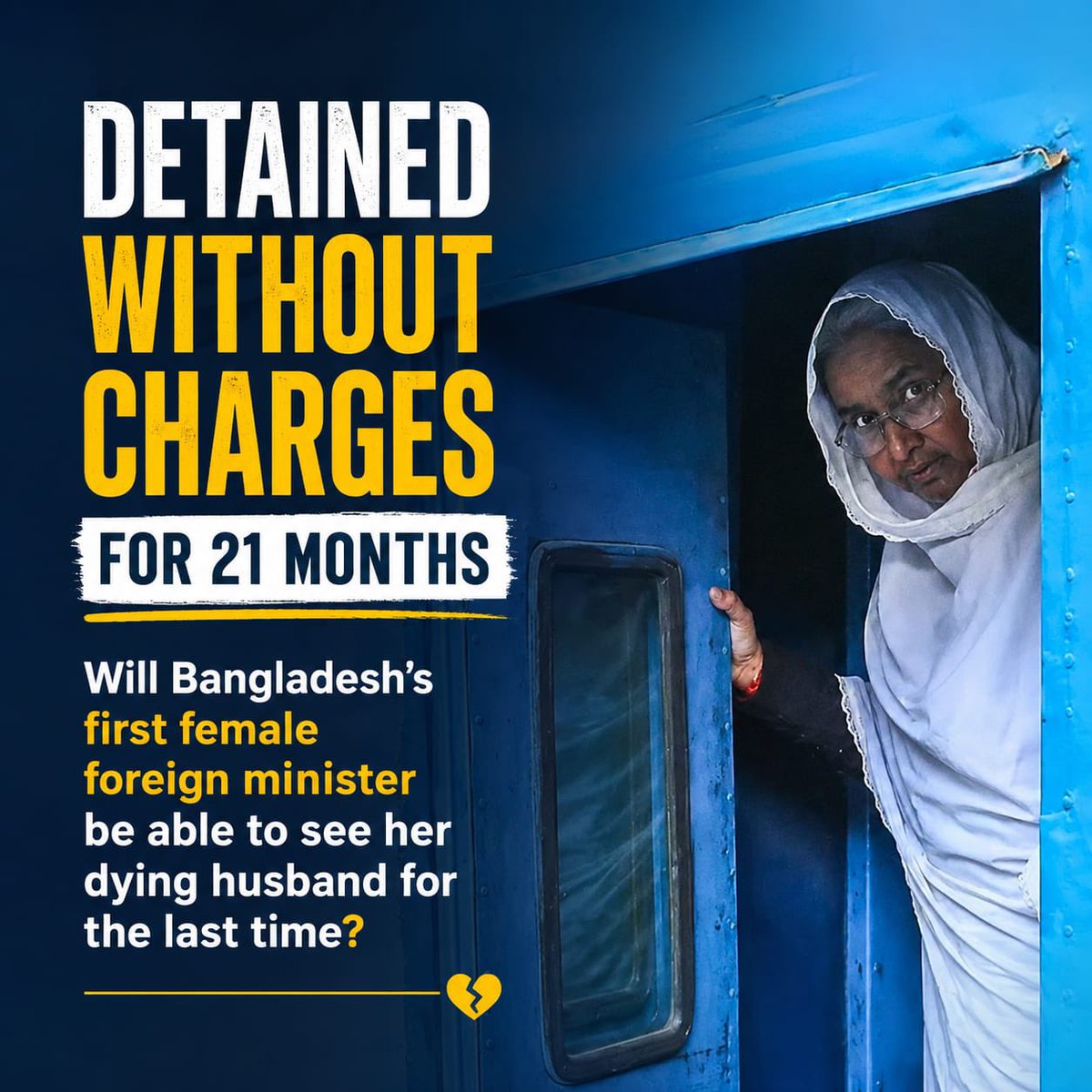
Will #Bangladesh’s first female foreign minister, now detained for more than 21 months without charges being framed against her, be able to see her critically ill husband one last time?
Dr. #DipuMoni, Bangladesh’s first female foreign minister, has remained in custody since 19 August 2024. Implicated in a staggering 38 criminal cases arising from the violent events of July–August 2024, she has been imprisoned in Munshiganj District Jail ever since.
Dipu Moni’s daughter has now applied for a seven-day parole release on humanitarian grounds, citing the critical condition of her father. The application was submitted on Wednesday to the Deputy Commissioner of #Munshiganj.
According to the application, Dipu Moni’s husband, Dr. Towfiq Nawaz, has been suffering from multiple serious health complications, including cancer, liver disease, and stroke-related conditions. He is currently receiving treatment in the CCU of a private hospital in #Dhaka and remains in critical condition. His health reportedly deteriorated sharply following a blood transfusion on Tuesday.
The petition further states that Dipu Moni has spent nearly 21 months in jail and has been unable to remain by her husband’s side throughout his prolonged illness. It argues that her presence is urgently needed both to oversee his treatment and to support him during this critical period.
The application therefore requests that, on humanitarian grounds, she be granted seven days’ parole to care for her seriously ill husband and remain beside him should his condition worsen further.
News:
https://t.co/pBVUpolEMS
In any country with an independent legal system devoid of political pressure, Dipu Moni would likely have been granted bail long ago, given that none of the cases against her has yet reached the charge-framing stage.
However, under the prevailing circumstances in “new” Bangladesh, a temporary seven-day parole release appears to be the most realistic outcome available to a high-profile politician associated with the #AwamiLeague.
The question now is whether even this request will be approved.
If recent examples are any indication, there may be little reason for optimism. BD Watch recently highlighted the case of a #ChhatraLeague leader who was denied parole to attend his father’s funeral and burial. Instead, he was reportedly allowed to view his father’s body for only five minutes at the jail gate.
See:
https://t.co/4vpo4fNOAg
Nor was that an isolated incident. Under both the Interim Govt and the #BNP Govt, there have been repeated allegations that political prisoners were denied parole to attend the funerals of close family members and loved ones.
Whether Dipu Moni will be granted the opportunity to spend time with her critically ill husband remains to be seen. Her application will be a litmus test of how humanitarian considerations are applied in politically sensitive cases in Bangladesh today.
….
#BangladeshCrisis @amnestysasia@StateDRL@hrw@IBAHRI@EURightsAgency@UNHumanRights@omctorg@Ginitastar@PearsonElaine@TheDavidBergman@StateDRL@UN_HRC@SRjudgeslawyers@ESandersFCDO@volker_turk@AgnesCallamard@justiceinfonet@MujMash@HannahEP@CordeliaSkyNews@UN_SPExperts@job71org@omctorg
Two Political Paths: Democracy vs Military Dominance
Bangladesh and Pakistan followed very different political journeys after independence.
Bangladesh emerged in 1971 and gradually rebuilt its parliamentary democratic system despite periods of military rule and political instability. Over time, electoral politics and civilian governance became the core of the state structure.
Pakistan, however, experienced repeated military coups and long periods of direct military rule after 1947. Even today, the military remains deeply influential in national politics and governance.
While Bangladesh’s political system evolved toward a democratic framework, Pakistan’s political history has been shaped more heavily by military intervention and instability.
Eid-ul-Adha Greetings from Bangladesh Awami League President and Daughter of Bangabandhu, Sheikh Hasina
Dear Countrymen,
Assalamu Alaikum.
On the occasion of the holy Eid-ul-Adha, I extend my heartfelt greetings and Eid Mubarak to all citizens of Bangladesh living both at home and abroad.
This holy Eid has returned to us at a time of profound crisis and hardship. For the past 21 months, leaders and activists of the Bangladesh Awami League have faced brutal killings, continuous attacks, and false cases, while countless party members remain imprisoned. Not only our political family, but also the people of the country are enduring immense suffering. The premature deaths of hundreds of children from measles, horrific violence and rape against women and children, the collapse of law and order, and a devastated economy have pushed the nation toward deep darkness. I express my deepest sympathy for the pain and suffering of the people.
Eid-ul-Adha teaches us the values of sacrifice and devotion. I believe that the spirit of sacrifice will inspire us anew during this difficult time. Even amid immense adversity, it will give us the strength to dedicate ourselves to truth and the welfare of the country, and to remain prepared for any sacrifice necessary.
Let us forget all sorrow and hardship and unite in the spirit of sacrifice. May Almighty Allah help and guide us all.
Stay well, stay healthy. Eid Mubarak.
Joy Bangla, Joy Bangabandhu.
May darkness give way to dawn.
May Bangladesh live forever.
#Bangladesh #SheikhHasina #EidMubarak
People talk about the digital age, yet in reality, new restrictions are being imposed on women’s freedom under the guise of rules and regulations.
The restrictions reportedly imposed by the BNP government regarding the clothing of female presenters on Facebook Live or online media — such as banning large bindis, forbidding scarves worn to one side, or prohibiting T-shirts and casual tops — cannot, in any way, represent the image of a modern state.
When a state claims to promote digital progress, it is unacceptable for personal choice, professional freedom, and creativity to be constrained in this way.
A woman’s clothing should not be the standard of judgment; rather, her work and competence should be valued. But when control increases in the name of regulations, it becomes clear that the issue is not development, but mindset.
Professionalism is never judged by clothing. A presenter’s qualifications lie in her voice, knowledge, presentation skills, and competence.
Such rules not only undermine women’s freedom, but also trap the entire media industry within a narrow and regressive mindset.
Who are these rules really for? If women are singled out and restricted merely to appease certain groups, then this is not progress — it is a reflection of backward thinking and an attempt to silence free expression. Every time the BNP government has come to power, women have been pushed backward under various excuses, and this time is no exception.
#Bangladesh #WomenEmpowerment #FreedomOfChoice
Bangladesh’s measles outbreak is now one of the deadliest public health crises in decades
----
More than 500 suspected and confirmed child deaths have already been reported. Hospitals are overwhelmed. Thousands of children remain at risk — especially those without full vaccination coverage.
Health officials say over 62,000 suspected cases have been identified nationwide since March. This is not just a statistic. These are children, families, and futures being lost.
Vaccination gaps, weak healthcare access, and delayed responses have turned a preventable disease into a national emergency.
Every child deserves protection. Every preventable death is a failure humanity must confront.
Read ➡️
https://t.co/bq0vVlaBnn
#Bangladesh #MeaslesOutbreak #PublicHealth #ChildHealth #Vaccination #SouthAsia #HealthCrisis
“When Children Keep Dying” 💔
545 children dead since March.
Thousands more hospitalized.
Hospitals overwhelmed. Families desperate.
A preventable health crisis is unfolding before the world’s eyes — and every delay costs more innocent lives.
Children need protection. Healthcare cannot wait.
#Bangladesh #MeaslesCrisis #ChildHealth #PublicHealth #SaveChildren #HealthcareEmergency
Bail Granted, Freedom Denied
How “Shown Arrests” Became a Tool of Fear in Bangladesh
---
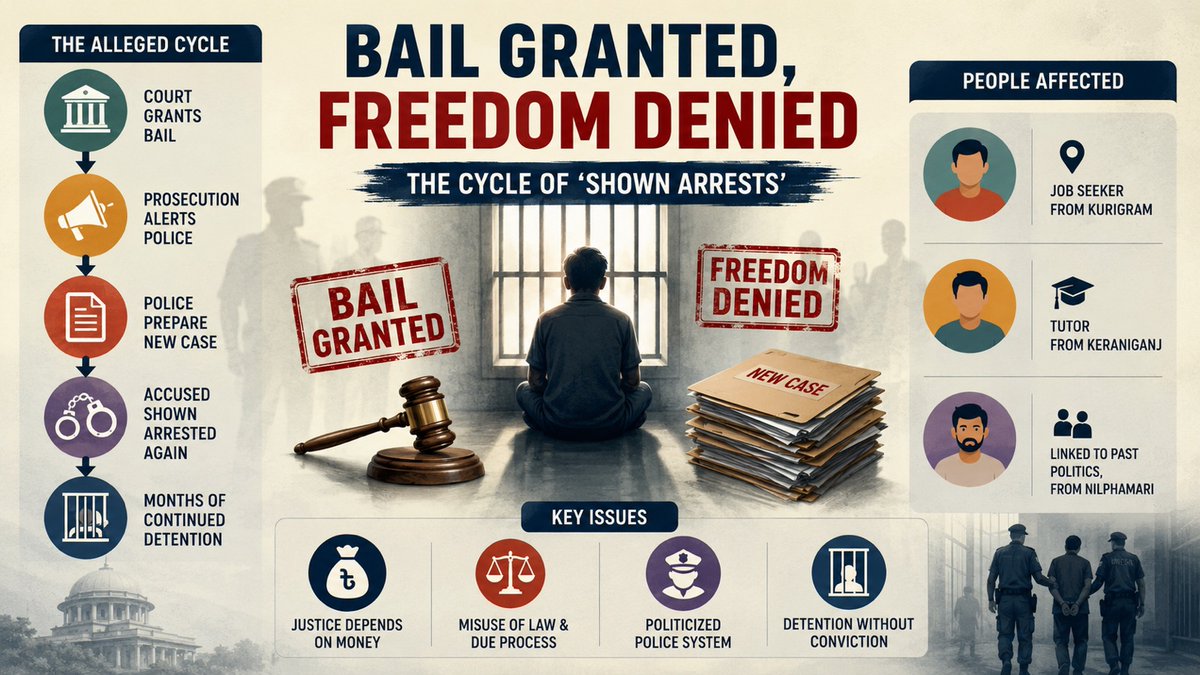
In Bangladesh’s current justice system, critics allege that securing bail no longer guarantees freedom. Instead, many detainees are reportedly being trapped in a cycle of repeated “shown arrests,” where police link already jailed individuals to new cases moments before release. Families accuse law enforcement of using these tactics to prolong detention, demand unofficial payments, and silence perceived political opponents or ordinary citizens with no proven involvement in crimes. Legal experts warn that detaining people without direct evidence, witness testimony, or inclusion in FIRs represents a dangerous misuse of law that weakens judicial credibility and undermines public trust in the rule of law.
According to allegations described in recent reports, many detainees in Bangladesh are not being released even after securing bail. Instead, they are allegedly being tied to fresh cases immediately after court approval, creating a cycle of repeated detention.
⸻
📌 What Is a “Shown Arrest”?
A “shown arrest” happens when a person already in custody is officially linked to another case while still in jail.
Critics say the system is being used to:
* Prevent release after bail
* Pressure families financially
* Extend detention without conviction
* Create fear among political opponents or ordinary citizens
Legal experts argue that in many cases:
* The accused person’s name does not appear in the FIR
* Witnesses do not identify them
* No direct evidence links them to the incident
Yet detention reportedly continues.
🏛️ Political Allegations
Reality -
* Politicizing police operations
* Reviving practices associated with the 2001–06 period
* Turning police stations into centers of extortion
* Using the justice system as a political weapon
💰 “Justice Depends on Money”
“Those without money stay in jail. Those who can pay are released.”
Critics describe this as:
* Institutionalized extortion
* Commercialization of police clearance
* Erosion of judicial credibility
📍Key Questions Being Raised
❓ If bail is granted, why are detainees not released?
❓ Who decides which new cases appear?
❓ Why are unnamed individuals repeatedly shown arrested?
❓ Is due process being bypassed?
#Bangladesh #FalseCases #MassArrest
“From Yunus to Tarique Rahman’s rule: Mockery in the name of law, injustice in the name of justice.”
---
More than four hundred days of darkness behind bars, one false case after another, inhumane torture during remand, sleepless nights with his eyes blindfolded, yet his spirit never broke. This is the story of Mehedi from the Chhatra League. After spending over four hundred days in prison, he has finally been released. He had been detained for a long period under what were described as politically motivated false cases filed by the administration of the “child-killer fascist Yunus,” and was allegedly subjected to inhumane torture during remand. According to the statement, even after the BNP came to power, the same pattern continued.
During remand, he was allegedly blindfolded, deprived of sleep, and subjected to repeated attempts to break him physically and mentally. Even after securing bail from the court, before he could walk out of the prison gate, he was reportedly shown arrested again in a new case.
A new case every time bail is granted. What kind of justice system is this?
This is not law, this is naked political vengeance.
In Mehedi’s words:
“Before I could be freed from one case, I would be chained into another. The goal was to silence us politically. But this cycle of prison, remand, and false cases could not stop me, and never will. The darker the night becomes, the closer the dawn arrives. The struggle will continue, and victory will come.”
The statement concludes by saying that this “mockery of law,” repression, and torture under the “fascist Yunus” administration will remain a dark chapter in Bangladesh’s history. It calls for a united protest by pro-democracy people against imprisonment, remand torture, and the alleged misuse of law, arguing that history shows repression and political persecution never last forever.
#AwamiLeague #MassArrest
A mother after 11 years of waiting now sits beside her only child in a crowded hospital ward, praying for one thing:
‘Allah, please give my child back.’
Inside Dhaka’s Mahakhali Infectious Diseases Hospital, dozens of parents are watching their children struggle to breathe as Bangladesh’s measles crisis deepens.
40 children have already died at this hospital alone.
1,070 children admitted with measles symptoms.
Medicine shortages continue, forcing desperate families to buy life-saving supplies from outside pharmacies.
This is not just a health crisis.
It is a humanitarian emergency.
No parent should have to beg for medicine while watching their child fight for life.
#Bangladesh #BangladeshCrisis
Bangladesh’s Islamist Inferno Could Soon Reach Trump’s America
---
Growing concerns over rising Islamist influence in Bangladesh are no longer being viewed as only a regional issue. Analysts now warn that the consequences could extend far beyond South Asia — impacting India, regional stability, and even U.S. strategic interests.
Reports and recent geopolitical discussions point to:
• Expanding influence of Islamist political networks
• Increasing engagement between global powers and hardline groups
• Concerns over minority persecution and radicalization
Many observers fear Bangladesh is entering a dangerous turning point where political instability and religious extremism could reshape the region’s future.
The warning being raised is simple:
Ignoring extremism today may create a far bigger crisis tomorrow.
Read more: @NewDelhiPost
- By Abu Obaidha Arin
👉 https://t.co/yqQaVFlgjF
#Bangladesh #BangladeshCrisis
#Bangladesh: ICTBD Chief Prosecutor Terms #Amnesty Int’l’s Comments Re: Arrest Warrants for #Journalists Rupa and Babu as “Interference”.
It appears that the partisan chief prosecutor of Bangladesh’s controversial International Crimes Tribunal (ICTBD), Md. Aminul Islam, lacks a basic understanding of the distinction between “observation” and “interference.”
Recently, Amnesty International issued a statement regarding the arrest warrants issued against detained journalists Farzana Rupa and Mozammel Babu, who have been accused of alleged crimes against humanity in connection with the so-called “Shapla Chattar Killings” of 5 May 2013.
In its statement, Amnesty asserted that journalists must not be targeted for expressing opinions that may be disagreeable to those in power, nor for their perceived political affiliations.
The org. further stated that arresting journalists in a crimes against humanity case for their reporting or commentary constitutes an affront to fundamental principles of press freedom and establishes a dangerous precedent that threatens the ability of all journalists to report without fear of retaliation.
Amnesty Statement:
https://t.co/59C3B8gQ63
Responding to Amnesty’s comments, Chief Prosecutor Aminul Islam stated that Amnesty or any other rights org. should not “interfere” in Bangladesh’s ongoing judicial process, adding that there is no legal scope for such involvement.
News Report:
https://t.co/NhCCsIfeoy
However, the Chief Prosecutor’s remarks equates legitimate international observation and unlawful interference. Amnesty and other commentators have correctly pointed out that journalists cannot be charged with crimes against humanity merely for their post-event analysis, commentary, or coverage of violent political events. There is no basis under int’l criminal law for such prosecutions.
Bangladesh chose to name the tribunal the “Int’l Crimes Tribunal,” a tribunal established to prosecute “int’l crimes”. Consequently, scrutiny and commentary from int’l legal experts, human rights orgs, and global observers are both inevitable and entirely legitimate.
Notably, Md. Aminul Islam himself has no known professional background in int’l criminal law or experience working with int’l tribunals. His principal qualification for appointment to this influential role appears to have been his longstanding political association with Bangladesh’s ruling party, the Bangladesh Nationalist Party (#BNP).
Given this context, the Chief Prosecutor of a tribunal that brands itself as “international” and claims jurisdiction over “int’l crimes” should be more receptive to observations and criticism from “int’l organisations” that possess extensive experience analysing comparable tribunals and prosecutions around the world.
In fact, they should welcome more engagement with int’l orgs. This is because the reconstituted tribunal has already become highly controversial.
Concerns raised by observers include allegations of corruption involving prosecutors and investigators, questions regarding the competence, neutrality, and independence of certain judges, and the continued existence of laws and procedural rules that fall short of internationally recognised fair trial standards.
Additional concerns have emerged regarding the tribunal’s apparent willingness to impose capital punishment based primarily on untested wiretap evidence and testimony from approver witnesses who may themselves be vulnerable to coercion, torture, intimidation, or external political pressure.
…
#BangladeshCrisis @amnestysasia@AgnesCallamard@taqbirhuda@meeganguly@PearsonElaine@StateDRL@justiceinfonet@job71org@icsforum@TheDavidBergman@IBAHRI@article19org@CPJAsia@pressfreedom@RSF_inter@IFJGlobal@ifjasiapacific@MediaFreedomC@S_Asian_Rights@CommonwealthJA@ESandersFCDO@CIVICUSalliance@BonaveroIHR@forum_asia@SRjudgeslawyers@Irenekhan@UN_SPExperts@DoughtyStIntl@volker_turk@UN_HRC
#BNP Govt set to significantly expand its capabilities to block and filter online content, including material posted on #socialmedia platforms and websites deemed to constitute “anti-government propaganda”.
The decision was taken at a recent meeting of the Cabinet Committee on Government Purchase, which approved a proposal titled “Expansion of Content Blocking and Filtering System (Phase-1)” for the National Telecommunications Monitoring Centre (NTMC).
The project is set to be implemented through a contract awarded to supplier Global Brand, involving the procurement of equipment and services from various int’l tech brands, at a total cost of Tk 949.05 million (approximately US$7.7 million).
However, the official meeting documents did not specify the precise products, technologies, or #surveillance systems that would be acquired under the agreement.
News:
https://t.co/VEzVLuwX9D
The move comes amid renewed scrutiny of the #NTMC’s surveillance activities, particularly longstanding allegations regarding the monitoring of citizens’ private communications under previous governments.
The expansion of the agency’s technical capabilities also coincides with a growing number of arrests linked to online expression. Over the past three months, multiple individuals have reportedly been arrested for social media posts or online content critical of the government, ruling party figures, or senior state officials, including the Prime Minister, Home Minister, Chief Whip, and other politicians.
The combination of enhanced surveillance and content-filtering capabilities, together with an increasingly aggressive willingness to prosecute individuals over allegedly “anti-government” online content, has raised serious concerns among #humanrights activists and digital rights advocates.
Critics warn that such measures risk enabling broader censorship, suppressing dissent, and undermining fundamental rights to #privacy and freedom of expression. Concerns have also been raised about the potential lack of transparency, judicial oversight, and accountability surrounding the deployment of these expanded surveillance and filtering mechanisms.
Taken together, these developments have intensified fears that #Bangladesh may be moving toward a significantly more restrictive and heavily monitored digital environment, where criticism of the government or ruling party could increasingly become subject to surveillance, censorship, and/or criminal prosecution.
…
#BangladeshCrisis #RIghtToPrivacy #FreedomOfExpression @amnestysasia@hrw@ESandersFCDO@BonaveroIHR@StateDRL@EURightsAgency@UNHumanRights@HRF@volker_turk@article19org@techglobalinst@Irenekhan@accessnow@AUDRights@EFF@edri@privacyint@EPICprivacy@calyxinstitute@AJListeningPost@orfonline
📷 Bangladesh is facing an alarming rise in violence against children, with hundreds of cases of rape, murder, and abuse reported over the past 16 months. According to the Human Rights Support Society (HRSS), at least 580 children were raped and 483 killed between January 2025 and April 2026.
The organization also documented 318 cases of sexual harassment and said that a total of 1,890 children and adolescent girls faced various forms of violence during this period.
Human rights activists warn that the repeated incidents reflect deep failures in child protection, law enforcement, and access to justice.
Key Statistics from HRSS
Reported Cases (Jan 2025 – Apr 2026)
580 children raped
483 children killed
318 sexually abused
1,407 subjected to physical and psychological violence
1,890 total victims of child abuse and violence
HRSS says the scale of violence indicates a worsening national crisis that requires urgent state intervention.
#Bangladesh #BangladeshCrisis
“UNICEF says that the interim government decided to change the way Bangladesh bought vaccines, which led to delays in placing orders. In 10 separate meetings with the interim government where UNICEF flagged risks associated with delays to vaccine procurement.”
"I can tell you I sat with the interim advisor and staff on at least ten occasions," she said. "Saying we are worried, look at my face, I am worried you are going to face an outage." -UNICEF representative.
———————
We need someone honest to point out that @Yunus_Centre and the Grameen cronies he appointed are to blame for this. He appointed Nurjahan, a Grameen Bank staff member loyal to him, and she reported directly to him. So he would have heard UNICEF’s warnings but chose to ignore them. Why are Western news outlets reluctant to say that Yunus and the Grameen Bank crony he appointed as Health Advisor are to blame for this avoidable tragedy?
Yunus was happy to talk about all sorts of things that happened during Sheikh Hasina’s tenure and lay the blame at her door. Now, will he come clean with the people of Bangladesh and tell them why he repeatedly ignored UNICEF’s warnings about this avoidable tragedy?
https://t.co/sWgsCO6UsN