Burnham probably is an authentic avatar of the British public, given wholly over to petty nostalgia, odiously sentimental, cloyingly subscribed to Bit Weird That, Mate conformism, performatively anti-deferential, proudly and wilfully ignorant. It does make me go a bit Sean Gabb.
a lot of those writers like Hemmingway, Steinbeck, JR Tolkien, Frank Herbert, Toni Morrison, Ursula de la Guinn, Octavia Butler, William Gibson, F Scott Fitzgerald, George RR Martin, Phillip K Dick etc.
had long periods where they took a lot of random odd jobs here and there -
you need a lot of deep reflection, periods of long rest, etc. to hone your writing and create great work
the whole tech biz model of scale big, grow fast, cannot be uniformly applied or mapped to creative arts -
but the current material conditions structurally force that due to high cost of living, an unstable job market, etc.
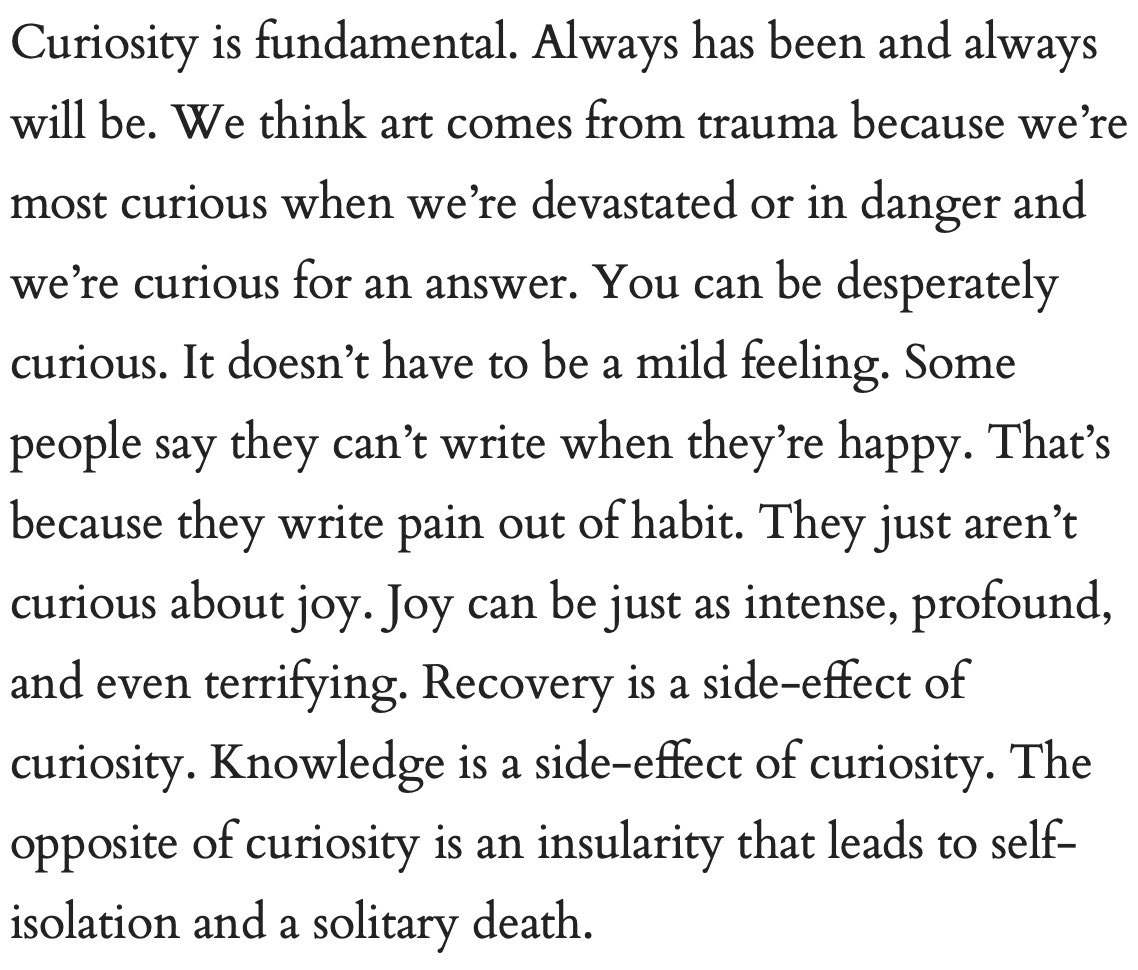
If curiosity is the pleasure principle of thought, you can probably tell how good a lover someone is by how curious they are, both about the world and about you. People complain about not being asked enough questions because curiosity is a form of desire. It’s never just conversational etiquette. When you’re attracted to someone you want to know about them, how they think, what they’re like, what they care about. Without that impulse, there isn’t much desire there in the first place.
Maya Angelou was so right when she said ;
“The heart of a woman should be so well hidden in God, that a man, to find it, would need to seek God first.”
The loss of the stiff upper lip is one of the most unfortunate things to ever happen to British culture. Now everybody has to emote and whinge and psychologise and diagnose and pathologise and mope. It's entirely unattractive, unhelpful, unhealthy, and unbecoming.
Few types of person are more exhausting than the “Thinks they can morally launder their misbehavior through self-loathing” type - as if hating oneself is an adequate substitution for personal growth - especially when they demand that other people play along with the switcheroo.
My personal truth as a clinical psychologist, for today (September 18, 2026): Many problems are developmental, not defects.
Sometimes people aren’t broken. They simply never had enough of the experiences that build a particular capacity.
The child who was never allowed to fail may become an adult terrified of mistakes. The child whose feelings were ignored may struggle to name them. Someone who never saw conflict handled well may avoid it or explode.
We develop through experience. And sometimes what looks like a flaw is really a skill that never had the chance to grow.
Fortunately, development can continue.